Have a personal or library account? Click to login
Support vector machine classification of patients with depression based on resting-state electroencephalography Cover

Support vector machine classification of patients with depression based on resting-state electroencephalography

By: Chia-Yen Yang and  Yin-Zhen Chen  
Open Access
|Oct 2024

Figures & Tables

Figure 1.

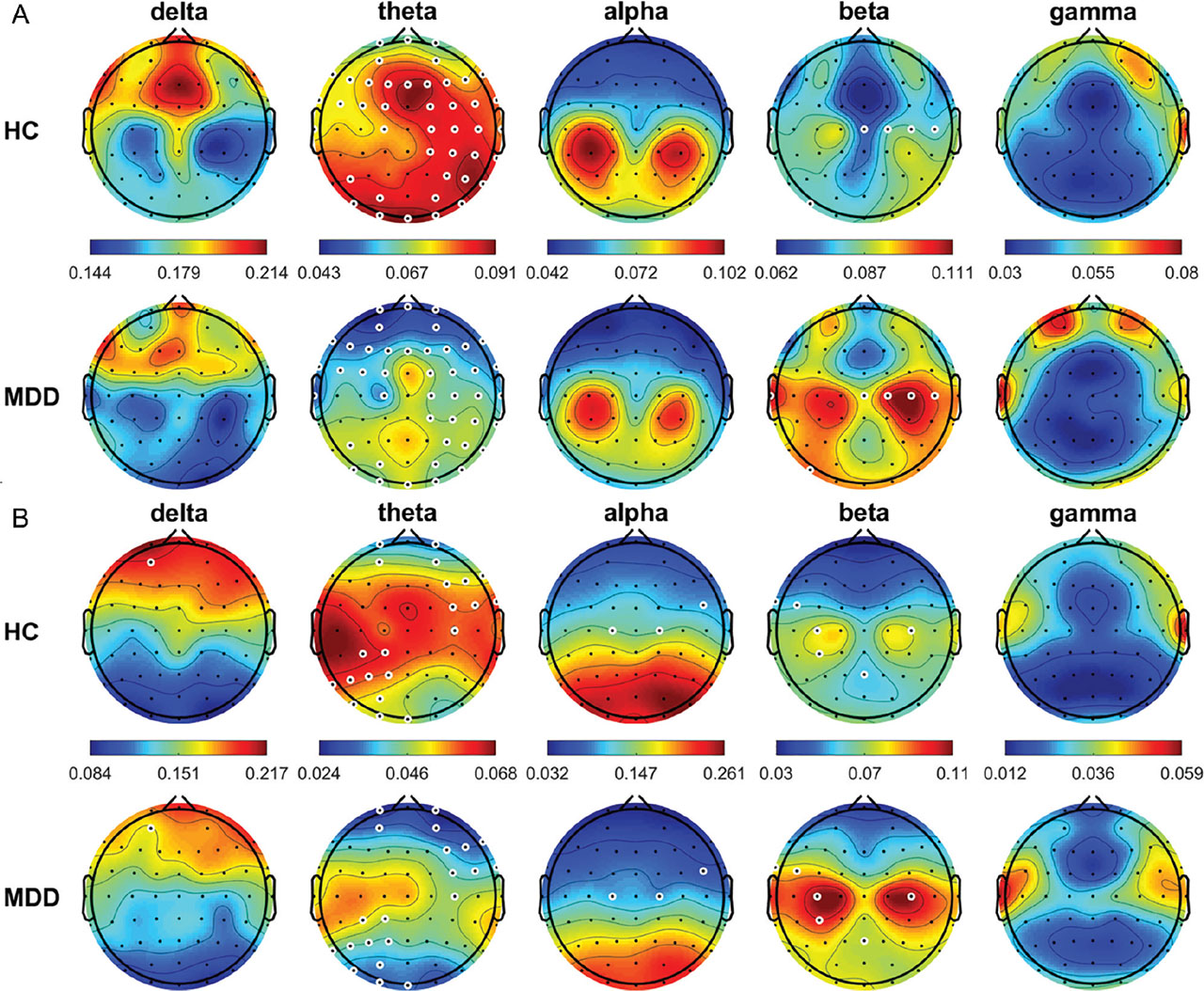
Average relative power of EEG signals (delta, 0.5–4 Hz; theta, 4–8 Hz; alpha, 8–13 Hz; beta, 13–30 Hz; and gamma, 30–50 Hz) from all HCs and patients with MDD in the OE (A) and CE (B) condition. White circles denote significant differences between groups (P < 0.05). CE, eyes-closed; EEG, electroencephalogram; HCs, healthy controls; MDD, major depressive disorder; OE, eyes-open.
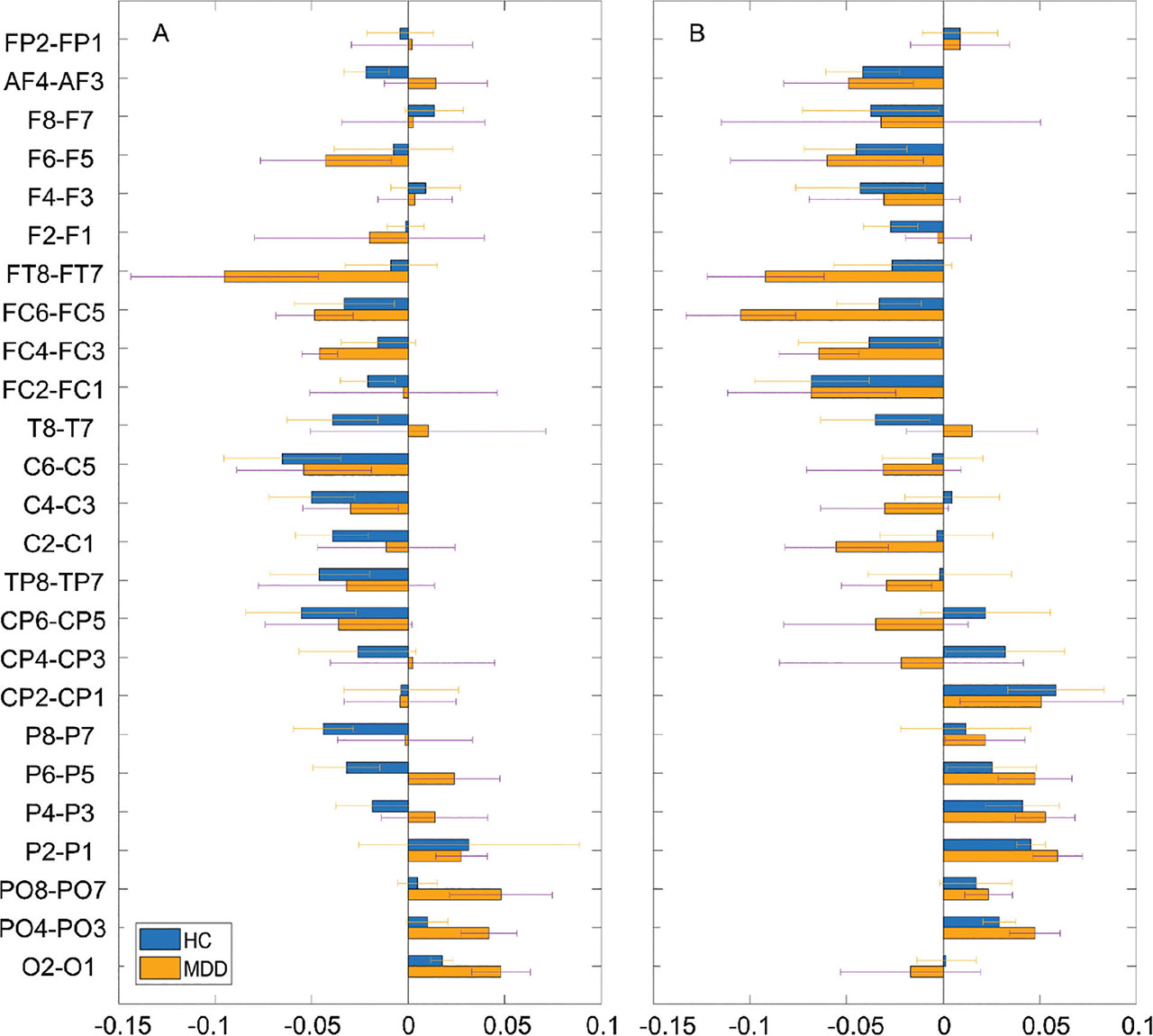

Figure 2.

Average power asymmetry of relative activity between the pairs of electrodes (i.e., right location–left location) in HCs and patients with MDD in the OE (A) and CE (B) condition. HCs, healthy controls; MDD, major depressive disorder; CE, eyes-closed; OE, eyes-open.
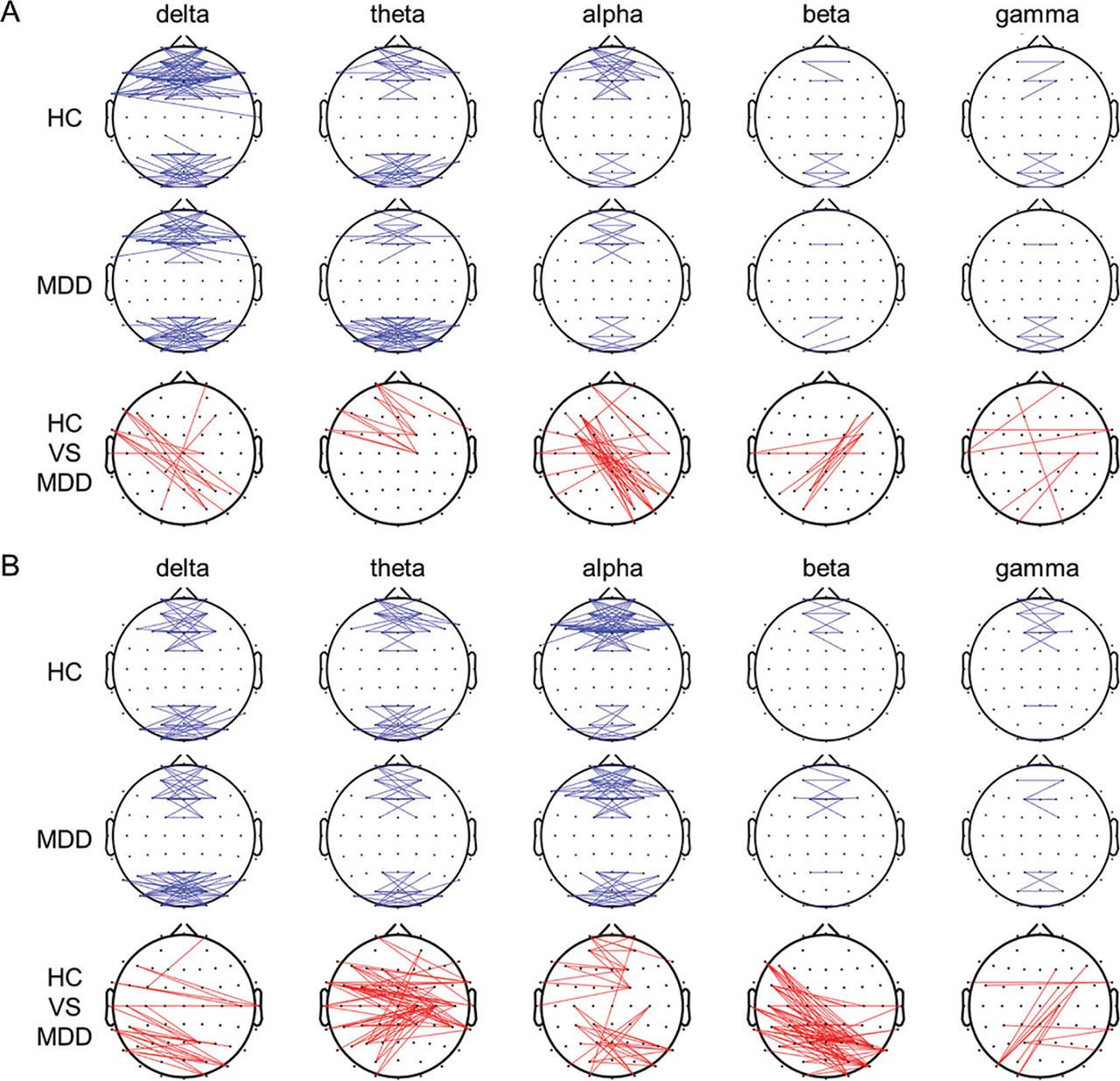

Figure 3.

Grand functional connection maps of the left–right coherence between the pairs of electrodes at the threshold of 0.6 for different frequency bands during the OE (A) and CE (B) conditions. Red lines in the bottom panels denote significant differences between groups (P < 0.05). CE, eyes-closed; OE, eyes-open.
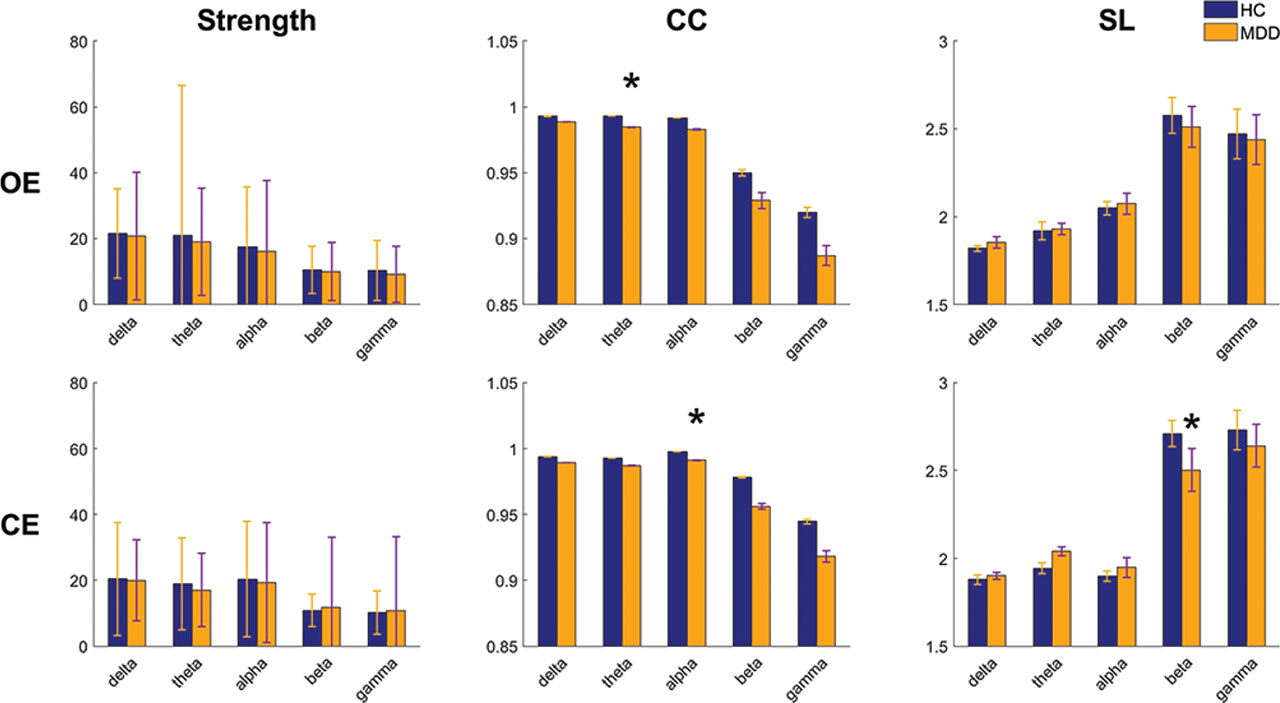

Figure 4.

Grand average of parameters, namely, strength, CC, and L, calculated from the delta, theta, alpha, beta, and gamma bands during the OE and CE conditions. *indicates significant differences between groups (P < 0.05). CC, clustering coefficient; CE, eyes-closed; OE, eyes-open.
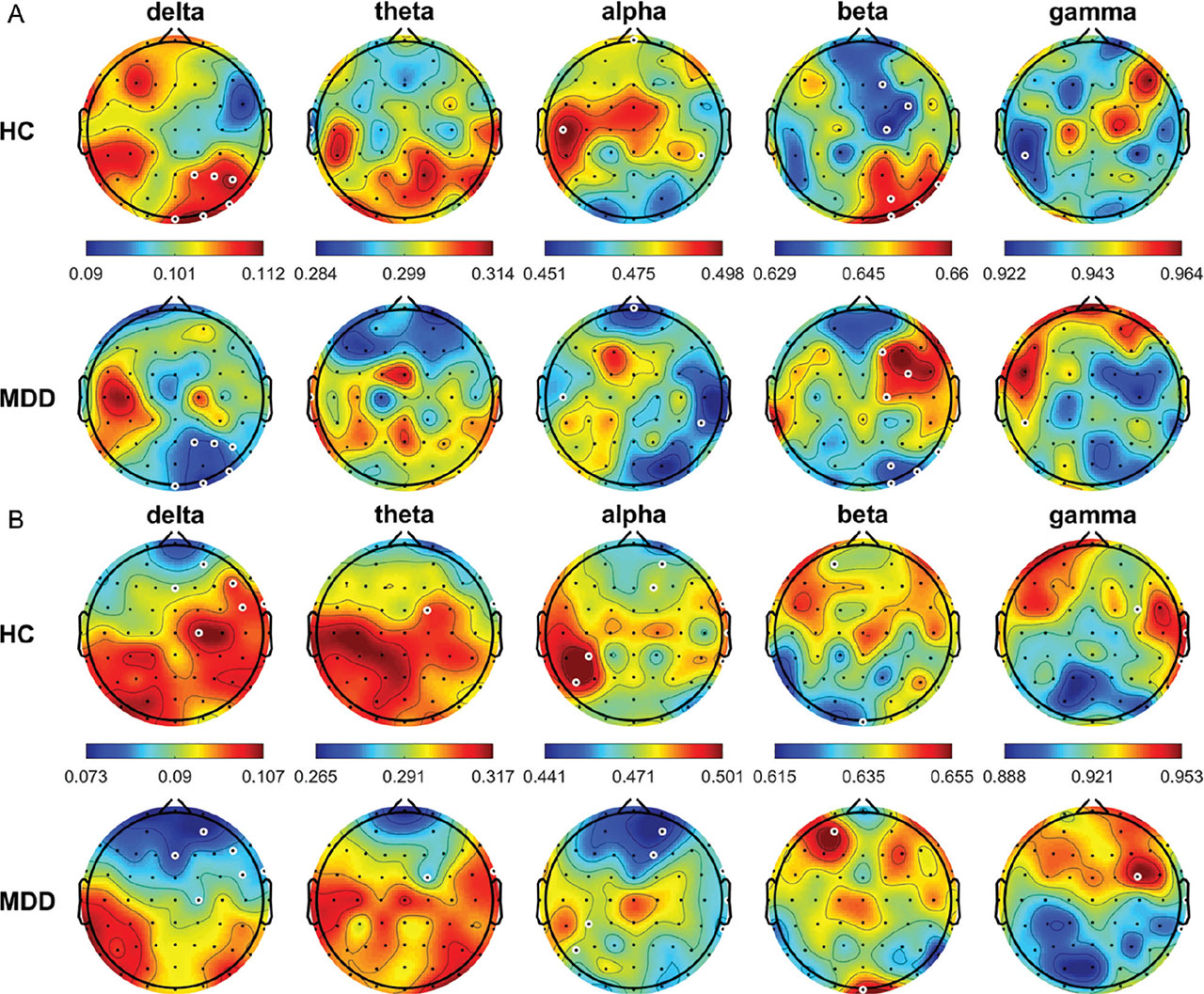

Figure 5.

Average SampEn for the different frequency bands from all HCs and patients with MDD in the OE (A) and CE (B) conditions. White circles denote significant differences between groups (P < 0.05). CE, eyes-closed; HCs, healthy controls; MDD, major depressive disorder; OE, eyes-open; SampEn, sample entropy.
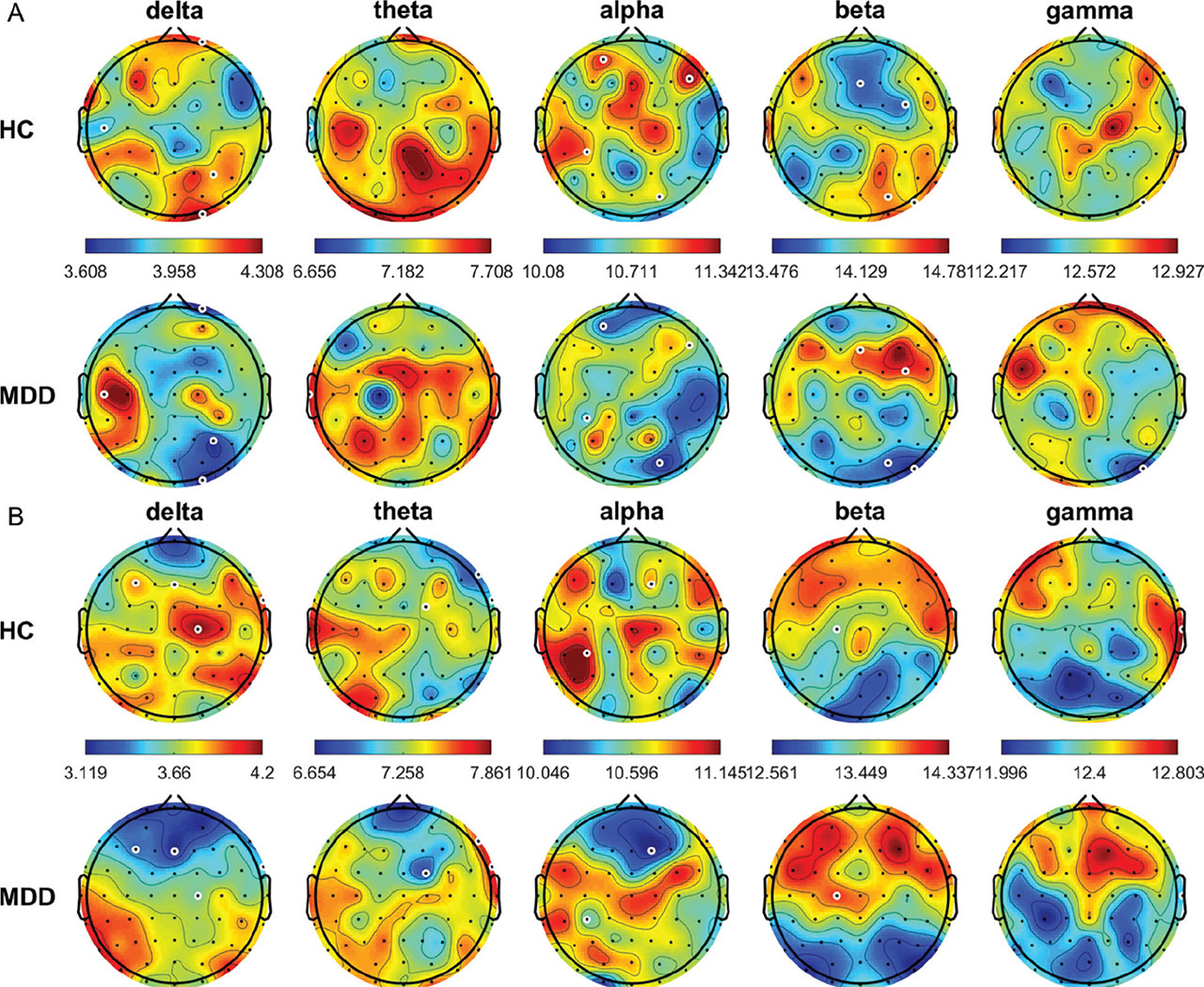

Figure 6.

Average MSE for the different frequency bands from all HCs and patients with MDD in the OE (A) and CE (B) conditions. White circles denote significant between-group differences (P < 0.05). CE, eyes-closed; HCs, healthy controls; MDD, major depressive disorder; MSE, multiscale entropy; OE, eyes-open.
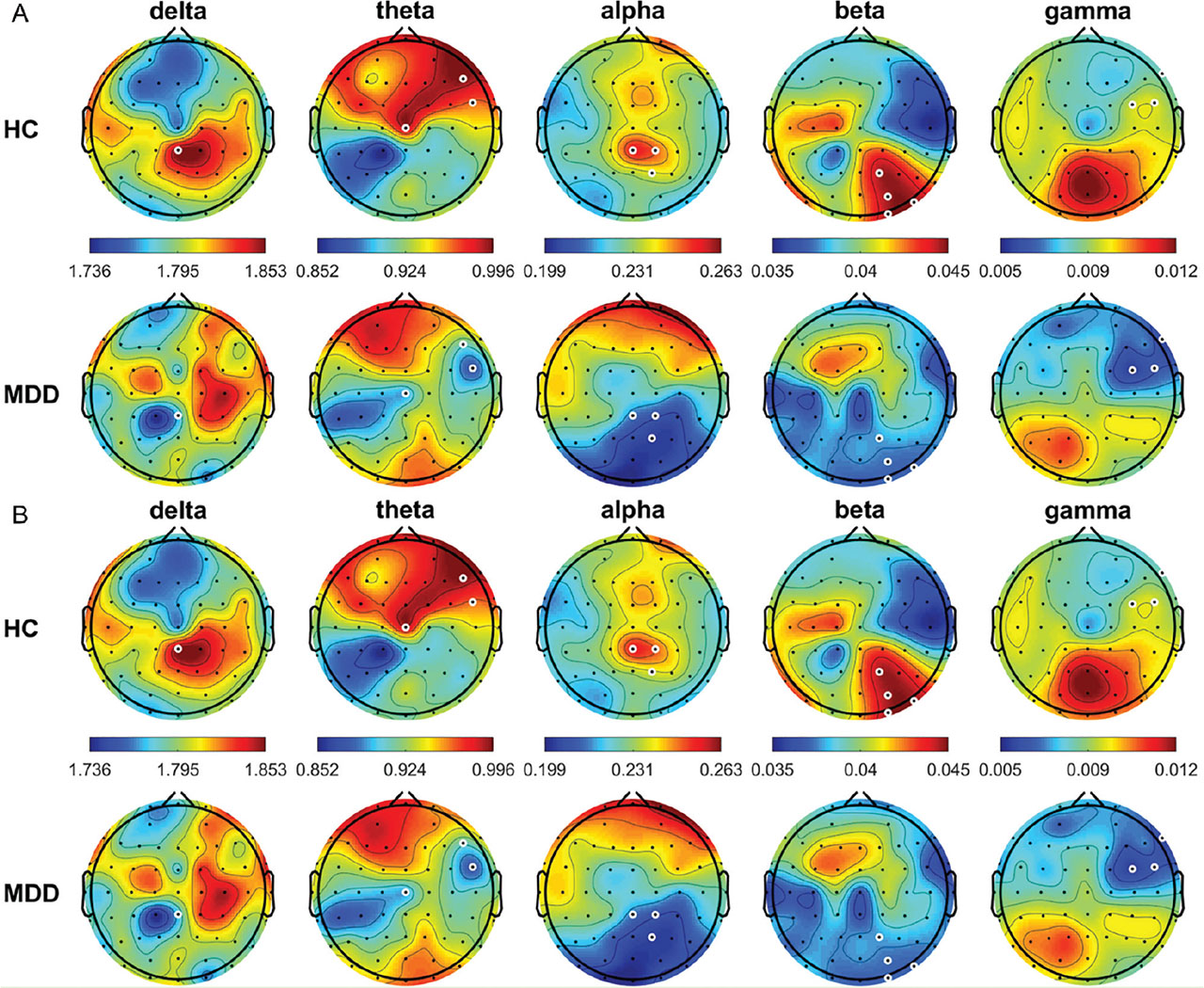

Figure 7.

Average DFA for the different frequency bands from all HCs and patients with MDD in the OE (A) and CE (B) conditions. White circles denote significant differences between groups (P < 0.05). CE, eyes-closed; DFA, detrended fluctuation analysis; HCs, healthy controls; MDD, major depressive disorder; OE, eyes-open.

Average accuracy, sensitivity, and specificity of the SVM models for the selected features

Number of featuresAccuracy (%)
Sensitivity (%)Specificity (%)
TrainingTesting
Eye-open18195.26 ± 3.3096.66 ± 5.8095.93 ± 8.5497.55 ± 8.86
1784.99 ± 3.7385.55 ± 10.9987.76 ± 15.28784.07 ± 18.83
Eye-closed29391.00 ± 3.9790.77 ± 8.5191.38 ± 13.0689.11 ± 15.52
987.65 ± 4.0486.88 ± 10.0387.73 ± 14.4386.76 ± 17.44
DOI: https://doi.org/10.2478/abm-2024-0029 | Journal eISSN: 1875-855X | Journal ISSN: 1905-7415
Language: English
Page range: 212 - 223
Published on: Oct 31, 2024
Published by: Chulalongkorn University
In partnership with: Paradigm Publishing Services
Publication frequency: 6 issues per year

© 2024 Chia-Yen Yang, Yin-Zhen Chen, published by Chulalongkorn University
This work is licensed under the Creative Commons Attribution 4.0 License.