Have a personal or library account? Click to login
A review of landmark studies on maintenance immunosuppressive regimens in kidney transplantation Cover

A review of landmark studies on maintenance immunosuppressive regimens in kidney transplantation

Open Access
|Jun 2024

Figures & Tables

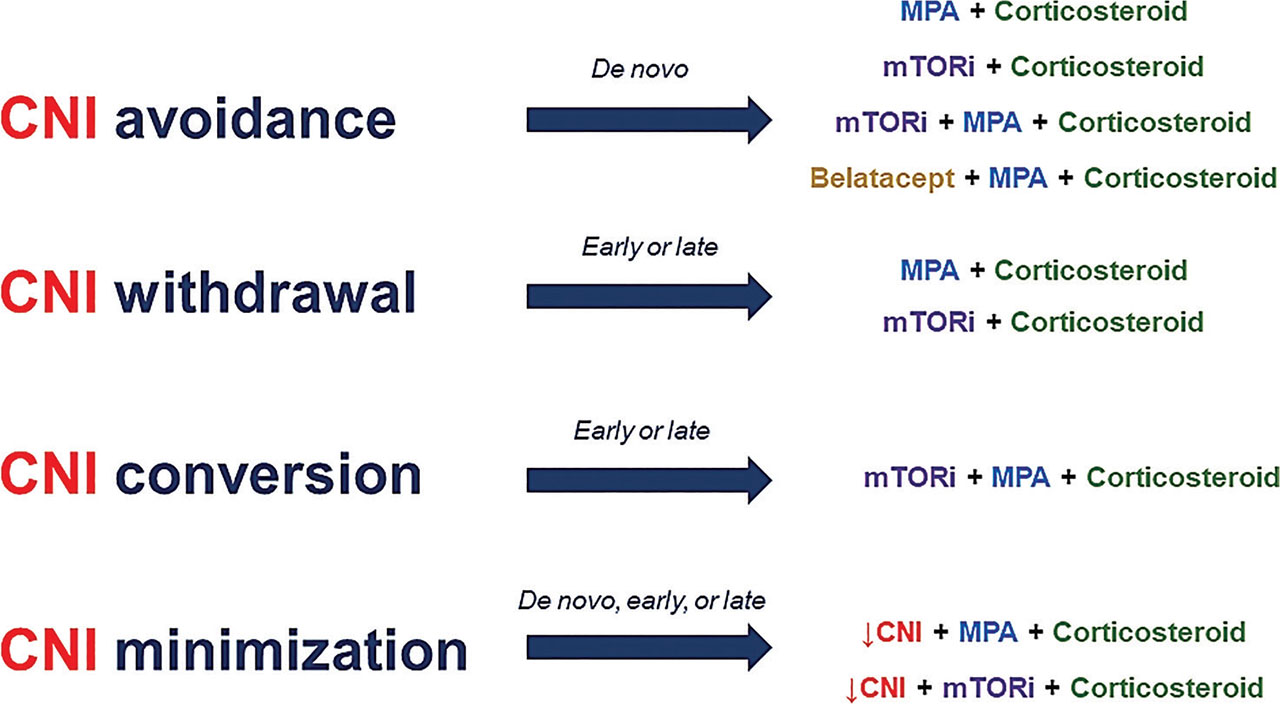
Figure 1.

Concept of CNI-sparing strategy. The “early period” denotes interventions applied within 4–6 months after transplantation, while the “late period” refers to interventional timing after that. CNI, calcineurin inhibitor; MPA, mycophenolic acid; mTORi, mammalian target of rapamycin inhibitor.

Example of key randomized controlled trials in maintenance immunosuppression in kidney transplantation and an overview of their outcomes_

CNI avoidanceCNI withdrawalCNI conversionCNI minimization
  • ELITE-Symphony [85]

  • ORION [72]

  • BENEFIT [103]

  • SPEISSER [65]

  • CAESAR [66]

  • ORION [72]

  • Creeping Creatinine Study [64]

  • Rapamune Maintenance Regimen Study [63]

  • CONVERT [88]

  • CONCEPT [68]

  • SMART [70]

  • Spare the Nephron Study [74]

  • ZEUS [75]

  • HERAKLES [77]

  • ASCERTAIN [73]

  • ELEVATE [78]

  • CAESAR [66]

  • ELITE-Symphony [85]

  • OPTICEPT [67]

  • A2309 Study [71]

  • EVEREST [69]

  • ASSEST [76]

  • TRANSFORM [95]

  • Increased risk of rejection [72, 85, 103]

  • Some showed better GFR [103]

  • Some showed increased risk of graft loss [85] (non-belatacept study)

  • Increased risk of rejection [66, 72]

  • Some showed better GFR and lower viral infection rate [63, 64]

  • Better GFR [68, 70, 73, 74, 75, 77, 78, 88]

  • Lower viral infection rate [70, 74, 77, 78, 88]

  • Some showed higher rejection rate and lower cancer rate [68, 75, 78, 88]

  • Better GFR [67, 85]

  • Some showed lower viral infection rate [66, 71, 95]

Limitations in interpretation
  • The included populations are different among studies, mostly low-to-moderate risk patients.

  • Different tissue typing, organ allocation system, preformed anti-HLA detection.

  • Dynamic change of outcomes: Banff classification, eGFR estimation.

  • Different patient care: target C0 concentration, induction regimen and dose.

  • Lacking of de novo anti-HLA detection protocol.

  • Different follow-up duration, time of intervention (conversion and withdrawal).

  • Different “standard” control group.

Summary of modern randomized controlled trials in maintenance immunosuppression in kidney transplantation_

Study (year)KTR includedType of studyComparison and target C0 (ng/mL)Allograft function (mean eGFR, mL/min)Acute rejection (%)Patient and graft survivalOther findings
ELITE-Symphony (NEJM 2007) [85]1,645
  • De novo CNI minimization

  • De novo CNI avoidance

  • CsA (relatively higher C0) (150–300 for 3 months then 100–200)

  • CsA (100–200) + daclizumab

  • TAC (3–7) + daclizumab

  • SRL (4–8) + daclizumab

  • (Base: MMF + steroid)

  • TAC was associated with best allograft function.

  • (57, 59, 65, 57)

  • TAC was associated with lowest allograft rejection.

  • (30, 27, 15, 40)

TAC was associated with best allograft survival. Patient survivals were not different.TAC was associated with lowest treatment failure rate.
FREEDOM (AJT 2008) [112]337
  • De novo steroid avoidance

  • Early steroid withdrawal

  • Steroid free

  • Steroid withdrawal on D8

  • Standard steroid (Base: Basiliximab + CsA + MPS)

  • (target C2 CsA 1,500–2,000 ng/mL during month 1, 1,300–1,700 ng/mL during month 2, 1,100–1,500 ng/mL during month 3, 900–1,300 ng/mL during months 4–6 and 800–1,000 ng/mL thereafter)

  • Allograft functions were similar.

  • (56, 55, 59)

  • Steroid-free regimen was associated with the highest incidence of acute rejection, followed by steroid-withdrawal, and standard steroid.

  • (32, 26, 15)

Allograft and patient survival were similar.
  • Steroid-free group used less anti-hyperglycemic medication.

  • Number of KTR diagnosed with diabetes at month 12 was similar between groups.

  • CONVERT (Transplantation 2009) [88]

  • 830

  • Late CNI conversion

  • CNI continuation (CsA C0 50–250 or TAC C0 4–10)

  • CNI conversion to SRL (6–120 months) (C0 8–20)

  • (Base: AZA or MMF + steroids)

  • Overall allograft functions were similar.

  • (61, 64)

  • Acute rejections were similar.

  • (1.5, 3.1)

Allograft and patient survival were similar.
  • Patients with baseline GFR >40 mL/min had significantly higher GFR after SRL conversion.

  • SRL conversion patients with baseline UPCR >1.0 had a higher percentage of UPCR >1.0 at 24 months.

BENEFIT (NEJM 2016) [103]666De novo CNI avoidance
  • More intensive belatacept

  • Less intensive belatacept

  • CsA (150–300 the first month and 100–250 thereafter)

  • (Base: Basiliximab + MMF + glucocorticoids)

  • Belatacept groups were associated with better allograft function.

  • (70, 72, 45)

  • Belatacept groups were associated with higher acute rejections.

  • (24, 18, 11)

The composite of patient and graft survival was better in belatacept group (patient but not graft survival reached significant level in secondary analysis).
  • De novo DSA was significantly lower in belatacept groups.

  • PTLD occurred mainly in EBV negative KTR with more intensive belatacept.

HARMONY (Lancet 2016) [113]587Early steroid withdrawal
  • Basiliximab + standard steroid

  • Basiliximab + steroid withdrawal on D8

  • ATG + steroid withdrawal on D8

  • (Base: advagraf + MMF)

  • (Advagraf target C0 7–12 ng/mL within the first month, 6–10 ng/mL during months 2 and 3, and 3–8 ng/mL during months 4–12)

  • Allograft functions were similar.

  • (46, 47, 50)

  • Acute rejections were similar.

  • (11, 11, 10)

Allograft and patient survival were similar.
  • Incidence of PTDM and osteoporosis were lower in steroid-withdrawal groups.

  • Anemia was more frequent in steroid-withdrawal groups.

TRANSFORM (JASN 2018) [95]2,226De novo CNI minimization
  • EVL (C0 3–8) + minimized TAC (C0 4–7 ng/mL during months 0–2, 2–5 ng/mL during months 3–6, 2–4 ng/mL thereafter) or CsA (C0 100–150 ng/mL, 50–100 ng/mL, and 25–50 ng/mL, respectively)

  • MPA + TAC (C0 8–12 ng/mL during months 0–2, 6–10 ng/mL during months 3–6, and 5–8 ng/mL thereafter) or CsA (C0 200–300 ng/mL, 150–200 ng/mL, and 100–200 ng/mL, respectively)

  • (Base: Basiliximab or ATG + prednisolone)

  • Allograft functions were similar.

  • (53, 54)

  • Acute rejections were similar.

  • (12, 9)

Allograft and patient survival were similar.
  • Discontinuation of study drug was more frequent in the EVL group.

  • Infections occurred less frequently in the EVL group, mainly CMV and BKV.

ATHENA (Kidney Int 2019) [98]655De novo EVL vs. MPA in modern CNI exposure
  • EVL (C0 3–8) + TAC (C0 4–8 until the end of months 2 and 3–5 thereafter)

  • EVL (C0 3–8) + CsA (C0 75–125 until the end of month 2 and 50–100 thereafter)

  • MPA + TAC (C0 4–8 until the end of month 2 and 3–5 thereafter)

  • (Base: Basiliximab + prednisolone)

  • Noninferiority was not shown in primary analysis (eGFR margin = 7 mL/min/1.73 m2).

  • (63, 61, 68)

  • Acute rejections were similar between TAC groups, but was higher in CsA group.

  • (7, 5, 19)

Allograft and patient survival were similar.
  • Drug discontinuation was more frequent in EVL groups.

  • Post hoc analysis showed noninferiority if eGFR margin set at 9 mL/min/1.73 m2.

  • Infections were less frequent in EVL groups, mainly CMV and BKV.

DOI: https://doi.org/10.2478/abm-2024-0015 | Journal eISSN: 1875-855X | Journal ISSN: 1905-7415
Language: English
Page range: 92 - 108
Published on: Jun 28, 2024
Published by: Chulalongkorn University
In partnership with: Paradigm Publishing Services
Publication frequency: 6 issues per year

© 2024 Suwasin Udomkarnjananun, Maaike R. Schagen, Dennis A. Hesselink, published by Chulalongkorn University
This work is licensed under the Creative Commons Attribution 4.0 License.