
Since the first successful kidney transplantation in 1954, kidney transplantation has become the standard treatment for patients with end-stage renal disease (ESRD), offering significant benefits in terms of both patient survival and quality of life when compared with dialysis [1, 2]. The progress in kidney transplantation has been greatly facilitated by advances in various aspects of the procedure, including pre-transplant evaluation of donor and recipient, surgical techniques, tissue typing and human leukocyte antigen (HLA) matching, and post-transplant care [3, 4]. However, the most impactful advance in kidney and other forms of solid organ transplantation has been the development of immunosuppression [5, 6]. The introduction of the calcineurin inhibitors (CNIs) cyclosporine A (CsA) and later, tacrolimus (TAC), along with mycophenolic acid (MPA), has significantly reduced the acute allograft rejection rate to <15% and has improved kidney allograft survival to over 95% at 1 year after transplantation [6]. Nevertheless, the use of CNIs in earlier eras, when higher pre-dose concentrations (C0) were targeted, was limited by their nephrotoxic effects [7], [8], [9], [10].
In this review article, we aim to provide a brief historical perspective and an update on the landmark randomized, controlled, clinical trials (RCTs) that have significantly influenced our clinical approach to maintenance immunosuppression in kidney transplantation.
The era of CNI and MPA
The concept of rejection in organ transplantation is grounded in the understanding of alloantigen recognition and sensitization [11]. Non-self HLA antigens on the allograft are primarily recognized by the recipient's T cells and subsequently by B cells, leading to T cell-mediated rejection and antibody-mediated rejection (ABMR), respectively [12]. Immunosuppressive medications have been utilized since the early era of solid organ transplantation to prevent transplant rejection. However, their use necessitates a delicate balance with the risk of adverse effects, notably infections, malignancies, and cardiovascular complications [13].
In the 1960s, azathioprine (AZA) and corticosteroids made up the standard immunosuppressive regimen for the prevention of acute rejection after kidney transplantation [14]. However, allograft survival was poor, and the acute rejection rate was as high as 60% in the first year after transplantation [2, 14]. In 1983, 2 landmark RCTs regarding the use of CsA in kidney transplantation were published in the New England Journal of Medicine and Lancet [15, 16]. A study conducted by the Canadian Multicentre Transplant Study Group compared kidney transplant recipients (KTRs) who received AZA vs. CsA, both in combination with prednisolone as part of their maintenance immunosuppressive regimen. The study found that the CsA group (n = 103) had significantly better allograft survival at 1 year compared with the AZA group (n = 107), with rates of 80% and 60%, respectively [15]. Similarly, results from the European Multicentre Trial Group demonstrated superior 1-year kidney allograft survival in KTR treated with CsA monotherapy (n = 117) compared with those who received AZA and prednisolone (n = 115), with survival rates of 72% and 55%, respectively [16]. These 2 RCTs were pivotal in integrating CsA into the standard maintenance immunosuppressive regimen following kidney transplantation.
Initially, CsA was prescribed in a fixed dose regimen of 5 mg/kg/d, which resulted in nephrotoxicity and poor kidney allograft function. Subsequent RCTs explored the use of reduced-dose CsA in combination with AZA and prednisolone. This approach aimed to mitigate the dose-dependent nephrotoxicity of CsA, while maintaining overall immunosuppressive efficacy. Notably, when administered at a lower dose of 2 mg/kg/d, as part of a triple therapeutic regimen, this protocol significantly improved kidney allograft function [17]. Conversely, KTR who received higher-dose CsA monotherapy experienced more adverse effects, particularly nephrotoxicity and gum hypertrophy [17]. As a result, the triple immunosuppressive regimen consisting of CsA, AZA, and prednisolone became the standard in the late 1980s. Around the same period, therapeutic drug monitoring (TDM) of CsA gained significant attention, marking CsA as the first immunosuppressive drug in solid organ transplantation to demonstrate a concentration–effect relationship [14, 18]. A higher concentration of CsA in the blood (initially in plasma, later whole blood) was demonstrated to be associated with a lower incidence of acute rejection but an increased likelihood of developing nephrotoxicity [19], [20], [21], [22]. The target concentration of CsA, determined using either the pre-dose (C0) or 2-h post-dose concentration (C2), serves as a surrogate for the total exposure measured by the area-under the concentration vs. time curve (AUC) [14, 18, 23]. Evidence indicates that utilizing C2, as opposed to C0, serves as a superior surrogate single concentration timepoint correlated with AUC. Comparative studies have shown that C2 is a more accurate predictor of kidney allograft loss [24], kidney function [25], [26], [27], and allograft rejection [27], [28], [29], [30], as extensively reviewed in dedicated articles on TDM [30], [31], [32], [33].
Not long after the incorporation of CsA into the standard AZA and corticosteroid immunosuppressive regimen for KTR, mycophenolate mofetil (MMF), a prodrug of MPA, demonstrated additional advantages when added to CsA-based regimens. A study, conducted by the European Mycophenolate Mofetil Cooperative Study Group, revealed that the addition of MMF to the CsA/prednisolone regimen resulted in a remarkable 60%–70% reduction in acute rejection episodes compared with a placebo [34]. This efficacy of MMF was further validated in another RCT that compared MMF with AZA in KTR who were receiving CsA and prednisolone. The MMF group exhibited a 16% lower incidence of either biopsy-proven rejection or treatment failure within 6 months compared with the AZA group [35]. Importantly, a pooled analysis of 3 phase III multi-center RCTs (the 3 pivotal trials) conducted in the US, Canada, Europe, and Australia, showed that the use of MMF compared with AZA, in the regimen containing CsA and corticosteroids, significantly reduced the incidence of acute rejection and resulted in better allograft function at 12 months [36]. It is worth noting that in another RCT, conducted in a more modern era, the use of a microemulsion form of CsA rather than the oil-based CsA, did not show a difference in terms of acute rejection and allograft survival when comparing MMF to AZA [37, 38]. The microemulsion form of CsA has more consistent exposure of CsA than the CsA form used in the older RCTs (including the 3 pivotal studies). A meta-analysis has confirmed the superiority of MPA over AZA in terms of graft survival and prevention of acute rejection [39]. As a result, MPA has replaced AZA and has become the primary antimetabolite used in the maintenance regimen of kidney transplantation in conjunction with CsA [40].
While CsA offered significant benefits in organ transplantation, the introduction of TAC (FK506), a second CNI, marked a further enhancement in kidney transplant outcomes. Initially, TAC was employed as a salvage therapy for refractory liver allograft rejection [41]. Subsequent trials, assessing various therapeutic concentration ranges, established that a C0 of 5–15 ng/mL was associated with optimal efficacy and minimal toxicity for TAC [42]. In head-to-head RCTs comparing this concentration range of TAC to CsA, TAC demonstrated a substantial reduction in the incidence of acute rejection and corticosteroid-resistant rejection amongst KTR [43, 44]. A meta-analysis further supported the superiority of TAC over CsA in terms of preventing acute rejection and improving kidney allograft survival [45]. Additional benefits of TAC compared with CsA include a reduced occurrence of severe hypertension, hyperuricemia, hypercholesterolemia, hirsutism, and gum hypertrophy [46], [47], [48], [50]. As a result, the standard maintenance immunosuppression regimen transitioned to TAC, MPA, and corticosteroids at the beginning of the 21st century.
Concern of CNI nephrotoxicity
Despite significant improvements in acute rejection rates and short-term (i.e., 1-year) allograft survival with the TAC, MPA, and corticosteroids regimen, long-term allograft survival has seen minimal improvement [51, 52]. Various proposed mechanisms contribute to these persistently poor long-term outcomes, with nephrotoxicity linked to TAC and CsA being a significant factor. Animal studies have clearly demonstrated that exposure of nephrons to CNIs results in dose-dependent constriction of afferent arterioles and acute tubular injury, leading to renal dysfunction [53]. These mechanisms involve decreased prostaglandin and nitric oxide production, as well as activation of the renin–angiotensin–aldosterone and sympathetic nervous systems [8, 9]. Additionally, CNIs can cause endothelial injury and thrombotic microangiopathy (TMA), either through vasoconstriction-related ischemia or the direct activation of pro-thrombotic factors [9, 54]. Furthermore, CNI nephrotoxicity also manifests as chronic and irreversible damage to kidney structures, including glomeruli (causing focal segmental or global glomerulosclerosis), tubulo-interstitium (characterized by interstitial fibrosis and tubular atrophy; IFTA), and vessels (resulting in medial arteriolar hyalinosis) [8, 9]. These chronic changes are believed to be one of the leading causes of long-term allograft failure [9].
Notably, a landmark study published in 2003 that analyzed 10-year surveillance biopsy results of 120 KTR, comprising 961 biopsy specimens, revealed that the prevalence of CNI nephrotoxicity was 100% at 10 years post kidney transplantation [7]. The authors concluded that CNI nephrotoxicity was a significant contributor to chronic allograft nephropathy (CAN, historically defined as chronic IFTA, vascular occlusive changes, and glomerulosclerosis), and suggested that CNIs were unsuitable for long-term immunosuppression due to these adverse effects [7]. While these statements have faced subsequent debates as will be discussed below, the transplant community has invested significant efforts in reducing the use of CNIs or minimizing their usage as much as possible to mitigate these long-term consequences, marking the beginning of the “CNI-sparing regimen” era in the early decades of the 21st century.
CNI-sparing regimens
The CNI-sparing regimens can be categorized into 4 main groups: CNI avoidance, CNI withdrawal, CNI conversion, and CNI minimization (Figure 1) [55], [56], [57]. CNI avoidance entails not including any CNIs from the time of transplantation. CNI withdrawal involves discontinuing CNIs from the maintenance regimen at specific time points, either early (<6 months) or late (≥6 months) after kidney transplantation. CNI conversion follows a similar strategy to CNI withdrawal, but instead of discontinuing CNIs, it substitutes them with another anti-metabolite, such as a mammalian target of rapamycin inhibitor (mTORi) or MPA, or converting to belatacept. Finally, CNI minimization uses CNIs throughout the post-transplant period but at a reduced dose to achieve a lower target therapeutic concentration (i.e., C0 <10 ng/mL) compared with the originally recommended concentrations in earlier eras (C0 10–15 ng/mL). Numerous RCTs have explored the efficacy and safety of these CNI-sparing regimens, as extensively reviewed elsewhere [55, 56], [58], [59], [60], [61], [62].
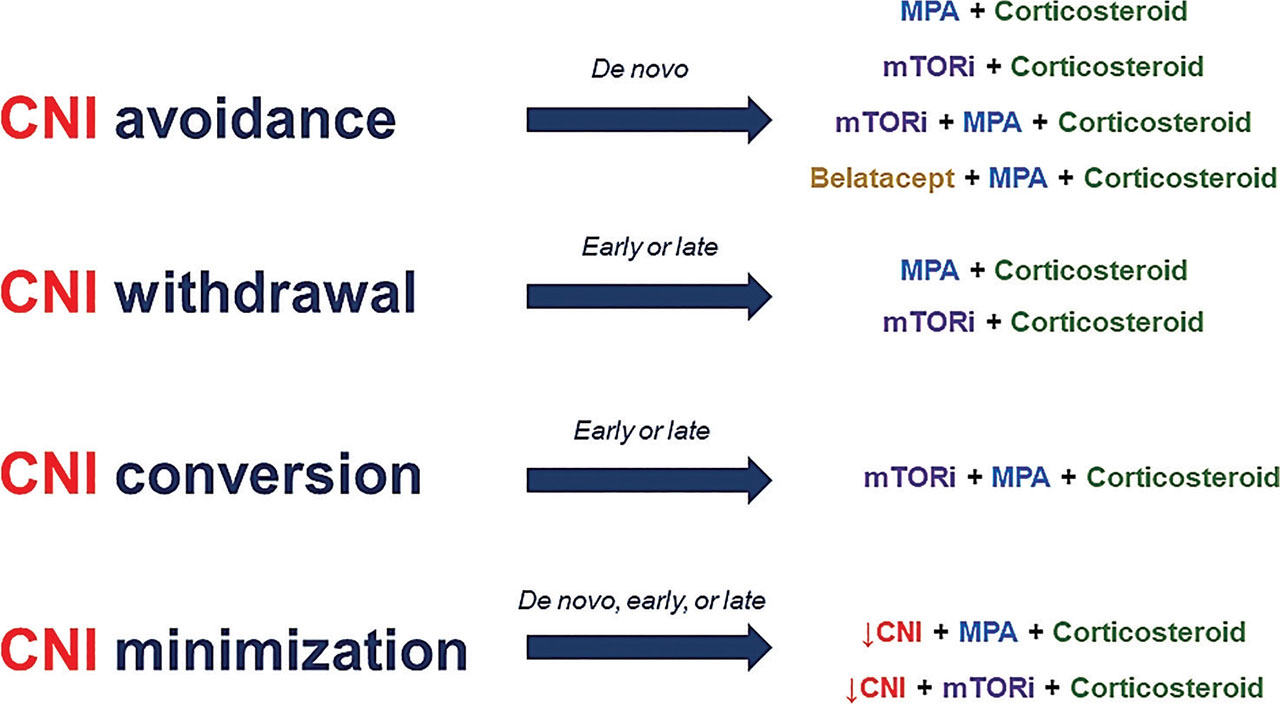
Figure 1.
Concept of CNI-sparing strategy. The “early period” denotes interventions applied within 4–6 months after transplantation, while the “late period” refers to interventional timing after that. CNI, calcineurin inhibitor; MPA, mycophenolic acid; mTORi, mammalian target of rapamycin inhibitor.
Examples of RCTs investigating various immunosuppressive regimens are presented in Table 1. These RCTs are provided for illustrative purposes and do not represent all available RCTs in the corresponding categories [63], [64], [65], [66], [67], [68], [69], [70], [71], [72], [73], [74], [75], [76], [77], [78]. Several meta-analyses have been conducted to compare the benefits of these strategies with the standard CNI dose plus MPA regimen [57], [79], [80], [81], [82]. The most comprehensive and up-to-date meta-analysis of all CNI-sparing strategies was performed by Sawinski et al. [57]. The authors found that the use of CNI avoidance (mTORi combined with MPA regimen) significantly increased the risk of graft loss with a relative risk (RR) of 3.40 compared with the standard TAC and MPA regimen. CNI withdrawal, followed by only MPA or mTORi maintenance, was associated with an increased risk of acute rejection (RR 3.17 and RR 1.71, respectively). However, the use of CNI conversion to mTORi demonstrated a significant improvement in kidney allograft function without increasing the risk of acute rejection or graft loss, similar to the effect of using a reduced dose of CNI combined with mTORi or MPA compared with the standard CNI dose. Additionally, when a reduced CNI dose was combined with MPA, the risk of acute rejection was significantly decreased (RR 0.80), along with the risk of graft loss (RR 0.71), compared with the standard dose CNI with MPA regimen. From this meta-analysis, the CNI-sparing regimens that appear to have a sufficient level of evidence supporting demonstrable benefits are CNI-to-mTORi conversion and the CNI minimization strategy. Among the “no CNI regimen” strategies, including avoidance, withdrawal, and conversion, it is important to emphasize that the CNI conversion and withdrawal strategy can be influenced by large variations in the timing of intervention. This timing can range from early (within 4–6 months after transplantation) to late (after 4–6 months after transplantation). Such variation may lead to different conclusions between studies. For instance, studies with early intervention might encounter higher rates of acute rejection due to allo-sensitization after CNI removal, whereas studies with late intervention might be more likely to achieve successful conversion or withdrawal due to T cell exhaustion after a longer period post-transplantation [83, 84].
Table 1.
Example of key randomized controlled trials in maintenance immunosuppression in kidney transplantation and an overview of their outcomes.
| CNI avoidance | CNI withdrawal | CNI conversion | CNI minimization |
|---|---|---|---|
Limitations in interpretation
| |||
An overview of outcomes from RCTs and meta-analyses is presented in Table 1. However, these comparisons are limited by several factors, primarily stemming from the high heterogeneity between studies. These CNI-sparing studies were conducted between 2000 and 2018, a period marked by continuous and significant changes in the field of kidney transplantation. These changes encompassed advancements in tissue typing methods, modifications in organ allocation procedures, the detection of preformed and de novo antibodies against HLA, and variations in the definition of “standard” groups in different studies. Importantly, outcome measurements also varied from one study to another, with differences in approaches such as the utilization of the Banff classification and the estimation of the glomerular filtration rate (GFR), which also underwent changes over time. It is crucial to recognize the differences in study design and the implications of each study. In the following section, notable landmark RCTs for the current maintenance immunosuppressive medication regimens are discussed to provide insight into the distinctions between each regimen and their respective advantages and disadvantages. The PubMed database was searched using Medical Subject Headings (MeSH) with “kidney transplantation” and “immunosuppression therapy.” Studies were selected based on their high impact on the transplant community and guidelines, starting from the Efficacy Limiting Toxicity Elimination (ELITE)-Symphony study, which significantly contributed to the current standard maintenance regimen. A summary of these RCTs is presented in Table 2.
Table 2.
Summary of modern randomized controlled trials in maintenance immunosuppression in kidney transplantation.
| Study (year) | KTR included | Type of study | Comparison and target C0 (ng/mL) | Allograft function (mean eGFR, mL/min) | Acute rejection (%) | Patient and graft survival | Other findings |
|---|---|---|---|---|---|---|---|
| ELITE-Symphony (NEJM 2007) [85] | 1,645 |
|
|
|
| TAC was associated with best allograft survival. Patient survivals were not different. | TAC was associated with lowest treatment failure rate. |
| FREEDOM (AJT 2008) [112] | 337 |
|
|
|
| Allograft and patient survival were similar. |
|
|
|
| Allograft and patient survival were similar. |
| |||
| BENEFIT (NEJM 2016) [103] | 666 | De novo CNI avoidance |
|
|
| The composite of patient and graft survival was better in belatacept group (patient but not graft survival reached significant level in secondary analysis). |
|
| HARMONY (Lancet 2016) [113] | 587 | Early steroid withdrawal |
|
|
| Allograft and patient survival were similar. |
|
| TRANSFORM (JASN 2018) [95] | 2,226 | De novo CNI minimization |
|
|
| Allograft and patient survival were similar. |
|
| ATHENA (Kidney Int 2019) [98] | 655 | De novo EVL vs. MPA in modern CNI exposure |
|
|
| Allograft and patient survival were similar. |
|
[ii] ATG, anti-thymocyte globulin; AZA, azathioprine; BENEFIT, Belatacept Evaluation of Nephroprotection and Efficacy as First-line Immunosuppression Trial; BKV, BK virus; C0, pre-dose concentration; C2, two hours-post-dose concentration; CMV, cytomegalovirus; CNI, calcineurin inhibitor; CONVERT, the Sirolimus Renal Conversion Trial; CsA, cyclosporine A; DSA, donor-specific anti-human leukocyte antigen antibody; EBV, Epstein-Barr virus; eGFR, estimated glomerular filtration rate; ELITE, Efficacy Limiting Toxicity Elimination; EVL, everolimus; GFR, glomerular filtration rate; KTR, kidney transplant recipient; MMF, mycophenolate mofetil; MPA, mycophenolic acid; MPS, mycophenolate sodium; PTDM, post-transplant diabetes mellitus; PTLD, post-transplant lymphoproliferative disorder; SRL, sirolimus; TAC, tacrolimus; TRANSFORM, Transplant Efficacy and Safety Outcomes with an Everolimus-based regimen; UPCR, urine protein-to-creatinine ratio.
Selected clinical trials of current maintenance immunosuppression
ELITE-Symphony study
In the current era, the pivotal RCT that holds significant importance in the realm of maintenance immunosuppression for kidney transplantation is the ELITE-Symphony study [85]. This study served as the catalyst for establishing TAC (with the current therapeutic target C0), MPA, and corticosteroids as the standard immunosuppressive regimen. The study encompassed 1,645 KTR from 15 countries, excluding those with a panel reactive antibody (PRA) >20% and a cold ischemic time (CIT) surpassing 30 h. KTR were randomized into 4 groups: the standard-dose CsA group (C0 100–200 ng/mL), low-dose CsA group (C0 50–100 ng/mL), low-dose TAC group (C0 3–7 ng/mL), and low-dose sirolimus (SRL) group (C0 4–8 ng/mL). The term “low-dose,” as employed in this study, was relative to the immunosuppressant dosages utilized during that period. For instance, low-dose TAC aimed at a target C0 of 3–7 ng/mL compared with the standard C0 of 10–15 ng/mL at that time. Each group received MMF (2 g/d) and prednisolone as part of the combined immunosuppressive therapy. Daclizumab was administered as the induction therapy in all groups, except for the high-dose CsA group, which did not receive any induction.
At the 12-month mark, the low-dose TAC group demonstrated superiority over the other groups in terms of the primary outcome, estimated glomerular filtration rate (eGFR), as well as secondary outcomes, including measured GFR, lower rejection rates, improved allograft survival, and reduced treatment failure. The advantages of enhanced allograft function and allograft survival persisted for at least 3 years in the subsequent extension follow-up study [86]. It is worth noting that, although the protocol specified a target C0 range of 3–7 ng/mL for TAC, the actual observed C0 in the study fell within the range of 5–10 ng/mL [87]. Consequently, CNI minimization, characterized by low-dose TAC, has since become the standard immunosuppressive regimen in kidney transplantation.
CONVERT study
Simultaneously with the minimization strategy in the ELITE-Symphony study, the Sirolimus Renal Conversion Trial (CONVERT) investigated the CNI-conversion strategy as a means to mitigate the long-term adverse effects of CNIs [88]. In this RCT, 830 KTR within 6–120 months post-transplantation were recruited from 11 transplant centers. They were randomized to either continue with CNI (CsA C0 50–250 ng/mL or TAC C0 4–10 ng/mL) along with MMF or AZA and corticosteroids, or to undergo a CNI-to-SRL conversion (target SRL C0 of 8–20 ng/mL).
The authors observed that among KTR with a baseline eGFR >40 mL/min (calculated using the Nankivell formula) and a baseline urine protein-to-creatinine ratio (UPCR) of ≤0.11, who underwent conversion to SRL, the mean eGFR was significantly higher than in the CNI-continuation group at both 12 months and 24 months after conversion. There were no significant differences in acute rejection rates, allograft survival, or patient survival between the 2 groups. However, a higher percentage of KTR in the SRL conversion group had to discontinue the treatment compared with the CNI-continuation group (15.7% vs. 9.5%) due to intolerable adverse effects of SRL including anemia, peripheral edema, fever, skin rash, thrombocytopenia, and leukopenia. Enrollment of KTR with a baseline eGFR of 20–40 mL/min was halted by the Drug Safety Monitoring Board due to a significantly higher number of KTR in the SRL conversion group experiencing acute rejection, graft loss, or mortality compared with the CNI-continuation group.
The results from the CONVERT study were consistent with previous observational studies, which found that lower baseline proteinuria was predictive of successful responders (those with stable or improved kidney allograft function) amongst KTR undergoing CNI-to-SRL conversion [89]. Consequently, the Kidney Disease: Improving Global Outcomes (KDIGO) Transplant Work Group recommended the replacement of CNI with mTORi in KTR experiencing CNI nephrotoxicity, provided their eGFR >40 mL/min/1.73 m2 and their UPCR is <500 mg/g creatinine [90].
TRANSFORM study
After a decade of utilizing low-dose TAC (C0 5–10 ng/mL) in combination with an MPA/corticosteroids regimen, there has been a growing trend towards using even lower doses of CNIs (a TAC C0 <5 ng/mL) in conjunction with mTORi, to further mitigate the adverse effects of CNI nephrotoxicity [55, 58, 80]. Evidence has indicated that replacing MPA with mTORi provides additional benefits, including a reduced incidence of post-transplant malignancies, particularly skin cancer and Kaposi's sarcoma, as well as a decreased risk of cytomegalovirus (CMV) and BK virus (BKV) infections [91], [92], [93], [94]. The Transplant Efficacy and Safety Outcomes with an Everolimus-based regimen (TRANSFORM) study is the largest RCT ever conducted in kidney transplantation, involving 2,226 KTR from 186 transplant centers [95]. The primary outcome aimed to compare the composite of biopsy-proven acute rejection and eGFR <50 mL/min/1.73 m2 at 12 months between KTR randomized to either the standard CNI with MPA group or the de novo CNI minimization with everolimus (EVL) group. The standard CNI with MPA group targeted C0 TAC at 5–8 ng/mL or CsA at 200–300 ng/mL, while the CNI minimization group aimed for C0 TAC at 2–4 ng/mL or CsA at 25–50 ng/mL combined with EVL at a C0 of 3–8 ng/mL during the maintenance period. Both groups received basiliximab as an induction therapy. The EVL group was found to be non-inferior to the MPA group for the primary endpoint at 12 months post-transplantation. There were no differences in terms of de novo donor-specific anti-HLA antibody (DSA) development, although this was assessed locally by available centers. However, the EVL group demonstrated a significantly lower incidence of CMV and BKV infections compared with the MPA group. The discontinuation rate was higher in the EVL group. In a 2-year follow-up study, EVL continued to be non-inferior to the MPA group [96]. This represents the first study to demonstrate the non-inferiority of de novo mTORi use, which allows for further reduction of CNI exposure compared with the current standard CNI dose with MPA. However, the long-term outcomes, particularly concerning DSA and ABMR, remain to be determined. In elderly KTR, who are less likely to reject their kidney allografts but are more likely to have infectious complications after transplantation, the Open Label Multicenter Randomized Trial Comparing Standard Immunosuppression with TAC and MMF with a Low Exposure TAC Regimen in Combination with EVL in De novo Renal Transplantation in Elderly Patients (OPTIMIZE) trial is currently running in the Netherlands to investigate the use of CNI-minimization in this specific population [97].
ATHENA study
During approximately the same period as the TRANSFORM study, another group of investigators designed the ATHENA study with the aim of evaluating the efficacy of reduced-dose TAC (TAC C0 3–5 ng/mL) in combination with EVL (C0 3–8 ng/mL, identical to the EVL group in the TRANSFORM study) vs. reduced-dose TAC (C0 3–5 ng/mL) in combination with MPA [98]. The ATHENA study sought to employ lower C0 levels of TAC in the MPA group compared with the TRANSFORM study (i.e., comparing the regimen containing EVL vs. MPA with similar reduced-dose TAC). The primary outcome of the ATHENA study was the eGFR at 12 months post-transplantation.
A total of 665 KTR from 27 centers were included in the ATHENA study. Although the study protocol stipulated that the TAC C0 should fall between 3 ng/mL and 5 ng/mL, the actual results revealed that both the EVL and MPA groups had significantly higher TAC C0 than the planned maximum throughout the study. At month 12 of the study, the TAC C0 for the EVL group averaged 6.0 ± 2.2 ng/mL, while in the MPA group, it was 5.9 ± 2.1 ng/mL. The prespecified non-inferiority margin for eGFR, set at 7 mL/min/1.73 m2, was not statistically achieved. However, a post hoc non-inferiority margin of 9 mL/min/1.73 m2 demonstrated non-inferiority between the EVL and the MPA groups. The authors discussed that the failure to show non-inferiority with the prespecified margin might have been due to insufficient differences between the treatment groups or that the TAC exposure in the groups was too high. Nevertheless, the EVL group was associated with a lower incidence of CMV and BKV infections, reaffirming the benefits of using mTORi, as also demonstrated in the TRANSFORM study [95]. Neither the ATHENA study nor the TRANSFORM study performed TDM of MPA, limiting the assessment of concentration-dependent efficacy and toxicity in the MPA group [99].
Belatacept study
Alongside the CNI minimization and CNI conversion strategies discussed earlier, CNI avoidance using belatacept has been extensively studied with impressive results [100]. Belatacept is a fusion protein comprising the Fc fragment of IgG1 and the extracellular domain of the cytotoxic T-lymphocyte-associated protein 4 (CTLA-4) [101]. Its primary function is to inhibit the costimulatory signal between CD80/86 and CD28 in the T cell activation process. The Belatacept Evaluation of Nephroprotection and Efficacy as First-line Immunosuppression Trial (BENEFIT) randomized 666 de novo KTR, excluding those with PRA >50% and a CIT >24 h, into 1 of 3 groups [102]. The first and second groups received either more intensive or less intensive belatacept in combination with MMF and glucocorticoids. The more intensive group was administered 11 doses of 10 mg/kg of belatacept intravenously in the first 6 months, followed by 5 mg/kg every 4 weeks, while the less intensive belatacept group received 6 doses of 10 mg/kg in the first 3 months, followed by 5 mg/kg every 4 weeks thereafter. The third group served as the standard comparator at the time of the study's design, involving CsA aiming for a C0 of 100–250 ng/mL and MMF/corticosteroids during the maintenance phase. The BENEFIT study is a modern RCT with one of the longest follow-up times of an immunosuppression regimen ever reported, with results spanning up to 7 years after transplantation [103]. At 7 years, both more intensive and less intensive belatacept regimens exhibited a 43% reduction in the risk of death or graft loss. Additionally, eGFR in the belatacept groups was significantly superior to that in the CsA group throughout the study period. KTR receiving belatacept also developed significantly fewer de novo DSA than those on CsA. While the rates of biopsy-proven acute rejection were higher in the belatacept groups, these rejections were considered manageable and did not adversely affect the long-term outcomes of the recipients. Importantly, the incidence of post-transplant lymphoproliferative disorder (PTLD) was found to be high among KTR with negative Epstein-Barr virus (EBV) serology who received belatacept. This led the US Food and Drug Administration (FDA) to contraindicate the use of belatacept for recipients with negative EBV serology [101]. It is worth emphasizing that the comparator in the BENEFIT study was CsA, which is not a standard CNI in the current era.
One RCT investigated the efficacy of de novo belatacept (n = 104) compared with TAC (n = 105) in an early steroid withdrawal regimen, with both groups receiving anti-thymocyte globulin (ATG) and MPA [104]. The 2-year outcomes revealed comparable patient and allograft survival. Similar to the BENEFIT study, KTR with belatacept also had a higher incidence of biopsy-proven acute rejection compared with the TAC group (25% vs. 7%), although the eGFR in the belatacept group was significantly better than in the TAC group. In another smaller RCT, KTR receiving de novo belatacept (n = 20) were compared with those receiving TAC (n = 20) in the context of basiliximab induction and an MMF/prednisolone maintenance regimen. The study revealed that the belatacept group had a significantly higher incidence of acute T-cell mediated rejection (TCMR), which was also more severe compared with the TAC group. This resulted in a trend toward a higher graft loss rate at 1-year in the belatacept group (P = 0.08) [105]. Although patient survival did not differ between the groups, this pilot study confirmed that belatacept may lead to a higher incidence of acute TCMR when compared with a TAC-based maintenance regimen.
Currently, belatacept is employed as an alternative to CNIs, particularly in cases where CNIs are contraindicated, such as in individuals who have experienced CNI-associated TMA or posterior reversible encephalopathy syndrome (PRES) [106]. However, the requirement for intravenous infusion and the associated infusion-related reactions have hindered its widespread use. Another strategy involving belatacept use is late conversion (after 6 months) from TAC to mitigate the risk of TCMR in the early period after transplantation while preserving graft function. This strategy has shown that kidney allograft function improves after belatacept conversion without an increased risk of rejection [107], [108], [109]. Additionally, belatacept conversion might benefit patients with ABMR, as indicated in case series and cohorts that have demonstrated stabilization of allograft function in KTR with ABMR [110, 111]. However, an RCT is required to investigate this strategy further.
Steroid withdrawal studies
Two landmark trials have investigated steroid withdrawal regimens in kidney transplantation. The FREEDOM study involved 337 KTR from 40 sites and randomized them into 3 groups: the steroid-free group, the early steroid withdrawal group (withdrawal after 7 d post-transplantation), and the standard steroid regimen, in which prednisolone was tapered to 5–10 mg/d after 2 months [112]. All KTR received basiliximab, CsA, and MPA. At 1-year post-transplantation, there was no difference in terms of eGFR, death, or graft loss between the early steroid withdrawal group and the standard steroid group, despite the increased incidence of acute rejection (26.1% in the steroid withdrawal group vs.14.7% in the standard steroid group). However, the composite of acute rejection, death, or graft loss was significantly higher in the steroid-free group compared with the standard steroid group (36% vs. 19%). The steroid withdrawal group exhibited a lower incidence of increased body mass index (BMI), required fewer lipid-lowering medications, and had lower triglyceride levels compared with the standard steroid group.
Another recent RCT exploring steroid withdrawal in kidney transplantation was the HARMONY trial [113]. A total of 587 KTR from 21 transplant centers were included in 1 of 3 groups: the standard group (basiliximab, TAC, MPA, prednisolone tapered to 2.5–5.0 mg/d after 3 months), the basiliximab with steroid withdrawal group (same as the standard group but with prednisolone stopped after 7 d), and the ATG with steroid withdrawal group (similar to the other steroid withdrawal group but using ATG instead of basiliximab). The included KTR were considered to have a low-to-moderate immunological risk, and those with PRA >30% were excluded. There was no difference in the primary endpoint of biopsy-proven acute rejection at 12 months. However, the steroid withdrawal groups showed benefits in terms of a lower incidence of post-transplant diabetes mellitus (PTDM) compared with the standard group. The steroid withdrawal groups also had a lower incidence of osteoporosis.
Based on the results from these steroid withdrawal RCTs, it is recommended that if a steroid withdrawal regimen is planned, it should be initiated within the first week after transplantation to decrease the metabolic adverse effects while maintaining an adequate level of immunosuppression [90]. Previous studies have shown that steroid withdrawal regimens are associated with a higher incidence of recurrent glomerular diseases, particularly IgA nephropathy [114], [115], [116], while other studies did not demonstrate an increased risk of recurrent glomerular disease [117, 118]. However, this information is limited by the retrospective design of these studies, resulting in mixed differences in the timing of steroid withdrawal (early vs. late) and the effects of other immunosuppressive medications used in the regimens during different eras. Additionally, the risk of recurrent IgA nephropathy does not depend solely on the steroid regimen but rather on other factors including age, time to ESRD, and dialysis vintage [119]. Therefore, the risk of recurrent IgA nephropathy in KTR with steroid withdrawal regimens may indeed exist. However, the extent of this burden in the current immunosuppression scheme necessitates further RCTs specifically examining this outcome with a sufficient follow-up period.
Looking back at CNI nephrotoxicity: Is it really a cause of great loss?
Nephrotoxicity arising from CNIs is one of the most concerning complications after kidney transplantation, and it is widely believed that CNI nephrotoxicity plays a significant role in allograft failure [7, 9, 10]. CNI nephrotoxicity is also a significant contributor to chronic kidney disease in the native kidneys following non-kidney solid organ transplantation [120], [121], [122]. This has prompted extensive efforts to reduce CNI exposure, as mentioned above. However, there is evidence suggesting that the association between CNI nephrotoxicity and negative outcomes may not be as clear-cut as initially perceived.
First, there are no histological lesions that are pathognomonic or specific for chronic CNI nephrotoxicity. In studies investigating chronic lesions in kidney allograft biopsies, none of the Banff categories was found exclusively in KTR who received CNIs but absent in those on non-CNI regimens [123, 124]. These chronic lesions include tubular atrophy, interstitial fibrosis, vascular fibrous intimal thickening, or arteriolar hyalinosis (either intimal or medial). Allograft biopsies from KTR who have never received CNIs also exhibited these histological lesions, albeit at a lower incidence than in KTR who had received CNIs [124]. This indicates that CNIs might contribute to the development of chronicity lesions through various pathways, but that they lack specificity.
Second, while CNI nephrotoxicity was long considered a significant factor in allograft loss, the reality appears different. In a study that followed 1,317 KTR for a mean follow-up of 50 ± 32 months, 153 grafts (12%) were lost due to graft failure after censoring for death [125]. Among these graft failures, only 1 case of kidney allograft was attributed to CNI nephrotoxicity, while the majority of grafts within the IFTA category were lost due to conditions such as polyomavirus nephropathy, recurrent pyelonephritis, TCMR, ABMR, and poor allograft quality [125]. Infections in kidney allografts and the baseline pathology of the donor kidney can lead to IFTA in subsequent biopsies [126, 127]. Another study conducted a survival analysis after for-cause allograft biopsies, and demonstrated that kidney allografts diagnosed with CNI nephrotoxicity did not exhibit inferior allograft survival when compared with allografts with other diagnoses [128].
Arguably, the most significant evidence diminishing the importance of CNI nephrotoxicity with regard to long-term outcomes is the increasing recognition of ABMR and DSA as the leading cause of graft failure [129], [130], [131]. In contrast to earlier studies when the possibility to diagnose ABMR and the DSA detection were limited, contemporary studies with well-defined criteria for the diagnosis of ABMR have identified it as the primary cause of long-term allograft loss [131, 132]. Chronic ABMR and TCMR contribute to allograft IFTA, arteriolosclerosis, and arteriosclerosis [133], [134], [135], [136]. Furthermore, investigations into gene expression and molecular phenotypes of allograft biopsies have unveiled that the extent of inflammation in areas of IFTA or within the scarred regions of the allograft, sharing molecular phenotypes with acute rejection, has a substantial impact on long-term outcomes and graft loss [137, 138]. Conversely, allografts displaying only phenotypic features of CNI nephrotoxicity (e.g., arteriolar hyalinosis or the ah score in Banff classification) in the absence of inflammation were not associated with decreased allograft survival, as shown in the Deterioration of Kidney Allograft Function (DeKAF) study [132].
It is undeniable that chronic CNI nephrotoxicity exists. It may be related to multiple factors, including the imbalance between intra-allograft and systemic CNI exposure and clearance [139, 140]. However, the concept of the major causes of long-term allograft loss has shifted away from CNI nephrotoxicity to chronic unopposed inflammation in kidney allografts, either in the form of chronic ABMR or TCMR, with immunosuppressive medication non-adherence being an important risk factor [141], [142], [143]. The process of developing IFTA and arteriolosclerosis in kidney allografts is complex and not fully understood [10], potentially involving multifactorial causes. However, only a very small proportion of graft loss is attributed to IFTA without inflammation, as observed in CNI nephrotoxicity [132]. Clinicians should be aware that when late kidney allograft dysfunction presents with a histological picture of IFTA or arteriolosclerosis, chronic immune-mediated injury should be ruled out first before considering a CNI-sparing regimen. Gene expression profiles of allograft biopsy samples might aid in determining the nature of IFTA, whether inflammation is present or not [137]. Reflecting on the landmark study from 2003 [7], which highlighted a 100% prevalence of CNI nephrotoxicity at 10 years and served as a catalyst for the initiation of CNI-sparing regimens, many debates have emerged in the contemporary era. Significantly, chronic CNI nephrotoxicity lacks specific histological lesions, and attributing allograft function decline solely to CNI nephrotoxicity remains inconclusive, primarily due to the absence of DSA testing.
Perspective and conclusion
Numerous contemporary RCTs have been conducted to offer various options for maintenance immunosuppression in kidney transplantation, beyond the conventional TAC/MPA/corticosteroid regimen. The initial goal of reducing CNIs to the lowest possible exposure to prevent allograft loss from CNI nephrotoxicity has gradually evolved. This transformation is driven by current evidence, which does not strongly support the notion that chronic CNI nephrotoxicity is the primary cause of graft loss [142, 143]. Instead, alternative explanations, particularly chronic inflammation resulting from unopposed immune processes, play a significant role in shaping the long-term outcomes of allografts.
As a result, the standard regimen of TAC/MPA/corticosteroids remains the cornerstone of immunosuppression for kidney transplantation, as it has consistently demonstrated superior outcomes in terms of reducing allograft rejection and improving allograft survival [144]. Nonetheless, CNI-sparing strategies still hold value, particularly for KTR with low-to-moderate immunological risk but a heightened risk for viral infections or malignancies. KTR who cannot tolerate CNIs, such as those with a history of CNI-induced TMA, are also potential candidates for CNI-sparing regimens. Most modern CNI-sparing strategies, like CNI minimization in the TRANSFORM study, have exhibited excellent and comparable short-term outcomes when compared with the standard regimen. However, comprehensive long-term data, especially information regarding the development of de novo DSA and chronic ABMR and/or TCMR, are still needed to determine whether these alternative strategies are equivalent to or possibly superior to the standard regimen. TDM of TAC, mTORi, and MPA is also crucial for enhancing efficacy and minimizing adverse effects of immunosuppressive medications [145]. Moreover, clinicians should stay updated on the latest developments of novel immunosuppressants for treating rejection, which may eventually replace current maintenance regimens in the future [146, 147].
In conclusion, CNI nephrotoxicity is not a major contribution to graft loss and the standard TAC with MPA regimen remains the preferred choice. CNI-sparing approaches are considered as alternative options but necessitate additional long-term data for validation.
Acknowledgments
The writing of this paper was supported by the National Research Council of Thailand (Grant for New Researcher), Grant/Award Number: N42A661041 and Ratchadapisek Sompoch Endowment Fund of Chulalongkorn University (GA66/084).
Notes
[4] Contributed by Author contributions. All authors made substantial contributions to the conception and design of the study and acquisition of data. SU contributed substantially to data analysis. SU drafted the manuscript, and MRS and DAH revised it critically for important intellectual content. All authors approve the final version submitted for publication and agree to be accountable for all aspects of the work and take responsibility for statements made in the published article.
[5] Conflicts of interest statement. Each author has completed and submitted an International Committee of Medical Journal Editors Uniform Disclosure Form for Potential Conflicts of Interest. None of the authors has any potential or actual conflicts of interest concerning the published article to disclose.
[6] Data sharing statement. The present review is based on the references cited. All data generated or analyzed during the present study are included in this published article and the citations herein. Further details, opinions, and interpretation are available from the corresponding author on reasonable request.