
1. Introduction
Chronic kidney disease (CKD) is on the rise due to a number of factors, including an aging population, an increase in the number of persons coping with diabetes and hypertension, and a general trend toward longer life expectancy.1 To prolong life in end-stage renal disease (ESRD), one must undergo renal replacement therapy, which may involve hemodialysis, peritoneal dialysis, or a kidney transplant.2 Hemodialysis remains the gold standard due to its ease of use and efficiency in removing metabolic waste and excess fluid.3
In order to carry out hemodialysis effectively, a reliable vascular access must be established. When it comes to long-term vascular access for hemodialysis patients, the arteriovenous fistula (AVF) is typically considered superior to alternative approaches such as central venous catheters and arteriovenous grafts.4 Its prolonged patency length and reduced complication risk are the reasons behind this. The constant cannulation of AVFs throughout dialysis treatments can cause considerable pain and concern for patients. Patients’ quality of life and treatment compliance could be negatively affected by this.5’6
Pain during AVF puncture is a typical and unpleasant experience for many hemodialysis patients. Some people find the numerous painful needle insertions that are a part of dialysis treatment to be the most taxing aspect of the treatment.7 There has been improvement in needle technology and cannulation processes, although many patients still report moderate to severe discomfort during this treatment.8 Uncontrolled procedural discomfort poses a threat to dialysis adequacy and vascular access management because it can induce needle phobia, anticipatory anxiety, and noncooperation in patients.9
The use of pharmacological interventions, such as lidocaine creams, local infiltration anesthesia, and systemic analgesics, has helped to control the discomfort that is often associated with cannulation. However, these methods are not without their flaws, like the fact that they might cause things to take longer to get rolling, that they might only work at the local level, that they could be more expensive, and that they could have systemic negative impacts.10 Because of their low cost, lack of side effects, and ease of implementation, non-pharmacological therapies are gaining popularity.11
Among these non-pharmacological methods, cryotherapy—the localized application of cold to bodily tissues—has shown efficacy in reducing pain perception via several processes. It produces a counter-irritant action by reducing nerve conduction velocity, inducing vasoconstriction, and modulating pain perception on the peripheral and central levels.12 Cryotherapy’s analgesic effects are further supported by the gate control hypothesis of pain, which states that cold stimuli excite large-diameter A-beta sensory fibers, which then block the transmission of pain signals that are transmitted by smaller A-delta and C fibers in the spinal cord. This hypothesis supports the idea that cryotherapy can be effective in relieving pain.13
The effectiveness of cryotherapy in reducing the discomfort associated with a wide variety of medical operations, such as intravenous cannulation, venipuncture, and injections, has been demonstrated by a number of studies for a long time.14,15 Nonetheless, little research has particularly examined its efficacy in mitigating pain during AVF cannulation in hemodialysis patients, despite its potential advantages and simplicity of implementation in practical environments.
Due to the enduring nature of dialysis therapy and the need for continuous vascular access puncture, it is essential to determine straightforward, secure, and economical methods to alleviate procedural discomfort and enhance patient comfort. Cryotherapy may serve as an accessible complement to standard care, possibly improving patients’ overall dialysis experience and adherence to treatment regimens.16
This research seeks to evaluate the efficacy of cryotherapy in alleviating discomfort during AVF puncture in patients receiving hemodialysis. The results may provide significant insights into evidence-based, non-pharmacological pain treatment options that may be seamlessly incorporated into standard nursing practice, therefore enhancing patient satisfaction and care quality.
1.1. Statement of the problem
Impact of Local Cryotherapy on Pain Perception during AVF Cannulation among Chronic Hemodialysis Patients in selected hospitals in Rajkot.
1.2. Objectives
– To compare the intensity of pain experienced during AVF vein puncture between the experimental group receiving cryotherapy and the control group receiving standard care.
– To evaluate the efficacy of cryotherapy in reducing pain during AVF vein puncture among hemodialysis patients in the experimental group.
– To analyze the relationship between selected demographic variables (such as age, gender, duration of dialysis, and site of fistula) and the level of pain during AVF vein puncture in both the experimental and control groups.
1.3. Hypothesis
H1: There will be a significant difference in the pain perception scores during AVF cannulation among chronic hemodialysis patients before and after the application of local cryotherapy.
H2: There will be a significant association between pain perception scores and selected demographic variables (such as age, gender, duration of hemodialysis, site of AVF) among chronic hemodialysis patients.
2. Review of literature
A systematic review and meta-analysis was done by Jafari-koulaee et al.17 to find out how cryotherapy affects the pain of AVF punctures in people who are on continuous hemodialysis. These people have this process done about 300 times a year. We found relevant experimental studies in English and Persian by searching through many databases and screening them against strict inclusion criteria. This led to 8 studies (422 people) being chosen for qualitative synthesis and 6 studies being chosen for meta-analysis. The studies that were looked at, which were done between 2008 and 2017, all showed that freezing successfully lessens pain from punctures. Cryotherapy seems like an easy, low-risk, and non-invasive way to help hemodialysis users deal with pain and the mental and physical problems that come with having fistula punctures over and over again.
Arshad et al.18 registered with the International Prospective Register of Systematic Reviews (PROSPERO) and followed the Preferred Reporting Items for Systematic reviews and Meta-Analyses (PRISMA) standards. They then did a systematic study of the effectiveness of several drug treatments in reducing pain during AVF cannulation in teens and adults with end-stage kidney disease. There were 15 studies chosen, but all of them had some risk of bias. The results showed that cryotherapy with ice packs at the fistula site worked better than Eutectic Mixture of Local Anesthetics (EMLA) cream at lowering pain by 1.05 points on the VAS. The side effects of both treatments were the same. It was 2.09 times more painful with EMLA cream than with lidocaine spray or 1.30 times more painful with piroxicam gel. At the Hoku site, cryotherapy also helped a lot with pain compared with a sugar pill (mean difference 2.53). Cryotherapy with ice packs and EMLA cream are usually thought to be effective ways to lessen the pain of punctures during fistula cannulation.
Cryotherapy and lavender oil inhalation were compared in quasi-experimental research that compared the two methods for alleviating pain associated with AVF punctures in 60 hemodialysis patients. The study was carried out at Menoufia University Hospital in Egypt and was led by Mahmoud et al.19 Both therapies considerably decreased discomfort during AVF puncture compared with levels before application, according to data obtained from structured interviews, a VAS, and physiological measurements. While the lavender oil group had a drop in pain levels from 2.46 to 1.8 over the course of 3 visits, the cryotherapy group saw a decrease from 2.63 to 1.16. Cryotherapy is more effective than ice packs in reducing discomfort after AVF punctures, so the research recommends that hemodialysis patients have it as part of their regular nursing care.19
3. Methodology
A quasi-experimental pre-test and post-test design was used in the research project, and a control group was included. The study utilized a quantitative methodology. A non-probability purposive sampling method was used in order to identify a total of 40 patients who were having hemodialysis at KDP Hospital in Atkot and had an AVF. Every participant was assigned to one of two groups: 20 were assigned to the experimental group, and 20 were assigned to the control group.
3.1. Description of the tool
Part I: This section has information about the person’s age, gender, food, the arm that has an AVF, where and how long the AVF was used, how many times a week they go to dialysis, and the size of the tube.
Part II: This section uses a standard numerical scale from 0 to 10 to rate pain: You can rate your pain on a scale from 0 (no pain) to 10 (extreme pain).
3.2. Data collection procedure
The research was carried out over 6 weeks. Due to the impracticality of accommodating all participants in 1 d, around 4–5 patients were chosen daily according to the inclusion criteria. Participants were alternately allocated to the experimental and control groups. The study’s goal was elucidated, formal permission was acquired, and confidentiality was guaranteed.
During the first dialysis session, demographic information and pre-test pain levels associated with AVF puncture were documented using the Standardized Numerical Pain Assessment Scale via a structured interview, lasting about 10 min per participant.
In the second dialysis session, the experimental group underwent cryotherapy, whereby ice cubes encased in a glove were administered to the web area between the thumb and the index finger of the contralateral hand (excluding the AVF) commencing 10 min prior to and persisting during the puncture procedure. The control group was given standard care. Post-procedure pain levels were evaluated in both groups immediately after the intervention using the same scale.
3.3. Data analysis
Analyses used frequency and percentage for demographic data. Pain was measured using mean and standard deviation. Cryotherapy efficacy was analyzed using paired and independent t-tests, while pain levels and demographic characteristics were examined using the chi-square test.
4. Result
4.1. Section I: Demographic data of patients experiencing pain associated with AVF vein puncture
The majority of patients in the experimental group were between the ages of 41 and 60 years, and there were an equal number of males and girls in the group. They had their AVF primarily in their left arm, most usually at the Radio-cephalic site, and they had been utilizing it for anywhere between 1 and 18 months. The majority of them followed a varied diet. The majority of patients went to dialysis 3 times/week and utilized a 17G AVF cannula for the majority of their treatments.
When it came to the control group, the majority of patients were between the ages of 21 and 60 years, with a greater percentage of males than females. In addition, the majority of patients followed a varied diet, had AVFs mostly in the left arm, most frequently at the Brachio-basilic site, used the fistula for the bulk of the period, which was between 7 and 12 months, went to dialysis 3 times a week, and primarily used a 17G external venous catheter.
4.2. Section II: Data on level of pain during AVF vein puncture among patients undergoing hemodialysis
During the pre-test, 11 patients (35%) in the experimental group reported experiencing moderate pain, whereas 65% reported experiencing severe pain. During the post-test that took place after the cryotherapy treatment, 16 patients (80% of the total) reported experiencing mild pain, while 4 patients (20% of the total) reported experiencing significant pain.
This suggests that the majority of patients initially had severe pain; however, after receiving cryotherapy, the majority of patients reported only minor discomfort in the post-test, indicating that there was a considerable reduction in the levels of pain experienced by the patients.
In the control group, during the pre-test, 8 patients (40%) indicated moderate pain, while 12 patients (60%) indicated severe pain. In the post-test, 7 patients (35%) indicated moderate pain, whereas 13 patients (65%) persisted in reporting severe pain.
This signifies that most patients in the control group endured intense pain both prior to and following the test, with no intervention administered, and just a minimal decrease in severity was noted.
4.3. Section III: Statistics on the impact of cryotherapy on pain severity during AVF vein puncture in hemodialysis patients
According to the hypothesis that was supplied, the results in the table may be stated as follows: “There will be a significant difference in the pain perception scores during AVF cannulation among chronic hemodialysis patients before and after the application of local cryotherapy.”
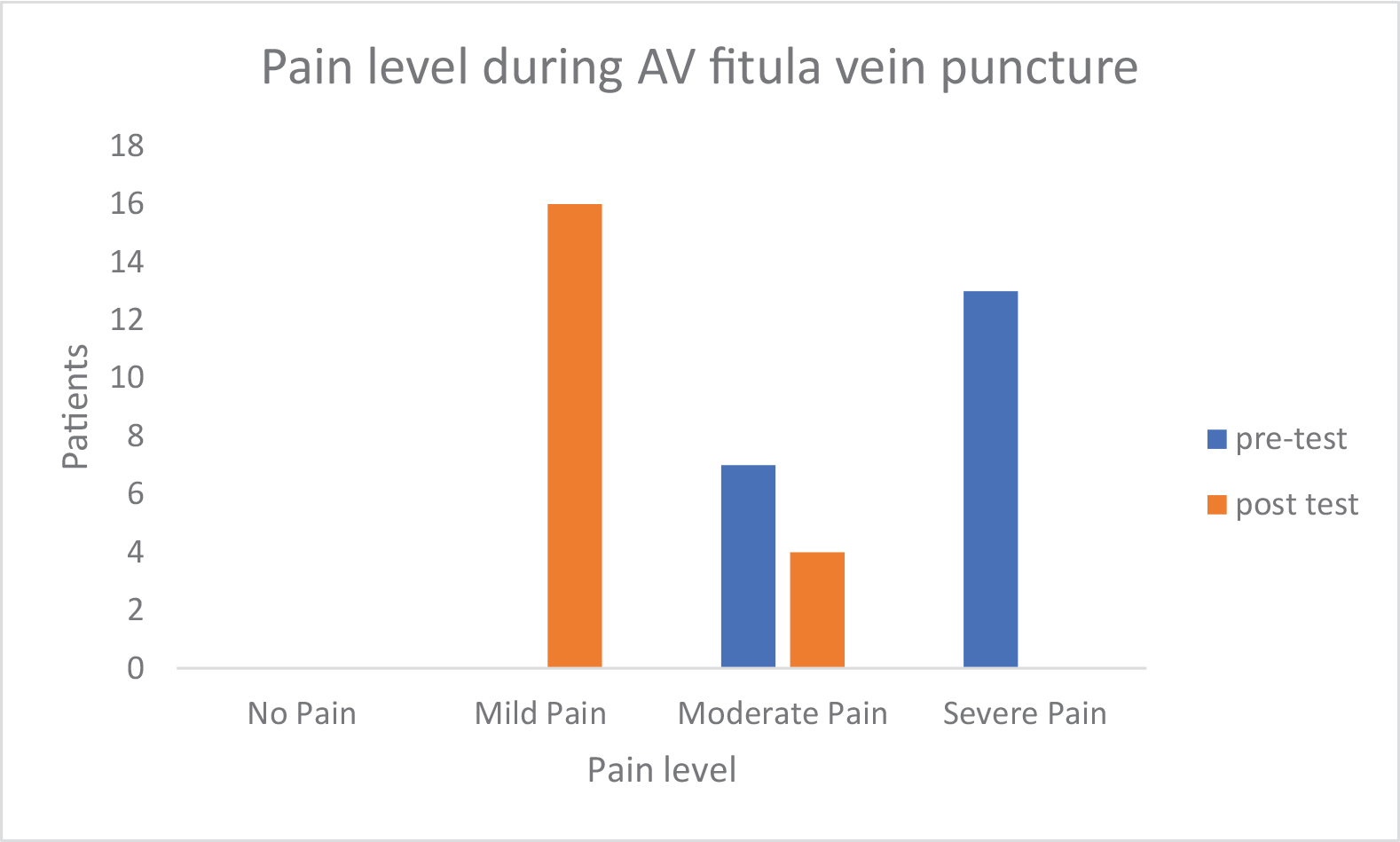
Figure 1.
Pain level during AV fistula vein puncture among hemodialysis patients before (pre-test) and after (post-test) intervention. Note: AVF, arteriovenous fistula.
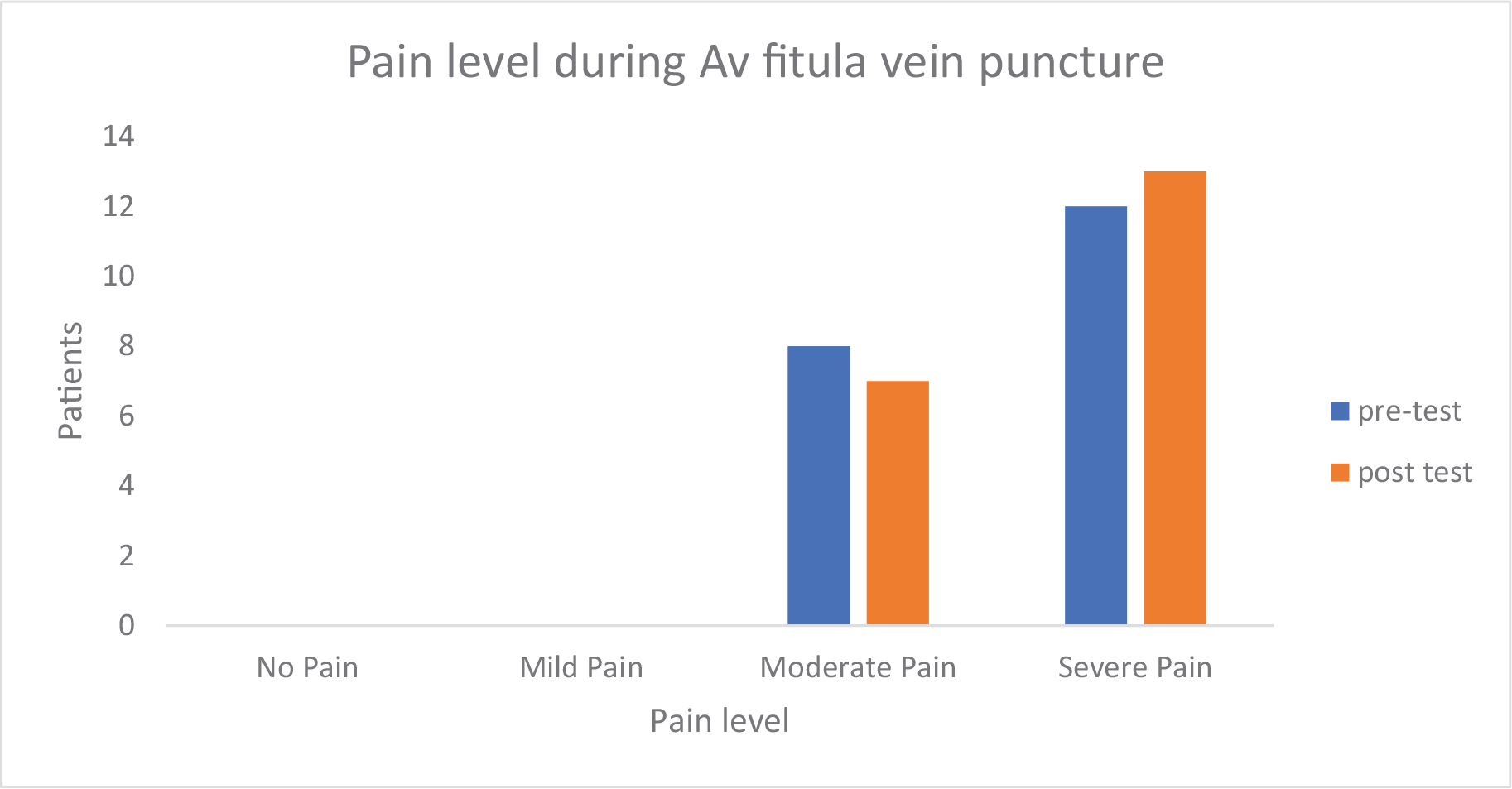
Figure 2.
AVF, arteriovenous fistula.
The mean pain perception score in the experimental group, which received local cryotherapy, dropped dramatically from 3.5 (SD = 0.8) before to 2.6 (SD = 0.6) after the procedure, with a t-value of 15.45 (**) indicating a very significant difference. Mean pain scores in the cryotherapy group decreased significantly from 4.5 (SD = 0.9) to 4.4 (SD = 0.8), with a t-value of 14.67, whereas in the control group, no cryotherapy was administered. The results show that local cryotherapy successfully lessens pain perception during AVF cannulation in chronic hemodialysis patients, lending credence to the idea (Table 1).
Table 1.
Pain scores during AVF cannulation among hemodialysis patients.
| Group & test | Mean | SD | t |
|---|---|---|---|
| Experimental | 15.45** | ||
| Pre-test | 3.5 | 0.8 | |
| Post-test | 2.6 | 0.6 | |
| Control | 14.67 | ||
| Pre-test | 4.5 | 0.9 | |
| Post-test | 4.4 | 0.8 |
The hypothesis was that “affected individuals undergoing chronic hemodialysis will report significantly different levels of pain during AVF cannulation prior to and following the administration of local cryotherapy.” The results demonstrate that compared with the control group (Mean = 4.4, SD = 0.8), which did not undergo cryotherapy, the experimental group, which underwent local cryotherapy, had a mean pain score of 2.6 (SD = 0.6). With a computed t-value of 12.54**, we can see that the groups’ pain perception scores are significantly different.
4.4. Section IV: Data on hemodialysis patients’ AVF vein puncture pain and selected demographic variables
This section assesses the relationship between AVF cannulation discomfort and demographic characteristics in hemodialysis patients in the experimental and control groups. The results showed that age, gender, existence of AVF in an arm, site of AVF, period of usage, and cannula size were significantly associated with cannulation pain. We accepted the hypothesis (H2) that AVF cannulation pain levels are significantly associated with these demographic characteristics. Diet and weekly dialysis frequency did not affect procedure pain. These findings show that patient variables can affect pain perception during AVF cannulation, emphasizing the significance of addressing these aspects when developing hemodialysis pain management strategies.
5. Discussion
Current study results significantly confirm the prediction that “There will be a significant difference in the pain perception scores during AVF cannulation among chronic hemodialysis patients before and after the application of local cryotherapy.”
This shows that local cryotherapy reduces cannulation-related pain in chronic hemodialysis patients. The experimental group’s mean pain perception scores dropped from 3.5 to 2.6, while that of the control group dropped from 4.5 to 4.4.
Numerous recent research support these findings. Singh et al.20 reported that local ice pack administration significantly reduced AVF puncture discomfort in hemodialysis patients, providing evidence for cold therapy as an addition to routine care. A controlled study in South India by Sabitha et al.21 found that cold application reduced pain scores significantly compared with the normal procedure. Pourhabib et al.22 found that cryotherapy reduces puncture pain during hemodialysis and advocated its routine use in clinical settings in a systematic review and meta-analysis. In a similar vein, Nasiri et al.23 described how cryotherapy administered prior to venipuncture significantly reduced the level of discomfort experienced by patients undergoing a variety of needle insertion procedures, demonstrating that its application is becoming more widespread.
In addition to the data that have been presented, local cryotherapy is a nursing intervention that is simple to administer, inexpensive, and has the potential to enhance care by lowering the amount of pain that is associated with the treatment, enhancing patient comfort, and maybe enhancing hemodialysis compliance at a lifelong level.
The results of this study demonstrate that local cryotherapy can alleviate the pain associated with cannulation of the AV fistula in chronic hemodialysis patients. Cryotherapy is a straightforward, cost-effective, and non-pharmacological method that can reduce cannulation pain and enhance patient comfort and compliance throughout repeated dialysis procedures. This is indicated by the significant drop in mean pain scores that occurred in the experimental group.
Previous study is consistent with these findings. According to Kaur et al.24 the application of a cold compress significantly alleviated the discomfort that hemodialysis patients experienced during the AVF puncture. In their study, Ray et al.25 discovered that local cold massage prior to needle insertion was more effective in reducing pain ratings than routine care. Another study conducted by Jahanshahi et al.26 demonstrated the practical nursing application of cryotherapy by demonstrating that it reduced the amount of discomfort experienced during vascular access cannulation.
The findings of the current study are consistent with those of earlier studies that have shown the efficacy of local cryotherapy in reducing the amount of discomfort experienced during the process of cannulating an AVF. Studies conducted by Patidar et al.27, Rout et al.28, and Kulkarni et al.29 consistently indicate a significant reduction in pain levels among hemodialysis patients who underwent cold application or ice massage prior to cannulation. This reduction was found to hold true throughout all 3 studies. In light of these findings, the proposal to add local cryotherapy as a routine, evidence-based nursing intervention is strengthened. The purpose of this intervention is to improve the entire experience of hemodialysis, make the patient more comfortable, and reduce the amount of worry they feel. In nursing care, the application of local cryotherapy has been demonstrated to be effective in reducing the level of discomfort that patients who are undergoing chronic hemodialysis suffer. This has been demonstrated in several clinical investigations.
6. Conclusions
Participants in the current study were patients who were undergoing AVF cannulation and were also receiving chronic hemodialysis. The purpose of this study was to determine whether or not local cryotherapy is useful in lowering the amount of discomfort that can be experienced by these patients. The findings of the research showed that the experimental group, which was administered local cryotherapy, saw a significant reduction in the mean pain perception score. This reduction occurred from 3.5 (standard deviation = 0.8) prior to the intervention to 2.6 (standard deviation = 0.6) after the application of the technology. This was indicated by a t-value of 15.45 (**), which is highly significant at the level of statistical significance. This was demonstrated by the fact that the score experienced a considerable drop as compared with before. By contrast, the control group, which did not receive cryotherapy, showed a slight improvement in mean pain levels, which went from 4.5 (standard deviation = 0.9) to 4.4 (standard deviation = 0.8). This was determined by comparing the mean pain levels of the different groups. There was no statistically significant difference between the two groups, as indicated by the t-value of 14.67 for this particular group. These data, which verify the theory, provide credence to the notion that there is a significant difference in the scores with which one perceives pain before and after the application of local cryotherapy.
On the subject of relieving pain during AVF cannulation, the findings are consistent with those of a previous study and provide strong evidence that local cryotherapy is a nursing intervention that is not only helpful but also simple, risk-free, and economical. Consistent adoption of this strategy has the potential to produce a number of results, including the enhancement of patient comfort, the reduction of anxiety that is associated with repeated needle punctures, and the improvement of compliance with ongoing hemodialysis therapy.
Recommendation
The results of the study suggest that hemodialysis units should incorporate local cryotherapy into their usual nursing interventions for AVF cannulation in order to reduce pain and suffering for patients. Cryotherapy and other non-pharmacological pain management techniques should be a part of hospital policy in order to improve patient outcomes. Effective pain treatment during dialysis requires nursing personnel to be trained on the proper use and advantages of local cryotherapy. To validate and generalize the efficacy of local cryotherapy, more large-scale, multicenter research with varied demographics are needed. Additionally, comparison studies with alternative non-pharmacological approaches should be investigated. Patients and caregivers can be better prepared for cryotherapy if they are informed about the benefits of the process.
Nursing implications
Nursing Practice: Simple, low-cost local cryotherapy can reduce procedure-related pain and improve hemodialysis.
Nursing Education: Students can learn to provide thorough and compassionate care by incorporating non-pharmacological pain treatment into nursing education.
Nursing Administration: By providing ice packs and practice guidelines, nursing leaders and managers can help cryotherapy be implemented.
Nursing Research: Continuous nursing research should expand the evidence foundation for non-pharmacological pain management strategies to provide safe and effective patient care.
Ethical approval
This investigation considered ethics. The college research ethics committee of SMT Mital Y Patel mahila nursing college and KDP hospital ethical committee members approved the study with the reference number (SMT/CON/2025/ETI142/5). The patients and ward in-charge were told of the study’s purpose after hospital approval. We acquired written consent and pledged secrecy. Participants could opt out of the trial. No hospital employe routines are hidden. There were no invasive procedures in the trial. Physical and mental pain were missing. Ethics were maintained in the study.
Notes
[3] Conflicts of interest Conflicts of interest
All contributing authors declare no conflicts of interest.