
Table 1.
Frequency (f) and percentage (%) distribution of characteristics of mothers with regard to demographic variables (n = 75).
| Demographic variables | Frequency (f) | Percentage (%) |
|---|---|---|
| Age (years) | ||
| 30–40 | 9 | 11.9 |
| 40–50 | 47 | 62.7 |
| 50–60 | 19 | 25.3 |
| Religion | ||
| Christian | 38 | 50.7 |
| Hindu | 36 | 48.0 |
| Muslim | 1 | 1.3 |
| Education | ||
| Graduate or postgraduate | 14 | 18.7 |
| P.U.C | 10 | 13.3 |
| High school (8–10) | 31 | 41.3 |
| Higher Primary (5–7) | 11 | 14.7 |
| Lower Primary (1–4) | 7 | 9.3 |
| Illiterate | 2 | 2.7 |
| Occupation | ||
| Professional | 2 | 2.7 |
| Semi professional | 3 | 4.0 |
| Clerical, shop-owner, farmer | 3 | 4.0 |
| Skilled worker | 5 | 6.6 |
| Housewife | 62 | 82.7 |
| Type of family | ||
| Nuclear | 62 | 82.7 |
| Joint | 4 | 5.3 |
| Extended | 9 | 12.0 |
| Family monthly income (in Rs) | ||
| <10,000 | 60 | 80.0 |
| 10,001–20,000 | 7 | 9.3 |
| 20,001–30,000 | 3 | 4.0 |
| 30,001–40,000 | 3 | 4.0 |
| 40,001–50,000 | 2 | 2.7 |
| Marital status | ||
| Living with husband | 48 | 64.0 |
| Separately living due to job | 13 | 17.3 |
| Separated | 1 | 1.3 |
| Widowed | 13 | 17.3 |
| Number of young adults (aged 18–30 years) in the family | ||
| 1 | 38 | 50.7 |
| 2 | 30 | 40.0 |
| 3 | 5 | 6.7 |
| 4 | 2 | 2.7 |
Table 2.
Frequency (f) and percentage (%) distribution of characteristics of young adults with regard to demographic variables (n = 75).
| Demographic variables | Frequency (f) | Percentage (%) |
|---|---|---|
| Age (years) | ||
| 18–23 | 57 | 76.1 |
| 24–30 | 18 | 23.9 |
| Gender | ||
| Male | 34 | 45.3 |
| Female | 41 | 54.7 |
| Education | ||
| Professional or honors | 1 | 1.3 |
| Graduate or postgraduate | 46 | 61.3 |
| P.U.C | 17 | 22.7 |
| High school (8–10) | 8 | 10.7 |
| Higher primary (5–7) | 3 | 4.0 |
| Occupation | ||
| Student | 52 | 69.3 |
| Professional | 7 | 9.3 |
| Clerical, shop-owner, Farmer | 2 | 2.7 |
| Skilled worker | 7 | 9.4 |
| Unskilled worker | 5 | 6.7 |
| Unemployed | 2 | 2.7 |
| Family monthly income (in Rs.) | ||
| <10,000 | 62 | 82.7 |
| 10,001–20,000 | 7 | 9.3 |
| 20,001–30,000 | 3 | 4.0 |
| 30,001–40,000 | 1 | 1.3 |
| 40,001–50,000 | 1 | 1.3 |
| >50,000 | 1 | 1.3 |
Table 3.
Mean, SD, Frequency (f), and percentage (%) distribution of levels of Intergenerational ambivalence of mothers and young adults (n = 150).
| Intergenerational ambivalence | Mothers | Young adults | ||||
|---|---|---|---|---|---|---|
| Mean ± SD | f | % | Mean ± SD | f | % | |
| Moderate | 53 | 70.7 | 55 | 73.3 | ||
| High | 2.29 ± 0.458 | 22 | 29.3 | 2.27 ± 0.445 | 20 | 26.7 |
Table 4.
Mean and SD of area-wise of intergenerational ambivalence of mothers and young adults (n = 150).
| Intergenerational ambivalence | Mothers Median = 83 | Young adults Median = 83 | ||
|---|---|---|---|---|
| Mean | SD | Mean | SD | |
| Communication | 26.88 | 4.103 | 25.95 | 3.341 |
| Mutual understanding | 22.19 | 3.482 | 22.81 | 2.793 |
| Attitude toward each other | 34.39 | 4.469 | 34.63 | 5.911 |
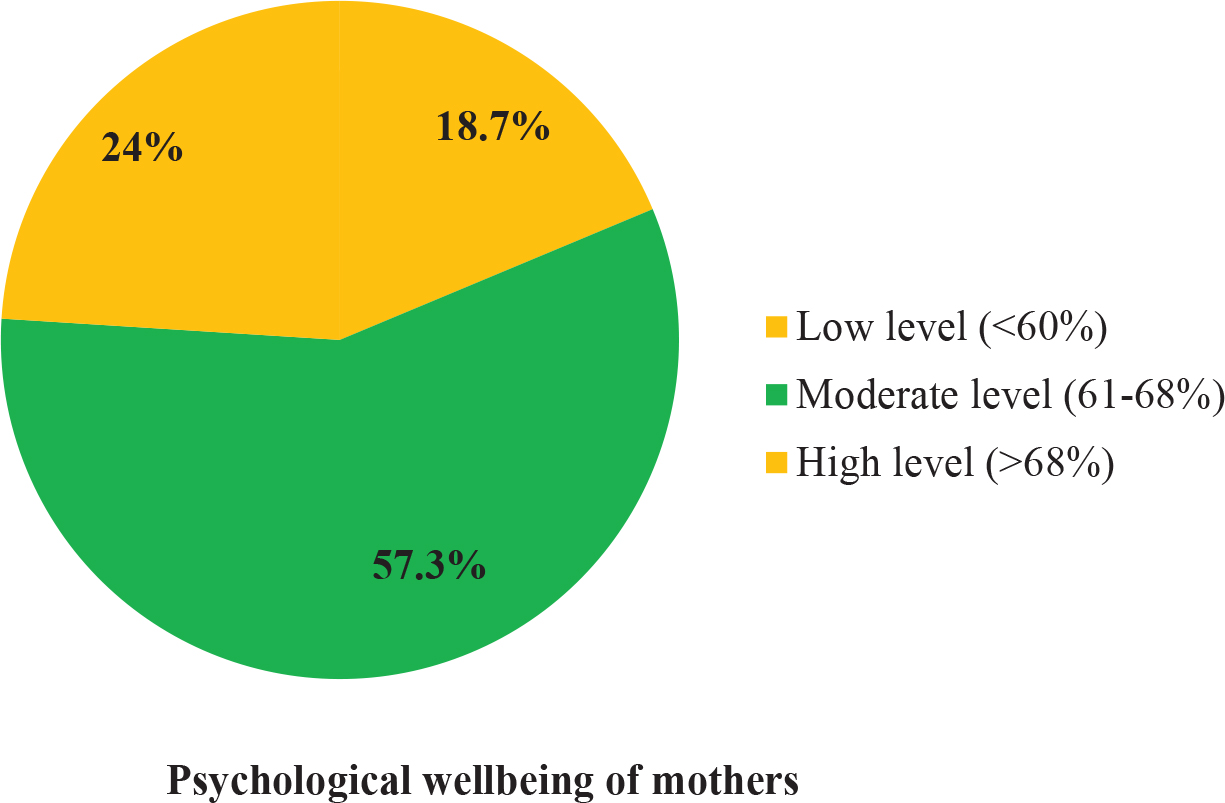
Figure 1.
Pie diagram showing levels of psychological well-being of mothers.