
1. Introduction
Parents and their children bind together naturally in the world. Through this bond, they meet each other’s needs. Both care for each other through security, connection, protection, and physical and emotional needs. They also cater to each other through influence and leadership, needs of worthiness, and understand each other’s uniqueness and importance. Both provide each other with a sense of belongingness and love. The approach of intergenerational ambivalence has been given more importance in the parent–adult–child relationship both theoretically as well as empirically.1
Luescher and Pillemer2 moved in depth toward intergenerational ambivalent relationships, as they felt a sense of warm and comforting feelings toward each other. They further report that ambivalent relationships can be a greater area to be researched in parent-child relations in later life.
Intergenerational ambivalence is the conflicts or differences in opinion occurring between the 2 or more generations. This phenomenon is explained in terms of autonomy versus dependency, which conflicts with the role expectation in intergenerational relations and tends to believe these factors lead to intergenerational ambivalence.3
Intergenerational ambivalence in family and kin relationships has become a focus of social science research since the 1980s. There are several reasons for this development, the most frequently mentioned reason being demographic change. However, Changes in population structure are embedded in broader social, economic, and cultural changes; therefore, specific attention should be paid to intergenerational relationships in family and society.4
A study was conducted to find the quality of relationships of 189 mothers aged 60 years and over toward their young adults. The study hypothesized that the failure of young adults to achieve and maintain normative adult statuses and financial independence, and the mother’s developmental stage will predict ambivalent assessments of the relationships. The study used regression analysis, which supports the hypothesis and reveals that the variables that predict ambivalence differed from those that predicted closeness and interpersonal stress.5
Another study conducted focused on the existence of positive and negative sentiments in the older paren–tadult–child relationship among 566 older mothers. An assessment for ambivalence toward their adult children was obtained. The data revealed that there exists a conflict between norms regarding solidarity with children and expectations that adult children should become independent. Results also revealed that children’s problem was positively associated with ambivalence, where the mother perceived her state of ambivalence toward the child.6
How ambivalence differs between mothers and fathers toward their young adults was also studied. Data were collected from 129 older mothers and fathers. Results showed fathers reporting higher levels of ambivalence. Data revealed that both mother and father showed lower levels of ambivalence toward children who were married and better educated. Fathers also revealed lower ambivalence toward daughters than sons, whereas mothers reported less ambivalence toward sons than daughters.7
A qualitative study was conducted for 14 years, which aimed at investigating changes in parent’s intergenerational ambivalence toward a focal child and its influence on their psychological well-being. The data were obtained from the National Survey of Families and Households (N = 1510 parents aged 35–54 years). Results showed that parental ambivalence declined over time equally between mother and father. It also showed that intergenerational ambivalence was counteracted by depressive symptoms of the parents.8
Another study in America found a relationship between intergenerational ambivalence and psychological well-being among parents and young adults. Data were collected from 158 families. Results revealed that parents and young adults who reported greater ambivalence showed poorer psychological well-being.9
Psychological well-being can be referred to as how people describe their lives. These descriptions can be in the form of affect or cognition. Cognitive description is the evaluation a person can give based on his/her satisfaction with life as a whole. The affective description is based on feelings and emotions, such as the frequency that people experience unpleasant/pleasant moods when compared to their lives. The basic idea behind this is that people judge their lives as good or bad, and this has a positive and negative effect on their lives. Hence, people can give a subjective level of wellbeing, which may or may not be consciously done, and the psychological system can offer as to what is happening to the person.10
A study on how Asian Americans perceived parent–child cultural orientations was related to family conflicts, psychological distress, and life satisfaction. Perceived mother-child cultural gap in values enculturation was the most consistent predictor of negative outcomes. However, a combination of low levels of children’s and perceived maternal values acculturation was also associated with greater psychological distress. In addition, the correlates of perceived parent–child cultural orientations differed depending on the parent’s gender.11
Existing studies reported that mother and daughter shared a close relationship where mothers sacrificed, nurtured, and cared for their daughters.12 During the developmental stage if the children are ambivalent toward their parents, which may increase their negative well-being, such as depressive symptoms at a later age.13
Advanced technology, busy lifestyles, working parents, etc. have widened the area of ambivalence between the mother and young adult. The present research aimed to fill the gap in intergenerational ambivalence between mothers and young adults and make a clear concept of its effect on the psychological wellbeing of the mother.
The study aimed to assess the intergenerational ambivalence and psychological well-being of mothers and young adults and to determine the relationship between intergenerational ambivalence and psychological well-being.
2. Methods
2.1. Study design and setting
A descriptive correlational survey was carried out among mothers and young adults of the Shirva panchayat area of Udupi taluk, Karnataka, India. By using a convenient sampling technique, Udupi taluk was selected, and the area of study (Shirva) was selected by using a simple random sampling technique. All the samples fulfilling the inclusion criteria were selected for the study through house-to-house visits.
2.2. Study participants
Mothers who were below 60 years of age and had an unmarried young adult between 18 years and 30 years of age, and young adults aged between 18 years and 30 years, unmarried, and residing with mothers were included in the study.
2.3. Sample and sample size
A total of 75 mothers and 75 young adults participated in the present study. The sample size was calculated based on the pilot study findings using the following statistical formula:
Where N = total sample size required for the study
Z1-α/2 = 1.96 at 5% level of significance
Z1-β = 0.8 at 80% power
d = clinically significant difference
σ2 = 10.92 (variance, pooled)
where, σ = σ1+ σ2
SD2 = Variance
N = 2[1.96 + 0.84]2 (10.9)2/52
N = 75 mothers and 75 young adults
2.4. Measures
The baseline data of participants were obtained by the demographic pro forma. A Likert scale developed by the researcher was used to assess the intergenerational ambivalence of mothers and young adults, and a standardized Psychological Wellbeing scale was used to assess the psychological well-being of mothers.
2.4.1. Demographic proforma
It has 2 sections, consisting of the demographic pro forma of mothers and the demographic pro forma of young adults. Age (in years), religion, education, occupation, type of family, family monthly income (in Rs.), marital status, and the number of young adults between the ages of 18 years and 30 years were the items in the mother’s demographic pro forma and for young adults, it included as age (in years), gender, education, occupation, family monthly income (in Rs.), and birth order of the young adult.
2.4.2. Intergenerational ambivalence scale
The intergenerational ambivalence scale consists of 26 items, which were expressed in terms of statements. Each item has 5 alternatives. The items were framed with the alternatives of ‘always’, ‘most of the time’, ‘sometimes’, ‘rarely’, and ‘never’. For positive items, scoring was given as 5, 4, 3, 2, and 1, and for negative items, scoring was given as 1, 2, 3, 4, and 5. The highest possible score was 130, and the lowest score was 26. Separate tools were used to measure the intergenerational ambivalence of mothers and young adults by the appropriate items suiting each group. The items were covered in the areas of communication, mutual understanding, and attitude toward each other. Cronbach’s alpha was used to evaluate the internal consistency, and it was found to be 0.751 and 0.828 for the intergenerational ambivalence scale for mothers and young adults.
2.4.3. Ryff Psychological wellbeing scale
This is a rating scale developed and standardized by Dr. Carol Ryff in 1984 to assess psychological wellbeing. The items of the tool were from the areas of personal growth, self-acceptance, autonomy, purpose in life, positive relations with others, and environmental mastery. This was a 6-point Likert scale with alternatives of strongly disagree, moderately disagree, slightly disagree, slightly agree, moderately agree, and strongly agree with the scoring of 1, 2, 3, 4, 5, and 6, respectively. The reliability of the tool was established by the author and was 0.86.14 Permission was given by the author to use the tool as well as to translate the tool into Kannada.
No specific scores or cut points are given for defining high or low well-being. Based on the main study, the scores are classified as Low well-being: <60, Moderate well-being: 61–68, and High well-being: >68.
2.5. Tool translation and validation
All the tools were translated into the local language of the study setting (Kannada) and validated by 7 experts from the fields of Psychiatry, psychiatric nursing, psychiatric social work, community medicine, community health nursing, and child health nursing.
2.6. Data collection procedure
The data were collected after obtaining formal administrative permission from the Tahsildar of Udupi Taluk, followed by the Panchayat president of selected Panchayats of Udupi Taluk. The participants were recruited by door-to-door visits. The purpose of the study was explained, and the participant information sheet (PIS) and formal written informed consent (IC) were obtained from the participants. The tools, namely demographic pro forma, intergenerational ambivalence scale, and psychological well-being scale, were administered.
2.7. Data analysis
The collected data were analyzed by using SPSS version 20.0. Both descriptive and inferential statistics were used to analyze the data. Frequency, percentage, mean, and standard deviation (SD) were used to describe the sample characteristics. The Intergenerational ambivalence and Ryff psychological well-being scale was assessed using mean and SD. The relationship between intergenerational ambivalence and the psychological well-being of mothers was assessed using the Spearman–Brown correlation formula.
3. Results
3.1. Background information
The background information of the participants is described in Tables 1 and 2. The data were presented in terms of frequency and percentage.
Table 1 describes that 47 (62.7%) participants were aged 40–50 years. Most of the mothers, i.e. 38 (50.7%) belong to the Christian religion. The highest level of education for 31 (41.3%) of the participants in High school and 2 (2.7%) were illiterate. A total of 62 (82.7%) mothers are housewives and reside in a nuclear type of family. The majority i.e. 60 (80.0%) of the participants’ family monthly income is less than Rs. 10,000. Most of the women 48 (64.0%) live along with their husbands and 38 (50.7%) mothers have only one young adult.
Table 1.
Frequency (f) and percentage (%) distribution of characteristics of mothers with regard to demographic variables (n = 75).
| Demographic variables | Frequency (f) | Percentage (%) |
|---|---|---|
| Age (years) | ||
| 30–40 | 9 | 11.9 |
| 40–50 | 47 | 62.7 |
| 50–60 | 19 | 25.3 |
| Religion | ||
| Christian | 38 | 50.7 |
| Hindu | 36 | 48.0 |
| Muslim | 1 | 1.3 |
| Education | ||
| Graduate or postgraduate | 14 | 18.7 |
| P.U.C | 10 | 13.3 |
| High school (8–10) | 31 | 41.3 |
| Higher Primary (5–7) | 11 | 14.7 |
| Lower Primary (1–4) | 7 | 9.3 |
| Illiterate | 2 | 2.7 |
| Occupation | ||
| Professional | 2 | 2.7 |
| Semi professional | 3 | 4.0 |
| Clerical, shop-owner, farmer | 3 | 4.0 |
| Skilled worker | 5 | 6.6 |
| Housewife | 62 | 82.7 |
| Type of family | ||
| Nuclear | 62 | 82.7 |
| Joint | 4 | 5.3 |
| Extended | 9 | 12.0 |
| Family monthly income (in Rs) | ||
| <10,000 | 60 | 80.0 |
| 10,001–20,000 | 7 | 9.3 |
| 20,001–30,000 | 3 | 4.0 |
| 30,001–40,000 | 3 | 4.0 |
| 40,001–50,000 | 2 | 2.7 |
| Marital status | ||
| Living with husband | 48 | 64.0 |
| Separately living due to job | 13 | 17.3 |
| Separated | 1 | 1.3 |
| Widowed | 13 | 17.3 |
| Number of young adults (aged 18–30 years) in the family | ||
| 1 | 38 | 50.7 |
| 2 | 30 | 40.0 |
| 3 | 5 | 6.7 |
| 4 | 2 | 2.7 |
Table 2 shows that 57 (76%) participants were aged 18–23 years. A total of 41 (54.7%) were females and 46 (61.3%) had graduate or postgraduate, with 52 (69.3%) being students. Most of the young adults’ 60 (80.0%) family’s monthly income is less than Rs. 10,000. Twenty-nine (38.7%) young adults were first children to their parents.
Table 2.
Frequency (f) and percentage (%) distribution of characteristics of young adults with regard to demographic variables (n = 75).
| Demographic variables | Frequency (f) | Percentage (%) |
|---|---|---|
| Age (years) | ||
| 18–23 | 57 | 76.1 |
| 24–30 | 18 | 23.9 |
| Gender | ||
| Male | 34 | 45.3 |
| Female | 41 | 54.7 |
| Education | ||
| Professional or honors | 1 | 1.3 |
| Graduate or postgraduate | 46 | 61.3 |
| P.U.C | 17 | 22.7 |
| High school (8–10) | 8 | 10.7 |
| Higher primary (5–7) | 3 | 4.0 |
| Occupation | ||
| Student | 52 | 69.3 |
| Professional | 7 | 9.3 |
| Clerical, shop-owner, Farmer | 2 | 2.7 |
| Skilled worker | 7 | 9.4 |
| Unskilled worker | 5 | 6.7 |
| Unemployed | 2 | 2.7 |
| Family monthly income (in Rs.) | ||
| <10,000 | 62 | 82.7 |
| 10,001–20,000 | 7 | 9.3 |
| 20,001–30,000 | 3 | 4.0 |
| 30,001–40,000 | 1 | 1.3 |
| 40,001–50,000 | 1 | 1.3 |
| >50,000 | 1 | 1.3 |
3.2. Intergenerational ambivalence between mothers and young adults
Both mothers and young adults have a moderate level of intergenerational ambivalence with scores of 53 (70.7%) and 55 (73.3%), respectively. Though the levels of intergenerational ambivalence were categorized as low, moderate, and high, none of the mothers or young adults had low intergenerational ambivalence (Table 3).
Table 3.
Mean, SD, Frequency (f), and percentage (%) distribution of levels of Intergenerational ambivalence of mothers and young adults (n = 150).
| Intergenerational ambivalence | Mothers | Young adults | ||||
|---|---|---|---|---|---|---|
| Mean ± SD | f | % | Mean ± SD | f | % | |
| Moderate | 53 | 70.7 | 55 | 73.3 | ||
| High | 2.29 ± 0.458 | 22 | 29.3 | 2.27 ± 0.445 | 20 | 26.7 |
The data presented in Table 4 shows that out of 75 mothers and 75 young adults, the mean score for the intergenerational ambivalence between mothers and young adults in the categories of communication was 26.88 and 25.95, mutual understanding was 22.19 and 22.81, and attitude toward each other was 34.39 and 34.63, respectively. The scores interpret that a greater level of intergenerational ambivalence was found in the area of attitude toward each other, for both groups.
Table 4.
Mean and SD of area-wise of intergenerational ambivalence of mothers and young adults (n = 150).
| Intergenerational ambivalence | Mothers Median = 83 | Young adults Median = 83 | ||
|---|---|---|---|---|
| Mean | SD | Mean | SD | |
| Communication | 26.88 | 4.103 | 25.95 | 3.341 |
| Mutual understanding | 22.19 | 3.482 | 22.81 | 2.793 |
| Attitude toward each other | 34.39 | 4.469 | 34.63 | 5.911 |
3.3. Psychological well-being of mothers
The data presented in Figure 1 shows that out of 75 mothers, 14 (18.7%) have low psychological well-being, 43 (57.3%) moderate, and 18 (24.0%) have high psychological well-being. The data is categorized based on quartiles. The scores presented in low psychological well-being represent the first 25% of the quartile, moderate being the middle 50% of the quartile, and high being the last 25% of the quartile.
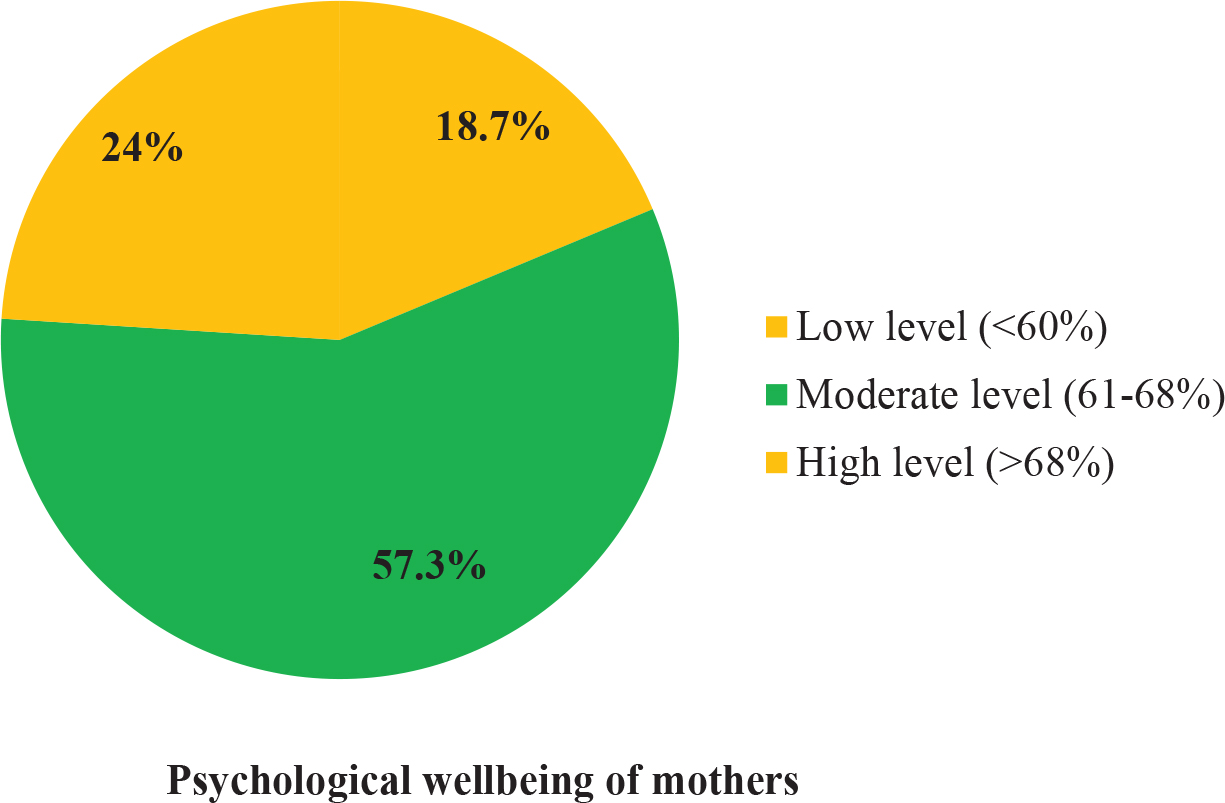
Figure 1.
Pie diagram showing levels of psychological well-being of mothers.
3.4. Relationship between the intergenerational ambivalence and psychological well-being of the mothers
To test the statistical significance, Spearman’s rho was computed and data did not follow normality. Findings are presented in Table 5.
Table 5.
Spearman rho computed between intergenerational ambivalence and the psychological well-being of the mother (n = 75).
| Variables | ρ | P |
|---|---|---|
| Intergenerational ambivalence of mothers psychological well-being of mothers | −0.035 | 0.08 |
The data presented in Table 5 show that there is a weak negative correlation which is not statistically significant (ρ = −0.035, P = 0.08), hence it is interpreted that the intergenerational ambivalence of the mothers and psychological well-being are independent of each other.
4. Discussion
The key findings of the present study show that both mothers and young adults have moderate levels of intergenerational ambivalence. The present finding was supported by the existing study conducted among 253 parent-young adult dyads to determine the direct and indirect measures of ambivalence. The existing study results showed that the mothers had a problem in maintaining continuity across the generations and that ambivalence may emerge if expectations for their young adults are not fulfilled and the results show a moderate level of ambivalence toward their young adults.15
The present study has shown a greater level of inter-generational ambivalence in the area of attitude toward mothers and young adults. This finding was supported by the study conducted in Australia among 93 mother–youth dyads, which showed a significant association between maternal emotional well-being and mother-young adult communication. The findings showed that maternal efficacy was positively related to more openness and satisfaction with mother-adolescent communication (β = 0.33, standard error [SE] = 0.14, F = 6.62). This implied that a highly competent mother was more likely to engage in open and satisfying communication with the young adult.16
In the present study, the mothers have moderate psychological well-being. The study result was supported by a previous study in which the authors explored whether understanding the effects of children’s problems on older parents’ well-being can be advanced by exploring differences in parent–child relationships within families. The study revealed strong and detrimental effects of any offspring’s problems on the mother’s well-being.17
The findings of the present study showed that as the intergenerational ambivalence increases the psychological well-being of mothers decreases. The existing study result also revealed that parents and young adults who showed poorer psychological well-being had greater ambivalence and poorer physical health. When grown children reported greater ambivalence, mothers reported poorer physical health. Results showed parents and young adults had experienced poorer health and well-being.9
4.1. Limitations
The study was conducted in a single setting, which may limit the generalizability of the findings.
An intergenerational ambivalence scale was developed by the researcher, many more areas of inter-generational ambivalence could have been included.
5. Conclusions
The parent–child conjunction tends to be marked by ambivalence, described as a concurrent feeling of both negative and positive qualities of the relationship. The present study concluded that a moderate level of intergenerational ambivalence exists between mothers and young adults. This ambivalence affects the psychological well-being of mothers. Future research can be done to assess the inter-generational ambivalence between both mother and father with their children in different age groups. A longitudinal study can be conducted to assess the relationship from adolescence to the young adulthood period. Furthermore, studies can be done on coping mechanisms to improve the psychological well-being of parents and children affected by intergenerational ambivalence.
Acknowledgment
The authors would like to acknowledge all the participants of the present study. The authors are also thankful to the Tahsildar and the president of selected Panchayats of Udupi Taluk for providing the administrative permission to conduct the study.
Notes
[3] Contributed by Authors contribution
SJQ: Conceptualization, methodology, formal analysis, investigation, data curation, writing-original draft, writing-review and editing.
TTJ: Conceptualization, methodology, validation, visualization, supervision.
SP: Conceptualization, methodology, validation, visualization, supervision.
KB: Writing-original draft, writing-review and editing, visualization.
[4] Ethical approval
Ethical clearance was obtained from the Institutional Ethics Committee with ethical number 888/2016.
[5] Conflicts of interest Conflicts of interest
All contributing authors declare no conflicts of interest.