

Life cycle assessment (LCA) is one of the frequently used tools for environmental impact assessment. It provides an analytical tool for evaluating a wide range of environmental aspects of the life cycle of a product or service (Hauschild et al., 2018). Although the idea of LCA dates back to the 1970s and was termed resource and environmental profile analysis (Klöpffer & Grahl, 2014), the LCA methodology saw great methodological development in the 1980s and 1990s, when many methodological procedures were developed and are still being developed today (Bjørn et al., 2018a). Like many other methodologies for environmental impact assessment, LCA has its shortcomings and limitations (Bjørn et al., 2018b). The complexity of environmental assessment using LCA is made possible by a number of simplifications and uncertainties (Hellweg et al., 2014). There is also a need to develop LCA based on current knowledge and technological progress (Karuppiah et al., 2023). The task of the LCA scientific community is to find ways to solve the outstanding problems of LCA (Reap et al., 2008). The Society of Environmental Toxicology and Chemistry (SETAC) has played a key role in the development and advancement of LCA through workshops, publications, and support for standardization (Fava et al., 2014). The three most active countries in LCA research are the USA, China, and Italy (Gaurav et al., 2021, 2023).
Four post-communist countries in Central Europe: Poland, Czechia, Hungary, and Slovakia, created an informal association called the Visegrad Group (Visegrad Four, V4) in 1991 with the aim of deepening mutual cooperation and harmonizing the development of these countries. The state of research and mutual cooperation of scientific teams dealing with LCA in the V4 has not yet been investigated. The purpose of this review is to map LCA research in the V4 using bibliometric methods. Bibliometrics is a research methodology that uses statistical methods to extract, aggregate, and analyze quantitative aspects of bibliographic information (Moed, 2005). Bibliometric analysis uses methods such as statistical analysis, citation analysis, and bibliometric mapping for a description of the intellectual structure in individual fields of study by analyzing the social and structural relationships between authors, countries, institutions, topics, etc. (Donthu et al., 2021). Therefore, this methodology was selected for mapping of LCA research in the V4.
For the purpose of mapping LCA research in the V4, the study seeks to answer the following research questions:
- –
RQ1 – What literature is relevant to LCA research in the V4 countries in terms of major publications and key authors?
- –
RQ2 – What specific areas of research are related to LCA in the V4 countries?
- –
RQ3 – How do the V4 countries cooperate in LCA research with each other and with other countries?
- –
RQ4 – What is the development of the production of scientific literature on LCA in the V4 countries?
The Scopus database was used for bibliometric data collection, which is a source-neutral abstract and citation database indexing peer-reviewed scientific works such as articles, contributions at conferences, or books. Scopus was chosen because it covers more journals published in Europe than the Web of Science database (Asubiaro et al., 2024) and ensures high accuracy of metadata records (Baas et al., 2020). Moutik et al. (2023) showed that Scopus indexes more articles focusing on LCA than Web of Science. Also, unlike new databases such as Dimension.AI, Crossref, or Lens.org, which rely primarily on Crossref data, i.e., on articles with an assigned DOI, Scopus is not limited to scientific articles with a DOI, but indexes all articles in selected journals.
Previous bibliometric analyses focused on LCA were analyzed to determine suitable search terms. Especially in the last few years, a large number of such studies focusing on individual countries have been published such as Brazil (Bodunrin et al., 2018), China (Nie, 2013), South Korea (Odey et al., 2021), Mexico (Güereca et al., 2015), New Zealand (Engelbrecht et al., 2018), Portugal (Burman et al., 2018), Sweden (Croft et al., 2019), groups of countries (Maepa et al., 2017) or parts of/entire continents such as Africa (Brent et al., 2002; Harding et al., 2021; Isah et al., 2024) or globally (Hou et al., 2015; He & Yu, 2020; Gaurav et al., 2021, 2023). On the other hand, other studies focus on particular areas such as construction (Yılmaz & Seyis, 2021; Aparna & Baskar, 2024), agriculture, and the food industry (Koblianska et al., 2024; Matos et al., 2024; Villagrán et al., 2024). Another area is the application of LCA to natural resources, such as bibliometric analysis of LCA studies evaluating groundwater (Carrión-Mero et al., 2022; Herrera-Franco et al., 2022). Dunmade (2019) analyzed a review of LCA teaching in Nigeria using bibliometric approaches. Other studies are focused on subfields of LCA, such as life cycle cost analysis (Martinho, 2023) or social life cycle assessment (Ghosh, 2023).
Based on the keywords used in previously published bibliometric studies of LCA, a list of keywords and their variants describing the field of LCA was created and used in this study. The following query was used to search for publications by authors from the V4 countries:
TITLE-ABS-KEY (“life cycle assessment” OR “life-cycle assessment” OR “lifecycle assessment” OR “environmental LCA” OR “social LCA” OR “life cycle sustainability assessment” OR “lifecycle sustainability assessment” OR “life-cycle sustainability assessment” OR “economic LCA” OR “conceptual LCA” OR “life cycle management” OR “life-cycle management” OR “lifecycle management” OR “life cycle cost*” OR “life-cycle cost*” OR “lifecycle cost*” OR “life cycle impact” OR “life-cycle impact” OR “lifecycle impact”) AND (AFFILCOUNTRY (Czech OR Slovakia OR Hungary OR Poland)) AND PUBYEAR < 2024
Data collection was performed on 2 July 2024, and data was exported in CSV format. Due to the date of data collection and the limitation to the year 2023 and older (including information on the number of citations), it is unlikely that there will be a significant expansion of the indexed works or the number of citations during this period. Of course, this can happen due to additional inclusion of conference proceedings or corrections to import mechanisms, when some works are omitted. Diacritics were removed as part of pre-processing, as names with diacritics are not always listed correctly in the Scopus database.
Every scientific article includes some kind of literature review, which demonstrates that the author has placed their study in the context of current knowledge. However, the usual descriptive (narrative) literature reviews can be biased by the researcher’s criteria, which threatens scientific objectivity (Tranfield et al., 2003). Therefore, several robust methods have been developed in recent years to eliminate possible biases in literature reviews. To obtain the latest picture of the development of the scientific field and the current state of knowledge, bibliometrics, systematic reviews, and meta-analyses were used. All three methods use statistical analysis of large amounts of data. Bibliometrics focuses on the analysis of descriptive information of scientific publications (keywords, data on authors, etc.) and is therefore suitable for analyses of large sets of publications ranging from hundreds to thousands of publications (Donthu et al., 2021). Bibliometric methods introduce objectivity into the evaluation of scientific literature and have the potential to increase rigor and mitigate researcher bias in scientific literature searches (Zupic & Čater, 2015). Similarly, systematic reviews and meta-analyses make it possible to bring new knowledge about the development in a specific scientific field in a methodologically robust and verifiable way. However, these methods are based on examining the content of published studies (Hodgkinson & Ford, 2014). Meta-analyses are more narrowly focused than systematic reviews. Meta-analysis aims to analyze the variability of the value of some quantity in the examined set of documents. These three methods are often combined depending on the goals of the analysis. Based on the size of the obtained data set and the set of research questions, bibliometrics was chosen as the main research method.
In order to find answers to the research questions, several types of bibliometric data analysis were performed using different tools. Using the Scopus web interface, basic analyses of the number and types of publications, number of citations, number of authors, and cooperation between countries were performed. These analyses were performed by enlarging or narrowing the basic query, and the data was transferred to a spreadsheet to generate graphs and tables. Bibliometric network analysis was used to express links between publications. Links between countries and between keywords were analyzed to answer the research questions. The bibliometric software VOSviewer (van Eck & Waltman, 2010) version 1.6.20, which uses a mapping technique called similarity visualization (van Eck & Waltman, 2007), was used to analyze the bibliometric networks. In the case of countries, a co-authorship analysis was used. Researchers, research institutions, or countries are linked in co-authorship networks based on the number of publications they have co-authored. In the case of keywords, co-occurrence analysis was used. Keyword co-occurrence networks were limited to keywords that achieved at least 10 co-occurrences. The number of co-occurrences of two keywords is the number of publications in which both appear together in the title, abstract, or keywords (van Eck & Waltman, 2014). Weights by number were not considered either for countries or for keywords.
A total of 1,665 records meeting the criteria listed in the data collection were searched. The dominant type of output is the research article (n = 961), followed by contributions in proceedings (n = 549) and review articles (n = 82). The chapters in a book also reach a significant number (n = 53). A total of nine books on LCA were published by authors from V4 countries. Minority outputs were letters to editors (n = 4), editorials (n = 4), notes (n = 2), and errata (n = 1). Figure 1 shows the share of individual types of publications. Figure 2 shows the development in the number of publications and citations. Before 2005, publications on LCA written by authors from V4 countries were rather rare. After 2005, there is a clear trend of an increasing number of these publications. It can be assumed that the increase in the number of articles is associated with the standardization of the entire methodology in the ISO 14000 series of standards (International Organization for Standardization [ISO], 2015), and the resolution of a number of methodological shortcomings, which culminated in 2006 with the adoption of a number of revised ISO standards (Pryshlakivsky & Searcy, 2013). The increasing impact of LCA research in the V4 countries is evidenced not only by the number of publications but also by the number of citations, which is growing every year (Fig. 2 – grey dashed line), even though recent publications have not yet had enough time to gain many citations.
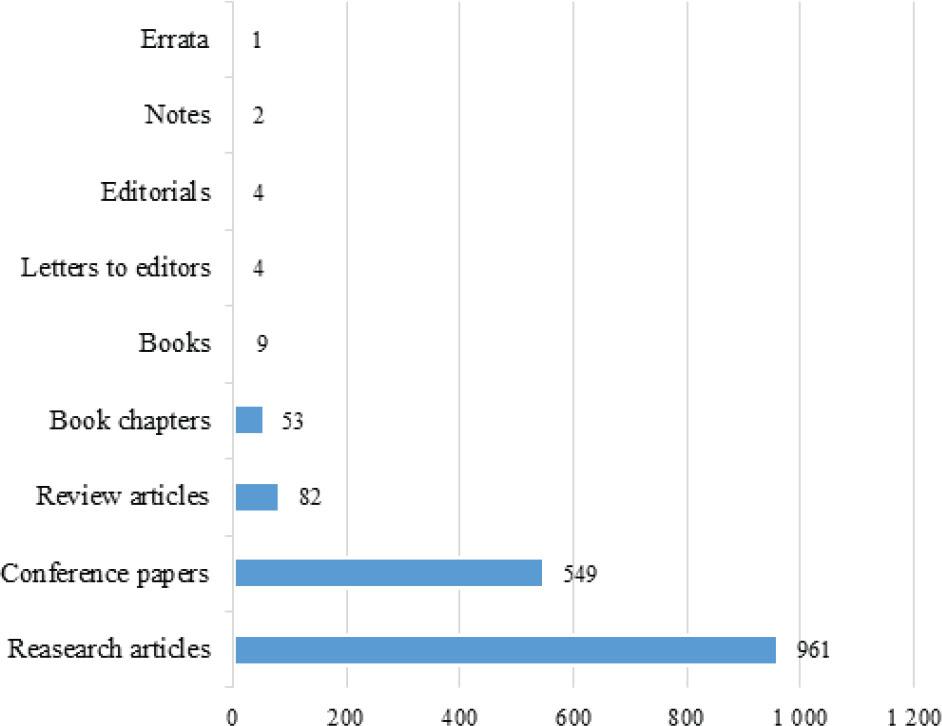
Structure of publications on LCA written by authors from V4 countries
Source: own work based on Scopus data.
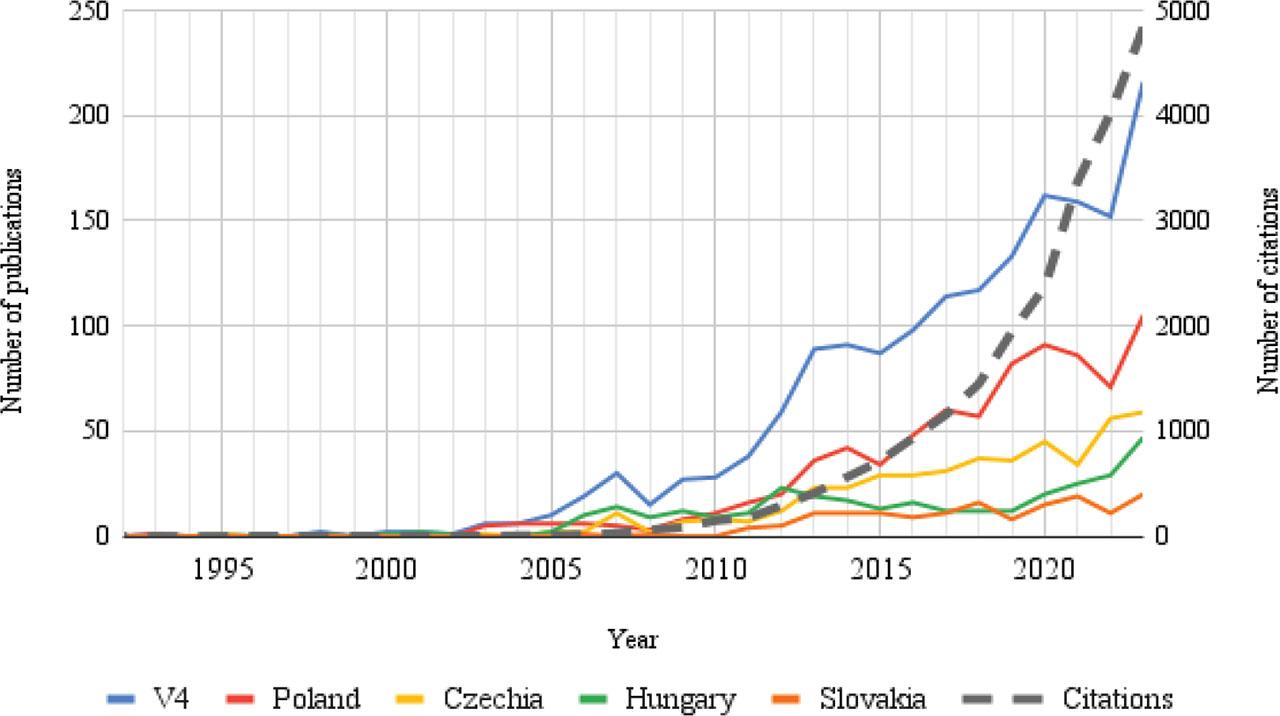
Number of publications on LCA written by authors from V4 countries over time
Source: own work based on Scopus data.
In total, publications written by authors from V4 countries received 22,613 citations. Authors from Poland participated in the most publications; they authored a total of 801 publications, and these publications received 11,573 citations. Czech authors participated in 455 publications that received 5,317 citations, Hungarian authors participated in 317 publications that received 5,401, and Slovak authors participated in 153 publications that received 1,187 citations.
Even in the case of authors from V4 countries, it is evident that the dominant language of contemporary science is English, of which 97.7% of all publications were published (Table 1). The reason why the sum of publications in individual languages is higher than the searched 1,665 publications is that Scopus registers 11 publications in two languages.
Number of publications by language used
| Language | Number of publications | Share of the total number of publications [%] |
|---|---|---|
| English | 1,626 | 97.66 |
| Polish | 37 | 2.22 |
| Czech | 7 | 0.42 |
| German | 2 | 0.12 |
| Serbian | 1 | 0.06 |
| Lithuanian | 1 | 0.06 |
| Hungarian | 1 | 0.06 |
| Chinese | 1 | 0.06 |
Source: own work.
Based on the number of publications, the 10 most active authors in each V4 country were selected. Based on the number of citations, the higher the number of citations, the better the ranking will be given to authors with the same number of publications. The list of the 10 most productive authors is shown in Table 2. A specific situation occurs with Jiří J. Klemeš, who has 35 publications with 2,115 citations and is thus the most cited author. However, he spent his career both at universities in Hungary and at the Brno University of Technology in Czechia. Therefore, the affiliations of his publications were individually analyzed in order to correctly assign them to individual countries.
A list of the 10 most active authors from each V4 country
| Poland | Number of publications | Number of citations | Czechia Number of publications | Number of citations | Poland |
|---|---|---|---|---|---|
| D. Burchart-Korol | 38 | 929 | V. Kočí | 35 | 419 |
| J. Kulczycka | 28 | 110 | J.J. Klemeš | 21 | 528 |
| A. Lewandowska | 25 | 646 | A. Lupíšek | 18 | 125 |
| K. Grzesik, | 21 | 55 | J. Furch | 17 | 66 |
| J. Adamczyk | 19 | 401 | P. Hájek | 16 | 239 |
| B. Bieda | 18 | 157 | K. Struhala | 16 | 127 |
| A. Tomporowski | 17 | 261 | D. Vališ | 12 | 134 |
| A. Żelazna | 16 | 50 | R. Černý | 10 | 328 |
| R. Dylewski | 15 | 232 | J. Fořt | 10 | 282 |
| K. Pikoń | 15 | 167 | B. Teplý | 9 | 91 |
| Hungary | Number of publications | Number of citations | Slovakia | Number of publications | Number of citations |
| L. Horváth | 77 | 465 | S. Vilčeková | 20 | 90 |
| I.J. Rudas | 71 | 352 | A. Eštoková | 16 | 85 |
| Z. Szalay | 15 | 146 | E.K. Burdová | 12 | 31 |
| J.J. Klemeš | 14 | 1,587 | J. Štefko | 11 | 51 |
| V. Mannheim | 13 | 112 | J. Mitterpach | 10 | 86 |
| A.J. Toth | 13 | 212 | M. Ondová | 10 | 52 |
| B. Kiss | 12 | 198 | M. Potkány | 8 | 83 |
| P. Mizsey | 12 | 275 | A. Sedláková | 7 | 44 |
| G.L. Kovács | 10 | 54 | R. Vaňová | 7 | 30 |
| D. Fozer | 9 | 247 | M. Debnár | 5 | 76 |
Source: own work.
LCA researchers in the V4 countries collaborate with scientists from around the world, as illustrated in Figure 3. However, cooperation within the V4 countries represents only a small part of international cooperation.
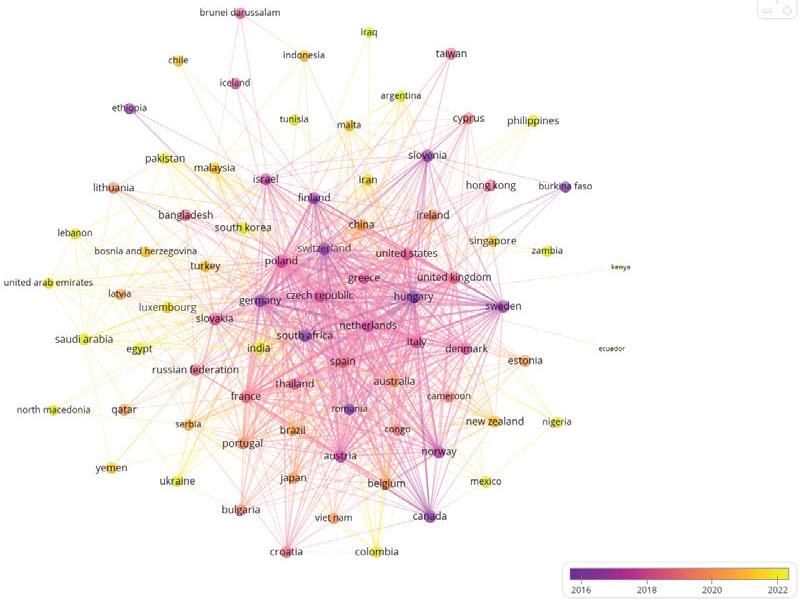
Cooperation networks between V4 countries based on co-authorship of published articles
Source: own work based on Scopus data.
Table 3 shows that the share of cooperation within the V4 is the highest in the case of Slovak authors and the lowest in the case of Polish authors. There is no publication that is authored by authors from all four V4 countries, and only one publication (Ključnikov et al. 2023) was authored by authors from three V4 countries.
Share of co-authorship within V4 countries
| Country | Total number of publications | Number of publications with co-authors from | Share of co-authors from the V4 [%] | ||||
|---|---|---|---|---|---|---|---|
| Poland | Czechia | Hungary | Slovakia | V4 | |||
| Poland | 801 | – | 22 | 9 | 10 | 40 | 5.0 |
| Czechia | 455 | 22 | – | 6 | 13 | 40 | 8.8 |
| Hungary | 317 | 9 | 6 | – | 2 | 17 | 5.4 |
| Slovakia | 153 | 10 | 13 | 2 | – | 24 | 15.7 |
Source: own work.
Table 4 shows the five countries for each V4 country with which they most often publish LCA research. Authors from the V4 cooperate with authors from 75 other countries. Excluding other V4 countries, Polish authors cooperate with authors from 68 countries, Czech authors cooperate with authors from 52 countries, Hungarian authors cooperate with authors from 49 countries, and Slovak authors cooperate with authors from 30 countries.
Top five partner countries for publishing research on LCA
| Poland | Czechia | Hungary | Slovakia |
|---|---|---|---|
| Germany (40) | USA (23) | Austria (22) | Czechia (13) |
| Italy (39) | Poland (22) | Italy (16) | Poland (10) |
| Spain (26) | Germany (22) | Spain (14) | Spain (6) |
| USA (25) | China (18) | USA (14) | Germany (5) |
| UK (25) | Italy (16) | Germany (13) | the Netherlands (4) |
Source: own work.
Conversely, the number of articles that were not created in collaboration with partners from other countries is shown in Table 5, which proves that the involvement of scientists from V4 countries in international research groups is still very limited. If authors from the V4 cooperate internationally, then they cooperate with authors mainly from other European countries, as well as the USA or China. Cooperation with researchers from Australia or South America is very rare.
Publications written only by authors from a particular V4 country
| Country | Total number of publications | Number of publications written by authors only from the given country | Share of publications written by authors only from the given country [%] |
|---|---|---|---|
| Poland | 801 | 565 | 70.5 |
| Czechia | 455 | 289 | 63.5 |
| Hungary | 317 | 193 | 60.9 |
| Slovakia | 153 | 111 | 72.5 |
Source: own work.
Another perspective provides cooperation on the author level. Figure 4 shows cooperation between authors with 10 or more papers. The figure shows that the cooperation between the most active authors is very limited.

Cooperation networks between authors with 10 or more published articles from V4 countries based on co-authorship
Source: own work based on Scopus data.
Authors create clearly defined author collectives that are not interconnected through joint articles. In particular, there is practically no international cooperation within the V4 among the most active authors.
Journals in which authors from the V4 countries most often publish research in the field of LCA were analyzed. Table 6 lists the journals in which ten or more articles were published. These journals published one-third of the total number of publications on LCA research in the V4 countries. The most often used is the journal Energies from the publishing house MDPI, which is mainly used by authors from Poland. Even in the field of LCA, the fact that the publishing house MDPI is very popular among Central European scientists (despite certain controversies) has been confirmed (Sasvari & Urbanovics, 2023). This is evidenced by the placement of several journals of the MDPI publishing house (Energies, Sustainability, Materials, Applied Science, Buildings) in Table 6. In second place is the Journal of Cleaner Production, which is the second most frequently used journal, even among authors from around the world (Gaurav et al., 2021).
Journals in which authors from V4 publish research on LCA
| Journal | Number of | Number of articles from | ||||
|---|---|---|---|---|---|---|
| articles | citations | Poland | Czechia | Hungary | Slovakia | |
| Energies | 91 | 811 | 77 | 9 | 9 | 4 |
| Journal of Cleaner Production | 83 | 4,357 | 49 | 25 | 13 | 2 |
| Sustainability | 77 | 956 | 34 | 26 | 10 | 9 |
| International Journal of Life Cycle Assessment | 45 | 975 | 35 | 7 | 5 | 0 |
| International Multidisciplinary Scientific Geoconference Surveying Geology and Mining Ecology Management SGEM | 33 | 64 | 17 | 6 | 0 | 11 |
| IOP Conference Series Materials Science and Engineering | 23 | 100 | 12 | 10 | 0 | 2 |
| Science of the Total Environment | 22 | 701 | 15 | 8 | 1 | 0 |
| IOP Conference Series Earth and Environmental Science | 18 | 43 | 4 | 11 | 0 | 1 |
| E3S Web of Conferences | 18 | 91 | 17 | 0 | 0 | 1 |
| Procedia Engineering | 17 | 318 | 5 | 10 | 0 | 1 |
| Chemical Engineering Transactions | 17 | 107 | 9 | 5 | 0 | 1 |
| Energy | 16 | 914 | 10 | 3 | 3 | 0 |
| Przemysł Chemiczny | 14 | 32 | 14 | 0 | 0 | 0 |
| Materials | 14 | 245 | 12 | 1 | 0 | 1 |
| Applied Sciences | 14 | 152 | 8 | 3 | 1 | 3 |
| CESB 2016 – Central Europe Towards Sustainable Building 2016: Innovations for Sustainable Future | 13 | 19 | 0 | 12 | 0 | 1 |
| Renewable and Sustainable Energy Reviews | 12 | 401 | 5 | 7 | 0 | 0 |
| Transport Means Proceedings of the International Conference | 11 | 20 | 1 | 9 | 0 | 1 |
| Buildings | 11 | 85 | 5 | 6 | 0 | 0 |
| Advanced Materials Research | 11 | 40 | 2 | 4 | 2 | 3 |
| MATEC Web of Conferences | 10 | 44 | 6 | 3 | 0 | 1 |
| Journal of Environmental Management | 10 | 180 | 6 | 2 | 2 | 0 |
Source: own work.
It is worth mentioning that of the ten most frequently used journals, five are conference proceedings journals (International Multidisciplinary Scientific Geoconference Surveying Geology and Mining Ecology Management SGEM, IOP Conference Series Materials Science and Engineering, IOP Conference Series Earth and Environmental Science, E3S Web of Conferences, Procedia Engineering). The other five journals in the top 10 are highly visible journals that are in the first or second quartiles, according to SJR. On the one hand, this is an example of the fact that authors from the V4 prefer high-quality journals. On the other hand, it should also be noted that with the exception of the International Journal of Life Cycle Assessment, the other four journals (Energies, Journal of Cleaner Production, Sustainability, Science of the Total Environment) are examples of mega-journals that publish tens of thousands of articles per year.
Table 7 shows the 20 articles with the highest number of citations. The most cited articles are in the fields of energy, engineering, and environmental science.
The most cited publications – top 20 (only citations before 2024 are included)
| Authors | Title | Year | Source | DOI | Number of citations |
|---|---|---|---|---|---|
| Čuček et al. | A review of footprint analysis tools for monitoring impacts on sustainability | 2012 | Journal of Cleaner Production | 10.1016/j.jclepro.2012.02.036 | 692 |
| Kacprzak et al. | Sewage sludge disposal strategies for sustainable development | 2017 | Environmental Research | 10.1016/j.envres.2017.03.010 | 516 |
| Kargarzadeh et al. | Advances in cellulose nanomaterials | 2018 | Cellulose | 10.1007/s10570-018-1723-5 | 329 |
| De Benedetto & Klemeš | The Environmental Performance Strategy Map: an integrated LCA approach to support the strategic decision-making process | 2009 | Journal of Cleaner Production | 10.1016/j.jclepro.2009.02.012 | 299 |
| Mikulčić et al. | Reducing greenhouse gasses emissions by fostering the deployment of alternative raw materials and energy sources in the cleaner cement manufacturing process | 2016 | Journal of Cleaner Production | 10.1016/j.jclepro.2016.04.145 | 241 |
| Boyano et al. | Exergoenvironmental analysis of a steam methane reforming process for hydrogen production | 2011 | Energy | 10.1016/j.energy.2010.05.020 | 236 |
| Ürge-Vorsatz et al. | Mitigating CO2 emissions from energy use in the world’s buildings | 2007 | Building Research and Information | 10.1080/09613210701325883 | 203 |
| Burchart-Korol | Life cycle assessment of steel production in Poland: A case study | 2013 | Journal of Cleaner Production | 10.1016/j.jclepro.2013.04.031 | 202 |
| Den et al. | Lignocellulosic biomass transformations via greener oxidative pretreatment processes: access to energy and value-added chemicals | 2018 | Frontiers in Chemistry | 10.3389/fchem.2018.00141 | 198 |
| Mayer et al. | Environmental and economic multi-objective optimization of a household level hybrid renewable energy system by genetic algorithm | 2020 | Applied Energy | 10.1016/j.apenergy.2020.115058 | 194 |
| Čuček et al. | Total footprints-based multi-criteria optimisation of regional biomass energy supply chains | 2012 | Energy | 10.1016/j.energy.2012.01.040 | 191 |
| Weinzettel et al. | Life cycle assessment of a floating offshore wind turbine | 2009 | Renewable Energy | 10.1016/j.renene.2008.04.004 | 180 |
| Frenger et al. | Reducing energy consumption in LTE with cell DTX | 2011 | IEEE Vehicular Technology Conference | 10.1109/VETECS.2011.5956235 | 179 |
| Weißbach et al. | Energy intensities, EROIs (energy returned on invested), and energy payback times of electricity generating power plants | 2013 | Energy | 10.1016/j.energy.2013.01.029 | 173 |
| Jędrzejczak et al. | The role of lignin and lignin-based materials in sustainable construction – A comprehensive review | 2021 | International Journal of Biological Macromolecules | 10.1016/j.ijbiomac.2021.07.125 | 172 |
| Mia et al. | Multi-objective optimization and life cycle assessment of eco-friendly cryogenic N2 assisted turning of Ti-6Al-4V | 2019 | Journal of Cleaner Production | 10.1016/j.jclepro.2018.10.334 | 165 |
| Pfister et al. | Understanding the LCA and ISO water footprint: A response to Hoekstra (2016) “A critique on the water-scarcity weighted water footprint in LCA” | 2017 | Ecological Indicators | 10.1016/j.ecolind.2016.07.051 | 155 |
| Puppán | Environmental evaluation of biofuels | 2002 | Periodica Polytechnica Social and Management Sciences | – | 124 |
| Sun et al. | Uncovering energy use, carbon emissions and environmental burdens of pulp and paper industry: A systematic review and meta-analysis | 2018 | Renewable and Sustainable Energy Reviews | 10.1016/j.rser.2018.04.036 | 121 |
| Bong et al. | A review on the global warming potential of cleaner composting and mitigation strategies | 2017 | Journal of Cleaner Production | 10.1016/j.jclepro.2016.07.066 | 119 |
Source: own work.
The most cited publication (Čuček et al., 2012) is the study of authors from Hungary and Slovenia. This publication is an overview or narrative review of footprints, which are defined footprint-based indicators that can be used to measure sustainability. The publication also assesses composite footprints, which combine two or more individual footprints, and create multi-objective optimization problems. Currently, the researchers combine individual footprints into the environmental footprint family.
Polish authors co-authored the second and the third most-cited publications. The second most cited article (Kacprzak et al., 2017) is again a narrative review that compares existing sewage sludge management solutions for environmental sustainability, focusing on treatment and disposal strategies within current European and national legislation. It discusses using decision-making tools like end-of-waste criteria and LCA to evaluate environmental, economic, and technical aspects of different systems. The third most cited publication (Kargarzadeh et al., 2018) is also a narrative review that presents the recent advances made in the production of cellulose nanofibrils and cellulose nanocrystals, including conventional mechanical and chemical treatments, as well as other promising techniques and pretreatment processes aimed at designing an economically efficient and eco-friendly production route for nanocellulose. These most cited articles thus confirm the conclusions of some studies (e.g., Montori et al., 2003; Cronin et al., 2008), showing that review articles have a greater social impact than original research articles.
Czech authors contributed up to the ninth most cited publication. Slovak authors did not participate in the most cited publications.
The Scopus database ranks individual indexed contributions into subject areas. LCA is an interdisciplinary research field; therefore, the division into subject areas makes it easier to identify the area on which LCA research focuses. The dominant subject areas are technical fields, and the most widespread in all V4 countries is engineering. This makes the V4 countries slightly different from the rest of the world, where environmental sciences are the most widespread and engineering the second (Gaurav et al., 2021). Environmental sciences are the second most common field of researchers involved in LCA in Poland, Czechia, and Slovakia. On the other hand, in Hungary, environmental sciences are in third place and the second most widespread field is computer science. In Poland and Czechia, energy is in third place, while in Slovakia it is the field of social sciences. Table 8 lists the top ten subject areas in which V4 scientists working on LCA are active.
Subject areas in which authors from V4 countries publish articles on LCA
| Subject area | V4 | Share [%] | Poland | Czechia | Hungary | Slovakia |
|---|---|---|---|---|---|---|
| Engineering | 804 | 48 | 367 | 251 | 147 | 72 |
| Environmental Science | 582 | 35 | 337 | 149 | 75 | 43 |
| Energy | 424 | 25 | 267 | 96 | 58 | 23 |
| Computer Science | 265 | 16 | 80 | 50 | 117 | 22 |
| Material Sciences | 194 | 12 | 99 | 58 | 23 | 20 |
| Social Science | 181 | 11 | 69 | 63 | 32 | 28 |
| Mathematics | 169 | 10 | 98 | 23 | 42 | 16 |
| Business, Management and Accounting | 154 | 9 | 86 | 43 | 22 | 12 |
| Chemical Engineering | 127 | 8 | 62 | 25 | 33 | 13 |
| Earth and Planetary Sciences | 104 | 6 | 57 | 27 | 8 | 18 |
Source: own work.
The same analysis was done for 20 highly cited papers listed in Table 7. A total number of 13 papers were involved in the subject of engineering. The same number of papers were involved in the subject area of energy. The subject area of environmental science contains 12 papers. That’s a similar situation to the group of all articles on LCA published by authors from the V4. Only two other subject areas (business, management and accounting) have more than two papers, with seven papers, and mathematics with four papers.
Most frequently used keywords
| Keyword | Number of occurrences |
|---|---|
| life cycle assessment | 412 |
| lca | 147 |
| life cycle assessment (lca) | 94 |
| environmental impact | 84 |
| sustainability | 65 |
| life cycle cost | 49 |
| circular economy | 46 |
| product lifecycle management | 38 |
| carbon footprint | 37 |
| recycling | 35 |
| sustainable development | 34 |
| environmental impacts | 33 |
| life-cycle assessment | 28 |
| climate change | 26 |
| poland | 25 |
| environment | 24 |
| global warming potential | 20 |
| life cycle | 20 |
| optimization | 19 |
| waste management | 19 |
| building | 18 |
| biomass | 17 |
| lcc | 17 |
| construction | 16 |
| energy | 16 |
| energy efficiency | 16 |
| life cycle costing | 16 |
| life cycle costs | 16 |
| product modelling | 16 |
| reliability | 16 |
| eco-efficiency | 15 |
| energy consumption | 15 |
| environmental assessment | 15 |
| buildings | 14 |
| greenhouse gases | 14 |
| biogas | 12 |
| design | 12 |
| concrete | 11 |
| efficiency | 11 |
| biofuels | 10 |
| environmental aspects | 10 |
| life cycle cost analysis | 10 |
| life cycle inventory (lci) | 10 |
| product lifecycle management (plm) | 10 |
| renewable energy sources | 10 |
Source: own work.
Keywords often reflect the aim and focus of the study. The authors used a total of 3,977 keywords. Figure 5 shows the links between 45 keywords that were used at least 10 times in the analyzed articles (Table 9). The diameter of the circle represents the occurrence of the keyword – the larger the circle is, the more often the keyword occurs. Co-occurrence relationships of two keywords are shown by a line connecting two circles. Circle colors indicate distinct clusters, and cluster structure is determined by the interaction between keywords, culminating in clusters of highly connected keywords. As can be seen, the keyword “life cycle assessment” is surrounded by many other keywords. Some of these keywords are similar; for example, for one term such as life cycle assessment, authors use other different notation variants such as LCA, life-cycle assessment, etc. Figures 6 and 7 show links between keywords that were used at least ten times in articles by Polish (Fig. 6) and Czech (Fig. 7) authors. Figures for Hungarian and Slovak authors are not presented because Hungarian authors met the limit of ten uses of only five keywords (life cycle assessment – 66×; product lifecycle management – 29×; LCA – 16×; product modeling – 16×; sustainability – 14×) and Slovak authors only four keywords (life cycle assessment – 41×; LCA – 24×; environmental impact – 16×; sustainability – 10×).

Co-occurrence analysis of LCA publication keywords published by V4 authors (keywords used at least 10 times are included)
Source: own work based on Scopus data.
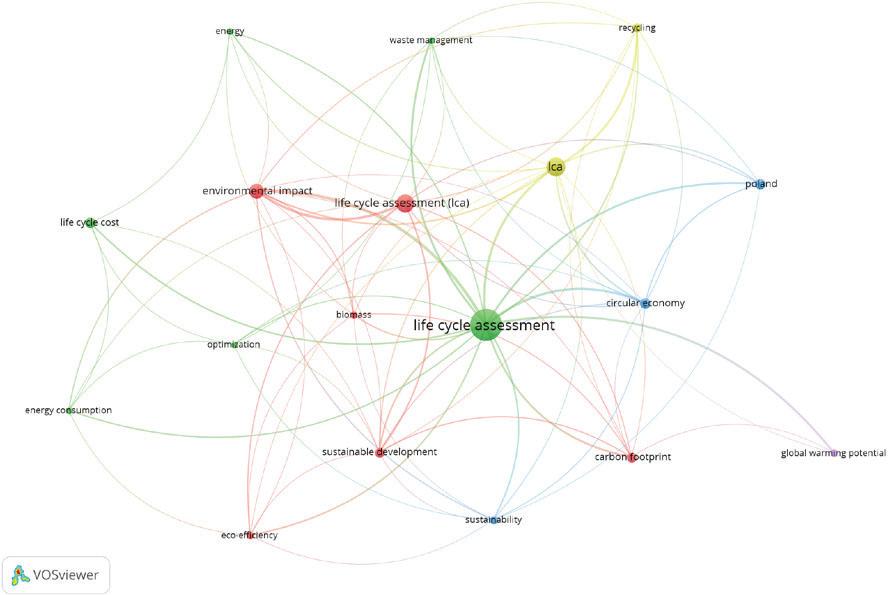
Co-occurrence analysis of LCA publication keywords published by authors from Poland (keywords used at least 10 times are included)
Source: own work based on Scopus data.
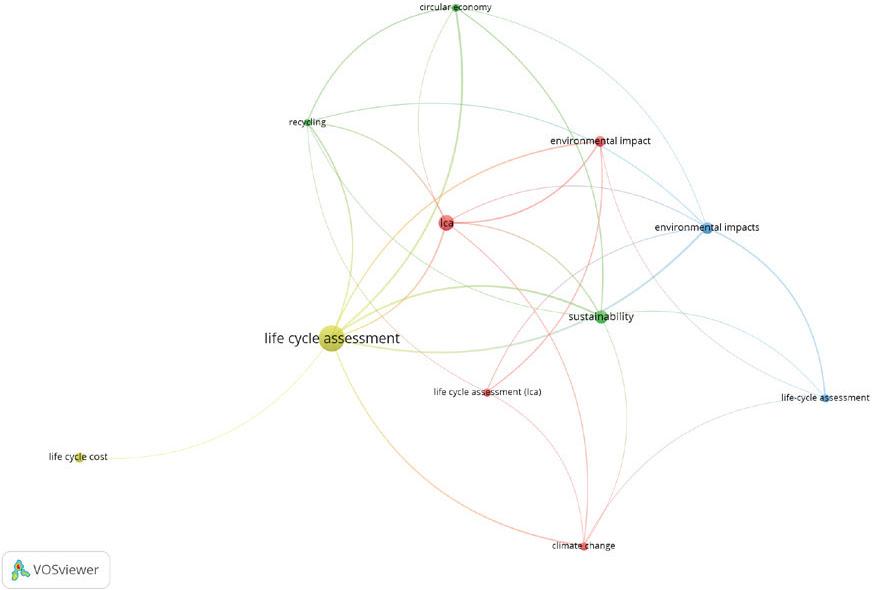
Co-occurrence analysis of LCA publication keywords published by authors from Czechia (keywords used at least 10 times are included)
Source: own work based on Scopus data.
Figure 5 shows several automatically generated clusters based on the co-occurrence of keywords according to the VOS methodology (van Eck & Waltman, 2007). The first cluster (red) focuses on the LCA of buildings and its impact on global warming. The second cluster (green) focuses on the impact of energy consumption and the improvement of energy efficiency. The third cluster (blue) focuses on the sustainability of biogas and biofuels. These three clusters are the largest, and each contains at least 10 keywords. However, most keywords are interconnected with keywords in other clusters, so the above interpretation of the focus of individual clusters should be considered significantly simplistic. The fourth cluster (yellow) focuses on the circular economy, renewable energy resources, and sustainability of buildings and constructions. The fifth cluster (purple) is not sector-specific, but deals with LCA in Poland. If the first five clusters can be said to be closely interconnected, then the last two clusters (light blue and orange) are relatively independent and deal with product life cycle management.
Figure 6 shows generated clusters for publication authored by authors from Poland. The main topics for authors from Poland are sustainability, eco-efficiency, and improving energy consumption and its impact on carbon footprint and global warming. The next topics are circular economy, recycling, waste management, and sustainable use of biomass.
Figure 7 shows generated clusters for publication authored by authors from Czechia. The topics of circular economy, recycling, and climate change are similar to those in Poland. On the other hand, there are far fewer keywords meeting the selection criteria, which may be due to the significantly smaller number of publications in which Czech authors participated.
Most publications do not have the research support stated. The most important support providers are the European Union and its programs, such as Horizon. The most important supporters with 20 or more supported publications include agencies and ministries from all V4 countries (Table 10).
Most important funding agencies
| Funding agency | State | Number of publications |
|---|---|---|
| European Commission | EU | 132 |
| Horizon 2020 Framework Programme | EU | 59 |
| Narodowe Centrum Badań i Rozwoju (National Center for Research and Development) | Poland | 43 |
| Ministerstvo Školství, Mládeže a Tělovýchovy (Ministry of Education, Youth and Physical Education) | Czechia | 36 |
| European Regional Development Fund | EU | 35 |
| Ministerstwo Edukacji i Nauki (Ministry of Education and Science) | Poland | 33 |
| Grantová Agentura České Republiky (Technology Agency of the Czech Republic) | Czechia | 33 |
| Vedecká Grantová Agentúra MŠVVaŠ SR a SAV (Scientific Grant Agency of the Ministry of Education, Science and Research of the Slovak Republic and the Slovak Academy of Sciences) | Slovakia | 28 |
| Nemzeti Kutatási, Fejlesztési és Innovaciós Alap (National Research, Development and Innovation Fund) | Hungary | 22 |
| Technologická Agentur České Republiky (Technology Agency of the Czech Republic) | Czechia | 21 |
| Seventh Framework Programme | EU | 21 |
| UK Research and Innovation | UK | 20 |
Source: own work.
This study has several limitations. First, the study was limited to Scopus data, so publications that are not indexed in this database but in other ones (such as Web of Science) are not included. As an example, an article by the author of this paper (Ansorge & Beránková, 2017) was published in the European Journal of Sustainable Development and is not indexed in Scopus. Authors from V4 countries will most probably also publish part of their research in national journals that are not indexed in prestigious international databases. An example is the articles by Vladimír Kočí (Kočí et al. 2019; Kráľová et al., 2020), who is the most active Czech author.
The second limitation results from the choice of search query. LCA is currently a highly widespread methodology, so many authors use only the abbreviation “LCA” as a keyword. Another article by Vladimír Kočí can be mentioned as an example (Pavlů et al., 2019). The point is that the abbreviation LCA is not only used for “life cycle assessment”, but also in medicine (LCA = lithocholic acid), mathematics (LCA group = locally compact Abelian group), statistics (LCA = latent class analysis), etc. The Scopus database indexes 472 publications with “LCA” in the keywords, title, or abstract, which were written by authors from V4 countries and do not meet the criteria of the search query used. A portion of these publications will probably also be focused on life cycle assessment.
The last limitation may result from the fact that many authors may not use some form of LCA notation in the title, keywords, or abstract, but their research may still relate to LCA or use LCA techniques. It may be cases where the authors used more general terms such as “life cycle analysis”, “life cycle”, and “life cycle thinking” or studies that consider individual impact indicators, such as water footprint, for example, the article by Jiří J. Klemeš (Jia et al., 2019).
LCA is a widespread tool for environmental impact assessment and one of the main tools to promote steps leading to the achievement of sustainable development. Research in this area is worldwide, and the V4 countries are no exception. Researchers from Poland are the most active, followed by researchers from Czechia and Hungary, and the least extensive LCA research is in Slovakia. The most active researchers are László Horváth and Imre J. Rudas from Hungary, whose more than 70 publications significantly exceed the number of publications of other V4 researchers. Dorota Burchart-Korol from Poland has 38 publications, and Jiří J. Klemeš and Vladimír Kočí from Czechia have 35 publications. The most active Slovak researcher is Silvia Vilčeková, with 20 publications. Three researchers from Poland have more than 20 publications.
The most cited publications in the field of LCA are those of Jiří J. Klemeš, who worked in Hungary and subsequently in Czechia. However, such international connectivity is rather an exception, as cooperation in LCA research within the V4 countries is not high (expressed by co-authorships). Only for Slovak researchers are the main collaborators researchers from Czechia and Poland. At the same time, international cooperation within the LCA topic is widespread and includes countries from all continents, except Antarctica.
The most widespread subject area in which LCA research is conducted is engineering, followed by environmental sciences. In Hungary, second place belongs to computer science, although the importance of computer science in Hungary is not reflected in keywords. The main areas that (according to keywords) are connected with LCA are mainly the impact on the environment, sustainability, circular economy, and sustainable development.
Due to its popularity among Polish authors, Energies is the most significant journal for the dissemination of LCA research conducted in V4 countries; in the other V4 countries, the journal was used less frequently. Other widely used journals are the Journal of Cleaner Production, Sustainability, and the International Journal of Life Cycle Assessment.
LCA research is gaining increasing attention in the V4 countries, albeit slowly compared to other parts of the world. This suggests that LCA will play a key role in fulfilling European environmental legislation and achieving the Sustainable Development Goals. The study highlights current and potential future areas of interest for LCA research. The knowledge published via this study can serve not only researchers working in the field of LCA but also research managers who are managing research in this field.