
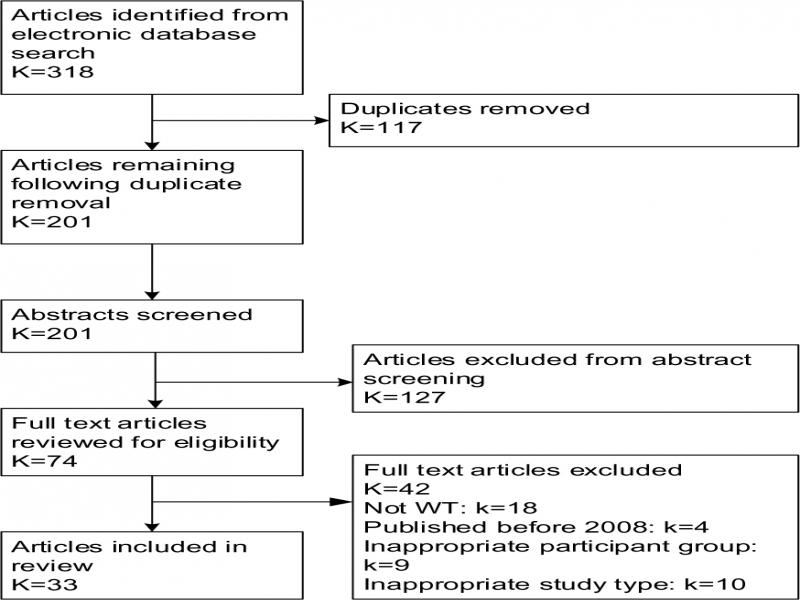
FIGURE 1.
Study selection process
TABLE 1.
Summary of purpose of WT and ICF codes
| Author (year) | Design | Participants | Wearable technology | Function assessed | Data processing/location, study setting | Measures of WT | Key findings | Quality |
|---|---|---|---|---|---|---|---|---|
| Quantitative | ||||||||
| Albinali et al., (2012) | Case series Case study | Study 1: Children and young adults with ASD; n=6 (12-20 years) Study 2: n=1 (participant of Study 1) | Three wireless accelerometers worn on wrists and torso | SMM | PC, naturalistic (classroom) and clinical settings | SMM classification Inter-rater agreement between real-time and offline annotators (Study 1); and expert and non-expert annotators (Study 2) | Accelerators had good recognition accuracy of SMM in classroom. Fair agreement between expert and non-expert annotators of SMM. | Strong (86%) |
| Billeci et al., (2016) | Case series | Male children with ASD, n=5, 6-8 years, mean age: 7.2 (SD: 0.83) | Enobio headset (EEG) ECG chest belt | Social function, imitation | CU, semi-naturalistic setting (therapy) | Observation EEG: Frequency power and coherence ECG – HR, HRV, RSA, root mean square of – successive- differences | WTs able to detect level of engagement during play therapy sessions. | Adequate (68%) |
| Di Palma et al., (2017) | Case series | Male children with ASD, n=5, 6-8 years, mean age: 7.2 years, (SD: 0.83) | ECG chest belt | Social function | CU, semi-naturalistic settings (therapy) | HR (bpm) HRV (Root mean square of the successive differences, RSA | WT feasible method for quantifying longitudinal variations in autonomic nervous system activity during therapy. | Adequate (63%) |
| Funahashi et al., (2014) | Case-control | Male child with ASD and TD male, 10 years of age | EMG worn on sides of the face, secured by a plastic structure | Social function, emotional regulation, verbal communication | PC, semi-naturalistic setting (therapy) | Time spent smiling (secs per session) Observation of positive and negate social behavior (coded) | WT reliably quantify smiles during animal-assisted therapy. | Adequate (59%) |
| Goodwin et al., (2014) | Follow-up case series | Children and young adults with ASD, n=6 (same participants from Albinali et al., 2012 study, 3 years later), 12-20 years | Three wireless accelerometers worn on the left and right wrists and torso | SMM | PC, naturalistic setting (classroom) | SMM classification | Classification of SMM in simple experiments was good but more variable in challenging experiments. | Strong (81%) |
| Hirokawa et al., (2016) | Case series | Individuals with ASD, n=10 (7 males, 3 females), mean age: 11.4 years | EMG worn on sides of the face, secured by a plastic structure | Social function, emotional regulation | PC, clinical setting | Accuracy of smile detection | WT could detect smile with high reliability for majority of participants. Measuring synchronization between smile and facing behavior showed typical pattern of expected results (less coordination) but some participants showed different synchronization patterns. | Adequate (59%) |
| Magrelli et al., (2013) | Case-control | Children with ASD, n=14 (9 male, 5 female), 2-11 years, mean age: 6.08 year (SD: 2.03). TD children, n=17 (9 male, 8 female), 3-6 years, mean age: 3.99 years (SD: 1.27) | WearCam (cameras and mirror mounted on headband) | Social function, social orientating | PC, clinical setting | Distance between gaze of children’s and adult’s face Durations of the first fixations to facial expression Reaction times (seconds) | WT able to quantify gaze differences and overt shifts in attention between ASD and TD children | Strong (95%) |
| Magrelli et al., (2014) | Case-control | Children with PDD, n=13 (5 females, 8 males), 3-10 years, mean age:6.17 years (SD: 2.40) Control: TD children, n=13 (5 females, 8 males), 2-6 years, mean age: 3.68 years (SD: 1.29) | WearCam (cameras and mirror mounted on headband) | Social function, social orientating | PC, clinical setting | Proportion of time spent looking at area of interest (seconds) Frequency (Hz) and duration (seconds) of gaze episodes Proportion of time a face appeared in their field of view (broad and middle) | WT able to quantify gaze behavior in ASD and TD groups. | Strong (95%) |
| Mazzei et al., (2010) | Case-control | Phase 1: Child with ASD: n=1, 7 years. TD child: n=1, 8 years Phase 2: Individuals with ASD, n=4 (3 male, 1 female), 7-20 years old. | HATCAM mounted on head Sensorised shirt | Social function, emotion recognition | CU, semi-naturalistic setting (therapy) | Eye gaze direction and head orientation (attention to face) HR, HRV, respiratory rate, skin temperature, skin conductance | WTs capable of monitoring attention to face and physiological arousal during FACE intervention and enabled robot control system (robotic face) to adapt to participants perceived emotion. | Limited (36%) |
| Min et al., (2009) | Case series | Children with ASD, n=2 | Wireless accelerometer worn on the wrist and back | SMM and self-injurious behavior | PC, semi-naturalistic (therapy) and naturalistic settings (home) | SMM Classification | Single sensor worn on the back could accurately detect body rocking and hand flapping. Flapping events more accurately detected by wrist sensors. | Adequate (54%) |
| Min et al., (2010) | Case series | Children with ASD, n=4 | Wireless accelerometer worn on wrist and back | SMM and self-injurious behavior | PC, semi-naturalistic (therapy) and naturalistic settings (home) | SMM classification | Classification of behaviors using accelerometer was improved through new methods. | Limited (45%) |
| Min et al., (2011) | Case series | Children with ASD, n=4 | Wireless accelerometer worn on wrist, ankle and upper body | SMM and Self injurious behavior | PC, semi-naturalistic (therapy) and naturalistic settings (home) | SMM Classification | Detection of behaviour based on accelerometer can better account for variability between individuals and individual behaviour changes over time, through an alternate method of classification training. This updated method had comparable accuracy to previous methods that did not accommodate as much variability. | Limited (45%) |
| Rad et al., (2017) | Case series | Simulated data: TD individuals n=5 (2 male, 3 female) Real data: Data from participants in previous study (Goodwin et al., 2014), children with ASD, n=6, 12-20 years | Simulated: EXLs3 sensor worn on wrist Real: Three wireless accelerometers worn on both wrists and torso | SMM | PC, clinical and naturalistic setting (classroom) | SMM classification | Updated software architecture was able to more accurately detect stereotypical motor movements through better accommodating for inter-subject variability | Adequate (68%) |
| Takahashi et al., (2016) | Case series | Male children with ASD, n=4, 3.8 – 5.5 years | Smart Clothe ECG sensor embedded in sleeve cuff | Emotion regulation | Tablet, Semi-naturalistic setting (therapy) | HR, HRV (R-R intervals on ECG waves) | Three out of four children tolerated WT. High reliability in measuring indicators of mental stress when performing tasks that require minimal movement. | Adequate (63%) |
| Vahabzadeh et al., (2017) | Case series | Children, Adolescents and young adults with ASD, n=8 (7 male, 1 female) | Empowered Brain System (smart glasses) | Social function, emotion recognition | WT, clinical setting | Attention deficit hyperactivity disorder (ADHD) symptoms (measured by Aberrant Behavioral Checklist) | All participants completed intervention without negative effects. The majority of participants showed reduction in ADHD-related symptoms 24 hours and 48 hours after intervention. | Adequate (68%) |
| Mixed methodology | ||||||||
| Billeci et al., (2018) | Case-control | Toddlers with and without ASD. ASD: n=20 (14 male, 6 female), Mean age: 2.18 (SD: 0.3) TD: n=20 (15 male, 5 female), mean age = 2.18 (SD: 0.31) | ECG Chest strap | Social function (joint attention) | PC, Clinical setting | HR (time domain: bpm, Standard deviation of NN intervals, coefficient variation, pNN10, frequency domain: Low frequency, high frequency, normalized low frequency, normalized high frequency), ADOS-G, Child behavior Checklist, Griffiths Mental Development Scales, Video observation | WT was capable of capturing ANS response during task. Results indicate that toddlers with ASD may have autonomic dysregulation, and possibly, reduced mental engagement during joint attention. WT did not cause observable annoyance to participants. All participants successfully completed task without sensory-motor and/or behavioral issues in wearing WT. | Quantitative Good (71%) Qualitative Strong (75%) |
| Daniels, Schwartz et al., (2018) | Case series | Children with ASD, n=14 (11 male, 3 female), Mean age: 9.57 (SD: 3.37) | SuperPower Glass system (smart glasses) | Emotion recognition | WT, Smartphone and database, naturalistic setting (home) | Autistic-like traits- Social Responsiveness Questionnaire (SRS-2) Labelling of emotions Semi-structured interview | WT resulted in reduced autistic-like traits, improved emotion recognition skills. Parents report system is engaging and useful. | Quantitative Strong (86%) Qualitative Limited (45%). |
| Daniels, Haber et al., (2018) | Case-control | Children with and without ASD Hypothesis 1: n=43, ASD: n=23 (19 male, 4 female), 6-17 years, mean age: 11.65 (SD: 3.20). TD: n=20 (14 male, 6 female), 7-17 years, mean age: 11.55 (SD: 3.09). Hypothesis 2 and 3: n=33, ASD: n=16 (13 male, 3 female), 16-17 years, mean age: 12.13 (3.31). TD: n=17 (9 male, 8 female), 8 – 17 years, mean age: 11.53 (SD: 2.48) | SuperPower Glass system (smart glasses) | Emotion recognition | WT, Smartphone and database, clinical setting | Interview Emotion recognition accuracy Classification of ASD and TD. | System fitted well and was not over stimulating for children. Children had difficulty reading visual cues from heads up display. Emotion information provided by WT associated with an increase in emotion labeling accuracy. Algorithms trained to classify ASD and TD performed no better than chance using the same nested cross-validation scheme. Differences between and TD depend on which expressions were confused. | Quantitative Strong (86%) Qualitative Limited (45%) |
| Hachisu et al., (2018) | Case series | Study 1: Children with ASD, n=6 (3 male, 3 female), 13-14 years Teachers, n=4 (2 male, 2 female) Study 2: Children with ASD, n=4 (2 male, 2 female), 15-17 years | FaceLooks Smart headband | Social function | Tablet/smart-phone, naturalistic setting (classroom) | Observation Face to face duration | No child removed WT. Some participants reported WT was too small to wear for long periods. Total duration of face-to-face durations increased with WT feedback, but some participants were not aware of the feedback rule. | Quantitative Strong (81%) Qualitative Adequate (65%) |
| Jiang et al., (2016) | RCT | Children with ASD, n=10 (7 male, 3 female), 7-14 years | ProCom (chest worn proximity sensor) | Social function, interpersonal space | Smartphone, clinical setting | Proximity (distance) Orientation in relation to interaction partner (degrees) Observation Child and parent interviews | WT effectively measured proximity. All parents reported the WT could be helpful in assisting their child. Participants who stood too close moved into appropriate space with WT feedback. | Quantitative: Good (73%) Qualitative: Adequate (60%) |
| Keshav et al., (2017) | Case series | Children and adults with ASD, n=21(19 male, 2 female), 4.4-21.5 years, mean age: 11.9 (SD: 4.9) years | Brain Power Autism System (BPAS) (Google Glass Explorer Edition) | Social-emotional function | WT, clinical setting | Tolerability (care-giver report and Likert scale) Successful use and experience (Likert scale) | Majority of participants found WT tolerable when worn for 1 minute and entirety of session. Participants also reported glasses were comfortable and caregivers reported participants could use WT with assistance. Caregivers reported that participants responded more positively to the smart glasses than expected. Caregivers reported that users may benefit from extended/repeated orientation to glasses. | Quantitative: Adequate (59%) Qualitative: Adequate (55%) |
| Kinsella et al., (2017) | Case series | Children with ASD, n=15 (10 male, 5 female), 8-16 years, mean age: 12.92 (SD: 2.33) | Google Glass and Holli app | Social function, communication | WT, clinical setting | Effectiveness: Detection accuracy, recognition accuracy Efficiency: System speed of interpreting and responding to speech and user response time to prompts. User satisfaction: Likert scale Semi-structured interview | Effectiveness: High detection and recognition accuracy indicating effective use of WT Efficiency: Response time WT robust enough to use in real time Likert scale: High comfortability Interview: High acceptability | Quantitative: Adequate (77%) Qualitative: Good (70%) |
| Lee et al., (2008) | case-series | Adolescent males with Asperger Syndrome, n=4 | Hat mounted wireless camera Wristband skin conductance sensor | Social function, communication | CU, clinical setting | Face contact data (positive, negative detection rates) Observation Interview/conversation | Variability in detection of faces using head-mounted camera. System may work in conversational setting, but it requires a fixed, stable environment. | Quantitative: Limited (27%) Qualitative: Limited (25%) |
| Liu et al., (2017) | Case series | Males with ASD, n=2, aged 8.6 years and 9.75 years | Brain power system (smart glasses) | Social function, emotion recognition | WT, clinical setting | Caregiver report (semi-structured interview) Aberrant behavior checklist | Caregivers reported participants had high to very high level of engagement, level of tolerability, level of enjoyment, ease of use and interaction with WT. Caregivers reported improved verbal and non-verbal communication, eye contact and social engagement. No change in verbal communication reported. One caregiver reported improvement in emotional connection and behavioral control while the other caregiver reported that both these areas were diminished. Both participants had reduced symptoms on aberrant behavior checklist following WT use. | Quantitative: Adequate (59%) Qualitative: Adequate (50%) |
| Ness et al., 2017 | Case-control | Child and adolescents with and without ASD. ASD: n=29 (25 male, 4 female), mean age: 10.1 (SD:5.2) TD: n=6 (3 male, 2 female), mean age 10.0 (SD: 2.83) | JAKE Biosensor Array of continous and perioic sensors: child daytime sensor (Q™ Sensor), child nighttime sensor (AMI Micro Motionlogger Sleep Watch), B-Alert® X24 (EEG), CamNTech Actiwave (ECG) | Everyday participation Sleep | Database (Janssen Research Data Warehouse), naturalistic (sleep), clinical setting | EDA and actigraphy, ECG and EEG (eye tracking also used but not WT). Experience with JAKE system (not linked to WT), safety, validity and reliability of data | Adverse events limited and were not related to the JAKE system. Q sensor not used as no longer commercially available. B-Alert (EEG) could not reach adequate impendence levels and difficulty with wireless. However, EDA sensor used 30 mins prior to clinical task battery. AMI Motionlogger Sleep watch able to provide reliable and valid data. | Quantitative Adequate (67%) Qualitative Limited (45%) |
| Suzuki et al., (2016) | Case series | Children with ASD, n=6 (5 male, 1 female), 5-8 years Session 1: Children with ASD, n=10 (8 male, 2 female) Session 2: Children with ASD, n=7 (4 male, 3 female), 5-8 years | EnhancedTouch worn on wrist | Social function, non-verbal communication | Tablet, naturalistic setting (club) | Touch events, reaction to device (observation), (frequency, duration and partner) Observation | WT accepted by participants and children were interested in device. Device capable of accurately measuring touch events. Visual feedback from device increased touch events. | Quantitative: Adequate (59%) Qualitative: Adequate (55%) |
| Torrado et al., (2017) | Case series | Male children with ASD, n=2, 10 years | LG Watch Urbane Smartwatches | Emotional regulation | WT, smartphone, naturalistic setting (classroom) | HR (bpm), Observation | Long duration (9 x 4-hour sessions) wearing of the device was well tolerated. Children enjoyed wearing the watch and observations suggest that strategies provided by the watch support self-regulation. WT able to detect changes in HR in real time. Measurement was confounded by states other than stress (e.g. excitement). | Adequate 65% |
| Qualitative | ||||||||
| Marcu et al., (2012) | Case series | Children and adolescents with ASD (and their mothers), n=5, 10-15 years | SenseCam (digital camera) worn around the neck iPod Touch (LifeLapse app) worn around the neck | Everyday participation | WT, PC, naturalistic setting (various) | Interviews with parents Observation | WT facilitated parents’ understanding of child’s experiences and needs. Parental concerns regarding the appearance of the device. | Adequate (65%) |
| Spiel et al., (2016) | Case study | Child with ASD, n=1, 6 years. | ThinkM (Headband with camera and pulse sensor) | Social function, emotional regulation | CU, clinical setting | Informal discussion/collaboration | Child expressed wish for technology to retain information of perceived negative behaviors. WT useful in assessing arousal (pulse) and reviewing social situations. | Adequate (60%) |
| Sahin et al., (2018a) | Case series | Children and adults with ASD, n=18 (16 male, 2 female), 4.4-21.5 years, mean age: 21.2 (SD:5.2) years | Brain Power Autism System (BPAS) (smart glasses) | Social function, emotion recognition | WT, clinical setting | Structured interviews | Majority of participants tolerated wearing glasses for at least 1minute (n=2 who did not tolerate were non-verbal). Three cases of mild adverse effects reported by 2 users including dizziness, one case of eye strain, and one instance of initial nasal bridge discomfort. Some reported glasses were warm. | Adequate (65%) |
| Sahin et al., (2018b) | Case series | Children with ASD, n=8 (7 male, 1 female), 6.7 – 17.2 years, mean age: 11.7 years (SD: 3.3) | Brain Power Autism System (BPAS) (smart glasses) | Social function, emotion recognition | WT, clinical setting | Semi-structured interviews | Children did not experience stress or sensory overload when using WT. Children reporting willingness to use WT at home and school. Caregivers reported that the experience was fun for their child and was successful. | Adequate (60%) |
| Voss et al., (2016) | Case series | Families of children with ASD, n=12, 4-17 years | SuperPower Glass (smart glasses) | Social function, emotion recognition | WT, smart phone, clinical and naturalistic setting (home) | Observation of video footage Interviews | Parents reported increased eye contacted in children with ASD. Participants enjoyed the activities. Participants stopped wearing the glasses if they became too warm. Optimal feedback mechanisms appeared to be a combination of audio and visual feedback. | Adequate (60%) |
| Washington et al., (2016) | Case-control | ASD and TD children and adolescents n=40 (20 ASD, 20 TD), 6-17 years | Smart glasses | Social function, emotional recognition | WT, smartphone, clinical and naturalistic settings (home) | Observation Informal interview Emotion recognition accuracy | Children responded well to wearing WT. Children responded well to the images and enjoyed the gamified activities and feedback mechanisms. Children responded better to audio feedback than to visual feedback. Majority of children chose audio cues over their own intuition. WT was uncomfortable when worn for long periods of time. | Adequate (55%) |
1 Notes. ASD: Autism Spectrum Disorder; SMM: Stereotypical Motor Movement or self-stimulatory movement; PC: Personal computer; EEG: Electroencephalography; ECG: Electrocardiography; WT: Wearable Technology; CU:Central/Control/Base Unit; HR: Heart Rate; HRV: Heart Rate Variability; RSA: Respiratory Sinus Arrhythmia; TD: Typically Developing; EMG: Electromyography; PDD: Pervasive Developmental Disorder; EDA: Electrodermal activity
TABLE 2.
Summary of purpose of WT and ICF codes
| Article | WT | Purpose | ICF Codes | ||||
|---|---|---|---|---|---|---|---|
| Basic Research | Intervention (WT is Intervention) | Intervention (WT supports Intervention) | Function measured | Function target | Context | ||
| Albinali et al., (2012) | Accelerometer | X | X (future) | b7563 | b7563 | d8201, e325, e330, e360, e5853 | |
| Billeci et al., (2016) | Enobio Headset and ECG Chest belt | X (Monitoring during intervention) | EEG (NC), b410 | b1403 | d880, d130, e355, e5800 | ||
| Billeci et al., (2018) | ECG Chest belt | X | b410 | b1403 | d110, e360 | ||
| Daniels et al., (2018a) | SuperPower Glass System (smart glasses) | X | d3150 | d3150, b122, d1600 | e310, e1301 | ||
| Daniels et al., (2018b) | SuperPower Glass System (smart glasses) | X | d3150 | d3150, b122, d1600 | e125, e360 | ||
| Di Palma et al., (2017) | ECG Chest belt | X (Monitoring during intervention) | b410 | b1403, b1251 | d130, d8803 e355, e5800 | ||
| Funahashi et al., (2014) | EMG | X (Monitoring during intervention) | b7300 | b1521, b1250, b1251, d335, d2502 | d880, e310, e355, e580, e350 | ||
| Goodwin et al., (2014) | Accelerometer | X | X (future) | b7653 | b7653 | d8201, e325, e330, e360, e5853 | |
| Hachisu et al., (2018) | FaceLooks Smart headband | X | X (future) | b140 | d1600 | d550, d9200, d8201 e325, e330, e360, e5853 | |
| Hirokawa et al., (2016) | EMG | X (Monitoring during intervention) | b7300, d335 | b1521, b1250, b1251 | d880, e3101, e355 | ||
| Jiang et al., (2016) | ProCom chest worn proximity sensor) | X | X (future) | d7204 | d7204 | e360, e130, e1301 | |
| Keshav et al., (2017) | Brain Power Autism System (smart glasses) | X | b2152, d3150 | d3150, d1600 | e310, e1301 | ||
| Kinsella et al (2017) | Google Glass and Holli App | X | b3100 | d3501 | e360, e1251 | ||
| Lee et al., (2008) | Hat Mounted Wireless Camera and Wristband skin conductance sensor | X | b830, b140 | d1600, b1251, b1521, d3503 | d3503, e310, e360 | ||
| Liu et al., (2017) | Brain Power System | X | b2152 | d3150, d1600, d2501 | e310, e1301 | ||
| Magrelli et al., (2013) | WearCam | X | b2152 | d1600 | d8803, e360 | ||
| Magrelli et al., (2014) | WearCam | X | b2152 | d1600 | d8803, e360 | ||
| Marcu et al., (2012) | SenseCam | X | Everyday participation (NC) | Everyday participation (NC) | e310 | ||
| Mazzei et al., | Hatcam and sensorised shirt | X | b2152, b830, b4400 | b1520, b1521, d1600 | e1301, e355 | ||
| Min et al., (2009) | Accelerometer | X | X (future) | b7653 | b7653 | Home (ND) | |
| Min et al., (2010) | Accelerometer | X | X (future) | b7653 | b7653, b1521, d2401 | Therapy and home (ND) | |
| Min et al., (2011) | Accelerometer | X | X (future) | b7653 | b7653, b1521, d2401 | Therapy and home (ND) | |
| Ness et al., (2017) | Biosensor array | X | b1344,b830, EEG (ND), b410 | b1340, b1341, b1342, b1343, b1521, b140 | d570, d1600, e310, e360, e115, everyday participation (ND)= | ||
| Rad et al., (2016) | Accelerometer | X | X (future) | b7653 | b7653 | d8201, e325, e330, e360, e5853 | |
| Sahin et al., (2018a) | Brain Power System (smart glasses) | X | b2152,d3150 | d3150, d1600, d2501 | e310, e1301 | ||
| Sahin et al (2018b) | Brain Power System (smart glasses) | X | b2152,d3150 | d3150, d1600, d2501 | e310, e1301 | ||
| Speil et al., (2016) | ThinkM headband | X | b140, b410 | d2502, b1521 | e360 | ||
| Suzuki et al., (2016) | EnhancedTouch | X | b265 | d1201, d7105 | d9100, d9201, e325, e330, e355 | ||
| Takahashi et al., (2016) | SmartClothe with ECG sensor | X (Monitoring during intervention) | b410 | b1521 | d4454, d110, d130, d880, d115, d166, d330, e355, e310 | ||
| Torrado et al., (2017) | LG Urbane Smartwatch | X | b410 | b1521 | d8201, d9201, e310, e330, e1151, e325 | ||
| Vahabzadeh et al., (2017) | Empowered Brain System | X | b2152,d3150 | ADHD symptoms (HC) | e310, e1301 | ||
| Voss et al (2016) | SuperPower Glass | X | d3150 | d3150, b122, d1600 | e310, e1301 | ||
| Washington et al (2016) | Smart glasses | X | d3150 | d3150, b122, d1600 | e310, e1301 | ||
TABLE 3.
Absolute and relative frequencies of studies linked to the ICF
| ICF Code | ICF Descriptor | Count | Relative frequency (within ICF domain) |
|---|---|---|---|
| Body functions | |||
| b152 | Emotional functions | 10 | 18% |
| b215 | Functions of structures adjoining the eye | 8 | 15% |
| b140 | Attention functions | 7 | 13% |
| b410 | Heart functions | 7 | 13% |
| b765 | Involuntary movement functions | 6 | 11% |
| b122 | Global psychosocial functions | 4 | 7% |
| b125 | Dispositions and intra-personal functions | 4 | 7% |
| b830 | Other functions of the skin | 3 | 5% |
| b730 | Muscle power functions | 2 | 4% |
| b134 | Sleep functions | 1 | 2% |
| b265 | Touch function | 1 | 2% |
| b310 | Voice functions | 1 | 2% |
| b440 | Respiration functions | 1 | 2% |
| Activity and participation | |||
| d160 | Focusing attention | 14 | 22% |
| d315 | Communicating with - receiving - nonverbal messages | 9 | 14% |
| d880 | Engagement in play | 7 | 11% |
| d250 | Managing one’s own behavior | 5 | 8% |
| d820 | School education | 5 | 8% |
| d130 | Copying | 3 | 5% |
| d920 | Recreation and leisure | 3 | 5% |
| d110 | Watching | 2 | 3% |
| d240 | Handling stress and other psychological demands | 2 | 3% |
| d335 | Producing nonverbal messages | 2 | 3% |
| d350 | Conversation | 2 | 3% |
| d115 | Listening | 1 | 2% |
| d120 | Other purposeful sensing | 1 | 2% |
| d166 | Reading | 1 | 2% |
| d330 | Speaking | 1 | 2% |
| d440 | Fine hand use | 1 | 2% |
| d445 | Hand and arm use | 1 | 2% |
| d550 | Eating | 1 | 2% |
| d570 | Looking after one’s health | 1 | 2% |
| d710 | Basic interpersonal interactions | 1 | 2% |
| d720 | Complex interpersonal interactions | 1 | 2% |
| d910 | Community life | 1 | 2% |
| Environment | |||
| e310 | Immediate family | 14 | 20% |
| e360 | Other professionals | 13 | 19% |
| e130 | Products and technology for education | 11 | 16% |
| e355 | Health professionals | 7 | 10% |
| e325 | Acquaintances, peers, colleagues, neighbors and community members | 6 | 9% |
| e330 | People in positions of authority | 6 | 9% |
| e585 | Education and training services | 4 | 6% |
| e580 | Health services, systems and policies | 3 | 4% |
| e115 | Products and technology for personal use in daily living | 2 | 3% |
| e125 | Products and technology for communication | 2 | 3% |
| e350 | Domesticated animals | 1 | 1% |