
TABLE 1.
Demographic characteristics of those with and without BP-I disorder from the individual studies and all studies combined
| Boys ADHD study | Girls ADHD study | BP disorder controlled study | BP disorder family study | All studies combined | ||||||||
|---|---|---|---|---|---|---|---|---|---|---|---|---|
| No BP disorder | BP disorder | No BP disorder | BP disorder | No BP disorder | BP disorder | No BP disorder | BP disorder | No BP disorder | BP disorder | |||
| n = 238 | n = 13 | n = 211 | n = 9 | n = 82 | n = 64 | n = n/a | n = 44 | n = 531 | n = 130 | Test statistic | p-value | |
| Mean ± SD | Mean ± SD | Mean ± SD | Mean ± SD | Mean ± SD | Mean ± SD | Mean ± SD | Mean ± SD | Mean ± SD | Mean ± SD | |||
| Age | 11.1 ± 3.3 | 10.3 ± 3.3 | 11.7 ± 3.2 | 11.0 ± 3.3 | 13.5 ± 2.1 | 13.7 ± 2.4 | n/a | 9.2 ± 3.4 | 11.7 ± 3.2 | 11.7 ± 3.6 | t659 = 0.08 | 0.94 |
| Socioeconomic statusa | 1.7 ± 0.9 | 2.1 ± 1.0 | 1.8 ± 0.9 | 1.8 ± 0.7 | 1.6 ± 1.0 | 1.9 ± 1.2 | n/a | 1.8 ± 1.0 | 1.7 ± 0.9 | 1.8 ± 1.1 | z = -1.29 | 0.20 |
| n (%) | n (%) | n (%) | n (%) | n (%) | n (%) | n (%) | n (%) | n (%) | n (%) | |||
|---|---|---|---|---|---|---|---|---|---|---|---|---|
| Male | 238 (100) | 13 (100) | 0 (0) | 0 (0) | 48 (59) | 43 (67) | n/a | 34 (77) | 286 (54) | 90 (69) | χ2 = 10.06 | 0.002 |
| Caucasianb | 238 (100) | 13 (100) | 192 (93) | 9 (100) | 58 (76) | 62 (98)* | n/a | 38 (86) | 488 (94) | 122 (95) | χ2 = 0.10 | 0.76 |
2a Socioeconomic status (SES) was measured using the 5-point Hollingshead scale. A higher score indicates being of lower SES. Not everyone has SES reported. Smaler sample sizes for this measure were: boys ADHD study: 251; girls ADHD study: 219: BP controlled study: 108; all studies combined: 622.
TABLE 2.
Sensitivity, specificity and percent correctly classified using the Child Behavior Checklist-Bipolar (BP) profile with ≥ 180 to identify youth with BP-I disorder in each study
| Study | Sensitivity (%) | Specificity (%) | Correctly classified (%) |
|---|---|---|---|
| Boys ADHD study (n = 251) | 85 | 74 | 74 |
| Girls ADHD study (n = 220) | 89 | 74 | 75 |
| BP disorder controlled study (n = 146) | 89 | 93 | 91 |
| BP disorder family study (n = 44) | 91 | n/aa | 91 |
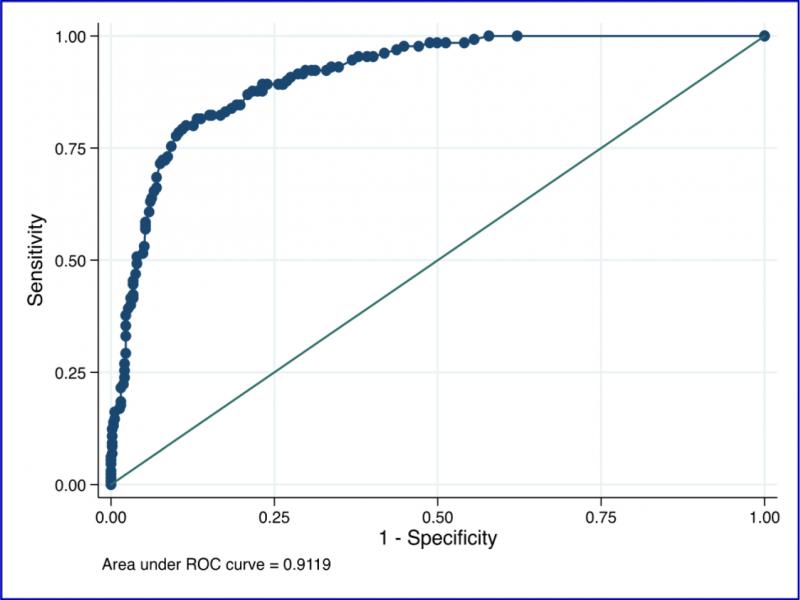
FIGURE 1.
Receiver operating characteristic (ROC) curve of the Child Behavior Checklist-Bipolar Profile T-scores in subjects from the total sample with and without Bipolar I disorder (n = 661)
TABLE 3.
Sensitivity, specificity, positive predictive value (PPV), negative predictive value (NPV) and percent correctly classified in the use of the Child Behavior Checklist-Bipolar (BP) profile t-scores to identify youth with BP-I disorder in the total sample from all four studies (n = 661)
| CBCL-BP profile Cut-point | Sensitivity (%) | Specificity (%) | PPV (%) | NPV (%) | Correctly classified (%) |
|---|---|---|---|---|---|
| ≥ 165 | 95 | 63 | 39 | 98 | 69 |
| ≥ 180 | 89 | 77 | 49 | 97 | 79 |
| ≥ 195* | 80 | 87 | 61 | 95 | 86 |
| ≥ 210 | 61 | 94 | 72 | 91 | 88 |
| ≥ 225 | 39 | 97 | 79 | 87 | 86 |
| ≥ 240 | 15 | 99 | 86 | 83 | 83 |