
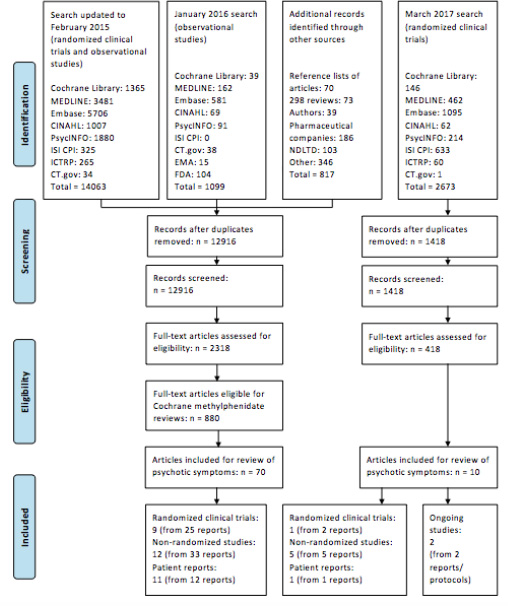
FIGURE 1.
PRISMA flow diagram (24)
TABLE 1.
Characteristics of included randomized clinical trials
| Study ID, country | Study design | N | Age range Mean (SD) (years) | Male [n (%)] | MPH-naïve [n (%)] | MPH type, mean daily dose Dosage regimen | Time of MPH intervention | Mode of assessment | Type and number of psychotic events |
|---|---|---|---|---|---|---|---|---|---|
| Becker 2016/Froehlich 2015, USA | Cross-over | 163 | 7-11 8.41 (1.24) | 117 (72) | 163 (100) | MPH-OROS <25 kg: 18/27/36 mg >25 kg: 18/36/54 mg Once daily | 3 weeks | Pittsburgh Side Effect Rating Scale, Parent rated | Hallucination Placebo: n=0/163 18 mg: n=1/163 27 mg: n=1/31 36 mg: n=4/163 54 mg: n=5/132 |
| Buitelaar 1996, The Netherlands | Cross-over | 52 | 6-13 9.29 (1.63) | 46 (88) | 52 (100) | MPH-IR, 20 mg Twice daily (at breakfast and at noon) | 4 weeks | Modified Stimulant Drug Side Effects Rating scale, Parent rated | Interim analysis Hallucination: n=1 |
| Childress 2009, NCT-00301236, USA | Parallel | 253 | 6-12 8.7 (1.84) | 163 (64) | 175 (69) | MPH-ER, 10/20/30 mg (3 parallel groups) Once daily in the morning | 5 weeks | Regular monitoring of serious adverse events | Tactile hallucination: n=1 (30 mg) |
| Palumbo 2008/Daviss 2008, NCT-00031395, USA | Parallel | 122 | 7-12 9.5 (1.6) | 98 (80) | 57 (47) | MPH-IR, 30.2 mg 1 to 3 times daily (in the morning, noon and at 4 p.m.) | 12 weeks | Pittsburgh Side Effect Rating Scale, Parent and teacher rated. Spontaneous self-reports. | Groups without co-intervention hallucination: n=0/59 |
| Green 2011, NCT-00768820, Israel | Parallel | 34 | 5-20 11.1 (3.7) | 20 (59) | 21 (62) | MPH-IR, 15.7 mg 1 dose | 1 day | Spontaneous reports | Psychotic symptoms: n=0 |
| Pelham 1999, USA, Summer Treatment Program 1988 | Cross-over | 21 | 6-12 10.3 (1.9) | 19 (90) | 7 (33) | MPH-IR, 0.9/0.75/0.3 mg/kg 1 to 3 times daily (morning, noon and afternoon at 3:30 p.m.) | 1day×3 (placebo: 2 daysx3) | Pittsburgh Side Effect Rating Scale. Parent, teacher, and counselor rated | Hallucination: n=1 |
| Pelham 2005, USA, Summer Treatment Program | Cross-over | 36 | 6-13 9.6 (NA) | 33 (92) | 26 (72) | MTS, 0.45/0.9/1.8 mg/h Worn at least 12 hours daily Application time once daily (at 6 or 7 a.m.) | 1 day×2 | Pittsburgh Side Effect Rating Scale. Parent, teacher, and counselor rated | Hallucination: n=0 |
| Riggs 2011, NCT-00264797, USA | Parallel | 303 | 13-18 16.5 (1.3) | 239 (79) | NA | MPH-OROS, 68 mg Once daily in the morning | 16 weeks | Systematic assessment of serious adverse events | Psychotic disorder: n=1 |
| Schachar 2008, USA | Cross-over | 18 | 6-15 11.3 (2.2) | 15* (88) | NA | MPH-IR or MPH-ER, 31.2 mg 1 to 2 times daily (morning- and lunch-time dose) | 1 week | Spontaneous reporting | Psychosis: n=1 |
| Waxmonsky 2008, NCT-00050622, USA, Summer Treatment Program | Cross-over | 101 | 5-12 8.35 (2.05) | 82 (81) | NA | MPH-IR, 15/30/54 mg Thrice daily (7:45 a.m., 11:45 a.m. and 3:45 p.m.) | 1day×3–4×3 | Pittsburgh Side Effect Rating Scale. Staff and parent rated | NA |
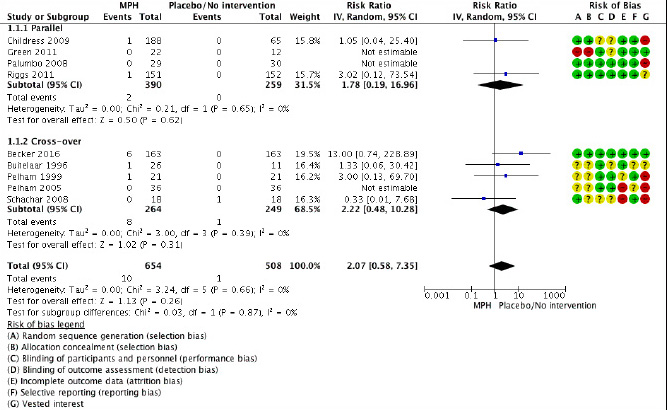
FIGURE 2.
Risk ratio of nine randomized clinical trials comparing methylphenidate versus placebo for patients with ADHD.
The following risk of bias items were rated as low (green), unclear (yellow) or high risk of bias (red): A: Random sequence generation (selection bias). B: Allocation concealment (selection bias). C: Blinding of participants and personnel (performance bias). D: Blinding of outcome assessment (detection bias). E: Incomplete outcome data (attrition bias). F: Selective reporting (reporting bias). G: Vested interest. C and D are for a number of trials assessed as without risk of bias, but because of prevalent and easily recognizable adverse events of methylphenidate, this assessment may well be wrong (19). CI, confidence interval; IV, inverse variance; MPH, methylphenidate; Random, random-effect model.
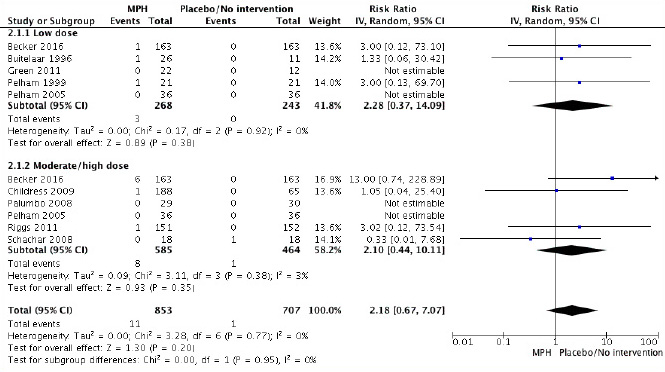
FIGURE 3.
Risk ratio of nine randomized clinical trials comparing methylphenidate versus placebo. Subgroup analysis of dose. Low dose: ≤20 mg/day or ≤0.6 mg/kg/day methylphenidate. Moderate/high dose: >20 mg/day or >0.6 mg/kg/day methylphenidate. CI, confidence interval; IV, inverse variance; MPH, methylphenidate; Random, random-effect model.
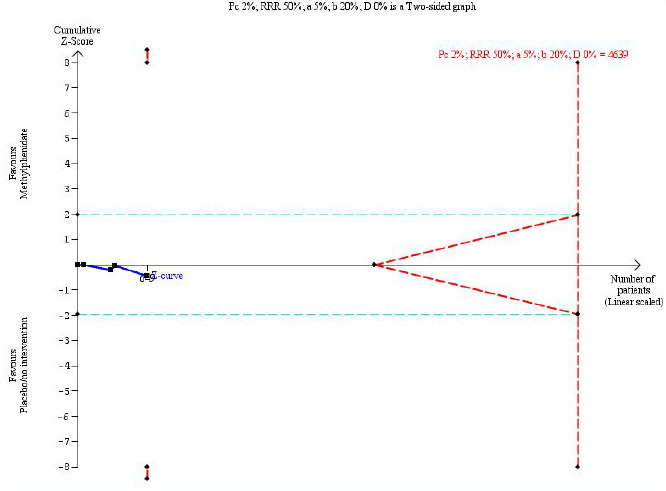
FIGURE 4.
Trial Sequential Analysis of parallel group trials. The diversity-adjusted required information size to demonstrate or reject a relative risk reduction or an increase of 50% with a control group risk of psychotic symptoms of 2%, an alpha of 5%, a beta of 20% and a diversity of 0% is 4639 patients (red vertical dashed line). The red vertical lines to the left represent the trial sequential monitoring boundaries for benefit and harm and the red dashed outward-sloping lines to the right represent the futility boundaries. The horizontal solid blue line is the cumulative Z-curve, showing that only 14.0% (649/4639) of the diversity-adjusted required information size has been accrued. a, alpha; b, beta; D, diversity; DARIS, diversity-adjusted required information size; RRR, relative risk reduction.
TABLE 2.
Characteristics of included non-randomised studies
| Study ID, country | N | Age range mean (SD) (years) | Male [n (%)] | MPH-naïve [n (%)] | MPH type, mean daily dose Dosage regimen | Time of intervention | Mode of assessment | Type and number of psychotic events |
|---|---|---|---|---|---|---|---|---|
| Ashkenasi 2011, NCT00989950, USA | 26 | 6-12 9.3 (1.95) | 19 (73) | NA | MTS, 10 ➔ max 30 mg (optimal dose) Applied once daily in the morning Worn for 9, 10, 11, and 12 h/day in 1 week each | Titration +4 weeks maintenance | Spontaneous reporting | Withdrawal due to hallucinations n=1 |
| Arnold 2015, TOSCA study, NCT00796302,USA | 168 | 6-12 8.89 (2.01) | 129 (77) | NA | MPH-OROS, ➔ 44.8 mg Once daily | 3 weeks titration +6 weeks maintenance | NA | Hallucinations n=0/156 in 3 weeks (0/70 in 9 weeks) Delusions n=0/156 in 3 weeks (0/70 in 9 weeks) |
| Baweja 2016,USA | NA | NA NA (NA) | NA | NA | MPH*, NA NA | 6 weeks | Pittsburgh Side Effects Rating Scale | Hallucinations n=NA |
| Cherland 1999, Canada | 98 | 4-17 NA (NA) | NA | NA | MPH*, NA Dose range: 5-80 mg NA | 21 months | Spontaneous reporting | Psychotic effects n=7/96 |
| Cortese 2015,Italy | 1426 | 6-18 10.55 (2.75) | 1247 (87) | NA | MPH-IR, 18.3 mg 2-3 times daily | up to 5 years | A structured form including any psychiatric symptomatology | Hallucination n=2 |
| Didoni 2011, Italy | 34 | 6-17 10.7 (2.7) | 28 (82) | 34 (100) | MPH-IR, 39.9 mg 2-3 times daily. | > 1 year | Parents were requested in advance to report any adverse events during follow-up visits | Psychotic symptoms n=0 |
| Elman 1998, Israel | 5 | NA NA (NA) | NA | NA | MPH*, NA NA | NA | NA | n=0 |
| Findling 2009, NCT-00151957, USA | 326 | 6-12 9.2 (1.9) | 212 (65) | ∼ 0 (∼ 0) | MTS, 10➔15➔20➔30 mg Applied once daily (∼7 am) Worn for ∼9 hours (∼4 pm) | 12 months | Systematic assessment | Psychosis/mania n=3 |
| Green 2011, NCT-00768820, Israel | 16 | 5-20 NA (NA) | NA | 0 (0) | MPH*, NA NA | 6 months | Spontaneous reports | Psychotic symptoms n=0 |
| Lee 2013/NA 2013, Republic of Korea, NCT01060150 | 55 | 12-18 14.33 (1.54) | 43 (78) | NA | MPH-OROS, 45.78 mg Once daily | 12 weeks | Adverse event checklist and general questioning | Hallucination n=0/55 |
| 121 | 12-18 13.8 (1.49) | 93 (77) | NA | 54.53 mg Once daily | 12 weeks | Adverse event checklist and general questioning | Withdrawal due to hallucinations n=1/121 | |
| MacKenzie 2016, Canada | 141 +MPH:NA | 6-21 NA (NA) | 67 (48) | NA | MPH*, NA NA | >12 months | Schizophrenia proneness instrument-child and youth version and structured interview for prodromal syndrome | Psychotic symptoms: Patients, +mph: n=6/NA Control, -mph: n=4/16 |
| Man 2016, Hong Kong | 76 | 6-19 NA (NA) | NA | NA | MPH-IR and –ER, NA NA | Mean: 2.17 years | Psychotic disorder or hallucination diagnostic code in the Clinical Data Analysis and Reporting System | Baseline period (no drug): n=NA Exposed period: n=NA |
| Mohammadi 2004, Iran | 16 | 6-14 8.87 (2.47) | 11 (69) | 16 (100) | MPH*, 1 mg/kg NA | 6 weeks | NA | Hallucination, delusion n=0 |
| Remschmidt 2005/Hoare 2005, UK and Germany | 89 | 6-16 NA (NA) | NA | 0 (0) | MPH-OROS, 18, 36 or 54 mg Once daily | 1 year | NA | Delusion n=1 (18 mg) |
| Shyu 2015, Taiwan | ADHD: 73,049 | NA 9.4 (3.3) | 58,293 (80) | NA | MPH*, NA NA | 5 months – 12 years | Schizophrenia spectrum disorders based on insurance status, outpatient and hospitalization claims databases | Psychotic disorder: +MPH: 856/52,646 (1.6%) -MPH: 229/19,125 (1.2%) |
| ADHD+MP H: 53,600 (73%) | Schizophrenia: +MPH: 452/52,752 (0.9%) -MPH: 120/19,119 (0.6) | |||||||
| Su 2015, China | 239 | 6-16 9.2 (2.02) | 203 (85) | NA | MPH-OROS, 18➔ 36 ➔54 mg Once daily | 8-week titration phase | Treatment-emergent adverse events were recorded throughout the study | Hallucination n=1 |
| Wilens 2005, USA | 407 | 6-13 9.2 (1.8) | 338 (83) | 0 (0) | MPH-OROS, 35.2➔44.2 mg Once daily | 21-24 months | Systematic assessment, parent rated | Withdrawal due to hallucinations n=1 |
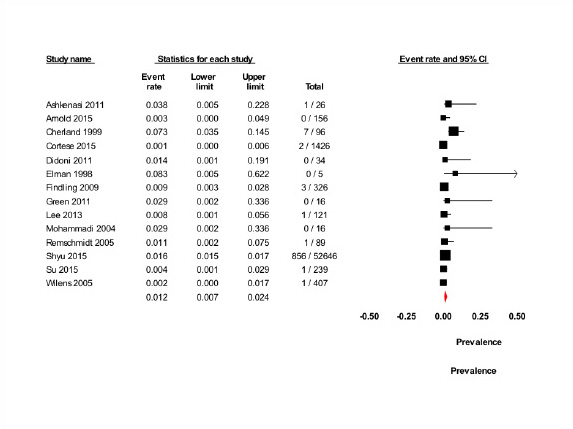
FIGURE 5.
Prevalence of psychotic symptoms in non-randomized studies. CI, confidence interval
TABLE 3.
Risk of bias in non-randomised studies
| Shyu 2015 | |
|---|---|
| Bias due to confounding | Critical |
| Bias in selection of participants into the study | Moderate |
| Bias in classification of interventions | Moderate |
| Bias due to deviations from intended interventions | Critical |
| Bias due to missing data | Critical |
| Bias in measurement of outcomes | Serious |
| Bias in selection of the reported result | No information |
| Risk of bias judgement | Critical |
TABLE 4.
Characteristics of included patient reports
| Study ID, country | N | Age, (years) | Sex | MPH-naïve (n) | MPH type, mean daily dose | Time of intervention | Type and number of psychotic events |
|---|---|---|---|---|---|---|---|
| Aguilera-Albesa 2010, Spain | 2 | 6 | F | NA | 50% MPH-IR/50% MPH-ER, 10➔20 mg Once daily | 4 days | Hallucinations: n=2 |
| 8 | M | NA | MPH-ER, 18 mg Once daily | 2 days | |||
| Coignoux 2009, France | 1 | 14 | M | NA | MPH-ER, 54 mg Once daily in the morning | 6 months | Psychotic symptoms: n=1 |
| Fernández-Fernández 2011, Spain | 1 | 10 | M | 0 | MPH-ER, 1.2 mg/kg Once daily | 1 week | Psychosis: n=1 |
| Goetz 2011, Czech Republic | 1 | 7 | F | 0 | MPH-OROS, 18 mg Once daily | 2.5 months | Hallucination: n=1 |
| Gross-Tsur 2004, Israel | 3 | 7 | M | NA | MPH*, 7.5 mg Once daily | 1 year | Hallucinations: n=3 |
| 12 | M | NA | MPH*, 10 mg Once daily | Short period | |||
| 7.5 | M | NA | MPH*, 7.5 mg Once daily | Months | |||
| Halevy 2009, Israel | 1 | 8 | M | 1 | MPH*, 10 mg NA | Days | Hallucination: n=1 |
| Herguner 2015, Turkey | 1 | 6 | M | NA | MPH-OROS, 18 mg† NA | 2 months | Hallucination: n=1 |
| Irmak 2014, Turkey | 1 | 9 | M | 1 | MPH*, ➔1mg/kg NA | NA | Hallucination: n=1 |
| Porfirio 2011, Italy | 1 | 11 | M | 1 | MPH-IR, 30 mg Twice daily | 3 years | Hallucination: n=1 |
| Rashid 2007, USA | 1 | 10 | M | 0 | MPH-IR, 20➔30 mg Twice daily | 2 days | Hallucination: n=1 |
| Shibib 2009, UK | 4 | 14 | F | 1 | MPH-ER, 30 mg Once daily | 4 months | Psychosis: n=4 Hallucinations: n=3-4 |
| 8 | M | 1 | MPH-IR, 5➔20 mg Twice daily | 7 days | |||
| 10 | M | 0 | MPH-ER, 36➔54 mg Once daily | 3 weeks | |||
| 14 | M | 0 | MPH-ER, 18 mg NA | 24 hours | |||
| Tomás Vila 2010, Spain | 1 | 10 | M | 0 | 50% MPH-IR/50% MPH-ER, 30 mg NA | 2 weeks | Hallucination: n=1 |