
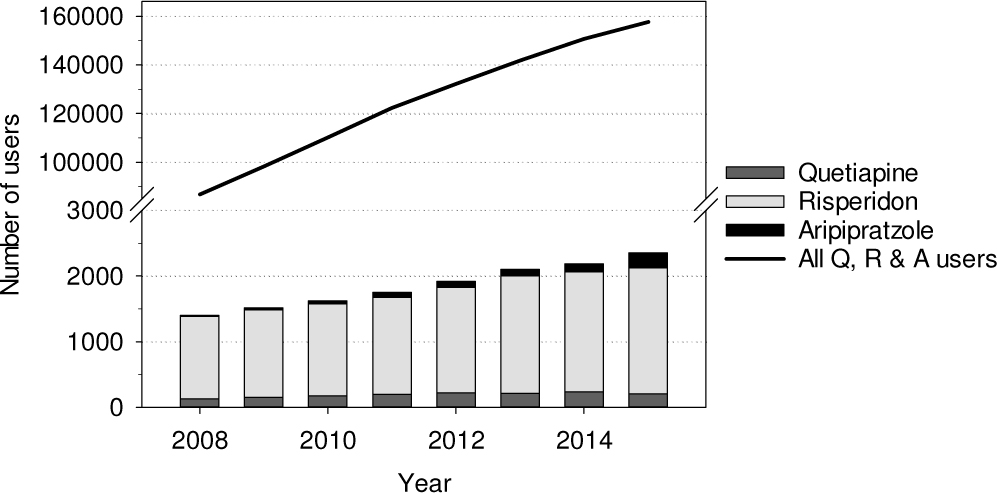
FIGURE 1.
Second-generation antipsychotic use of 0 to 12-year-old children and all users in Finland (2008 to 2015)
TABLE 1.
Recommendations for monitoring second-generation antipsychotic treatment according to National Institute for Health and Care Excellence (NICE), American Academy of Child and Adolescent Psychiatry (AACAP), and Canadian Alliance for Monitoring Effectiveness and Safety of Antipsychotics in Children (CAMESA) (39,40,42)
| Follow-ups | |||||
|---|---|---|---|---|---|
| Issued by | Baseline | 1 | 2 | 3 | 4 |
| NICE | Weekly (first 6 weeks) | 12 weeks | Every 6 months | ||
| Growth chart3*, WHC, RR, pulse, fb-gluc, HbA1c, lipids, prolactin, MD, nutritional status, diet, physical activity | Growth chart, MD, efficacy, side-effects | Growth chart, MD, RR, pulse, fb-gluc, HbA1c, lipids, prolactin, physical health, efficacy, side effects | Growth chart, MD, WHC, RR, pulse, fb-gluc, HbA1c, lipids, prolactin, physical health, efficacy, side effects | – | |
| AACAP | Regular intervals | ||||
| Family history, BMI, WC, RR, pulse, fb-gluc, lipids, MD | BMI, RR, pulse, fb-gluc (HbA1c if needed), lipids4†, MD | – | – | – | |
| CAMESA | 1, 2, 9 months | 3 months | 6 months | 1 year | |
| Growth chart, BMI, WC, RR, NEU, fb-gluc, insulin, lipids, ASAT, ALAT, TSH (with quetiapine), prolactin | Growth chart, BMI, WC, RR, NEU | Growth chart, BMI, WC, RR, NEU, fb-gluc, insulin, lipids, prolactin | Growth chart, BMI, WC, RR, NEU, fb-gluc, insulin, lipids ASAT, ALAT, TSH (with quetiapine) | Same as baseline | |
ALAT, alanine aminotransferase; ASAT, aspartate aminotransferase; fb-gluc, fasting glucose; HbA1c, glycosylated hemoglobin; lipids, blood lipid profile; MD, movement disorders; NEU, neurological examination; TSH, thyroid-stimulating hormone; RR, blood pressure; WC, waist circumference; WHC, waist and hip circumference
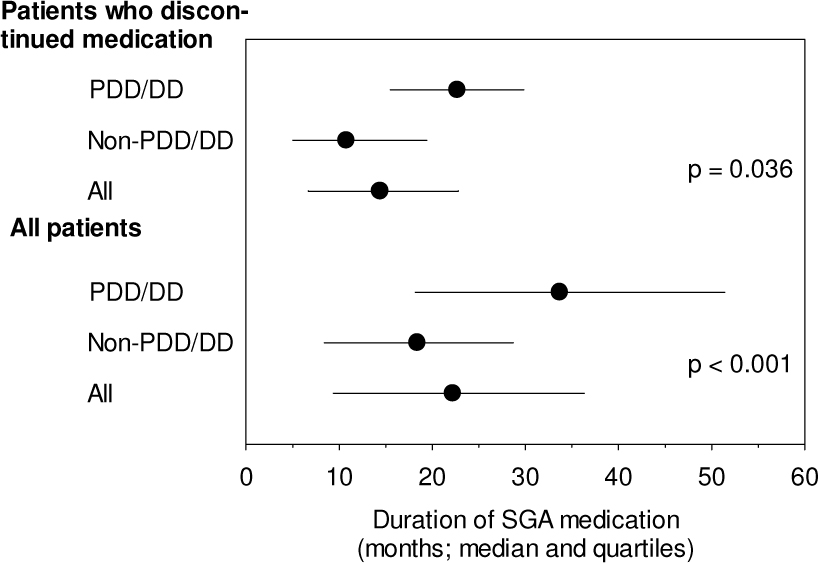
FIGURE 2.
Duration of second-generation antipsychotic (SGA) medication. Figures in the “all patients” group do not describe the genuine duration of SGA medication because the duration after the endpoint of the follow-up is not known
TABLE 2.
International Statistical Classification of Diseases and Related Health Problems, 10th Revision, diagnoses of second-generation antipsychotic (SGA)-treated children (n=133)
| Diagnoses | ICD-10 class | % |
|---|---|---|
| Hyperkinetic disorders | F90 | 50 |
| Conduct/mixed conduct and emotional disorder | F91-92 | 40 |
| Pervasive developmental disorders | F84 | 30 |
| Obsessive compulsive disorder | F42 | 13 |
| Disorders of social functioning with onset specific to childhood and adolescence2 | F94 | 13 |
| Reaction to severe stress/adjustment disorders | F43 | 10 |
| Tic disorders | F95 | 8 |
| Emotional disorder with onset specific to childhood | F93 | 7 |
| Disorders of psychological development | F80-82 | 7 |
| Depressive episode | F32 | 6 |
| Bipolar affective disorder | F31 | 5 |
| Psychotic disorders | F23, F29 | 5 |
| Mixed specific developmental disorders | F83 | 5 |
| Other mood (affective) disorders | F38 | 5 |
| Phobic and other anxiety disorders | F40-41 | 3 |
| Dissociative (conversion) disorders | F44 | 3 |
| Other behavioural and emotional disorders with onset usually occurring in childhood and adolescence3* | F98 | 2 |
| Eating disorders | F50 | 1 |
| Unspecified mental retardation | F79 | 1 |
TABLE 3.
Family background of the second-generation antipsychotic-treated children
| All (%) | PDD/DD (%) | Non-PDD/DD (%) | p | |
|---|---|---|---|---|
| Family status (n=133) | <.001 | |||
| Biological parents | 37 | 57 | 26 | |
| Parental separation | 40 | 36 | 42 | |
| Foster home | 18 | 6 | 24 | |
| Other (e.g. adoption) | 5 | 0 | 8 | |
| Number of siblings (n=126) | NS | |||
| None | 21 | 23 | 20 | |
| One | 38 | 40 | 37 | |
| Two or more | 41 | 36 | 43 | |
| Mother’s working status (n=133) | .018 | |||
| Working at least part time | 53 | 68 | 45 | |
| Other or not known | 47 | 32 | 55 | |
| Father’s working status (n=133) | NS | |||
| Working at least part time | 57 | 64 | 54 | |
| Other or not known | 43 | 36 | 47 | |
| Alcohol/drugs (n=83) | 60 | 44 | 71 | .021 |
| Psychiatric history of first-degree relatives | ||||
| Schizophrenia, bipolar disease or other psychosis (n=67) | 33 | 15 | 45 | .016 |
| Depression (n=88) | 67 | 61 | 72 | NS |
| Suicide (n=133) | NS | |||
| Committed | 2 | 2 | 2 | |
| At least one attempt | 7 | 2 | 9 | |
| Child exposed to violence (n=133) | 41 | 30 | 48 | .065 |
| Exposed to domestic violence | 11 | 4 | 15 | |
| Been object of physical punishment or other domestic violence | 12 | 13 | 12 | |
| Both exposed and been object | 11 | 6 | 13 | |
| Other kind of violence exposure (e.g. war experiences) | 8 | 6 | 8 |
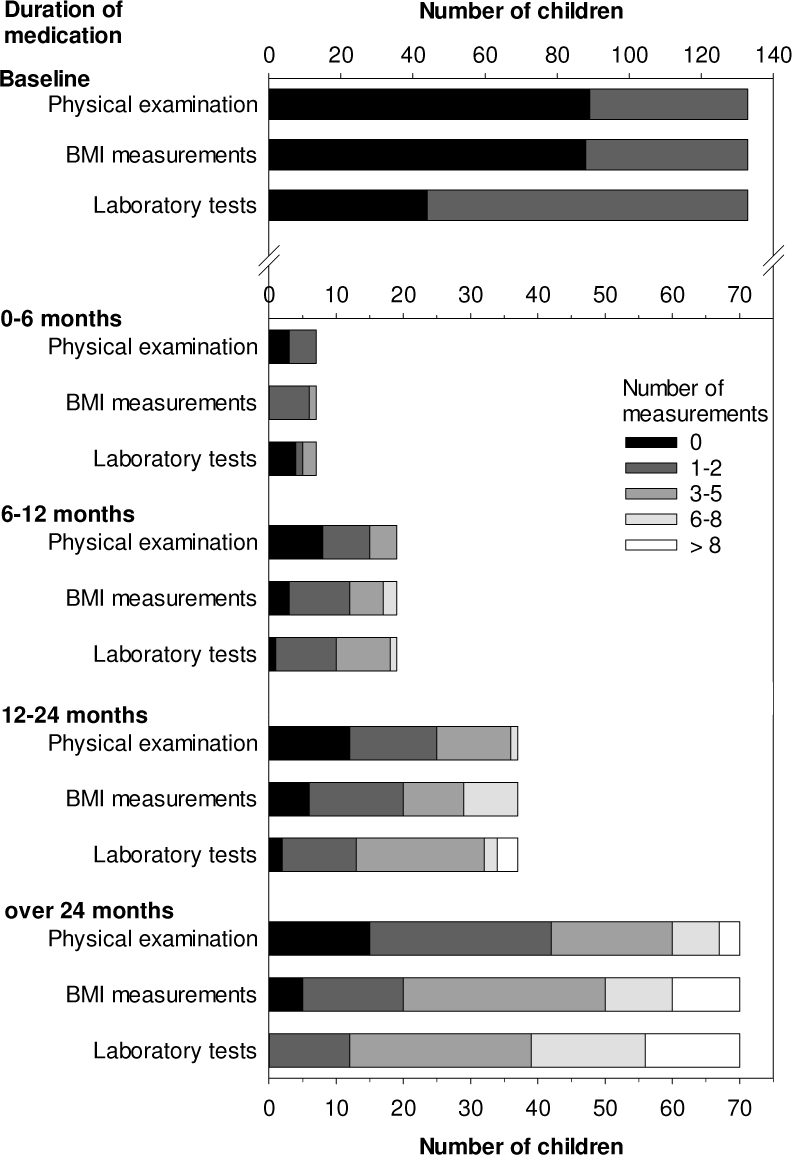
FIGURE 3.
Physical examination, BMI measurements, and laboratory tests performed during the second-generation antipsychotic treatment