
Table 1.
Descriptive statistics
| Sex | Year of study | Seniority | Other student associations | Residence | ||
|---|---|---|---|---|---|---|
| N | Valid | 25 | 25 | 25 | 25 | 25 |
| Missing | 1 | 1 | 1 | 1 | 1 | |
| Average | 0.32 | 2.56 | 1.76 | 0.48 | 0.72 | |
| Median | 0.00 | 3.00 | 2.00 | 0.00 | 1.00 | |
| Mode | 0 | 2a | 2 | 0 | 1 | |
| SD | 0.476 | 1.003 | 0.663 | 0.510 | 0.458 | |
| Variance | 0.227 | 1.007 | 0.440 | 0.260 | 0.210 |
Table 2.
General measurements
| Valid | Missing | |||||
|---|---|---|---|---|---|---|
| Perception of friendship network density | 25 | 1 | 3.40 (14.2%) | 4.00 | 1.190 | 1.417 |
| Perception help network density | 25 | 1 | 3.36 (14%) | 4.00 | 1.186 | 1.407 |
| Precision help network | 25 | 1 | .353 | .333 | .289 | .083 |
| Precision friendship network | 25 | 1 | .482 | .500 | .237 | .056 |
| Bridge position perception-friendship network | 25 | 1 | 2.32 | 2.00 | 1.249 | 1.560 |
| Bridge position perception-help network | 25 | 1 | 2.68 | 3.00 | 1.345 | 1.810 |
| Ego-network density-Help | 17 | 9 | .225 | .000 | .333 | .111 |
| Ego-network density-Friendship | 25 | 1 | .257 | .071 | .441 | .195 |
| Ego-network size-Help | 17 | 9 | 2.35 | 2.00 | 1.367 | 1.868 |
| Ego-network size-Friendship | 24 | 2 | 2.67 | 2.00 | 1.857 | 3.449 |
| Self-monitoring level | 25 | 1 | 11.00 | 10.00 | 4.041 | 16.333 |
Table 4.
Regression coefficients
| Model | Unstandardized coefficients | Standardized coefficients | t | Sig. | |
|---|---|---|---|---|---|
| B | SD | Beta | |||
| (Constant) | −.258 | .360 | −.716 | .482 | |
| Self-monitoring level | .087 | .019 | .710 | 4.482 | .000 |
| Seniority | .084 | .120 | .113 | .702 | .491 |
| Residence | .132 | .171 | .123 | .774 | .448 |
| Sex | .008 | .147 | .008 | .055 | .957 |
| Year of study | −.041 | .087 | −.084 | −.476 | .640 |
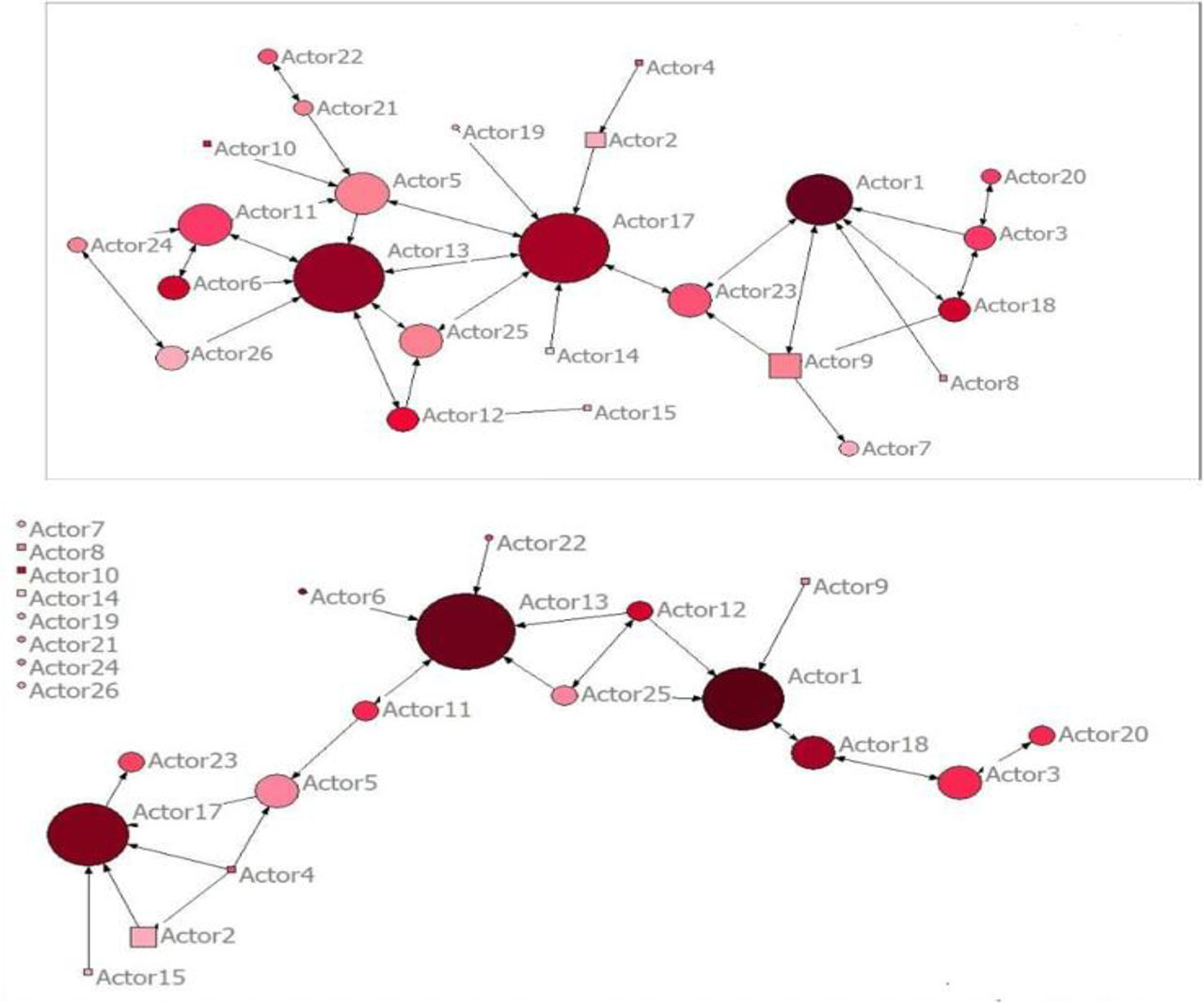
Figure 1.
Friendship and support networks
LEGEND
Size: Indegree (Number of connections received)
Residence: Round-Campus, Square-Other area
Color intensity: Self-monitoring level
| No. | Statement | Agree (A) | False (F) |
|---|---|---|---|
| 1 | It seems difficult for me to imitate other people’s behavior. | ☐ | ☐ |
| 2 | My behavior usually expresses my true feelings, attitudes, and beliefs. | ☐ | ☐ |
| 3 | At parties or social gatherings, I don’t expect to do or say things just to please others. | ☐ | ☐ |
| 4 | I can only argue for ideas I truly believe in. | ☐ | ☐ |
| 5 | I can improvise conversations even on topics I don’t know much about. | ☐ | ☐ |
| 6 | I think I can act like a show-off to impress or entertain people. | ☐ | ☐ |
| 7 | When I’m unsure how to behave in a social situation, I watch others’ behavior for cues. | ☐ | ☐ |
| 8 | I could probably be a good actor. | ☐ | ☐ |
| 9 | I rarely ask my friends for advice on choosing movies, books, or music. | ☐ | ☐ |
| 10 | Sometimes I give others the impression that I’m experiencing stronger emotions than I really am. | ☐ | ☐ |
| 11 | I laugh more when watching a comedy with others than when I’m alone. | ☐ | ☐ |
| 12 | In a group of people, I’m rarely the center of attention. | ☐ | ☐ |
| 13 | In different situations and with different people, I often behave like two different persons. | ☐ | ☐ |
| 14 | I’m not good enough to make others like me. | ☐ | ☐ |
| 15 | Even if I’m not having fun, I often pretend that I’m enjoying myself. | ☐ | ☐ |
| 16 | I’m not always the person I appear to be. | ☐ | ☐ |
| 17 | I don’t change my opinions (or the way I do things) just to please someone or get a favor. | ☐ | ☐ |
| 18 | I consider myself the life of the party. | ☐ | ☐ |
| 19 | To get something and to be liked, I tend to be what people expect me to be rather than who I really am. | ☐ | ☐ |
| 20 | I have never been good at role-playing or improvisational games. | ☐ | ☐ |
| 21 | I have trouble changing my behavior to match that of other people or different situations. | ☐ | ☐ |
| 22 | At a party, I let others tell jokes and stories. | ☐ | ☐ |
| 23 | I feel a bit awkward in social settings and don’t present myself as well as I should. | ☐ | ☐ |
| 24 | I can look someone in the eye and tell a lie wit | ☐ | ☐ |
| 25 | I can deceive people by being friendly when I actually don’t like them. | ☐ | ☐ |
| One point was calculated for each of the following: | |||
| 1, 2, 3, 4, 9, 12, 14, 17, 20, 21, 22, 23- False, | |||
| 5, 6, 7, 8, 10, 11, 13, 15, 16, 18, 19, 24, 25- True | |||
| According to Snider’s (1976) classification, there will be three categories: low level of self-monitoring (between 0 and 8 points), medium (9–14) and high (15–22). The relationships of the actor who did not participate were excluded from the analysis. | |||
| Year of study…. | |||
| Are you a member of any other student organizations? If so, which ones? | |||
| ….. | |||
| How many years have you been a member of ASUB? | |||
| …….. | |||
| Where do you live? | |||
| a) Grozăvești | |||
| b) Other location…. | |||
| Gender: | |||
| a) Female | |||
| b) Male | |||
| The survey is over. | |||
| Thank you for your time and willingness to participate in this study. | |||
| Have a nice day! | |||