
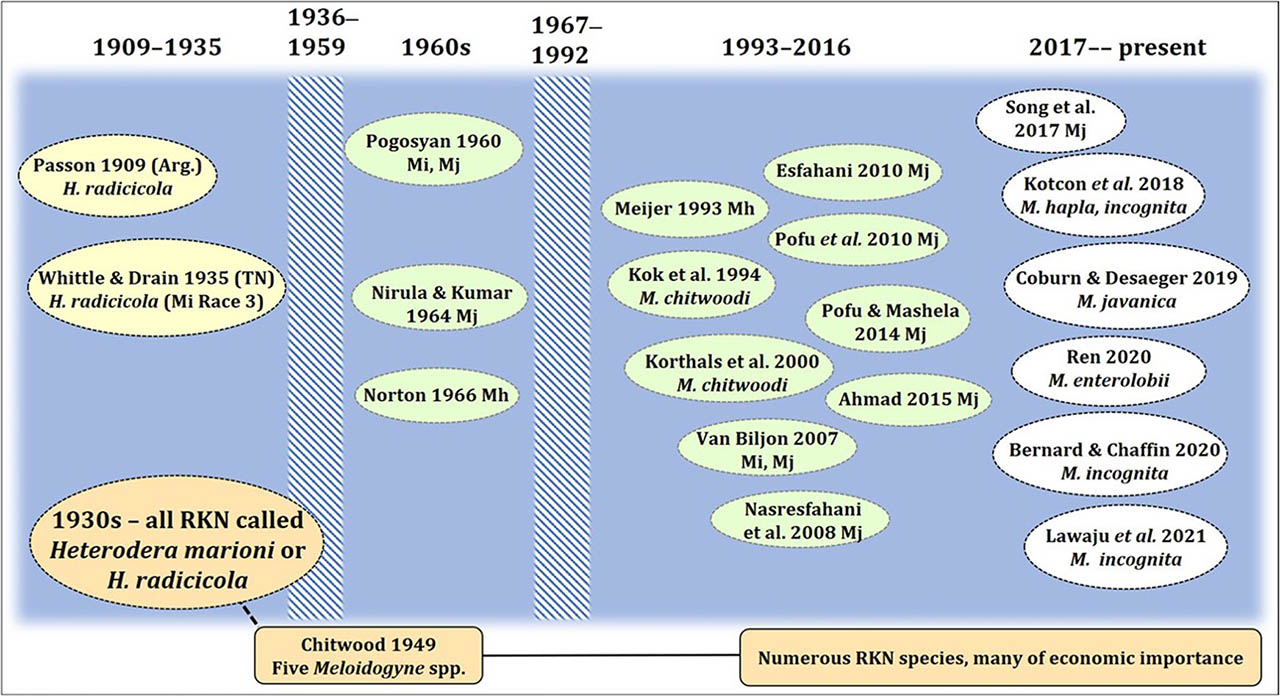
Figure 1
Time chart of primary literature reporting root-knot nematode-Cannabis sativa associations. Mh, Meloidogyne hapla; Mi, M. incognita; Mj, M. javanica.
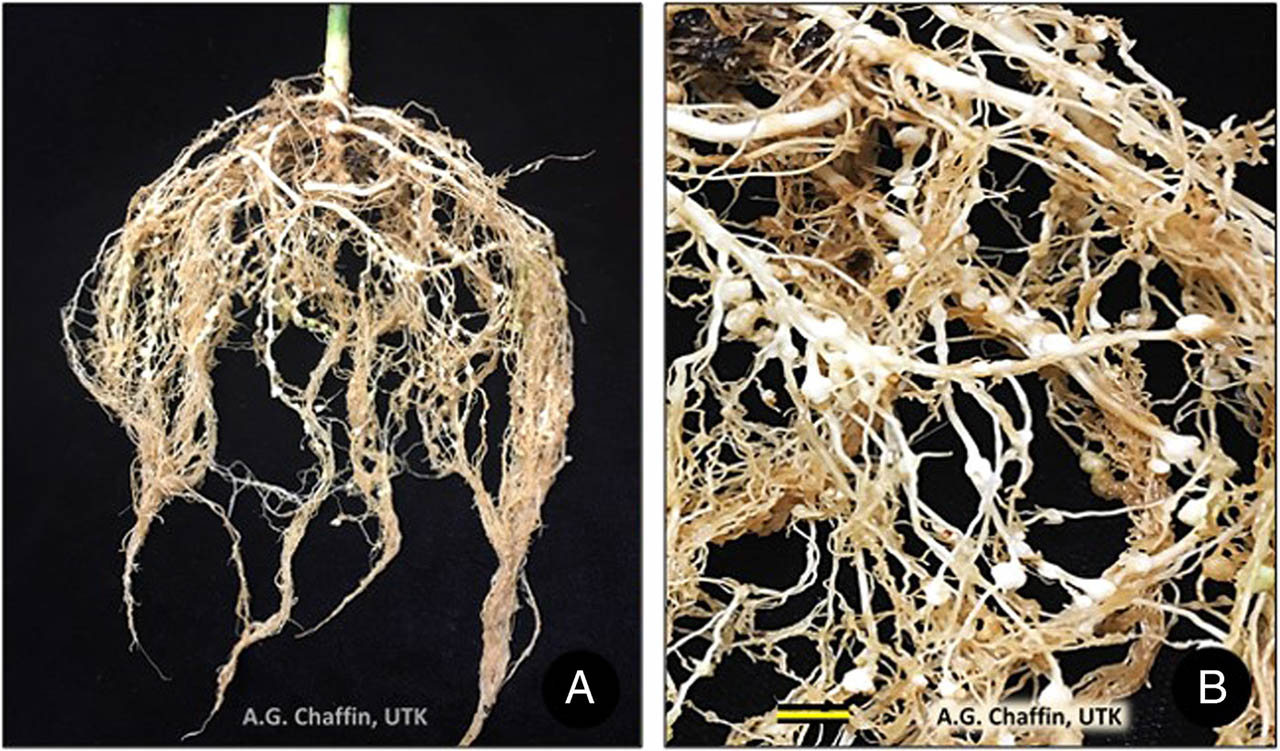
Figure 2
Galling of Meloidogyne incognita on Cannabis sativa ‘Cherry’, Pi = 10,000 eggs. (A) Entire root system. (B) Closeup of small, white galls. Scale = 5 mm.
Table 1
Experimental results on the use of hemp tissues and extracts for nematode management.
| Treatment with hemp | Target nematode(s) | Results | Authors |
|---|---|---|---|
| Rotation crop with soybean | Heterodera glycines | J2 numbers were reduced 30%, soybean yields increased 11% when soybean followed hemp | Zhang et al. (2013) |
| Chopped leaves incorporated into potted soil | Meloidogyne incognita | Reproduction on tomato reduced 74% but plant growth parameters not significantly improved | Khanna and Sharma (1998) |
| Chopped leaves | Tylenchorhynchus sp. Helicotylenchus sp. | 42% reduction 82% reduction | Somvanshi and Gupta (2003) |
| Pulverized leaves incorporated into soil | Meloidogyne incognita | Galls decreased up to 54% on subsequent crop | Kayani et al. (2012) |
| Chopped leaves | Meloidogyne incognita | Incorporation of leaves did not improve growth of False Eranthemum infected with the nematode | Ganaie and Khan (2017) |
| Whole plant extract | Hoplolaimus indicus Longidorus sp. Pratylenchus sp. Xiphinema americanum | High nematode mortality | Pandey and Dwivedi (2000) |
| Plant extract | Aphelenchoides composticola | 70% mortality after 72 hr | Khanna et al. (1988), a |
| Green manure or plant powder | Meloidogyne incognita Helicotylenchus dihystera Tylenchorhynchus nudus Pratylenchus zeae | For green manure, increased plant growth, reduced nematode numbers; for plant powder, reduced nematode numbers but no improvement in plant growth | Thakur (2014) |
| Aqueous extract of stems, leaves, inflorescences | Strongylus papillosus Haemonchus contortus (mammal parasites) | Weak effect on S. papillosus J1, J2; no effect on J3 or H. contortus | Boyko and Brygadyrenko (2019) |
| Ethanol extracts of roots, leaves, inflorescences | Steinernema spp. Heterorhabditis bacteriophora (EPNs) | Highest attraction of dauer juveniles was to inflorescence extracts | Laznik et al. (2020) |
| Water extracts of plant tissue | Meloidogyne incognita | High mortality of J2 | Singh and Singh (2002) |
| Root and shoot extracts | Hoplolaimus indicus Rotylenchulus reniformis Tylenchorynchus brassicae | Effective mortality of nematode species tested down to 1:10 dilution | Haseeb et al. (1978) |
| Root extract | Meloidogyne incognita | Inhibited egg hatch, increased juvenile mortality | Ganaie and Khan (2016) |
| Leaf extract | Meloidogyne incognita | 74–96% juvenile mortality | Saxena and Gupta (2004) |
| Leaf extract | Meloidogyne incognita | 88% inhibition of egg hatch | Adegbite (2011) |
| Water extracts from ground leaves | Meloidogyne javanica | J2 mortality was 92% or higher at dilutions of 1:5 to 1:40 | Nandal and Bhatti (1983) |
| Water extracts from ground leaves | Meloidogyne javanica | Activity of 10-day-old extracts to J2 remained above 94% | Nandal and Bhatti (1986) |
| Hot and cold-water leaf extracts | Aphelenchoides composticola | Mortality increased with concentration, hot-water extracts more effective than cold extracts | Grewal (1989) |
| Aqueous leaf extract | Heterodera cajani | 100% mortality of J2 after 24 and 48 hr of exposure | Mojumdar et al. (1989) |
| Boiled aqueous leaf extract | Meloidogyne incognita | Soaking chickpea seed in extract totally inhibited J2 invasion of seedlings | Mojumder and Mishra (1991) |
| Water extract of leaves | Meloidogyne incognita | 100% mortality of juveniles | Sharma (1996) |
| Water extracts of macerated leaves | Meloidogyne incognita | Plant growth improved and J2 numbers reduced 40% on brinjal (eggplant) but not as much as with margosa extract | Shah et al. (2018) |
| Methanol extracts of dried, pulverized leaves | Meloidogyne javanica | 89% mortality of J2 in 5% solution | Amini et al. (2011) |
| Water extracts from ground leaves | Meloidogyne incognita | Extracts gave high mortality of J2 after 72 hrs | Mukhtar et al. (2013) |
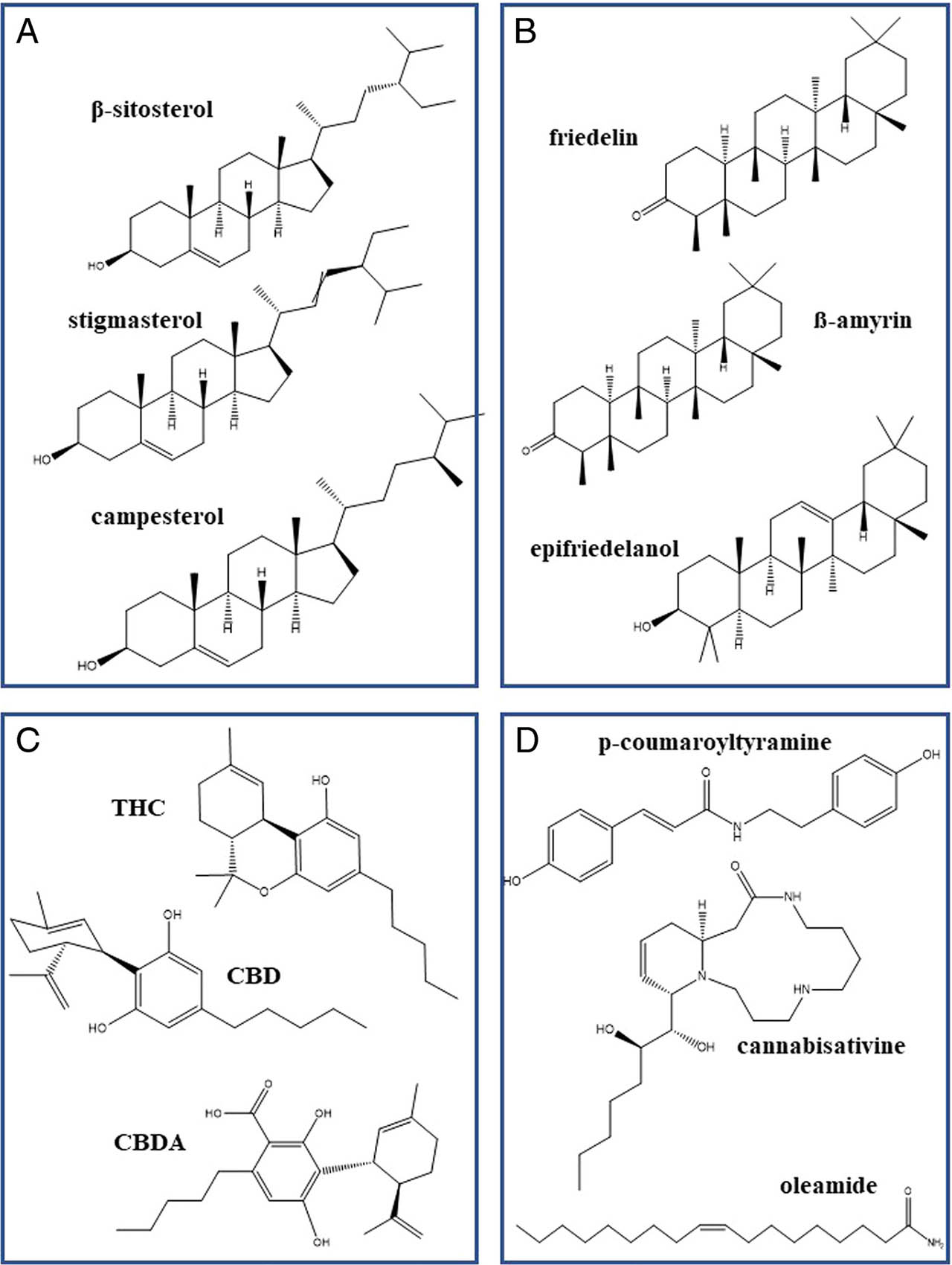
Figure 3
Chemicals isolated from Cannabis sativa roots. (A) Phytosterols. (B) Triterpenoids. (C) Cannabinoids: - (−)-trans-Δ9-tetrahydrocannabinol (THC); cannabidiol (CBD); cannabidiolic acid (CBDA). (D) Nitrogen-containing compounds.