
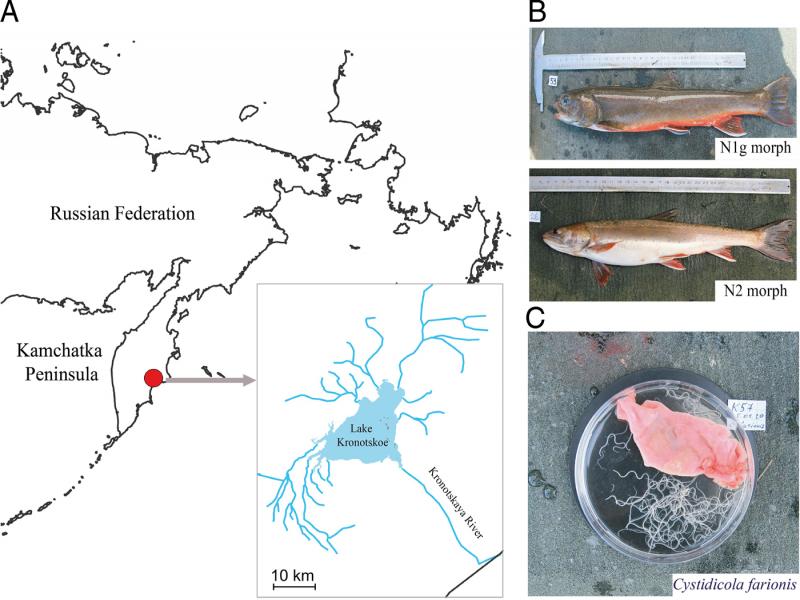
Figure 1:
Sampling site (A) of C. farionis (C) parasitizing the swim bladder of different morphs of the nosed charr (B). Picture by P.G. Vlasenko.
Table 1.
Descriptions of samples used in this study.
| Ecological group of fish | Sex | Body weight, g | Total length, mm | Fork length, mm | Type of sample for microbiome analysis | Number of pooled samples |
|---|---|---|---|---|---|---|
| 1-N1g | F | 304.4 | 355.0 | 309.0 | Gut | 15 |
| Gut | 15 | |||||
| “Body” | 15 | |||||
| “Body” | 15 | |||||
| Swim bladder | 1 | |||||
| 2-N1g | M | 652.1 | 438.0 | 400.0 | Gut | 20 |
| “Body” | 20 | |||||
| Swim bladder | 1 | |||||
| 3-N2 | M | 229.6 | 292.0 | 260.0 | Gut | 5 |
| Gut | 5 | |||||
| Gut | 10 | |||||
| Gut | 25 | |||||
| “Body” | 5 | |||||
| “Body” | 5 | |||||
| “Body” | 10 | |||||
| “Body” | 25 | |||||
| Swim bladder | 1 | |||||
| 4-N2 | F | 294.3 | 295.0 | 333.0 | Gut | 20 |
| “Body” | 20 | |||||
| Swim bladder | 1 |
Table 2.
Nearest-match identification of C. farionis to known sequences in NCBI database.
| GenBank acc. no. | Gene | Species |
|---|---|---|
| JF803919.1 | small subunit ribosomal RNA gene (18S) partial | C. farionis |
| MG594291.1 | small subunit ribosomal RNA gene (18S) partial | C. farionis |
| DQ094172.1 | small subunit ribosomal RNA gene (18S) partial | Ascarophis arctica |
| MN294781.1 | small subunit ribosomal RNA gene (18S) partial | Comephoronema werestschagini |
| MN294783.1 | small subunit ribosomal RNA gene (18S) partial | Capillospirura ovotrichuria |
| MG594289.1 | small subunit ribosomal RNA gene (18S) partial | Capillospirura sp. |
| JF934733.1 | small subunit ribosomal RNA gene (18S) partial | Proleptus sp. |
| DQ442660.1 | small subunit ribosomal RNA gene (18S) partial | Neoascarophis macrouri |
| JF803921.1 | small subunit ribosomal RNA gene (18S) partial | N. longispicula |
| JF803926.1 | small subunit ribosomal RNA gene (18S) partial | Heliconema longissimum |
| JF803949.1 | small subunit ribosomal RNA gene (18S) partial | H. longissimum |
| JF803930.1 | small subunit ribosomal RNA gene (18S) partial | Ascarophis adioryx |
| MT086834.1 | large subunit ribosomal RNA gene (28S) partial | C. farionis |
Table 3.
Prevalence, intensity and mean abundance of C. farionis in swim bladder of three morphs of nosed charr at different sampling times.
| Year | Month | Prevalence, % | Intensity | Mean abundance | Number of fish |
|---|---|---|---|---|---|
| Nosed charr N1 (n = 227) a | |||||
| 2013 | VI-VIII | 69 | 0–328 | 83.0 ± 3.9 | 13 |
| 2014 | VI | 96 | 0–452 | 144.0 ± 15.4 | 49 |
| VII | 84 | 0–335 | 131.0 ± 13.6 | 50 | |
| VIII | 87 | 0–526 | 150.0 ± 18.2 | 38 | |
| IX | – b | – | – | – | |
| X | 94 | 0–550 | 140.0 ± 18.2 | 47 | |
| XI | 100 | 12–508 | 154.9 ± 23.4 | 30 | |
| Nosed charr N1g (n = 2) | |||||
| 2020 | IX-X | 100 | 15–20 | 16.6 ± 5.0 | 2 |
| Nosed charr N2 (n = 57) | |||||
| 2013 | VI-VIII | 82 | 0–685 | 172.0 ± 44.8 | 17 |
| 2014 | VI | 63 | 0–274 | 126.0 ± 42.0 | 8 |
| VII | 80 | 0–362 | 179.0 ± 38.9 | 10 | |
| VIII | 100 | 43–252 | 118.0 ± 28.8 | 8 | |
| IX | 100 | 23 | 23.0 | 1 | |
| X | 100 | 130–376 | 243.0 ± 33.1 | 8 | |
| XI | 100 | 155–466 | 333.0 ± 92.0 | 3 | |
| 2020 | IX-X | 100 | 5–45 | 32.5 ± 12.5 | 2 |
| Nosed charr N3 (n = 37) | |||||
| 2013 | VI-VIII | 88 | 0–519 | 205.0 ± 58.2 | 8 |
| 2014 | VI | – | – | – | – |
| VII | 100 | 28–225 | 130.0 ± 44.5 | 4 | |
| VIII | 100 | 420 | 420.0 | 1 | |
| IX | 74 | 0–466 | 102.0 ± 24.04 | 23 | |
| X | 100 | 318 | 318.0 | 1 | |
| XI | – | – | – | – | |
| 2020 | IX-X | – | – | – | – |
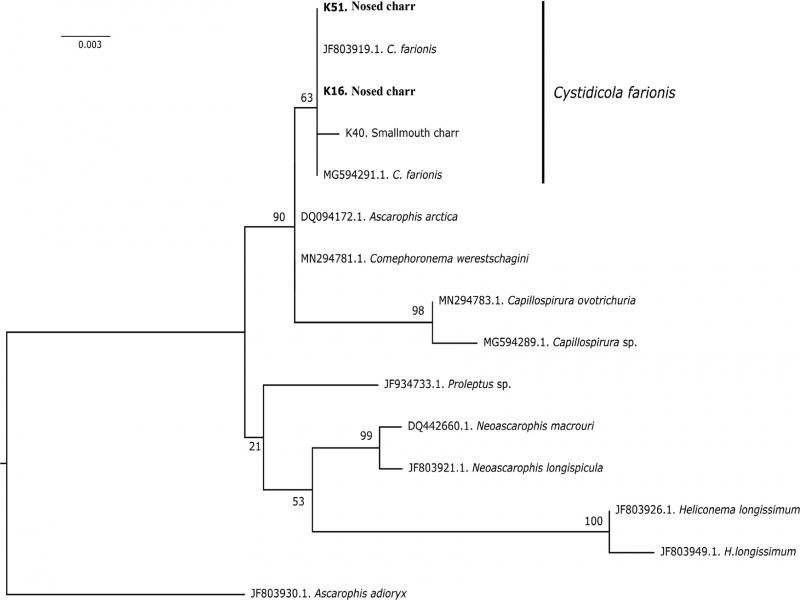
Figure 2:
18S rRNA gene tree reconstruction based on ML methods.
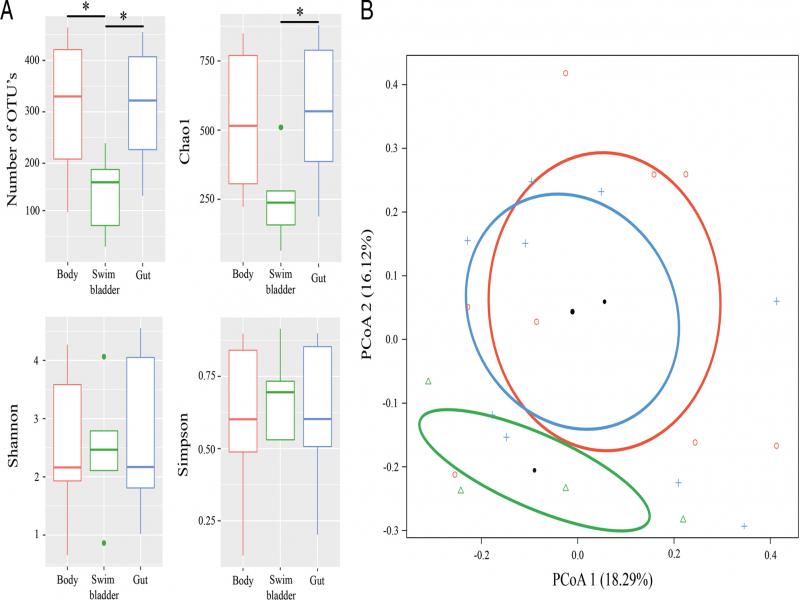
Figure 3:
Diversity analysis of microbial community associated with nematodes Cystidicola farionis. (A) The richness and diversity estimates of microbial communities. (B) Principal coordinates analysis (PCoA) for nematode-associated microbiota: red—“body”, green—swim bladder, blue—gut. The asterisk character indicates significance at p ≤ 0.05.
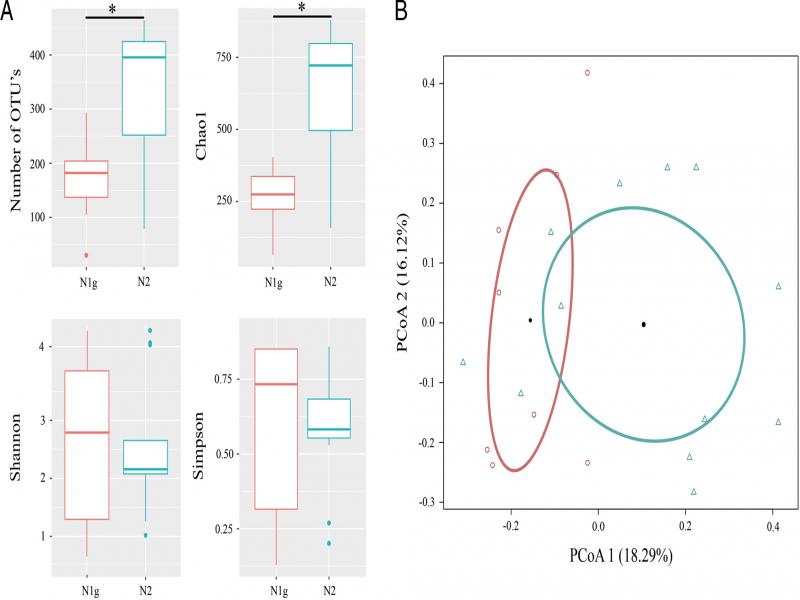
Figure 4:
Diversity analysis of the microbial community associated with nematodes Cystidicola farionis parasitizing the swim bladder of two morphs of nosed charr. (A) The richness and diversity estimates of microbial communities. (B) Principal coordinates analysis (PCoA) for nematode-associated microbiota: red—morph N1g of nosed charr, blue—morph N2 of nosed charr. The asterisk character indicates significance at p ≤ 0.05.
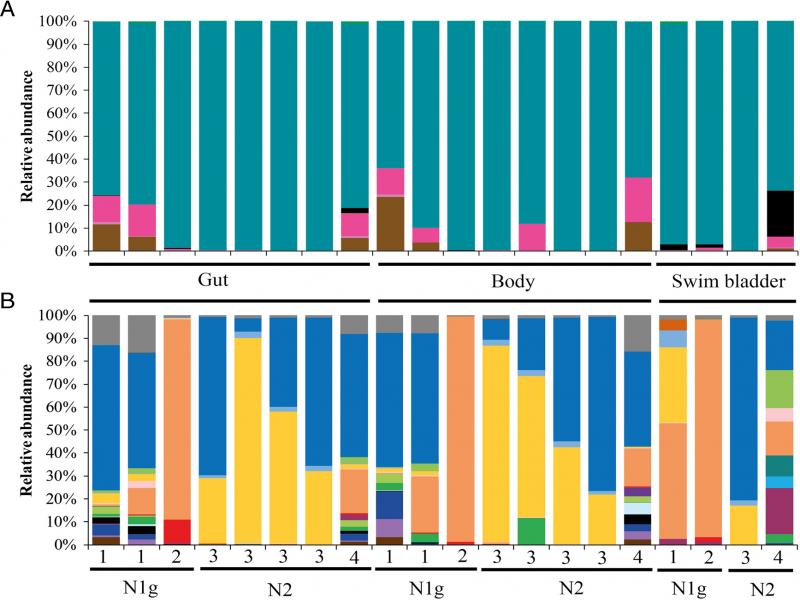
Figure 5:
Taxonomical composition of microbial communities identified in gut, “body” remains of Cystidicola farionis and microbiota of swim bladder of nosed charr. Numbers 1 to 4 along x-axis denotes the number of individual of nosed charr per pool; N1g/N2 indicates an ecological group of fish, «whole» indicates whole nematode without dissection of their “body”. (A) Phylum composition: ( ) Actinobacteria, (
 ) Bacteroidetes, (
 ) Chloroflexi, (
 ) Firmicutes, (
 ) Fusobacteria, (
 ) Proteobacteria, (
 ), Others<1%. (b) Genus and family proportions: (
 ) Corynebacterium 1, (
 ) Lawsonella, (
 ) Cutibacterium, (
 ) Nodosilinea PCC-7104, (
 ) Tumebacillus, (
 ) unc. Alicyclobacillaceae, (
 ) Bacillus, (
 ) Staphylococcus, (
 ) Cetobacterium, (
 ) Caulobacter, (
 ) Paracoccus, (
 ) Pajaroellobacter, (
 ) Aeromonas, (
 ) Shewanella, (
 ) Ambiguous taxa of Enterobacteriaceae, (
 ) Yersinia, (
 ) unc. other Enterobacteriaceae, (
 ) Acinetobacter, (
 ) Pseudomonas, (
 ) unc. Gammaproteobacteria, (
 ) Other < 3%.