
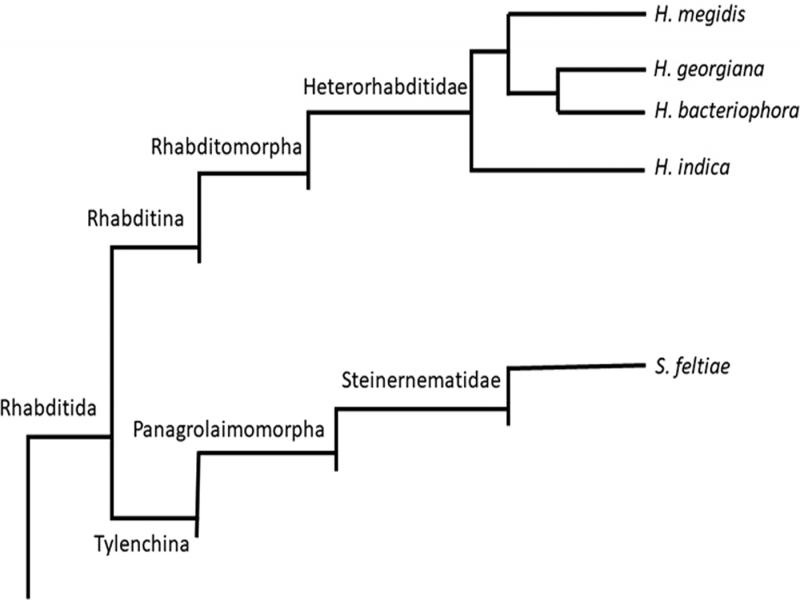
Figure 1:
Abbreviated phylogeny showing the five EPN species used in the current study. Adapted from Kaplan et al. (2012), Spiridonov and Subbotin (2016) and De Brida et al. (2017).
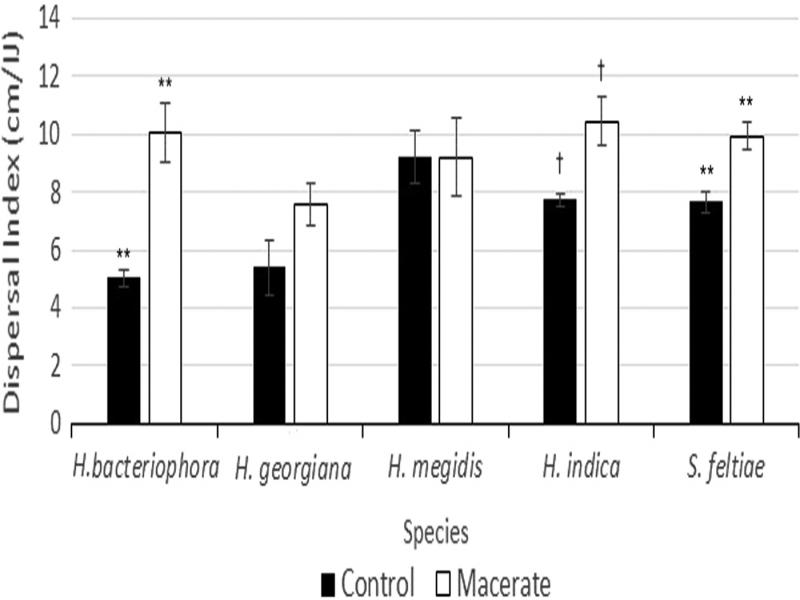
Figure 2:
Dispersal responses of five EPN species after exposure to their own macerate. Bars show means +/- SEM. Symbols over bars indicate species that showed statistically significant increases in dispersal after conspecific macerate exposure († = P < 0.10, ** = P < 0.01).
Table 1.
Average number of IJs infecting G. mellonella larvae after exposure to either DI water, their own macerate, or macerate derived from H. bacteriophora infected cadavers. Data show means ± SEM. Significant effects of macerate exposure based on post-hoc tests comparing DI water to macerate treatment; † = P < 0.10, * = P < 0.05.
| Species | Own maceratea | H. bacteriophora macerateb | ||
|---|---|---|---|---|
| DI water | Macerate | DI water | Macerate | |
| H. bacteriophora | 0 | 4.4 ± 1.1* | 0 | 3.2 ± 2.1 |
| H. georgiana | 0 | 15.9 ± 12.5 | 0.5 ± 0.5 | 0.8 ± 0.5 |
| H. megidis | 143.7 ± 31.1 | 83.7 ± 25.4 | 102.3 ± 50.2 | 65.3 ± 21.3 |
| H. indica | 2.4 ± 1.5 | 26.1 ± 13.4† | 2.5 ± 2.5 | 1.8 ± 0.7 |
| S. feltiae | 0 | 8.6 ± 3.9* | 0 | 0 |
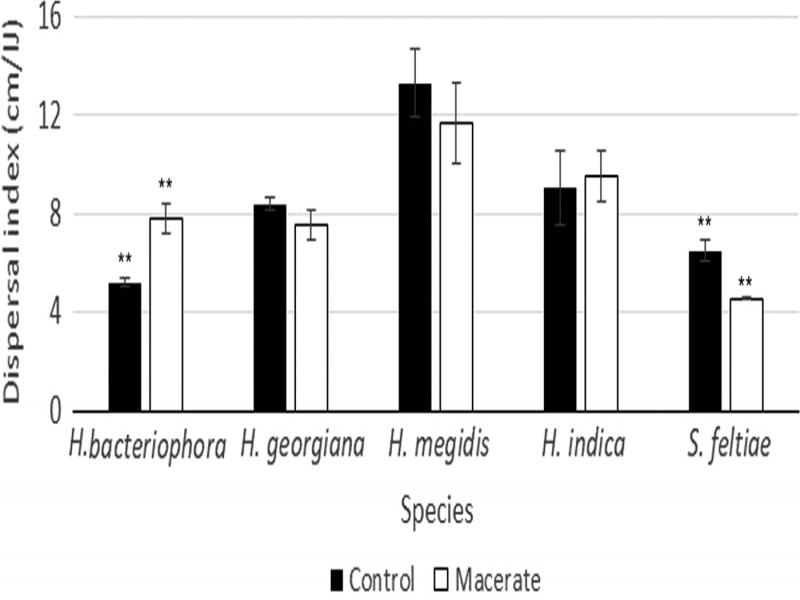
Figure 3:
Dispersal responses of five EPN species after exposure to macerate derived from Heterorhabditis bacteriophora-infected cadavers. Bars show means ± SEM. Symbols over bars indicate species that showed statistically significant changes in dispersal after conspecific macerate exposure (**= P < 0.01). Relative to H. bacteriophora, increasing distance to the right along the graph represents increasing phylogenetic distance, according to Spiridonov and Subbotin (2016).