
Table 1.
Locations of plantations sampled for the recognition of nematodes in Desmodium ovalifolium.
| Sample No. | Coordinate Length | Latitude | Location | Oil palm planting year | Presence of galls in D. ovalifolium |
|---|---|---|---|---|---|
| 1 | 6,7073 | ‒74,0007 | Puerto Parra (Santander) | 2013 | + |
| 2 | 6,7073 | ‒73,9994 | Puerto Parra (Santander) | 2012 | + |
| 3 | 6,7722 | ‒74,0502 | Puerto Parra (Santander) | 2013 | + |
| 4 | 6,9736 | ‒73,6815 | Barrancabermeja (Santander) | 2012 | + |
| 5 | 6,9066 | ‒73,6816 | San Vicente de Chucurí (Santander) | 2007 | + |
| 6 | 6,9823 | ‒73,6232 | San Vicente de Chucurí (Santander) | 2004 | + |
| 7 | 7,0328 | ‒73,5576 | San Vicente de Chucurí (Santander) | 2010 | ‒ |
| 8 | 7,2072 | ‒73,5793 | Puerto Wilches (Santander) | 2013 | + |
| 9 | 7,2636 | ‒73,5804 | Rio Negro (Santander) | 2012 | ‒ |
| 10 | 7,6562 | ‒73,5765 | Rio Negro (Santander) | 2012 | ‒ |
| 11 | 7,2308 | ‒73,5588 | Sabana de Torres (Santander) | 2001 | + |
| 12 | 7,1554 | ‒73,5183 | Girón (Santander) | 2014 | ‒ |
| 13 | 7,1655 | ‒73,5009 | Girón (Santander) | 2013 | ‒ |
| 14 | 7,3257 | ‒73,5661 | Sabana de Torres (Santander) | 2007 | ‒ |
| 15 | 7,3862 | ‒73,5256 | Sabana de Torres (Santander) | 2013 | + |
| 16 | 6,7806 | ‒73,9080 | Simacota (Santander) | 2010 | ‒ |
| 17 | 6,7781 | ‒73,9042 | Simacota (Santander) | 2010 | ‒ |
| 18 | 6,7923 | ‒73,7590 | Simacota (Santander) | 1999 | + |
| 19 | 7,3116 | ‒73,8327 | Puerto Wilches (Santander) | 2014 | + |
| 20 | 7,3000 | ‒73,8793 | Puerto Wilches (Santander) | 2010 | ‒ |
| 21 | 7,2451 | ‒73,8438 | Puerto Wilches (Santander) | 1997 | + |
| 22 | 7,2836 | ‒73,7143 | Puerto Wilches (Santander) | 2006 | + |
| 23 | 7,3301 | ‒73,6687 | Puerto Wilches (Santander) | 2009 | + |
| 24 | 7,2260 | ‒73,5466 | Sabana de Torres (Santander) | 2013 | ‒ |
| 25 | 7,2340 | ‒73,5445 | Sabana de Torres (Santander) | 2013 | ‒ |
| 26 | 7,7864 | ‒73,4530 | San Alberto (Cesar) | 2008 | ‒ |
| 27 | 7,7864 | ‒73,4538 | San Alberto (Cesar) | 2009 | ‒ |
| 28 | 7,6551 | ‒73,3853 | La Esperanza (Norte de Santander) | 2008 | + |
| 29 | 7,7678 | ‒73,4023 | San Alberto (Cesar) | 2005 | + |
| 30 | 7,2159 | ‒73,5777 | Sabana de Torres (Santander) | 2008 | + |
Table 2.
Morphometric data for Pterotylenchus cecidogenus, including those characterized in the present study, those reported in the original description, and those from reference populations of Orrina phyllobia (=Ditylenchus phyllobius).
| Measurement | Pterotylenchus cecidogenus (females)1 n = 23 | Pterotylenchus cecidogenus (females)2 n = 30 | Orrina phyllobia (females)3 n = 20 | Ditylenchus phyllobius(females)4 n = not available | Ditylenchus phyllobius(females)5 n = not available |
|---|---|---|---|---|---|
| Body length | 708.4 ± 36.5 (646.4–790.3) | 640 (590–800) | 696.2 (637–785) | (590–840) | 684 (592–838) |
| a | 30.5 ± 1.8 (26.5–33.7) | 28 (22–35) | 31.6 (22.5–39) | (20–32) | 25 (20–32) |
| c | 12.5 ± 1.6 (11.1–17.4) | 11.0 (9.6–12.5) | 18.3 (17–19.6) | (11.4–17.6) | 14.6 (11.4–17.6) |
| c´ | 4.2 ± 0.4 (2.8–4.8) | 4.5 (3.6–5.2) | 4.4 (3.5–5.6) | (2.9–4.5) | 3.7 (2.9–4.5) |
| V% | 82 ± 0.9 (80.0–84.3) | 82 (80.0–84.0) | 79.2 (78–81) | (78–85) | 81 (78–84) |
| Stylet | 9.1 ± 2.4 (5.2–11.9) | 9.5 (8.0–11.0) | 9 (8–9) | (9–10) | (9–11) |
| Max. body diameter | 23.2 ± 1.3 (21.0–26.6) | 22 (20.0–25.0) | - | - | - |
| Anal body diameter | 13.5 ± 1.0 (11.8–14.9) | - | - | - | - |
| Tail length | 57,6 ± 6.1 (40.4–64.1) | 60 (53.0–68.0) | - | - | - |
1 Note: L = total body length, a = total body length divided by maximum body diameter, c = total body length divided by tail length, c´ = tail length divided by diameter at the anal aperture, V% = position of vulva from anterior end expressed as percentage of body length. Present study of Colombian central zone. Carimagua, Colombia (Siddiqi and Lenné, 1984). Guanajuato, Mexico (Medina et al., 2016). Nickle (1991). Brzeski (1991).
Table 3.
Information of sequences D2-D3 and internal transcribed spacer (ITS) of ribosomal deoxyribonucleic acid (DNA) downloaded from GenBank and obtained in the present study.
| Species name | Location | Host plant | D2-D3 accession number | ITSaccession number | Reference or source |
|---|---|---|---|---|---|
| P. cecidogenus | Colombia | D. ovalifolium | MW208689; MW208690; MZ404621; MZ404622; MZ404623; MZ404624; MZ404625; MZ404626; MZ404627; MZ404628; MZ404629; MZ404630 | MZ449098;MZ449099;MZ449100;MZ449101;MZ449102;MZ449103;MZ449104;MZ449105;MZ449106;MZ449107;MZ449108;MZ449109;MZ449110 | Present study |
| Anguina tritici | China | Triticum sp. | DQ328723; KC818620 | - | Subbotin et al. (2006) |
| Anguina graminis | Russia | Festuca rubra | - | AF396351 | Subbotin et al. (2004) |
| Anguina wevelli | USA | Eragrostis curvula | - | AM888393; KU052862 | Song et al. (2015) |
| Anguina amsinckiae | USA | Amsinckia sp. | - | MK032870 | Cid del Prado Vera et al. (2018) |
| Subanguina chilensis | Chile | - | DQ328724 | - | Subbotin et al. (2006) |
| Subanguina moxae | China | Artemisia argyi | JN885540 | - | Yao et al. (2012) |
| Subanguina radicicola | Belgium; China | Poa sp. | DQ328721 | AF396365; JN885538 | (Subbotin et al., 2004; Subbotin et al., 2006) |
| Subanguina danthoniae | USA | Danthonia californica | - | MK032869 | Cid del Prado Vera et al. (2018) |
| Heteroanguina graminophila | Russia | Calamagrostis spp. | DQ328720 | AF396315; AF396318 | (Subbotin et al., 2004; Subbotin et al., 2006) |
| Mesoanguina millefolii | Russia | - | DQ328722 | - | Subbotin et al. (2006) |
| Ditylenchus destructor | Russia; Poland; China; Iran | Solanum tuberosum; Ipomoea batatas | DQ328727; EU400639; HQ235698 | KC923223; KC923224 | (Subbotin et al., 2006; Subbotin et al., 2011; Jeszke et al., 2013; Mahmoudi et al., 2020) |
| Ditylenchus dipsaci | Yemen; Mexico | Allium sativum; Medicago sativa | JF327759 | KY348764 | Rosas-Hernández et al. (2017) |
| Ditylenchus gallaeformans | Brazil | Miconia albicans; Miconia coralline; Leandra lacunosa | JQ429769; JQ429770 | JQ429778; JQ429779 | Oliveira et al. (2013) |
| Ditylenchus drepanocercus | Brazil | Miconia calvescens | JQ429772 | - | Oliveira et al. (2013) |
| Ditylenchus oncogenus | Italy | Sonchus bulbosus | KF612015 | - | Vovlas et al. (2015) |
| Ditylenchus phyllobius | Mexico | Solanum elaeagnifolium | KT192617, KT192618 | KT192615; KT192616 | Medina et al. (2016) |
| Ditylenchus persicus | Iran | Vitis vinifera | KX463285 | KX463286 | Esmaeili et al. (2017) |
| Ditylenchus weischeri | Canada | Cirsium arvense | MG551902 | MG386845 | Madani and Tenuta (2018) |
| Ditylenchus gigas | Italy; Iran | Vicia faba; Allium sativum | HQ219216 | KJ653270 | Vovlas et al. (2011) |
| Ditylenchus arachis | China | Arachis hypogaea | KX426054 | JN635037; JX040545 | Zhang et al. (2014) |
| Ditylenchus halictus | Germany | Halictus sexcinctus | AY589364 | - | Ye et al. (2007) |
| Ditylenchus gilanicus | Iran | Fagus orientalis | MG742325 | - | Yaghoubi et al. (2018) |
| Cervidellus cervus | USA | Ferocactus | HM452377 | - | Bostrom et al., (2011) |
| Radopholus similis | Colombia | Musa sp. | - | GQ281456 | Múnera et al. (2010) |
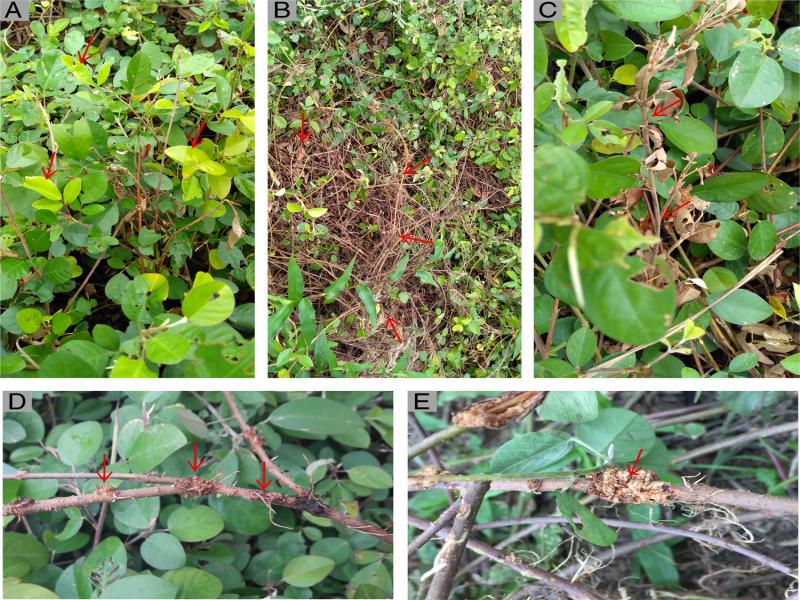
Figure 1:
Symptoms caused by Pterotylenchus cecidogenus nematode on Desmodium ovalifolium. (A) Chlorosis on leaves. (B) Patches caused by drying of plants. (C) Drying and death of the plant. (D) Galls at stem nodes. (E) Old and cracking galls, and the affected cortical tissue. All symptoms are indicated by arrows.
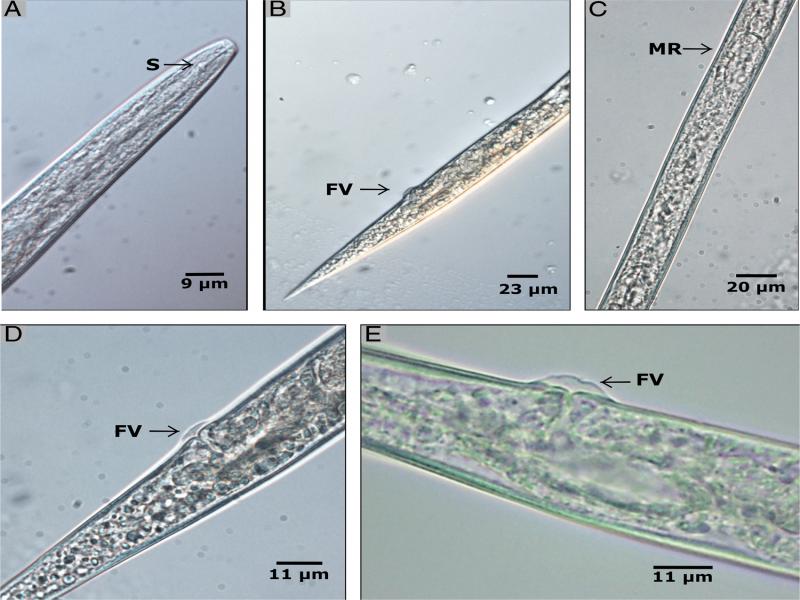
Figure 2:
Pterotylenchus cecidogenus microphotographs. (A) Anterior region of the female. (B) Posterior region of the female. (C) Middle region of the female. (D, E) Vulval region of the female. S = stylet, FV = Vulval flaps and MR = Middle region.
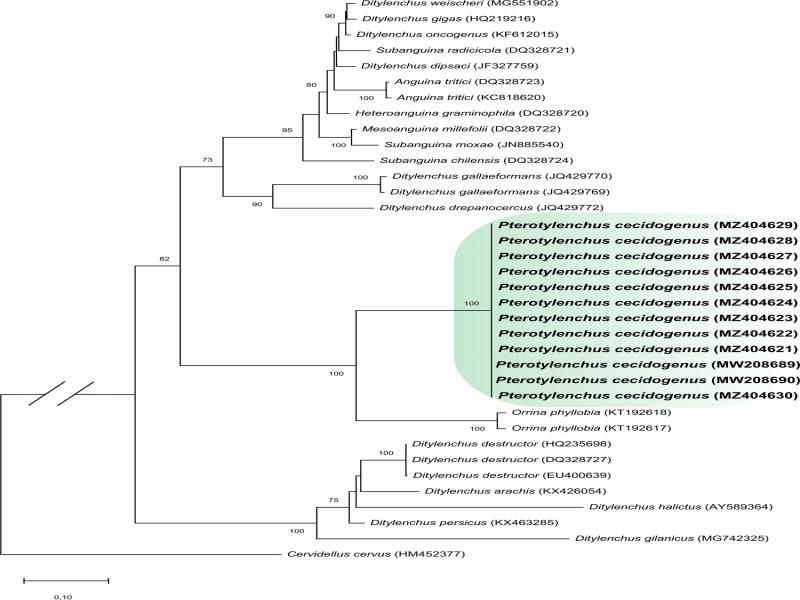
Figure 3:
Phylogenetic tree obtained by the statistical method of maximum likelihood based on the Tamura-Nei model of the consensus sequences of the D2–D3 partial segment of Pterotylenchus and related genera. The sequences of this work are indicated in bold. The numbers on the nodes indicate bootsrap values of ≥ 70%. The species Cervidellus cervus (HM452377) is included as an outgroup.
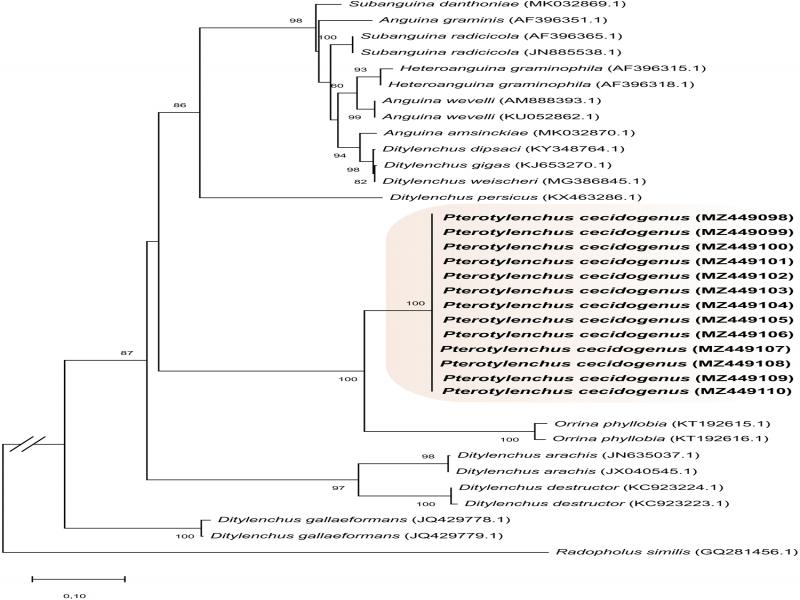
Figure 4:
Phylogenetic tree obtained by the statistical method of maximum likelihood based on the Tamura-Nei model of the consensus sequences of the internal transcribed spacer (ITS) of Pterotylenchus and related genera. The sequences of this work are indicated in bold. The numbers on the nodes indicate bootstrap values of ≥ 70%. The species Radopholus similis (GQ281456) is included as an outgroup.
Table 4.
Parasitic and ecological parameters of nematodes associated with Desmodium ovalifolium roots.
| Nematode | Absolute frequency | Relative frequency | Absolute density | Relative density | Prominence value | Relative prominence value |
|---|---|---|---|---|---|---|
| Meloidogyne | 33,3 | 30,2 | 8,7 | 25,2 | 50,2 | 30,5 |
| Pterotylenchus | 13,3 | 12,1 | 12,8 | 37,1 | 46,7 | 28,3 |
| Helicotylenchus | 30 | 27,3 | 6,2 | 18 | 34 | 20,6 |
| Pratylenchus | 26,7 | 24,3 | 6,3 | 18,3 | 32,6 | 19,8 |
| Xiphinema | 6,7 | 5,9 | 0,5 | 1,4 | 1,3 | 0,76 |
Table 5.
Parasitic and ecological parameters of nematodes in rhizospheric soil of Desmodium ovalifolium.
| Nematode genus | Absolute frequency | Relative frequency | Absolute density | Relative density | Prominence value | Relative prominence value |
|---|---|---|---|---|---|---|
| Helicotylenchus | 33.3 | 28,6 | 32,7 | 47,6 | 188,7 | 64,4 |
| Tylenchorhynchus | 23.3 | 20 | 14,5 | 21,1 | 70 | 23,9 |
| Xiphinema | 20 | 17,2 | 10,5 | 15,3 | 46,96 | 16 |
| Meloidogyne | 13,3 | 11,4 | 4 | 5,8 | 14,6 | 4,98 |
| Pterotylenchus | 10 | 8,6 | 3,5 | 5,1 | 11,1 | 3,8 |
| Pratylenchus | 6,7 | 5,7 | 1,5 | 2,2 | 3,9 | 1,33 |
| Criconemella | 6,7 | 5,7 | 1,3 | 1,9 | 3,4 | 1,16 |
| Trichodorus | 3,3 | 2,8 | 0,7 | 1 | 1,3 | 0,44 |