Have a personal or library account? Click to login
Molecular and morphological characterization of a first report of Cactodera torreyanae Cid del Prado Vera & Subbotin, 2014 (Nematoda: Heteroderidae) from Minnesota, the United States of America Cover

Molecular and morphological characterization of a first report of Cactodera torreyanae Cid del Prado Vera & Subbotin, 2014 (Nematoda: Heteroderidae) from Minnesota, the United States of America

Open Access
|Nov 2021

Figures & Tables

Figure 1:

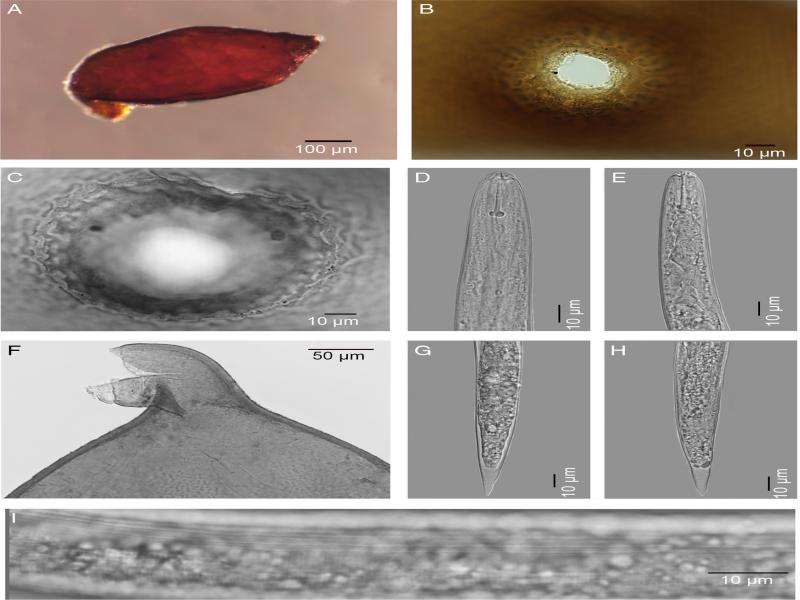
Photomicrographs of cysts, vulva cones and second-stage juveniles (J2) of Cactodera torreyanae. A: Entire cyst; B-C: Vulva cones; D-E: Anterior end of J2s; F: Cyst anterior end (arrow showing anterior end of J2 with stylet sticking out); G-H: Tails of J2s; I: Lateral field with 4 incisures for J2.
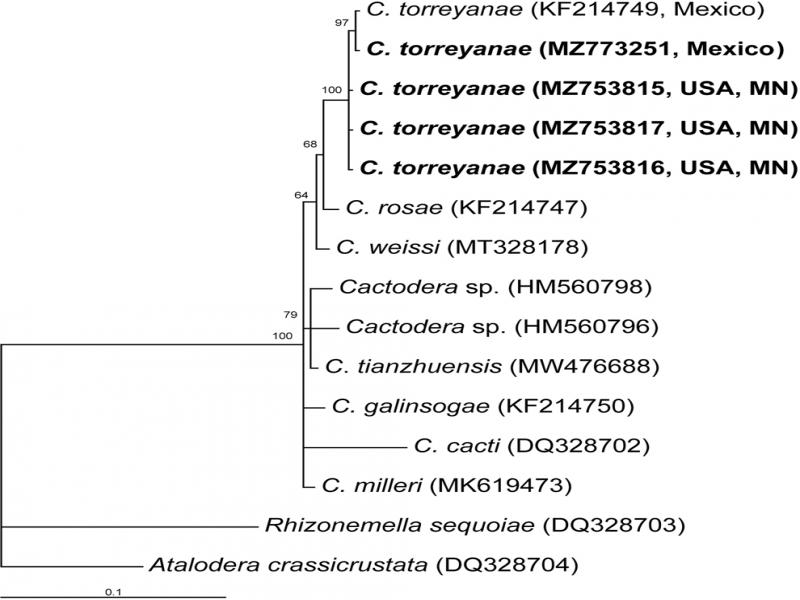

Figure 2:

Phylogenetic relationships within the genus Cactodera as inferred from Bayesian analysis using the D2-D3 of 28S rRNA gene sequences under the GTR + I + G model. Posterior probabilities are given for appropriate clades. New sequences obtained in the present study are indicated in bold.
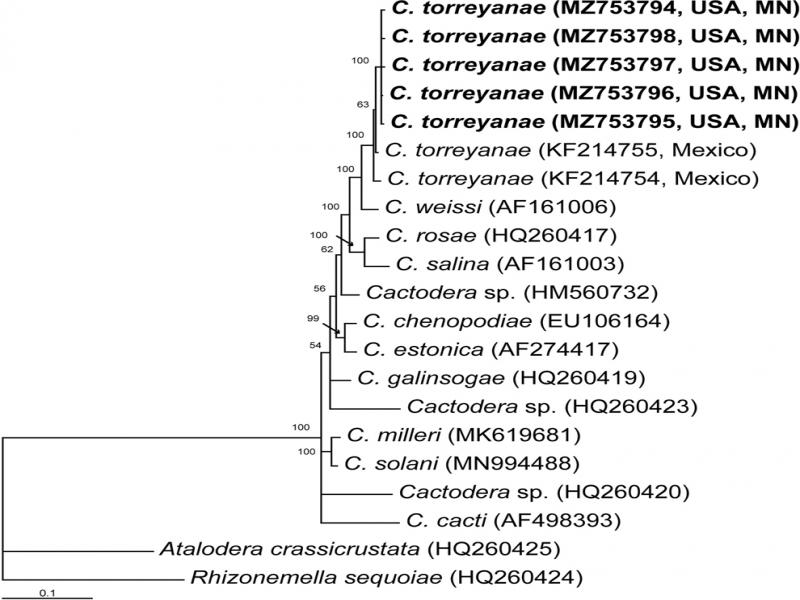
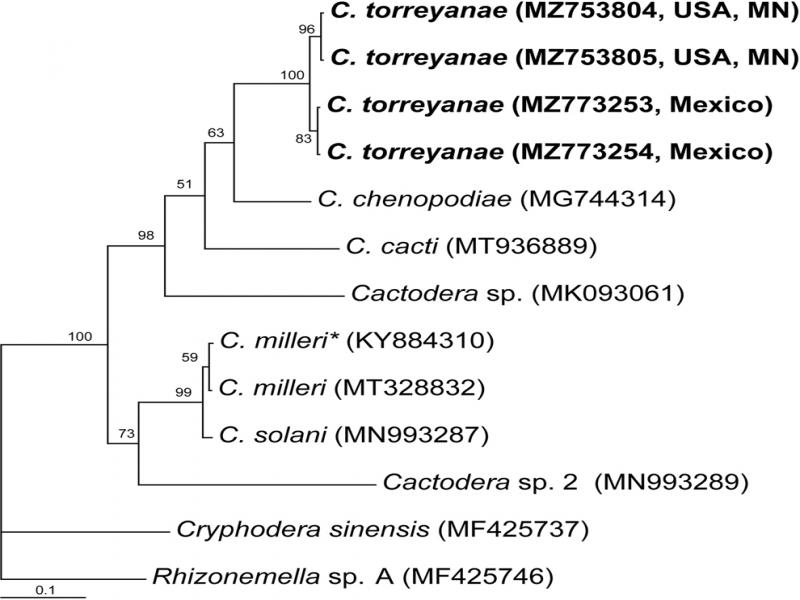
Figure 3:

Phylogenetic relationships within the genus Cactodera as inferred from Bayesian analysis using the ITS rRNA gene sequences under the GTR + I + G model. Posterior probabilities are given for appropriate clades. New sequences obtained in the present study are indicated in bold.

Figure 4:

Phylogenetic relationships within the genus Cactodera as inferred from Bayesian analysis using the COI gene sequences under the GTR + I + G model. Posterior probabilities are given for appropriate clades. New sequences obtained in the present study are indicated in bold. *- identified as C. torreyanae in the GenBank.
DOI: https://doi.org/10.21307/jofnem-2021-093 | Journal eISSN: 2640-396X | Journal ISSN: 0022-300X
Language: English
Page range: 1 - 5
Published on: Nov 3, 2021
Published by: Society of Nematologists, Inc.
In partnership with: Paradigm Publishing Services
Publication frequency: 1 issue per year

© 2021 Zafar A. Handoo, Andrea M. Skantar, Sergei A. Subbotin, Mihail R. Kantor, Maria N. Hult, Michelle Grabowski, published by Society of Nematologists, Inc.
This work is licensed under the Creative Commons Attribution 4.0 License.