
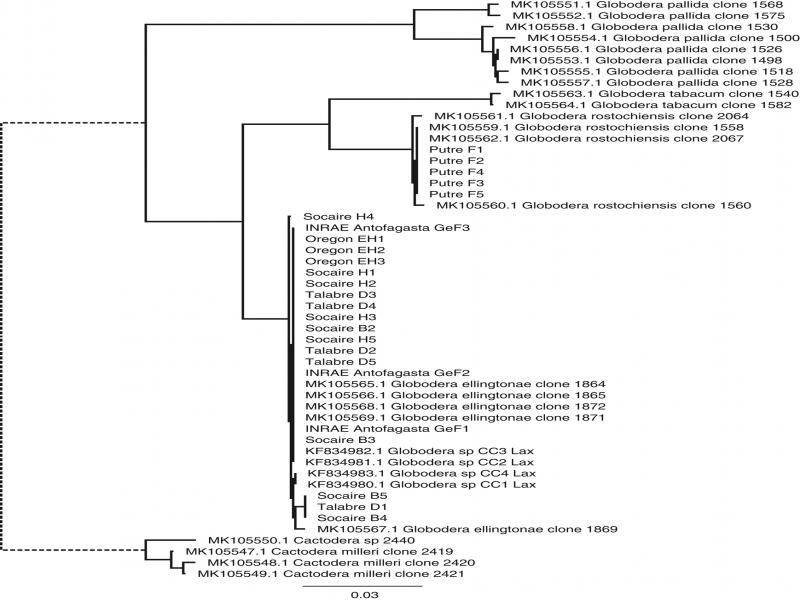
Figure 1:
Single gene phylogeny of Heat Shock Protein 90 (HSP90) constructed form a 437 nt alignment of morphologically identified Globodera spp. from Skantar et al. (2021), G. ellingtonae from Argentina (Lax et al., 2014), and populations from this study. The maximum likelihood tree was rooted to the outgroup Cactodera and the branch of the outgroup was artificially truncated for clarity (dashed lines).
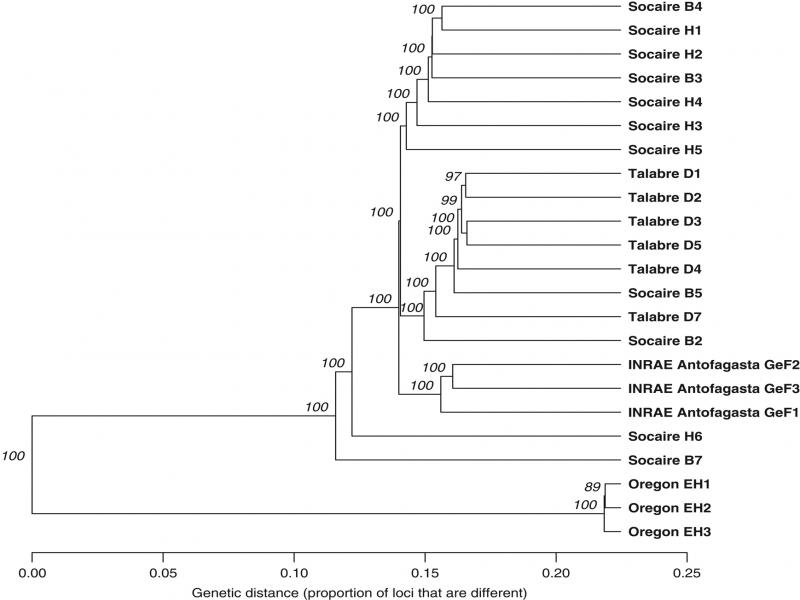
Figure 2:
Nuclear single nucleotide polymorphism (SNP) phylogenetic reconstruction of 23 Globodera ellingtonae cysts from Chile, United States, and a cultured population originally collected in Chile and maintained at Institut National de la Recherche Agronomique (INRAE; Rennes, France). Phylogenetic relationships were inferred using Unweighted Pair Group Method with Arithmetic Mean (UPGMA) clustering from a bitwise distance matrix derived from 168,354 binary SNPs across the nuclear genome.
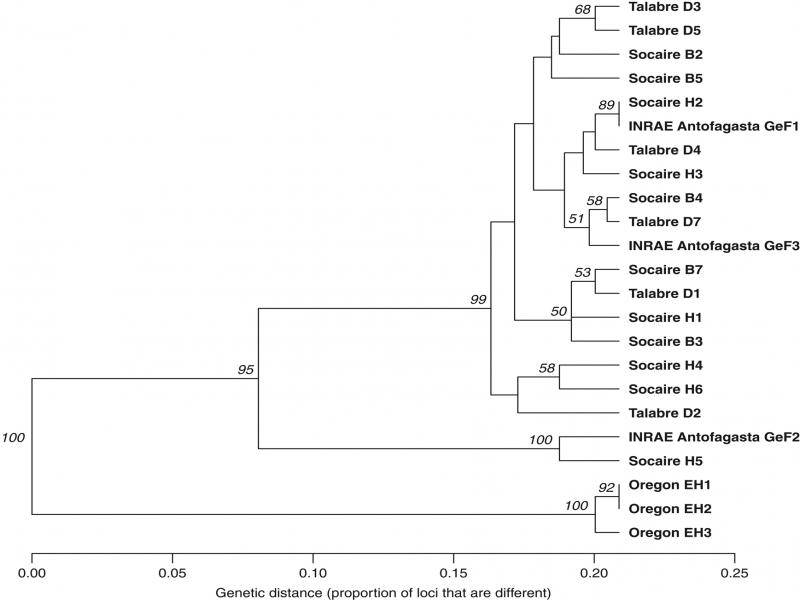
Figure 3:
Mitochondrial single nucleotide polymorphism (SNP) phylogenetic reconstruction of 23 Globodera ellingtonae cysts from Chile, United States, and a cultured population originally collected in Chile and maintained Institut National de la Recherche Agronomique (INRAE; Rennes, France). Phylogenetic relationships were inferred using Unweighted Pair Group Method with Arithmetic Mean (UPGMA) clustering from a bitwise distance matrix derived from 59 binary SNPs across the nuclear genome.
Table 1.
Morphometric characters of second-stage juveniles and cysts of Globodera sp. from Oregon, Argentina, and Antofagasta, Chile. Measurements are in µm and are mean + standard deviation (minimum – maximum).
| Second-stage juveniles | Cysts | |||||||
|---|---|---|---|---|---|---|---|---|
| Population | Body length | Stylet length | Tail length | Hyaline length | Diameter of vulval basin | Distance from anus to vulval basin | No. cuticular ridges | Granek’s ratio |
| G. ellingtonae (Oregon) a | 450 + 28 (365-515) | 20.9 + 0.9 (19-22.5) | 46.7 + 3.5 (39-55) | 24.3 + 2.7 (20-32.5) | 27.4 + 5.4 (20-42.5) | 64.5 + 10.3 (50-85) | 13 + 2.3 (10-18) | 2.4 + 0.4 (1.7-3) |
| G. ellingtonae (Argentina) b | 458 + 23 (418-526) | 23 + 0.6 (22-24) | 50 + 3 (43-56) | 25 + 3 (19-31) | 23 + 5 (12-36) | 52 + 12 (32-84) | 13 + 4 (8-25) | 2.6 + 0.9 (0.9-5.9) |
| Globodera sp. (Antofagasta) c | 490 + 22.5 (447-533) | 21.9 + 0.8 (20-23.2) | 49.2 + 3.1 (43-54.8) | 24 + 2.6 (18.5-29.5) | 21 + 2.5 (15.5-25.1) | 68.1 + 14.8 (43-115.6) | 13.8 + 3.4 (7-20) | 3.3 + 0.9 (2-5.8) |
1 Notes: aMeasurements based on 93-106 second-stage juveniles and 22-23 cysts (Handoo et al., 2012).
2 bMeasurements based on 37-41 second-stage juveniles and 42 cysts (Lax et al., 2014).