
Table 1.
Recurrent sorghum parents used for marker-assisted selection of the M. incognita resistance QTL, QTL-Sb.RKN.3.1, from ‘Honey Drip’ (PI 641821).
| Name | PI number | Reference/source | Sorghum type |
|---|---|---|---|
| Collier | PI 641862 | Maunder (2000) | sweet |
| Dale | PI 651495 | Broadhead and Coleman (1973) | sweet |
| Entry 22 | – | University of Florida | forage |
| GT-IR7 | PI 602445 | Widstrom (1998) | grain |
| Top 76-6 | PI 583832 | Day et al. (1995) | sweet |
Table 2.
Sorghum primer sequences of microsatellite markers used for confirming sorghum crosses in the M. incognita resistance quantitative trait locus region.
| Marker | Forward sequence | Reverse sequence | Repeat motif | Expected amplicon (bp)a |
|---|---|---|---|---|
| RKNP17 | GCAGTTTTTCAAGGAACGTG | GAGGAATGGGTGATGAAACAA | (TTA)106 | 422 |
| RKNP135 | GTTTCGTTTCAATCGGCTTC | GCGCCCCATCATATGTCTT | (AAG)21 | 197 |
| RKNP194 | TCATACTACCACAGCCGCTAGA | TGGTGTAGATGTGTGTGATTCAA | (AT)40 | 236 |
| RKNP259 | AGCTCTTCAGGCACATCGTT | TCTCCTTCCCACCCTGTATG | (GA)48 | 243 |
| RKNP342 | TTCCAACAGGCAAACAACAG | TCATGGCCTGTGTATCAAGC | (CT)25 | 205 |
| RKNP402 | TCAGCAAGATGGTTGGTTGA | ACGAGGCCGTTGAGATTATG | (TTA)22 | 213 |
| RKNP465 | TGACTGAGAGGGTCTACCTAACG | CAACCGGAAGTACGCTGATT | (AT)19 | 247 |
| RKNP529 | GCGAAATGGAGAAGAACAGG | CGTCATCAGCTTCCAGGAGT | (GA)25 | 199 |
| RKNP638 | CCACACCGGTTTCCTGTTAT | TAATAAGCCCCGCATGAAGA | (ATA)21, (TAT)6, (TAA)25 | 251 |
| RKNP709 | GCAAGCTGAAGTGGCCTAGT | CTACTCCCTCCGTCCCAAAT | (CT)9, (TA)18 | 324 |
| RKNP821 | CTCGGCAGCACCAAATAAAA | TCTCAACCGATGATTGTCCA | (TA)51 | 199 |
| TRKN1 | TGTACACTGCATGCCAACCT | GCCTCGTCTGGTTCATTGTT | (AT)14 | 246 |
| TRKN3 | GAAGAATTGCTCCAGGAACG | AAGCAGTATCCGGGGAAGAT | (TA)10 | 271 |
| TRKN4 | CGTAAATGGAGGTGGCTACA | CCCGGTTGGTACAACATAGA | (AT)29 | 232 |
| TRKN5 | ACTGTTATGTCGGCTGGTCA | AGTGTTACTGCCTGGCCAAA | (TC)11 | 196 |
Table S1.
Genotyping information for the creation of sorghum BC1F6 lines.
| Date of PCR | Sorghum seedling(s) with confirmed cross | Microsatelite markers used |
|---|---|---|
| 7/17/2015 | Honey Drip x Collier | TRKN1, TRKN3, TRKN4 |
| 8/4/2015 | Honey Drip x GT-IR7 | TRKN1, TRKN3, TRKN4, TRKN5 |
| 8/4/2015 | Honey Drip x Entry 22 | TRKN1, TRKN3, TRKN4, TRKN5 |
| 8/4/2015 | Honey Drip x Entry 22 | TRKN1, TRKN3, TRKN4, TRKN5 |
| 8/25/2015 | Honey Drip x Dale | TRKN1, TRKN3, TRKN4, TRKN5 |
| 11/30/2015 | Honey Drip x Top 76-6 | RKNP402, RKNP342 |
| 11/30/2015 | Entry 22 x (Honey Drip x Entry 22) | RKNP402, RKNP342 |
| 12/16/2015 | Honey Drip x Top 76-6 | RKNP194, RKNP259, RKNP402, RKNP529 |
| 1/26/2016 | Dale x (Honey Drip x Dale) | RKNP194, RKNP259, RKNP465, RKNP529 |
| 2/19/2016 | GT-IR7 x (Honey Drip x GT-IR7) | TRKN4, TRKN3, RKNP529, RKNP638 |
| 2/29/2016 | Collier x (Honey Drip x Collier) | RKNP529, RKNP638 |
| 3/9/2016 | GT-IR7 x (Honey Drip x GT-IR7) | RKNP529, TRKN3, RKNP638 |
| 3/14/2016 | GT-IR7 x (Honey Drip x GT-IR7) | RKNP638, RKNP194, RKNP465 |
| 3/15/2016 | GT-IR7 x (Honey Drip x GT-IR7) | RKNP638, RKNP194, RKNP465 |
| 3/28/2016 | Entry 22 x (Honey Drip x Entry 22) F2 homozygous | RKNP342, RKNP402, RKNP529 |
| 3/28/2016 | Collier x (Honey Drip x Collier) | RKNP342, RKNP402, RKNP529 |
| 4/20/2016 | Top 76-6 x (Honey Drip x Top 76-6) | RKNP342, RKNP402, RKNP529 |
| 4/20/2016 | Entry 22 x (Honey Drip x Entry 22) F2 homozygous | RKNP342, RKNP402, RKNP529 |
| 4/21/2016 | Entry 22 x (Honey Drip x Entry 22) F2 homozygous | RKNP342, RKNP402, RKNP529 |
| 5/6/2016 | Dale x (Honey Drip x Dale) F2 homozygous | RKNP342, RKNP402, RKNP529 |
| 5/11/2016 | Dale x (Honey Drip x Dale) F2 homozygous | RKNP342, RKNP402, RKNP529 |
| 6/1/2016 | Dale x (Honey Drip x Dale) F2 homozygous | RKNP342, RKNP402, RKNP529 |
| 6/8/2016 | Dale x (Honey Drip x Dale) F2 homozygous | RKNP342, RKNP402, RKNP529 |
| 6/9/2016 | GT-IR7 x (Honey Drip x GT-IR7) F2 homozygous | RKNP342, RKNP402, RKNP529 |
| 6/22/2016 | Collier x (Honey Drip x Collier) F2 homozygous | RKNP342, RKNP402, RKNP529 |
| 8/30/2016 | Top76-6 x (Honey Drip x Top 76-6) F2 homozygous | RKNP529, RKNP638, RKNP709, RKNP821 |
| 6/15/2017 | Genotyping of BC1F6 lines to determine the size of the Honey Drip crossover in the RKN region | RKNP17, RKNP135, RKNP342, RKNP402, RKNP529 |
Table 3.
Presence of the introgression from ‘Honey Drip’ in the QTL-Sb.RKN.3.1 region of each backcross (BC1F6) line.
| Allele Sizes (bp) | |||||
|---|---|---|---|---|---|
| RKNP17a | RKNP135 | RKNP342 | RKNP402 | RKNP529 | |
| NC_012872 (bp)b | (52,744,750) | (53,190,542) | (53,974,058) | (54,199,591) | (54,678,311) |
| Genotype | |||||
| Honey Drip | 120, 120 | 153, 153 | 240, 240 | 173, 173 | 222, 222 |
| Entry 22 | 198, 198 | 210, 210 | 222, 222 | 204, 204 | 185, 185 |
| Entry 22-BC1F6 | 120, 120 | 153, 153 | 240, 240 | 173, 173 | 222, 222 |
| Collier | 198, 198 | 200, 200 | 220, 220 | 253, 253 | 116, 116 |
| Collier-BC1F6 | 120, 120 | 153, 153 | 240, 240 | 173, 173 | 222, 222 |
| GT-IR7 | 198, 245 | 210, 210 | 220, 220 | 265, 265 | 116, 232 |
| GT-IR7-BC1F6 | 120, 120 | 153, 153 | 240, 240 | 173, 173 | 222 , 232 |
| Dale | 198, 198 | 206, 206 | 222, 222 | 234, 234 | 185, 185 |
| Dale-BC1F6 | 120, 120 | 153, 153 | 240, 240 | 173, 173 | 222, 222 |
| Topper | 198, 198 | 202, 202 | 220, 220 | 255, 255 | 116, 232 |
| Top 76-6-BC1F6 | 120, 120 | 153, 153 | 240, 240 | 173, 173 | 222 , 232 |
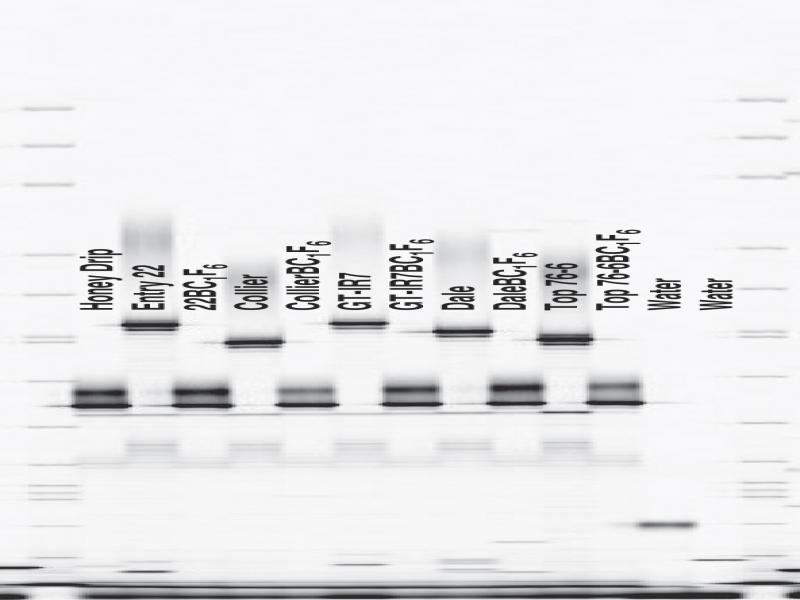
Figure 1:
Polyacrylamide gel image of microsatellite marker RKNP135 from the sorghum donor line ‘Honey Drip’, the recurrent parents ‘Collier’, GT-IR7, ‘Dale’, and ‘Top 76-6’, and the BC1F6 progeny lines. A 50-350 bp sizing standard (LI-COR Biosciences, Lincoln, NE) was loaded in the first and last lanes.
Table 4.
Fresh root weights of parental sorghum genotypes and their BC1F6 progeny.
| Trial 1 | Trial 2 | |||
|---|---|---|---|---|
| Genotype | Root weight (g)a | Root weight (g)a | ||
| Top 76-6 | 63.3 | Ab | 97.8 | Ab |
| Top 76-6-BC1F6 | 56.6 | AB | 69.2 | B |
| Honey Drip | 43.9 | BC | 52.6 | BCD |
| Dale-BC1F6 | 41.4 | BCD | 53.7 | BC |
| Entry 22-BC1F6 | 41.1 | CD | 43.3 | CDE |
| Collier | 40.9 | CD | 32.9 | DE |
| Collier-BC1F6 | 40.1 | CD | 31.5 | E |
| GT-IR7 | 38.5 | CD | 27.9 | E |
| GT-IR7-BC1F6 | 38.3 | CD | 30.6 | E |
| Dale | 37.1 | CD | 39.5 | CDE |
| Entry 22 | 26.6 | D | 24.0 | E |
Table 5.
Total M. incognita eggs and eggs/gram of root of parental sorghum genotypes and their BC1F6 progeny that have the M. incognita resistance QTL QTL-Sb.RKN.3.1.
| Genotype | Total eggsa | Eggs/g roota | ||
|---|---|---|---|---|
| Dale | 425775 | Ab | 11141 | Ab |
| Top 76-6 | 297250 | A | 3977 | A |
| Collier | 206325 | A | 5856 | A |
| GT-IR7 | 170125 | A | 5584 | A |
| Entry 22 | 115808 | A | 4661 | A |
| Honey Drip | 2300 | B | 48 | B |
| Collier-BC1F6 | 1175 | B | 36 | B |
| Entry 22-BC1F6 | 975 | B | 20 | B |
| Dale-BC1F6 | 875 | B | 19 | B |
| Top 76-6-BC1F6 | 750 | B | 18 | B |
| GT-IR7-BC1F6 | 625 | B | 16 | B |