
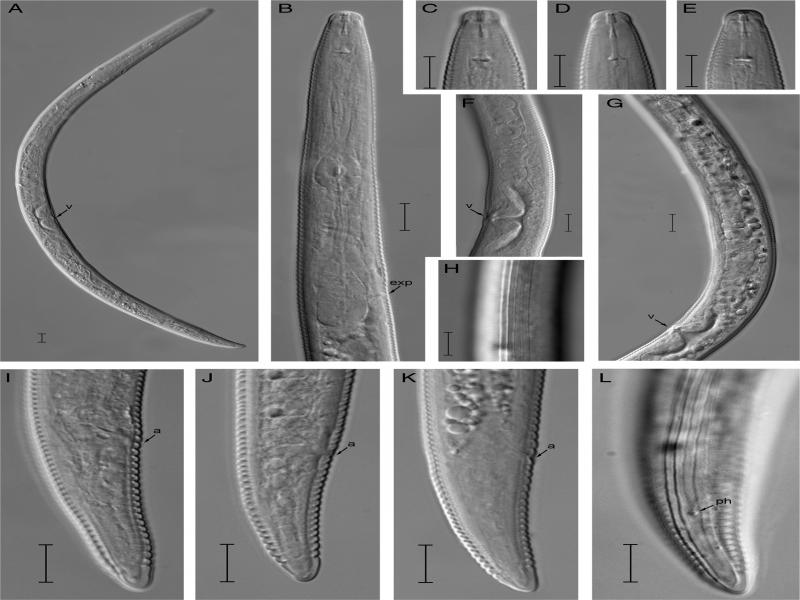
Figure 1:
Quinisulcius curvus Female. (A) Entire female; (B) Pharyngeal region; (C-E) Lip region; (F, G) Vulval region; (H) Lateral lines; (I-L) Tail regions. Scale bars (A = 10 μm; B-L = 10 μm) Abbreviation: a=anus; exp = excretory pore; ph = phasmid; v = vulva.
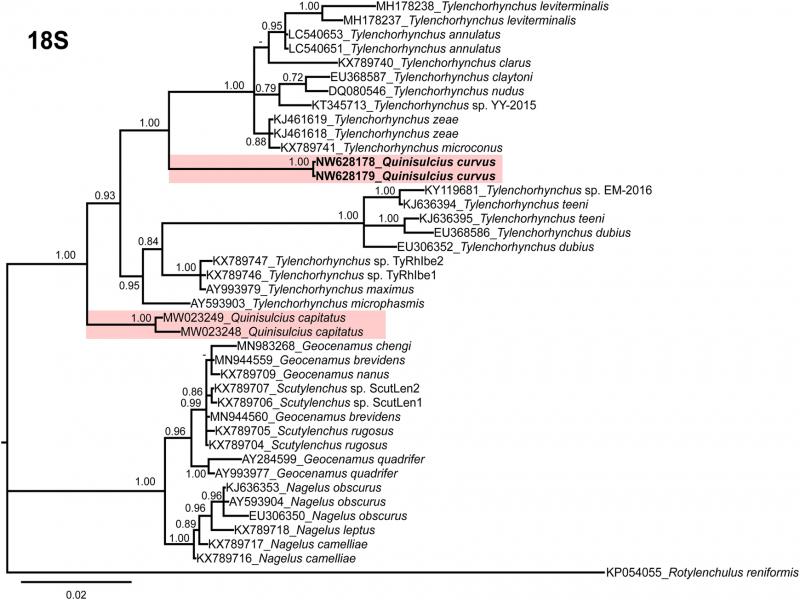
Figure 2:
Phylogenetic relationships within selected genera of subfamily Telotylenchinae and subfamily Merliniinae as inferred from Bayesian analysis using the 18S of the rRNA gene sequence dataset with the TIM1ef + I + G model. Posterior probability of more than 70% is given for appropriate clades. Newly obtained sequences are indicated in bold.
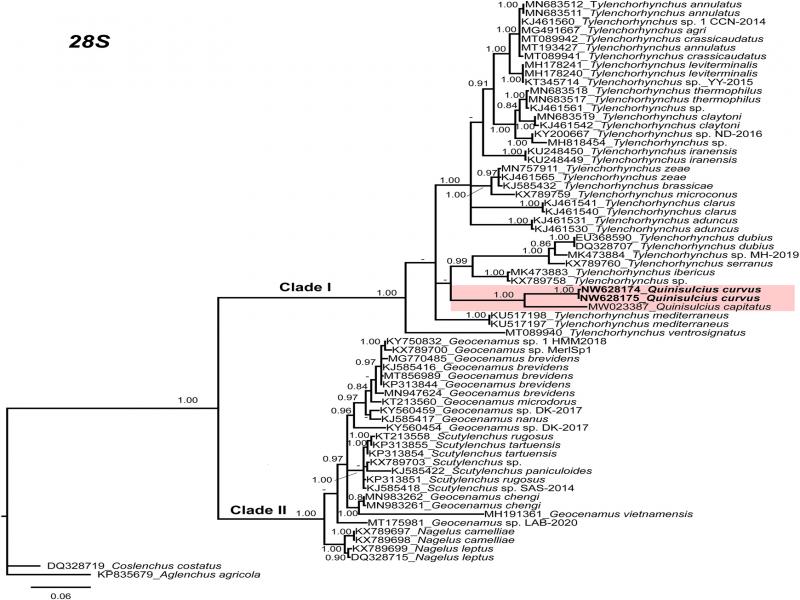
Figure 3:
Phylogenetic relationships within selected genera of subfamily Telotylenchinae and subfamily Merliniinae as inferred from Bayesian analysis using the 28S of the rRNA gene sequence dataset with the TIM3 + G model. Posterior probability of more than 70% is given for appropriate clades. Newly obtained sequences are indicated in bold.
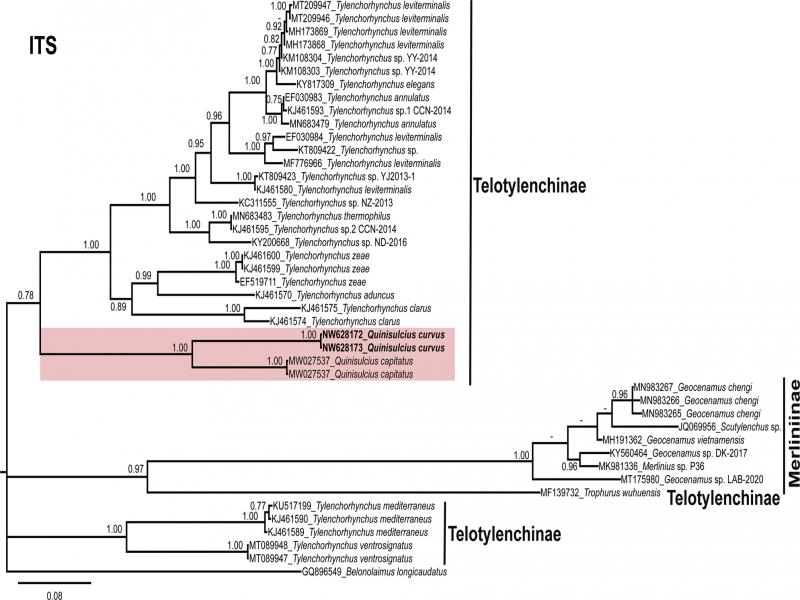
Figure 4:
Phylogenetic relationships within selected genera of subfamily Telotylenchinae and subfamily Merliniinae as inferred from Bayesian analysis using the ITS of the rRNA gene sequence dataset with the TVM3 + I + G model. Posterior probability of more than 70% is given for appropriate clades. Newly obtained sequences are indicated in bold.
Table 1.
Comparative morphometrics of Quinisulcius curvus (Williams, 1960) Siddiqi, 1971.
| This study | Williams, 1960 | Mizukubo et al., 1993 | Li et al., 1986 | |
|---|---|---|---|---|
| Origin | Hainan, China | Mauritius | Thailand | Henan, China |
| Host | Guettarda speciosa | Sugarcane | Maize | Brassica caulirapa |
| Male | Unknown | Unknown | Unknown | Unknown |
| n | 20 | - | 6 | 1 |
| L | 581 ± 36.7 (503-644) | 490-630 | 547 ± 56.9 (442-606) | 603.2 |
| a | 27.2 ± 1.6 (24.3-31.0) | 29-37 | 28.5 ± 2.37 (25.7-31.8) | 27.3 |
| b | 5.0 ± 0.3 (4.6-5.6) | 5.3 ± 0.18 (5.0-5.5) | 4.9 | |
| c | 16.5 ± 0.7 (15.3-18.0) | 15-18 | 17.3 ± 1.19 (15.4-18.9) | 16.6 |
| c' | 2.5 ± 0.2 (2.3-2.9) | 2.5 | 2.5 ± 0.10 (2.3-2.6) | - |
| V | 56.9 ± 1.6 (53.6-60.0) | 52-57 | 56.4 ± 0.7 (55.3-57.2) | 55.2 |
| MB (median bulb position)a | 54.8 ± 11.7 (50.7-93.5) | 51 | 51.0 ± 2.2 (49.2-55.3) | - |
| Lip height | 3.0 ± 0.3 (2.6-3.5) | - | - | - |
| Lip width | 6.6 ± 0.4 (5.7-7.2) | - | - | - |
| Lip diam./lip height | 2.2 ± 0.2 (1.8-2.5) | - | - | - |
| Stylet length | 12.6 ± 0.5 (11.5-13.5) | 17 | 14.6 ± 0.60 (13.5-15) | 18.2 |
| Conus length | 5.2 ± 0.3 (4.5-6.0) | - | - | - |
| DGO | 2.1 ± 0.3 (1.7-2.6) | 1.5 | 1.4 ± 0.2 (1.2-1.7) | - |
| Median bulb length | 13.4 ± 0.5 (12.4-14.2) | - | - | - |
| Median bulb diam. | 10.1 ± 0.4 (9.6-11.0) | - | - | - |
| Median bulb length/diam. | 1.3 ± 0.1 (1.2-1.4) | - | - | - |
| Distance from anterior end to hemizonid | 97.7 ± 4.7 (89.0-106.7) | - | - | - |
| Distance from anterior end to excretory pore | 103.6 ± 4.3 (93.2-110.3) | - | 99 ± 9.1 (83-106) | - |
| Maximum body diam. | 21.3 ± 0.9 (19.2-23.0) | 19 | - | - |
| Vulval body diam. | 20.1 ± 0.9 (18.3-22.3) | - | - | - |
| Anterior reproductive branch | 161.1 ± 15.4 (119.7-188.1) | - | - | - |
| Posterior reproductive branch | 157.6 ± 24.7 (109.5-208.0) | - | - | - |
| Body diam. at anus | 14.2 ± 0.7 (13.1-15.7) | - | - | - |
| Tail length | 35.3 ± 2.8 (29.6-40.7) | 39 | 32 ± 1.9 (29-34) | - |
| Tail annuli | 18.0 ± 2.0 (15.0-23.0) | 15-20 | 15-18 | 16-17 |
| Phasmid to tail terminus | 24.2 ± 2.4 (19.3-29.3) | - | - | - |