
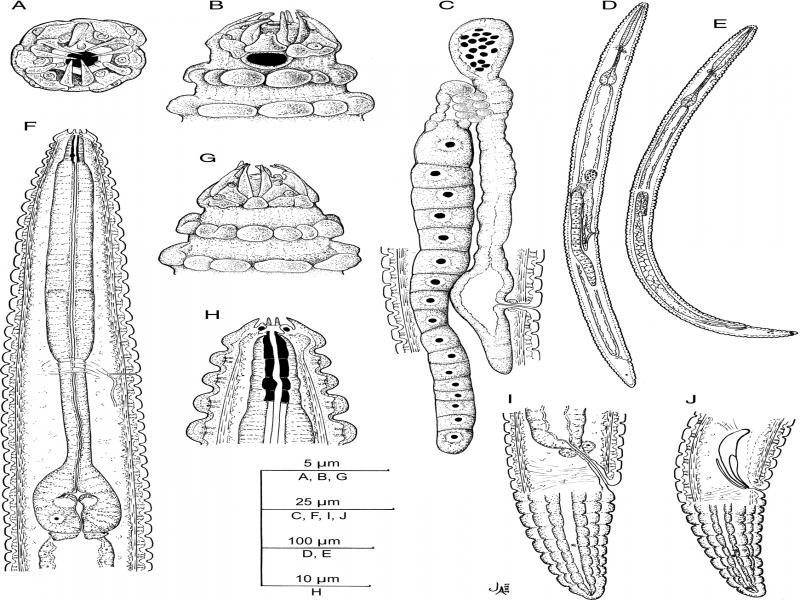
Figure 1:
Spinocephalus tessellatus n. gen., n. sp. (line drawing). A, B, G: Lip region in frontal, lateral and ventral views, respectively; C: Female genital system; D: Entire female; E: Entire male; F: Neck; H: Stoma; I: Female posterior end; J: Male posterior end.
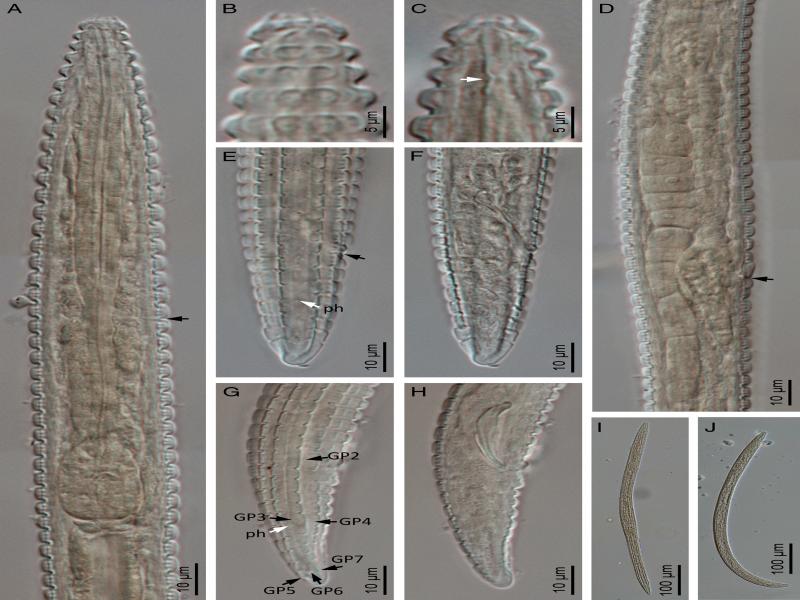
Figure 2:
Spinocephalus tessellatus n. gen., n. sp. (light microscopy). A: Neck (arrow pointing the excretory pore); B, C: Anterior end at cuticle and stoma levels, respectively (arrow pointing the metastomatal dorsal tooth); D: Female genital system (arrow pointing the vulva); E, F: Female posterior end at cuticle and rectum levels, respectively (black arrow pointing the anus, white arrow pointing the phasmid, ph); G, H: Male posterior end at cuticle and spicules level (black arrows pointing the genital papillae, GP, white arrow pointing the phasmid, ph); I: Entire female; J: Entire male.
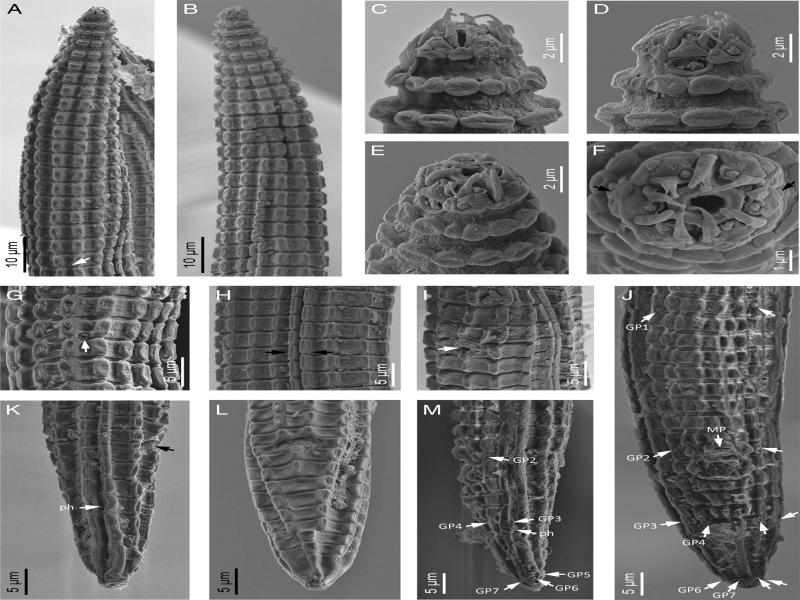
Figure 3:
Spinocephalus tessellatus n. gen., n. sp. (scanning electron microscopy). A, B: Neck at ventral and lateral views, respectively (arrow pointing the excretory pore); C–F: Lip region in dorsal, lateral, subdorsal and frontal views, respectively; G: Excretory pore (arrow); H: Lateral field (between arrows); I: Vulva (arrow); J, M: Male posterior end in ventral and lateral views, respectively (arrows pointing the genital papillae, GP, middle papillae, MP, and phasmid, ph); K, L: Female posterior end in lateral and ventral views, respectively (black arrow pointing the anus, white arrow pointing the phasmid, ph).
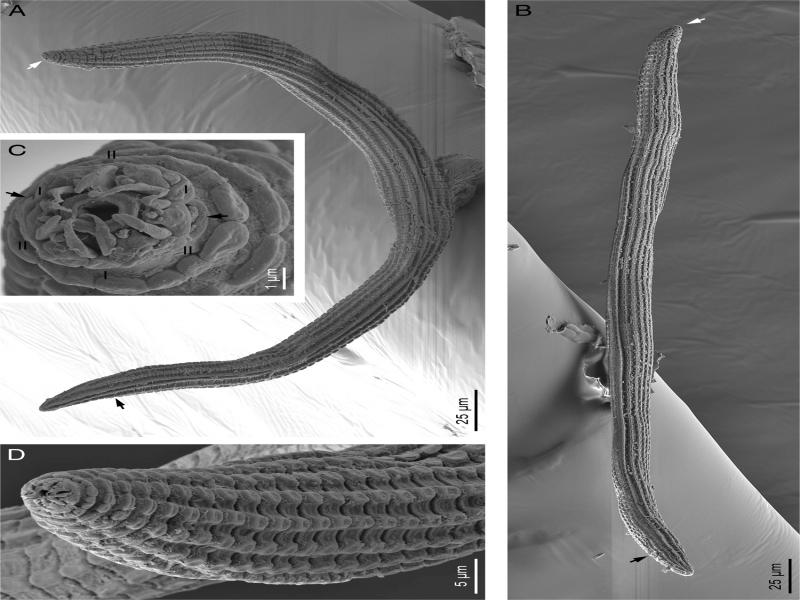
Figure 4:
Spinocephalus tessellatus n. gen., n. sp. (scanning electron microscopy). A: Entire female (white arrow pointing the anterior end, black arrow pointing the anus); B: Entire male (white arrow pointing the anterior end, black arrow pointing the cloacal aperture); C: Lip region in frontal view (arrows pointing the phasmids, I = primary axil, II = secondary axil); D: Neck region.
Table 1.
Morphometrics of Spinocephalus tessellatus n. gen., n. sp
| Sex | Holotype | Paratypes | |
|---|---|---|---|
| n | Female | 11 females | 6 males |
| L | 575 | 612.4 ± 34.8 (552–668) | 596.0 ± 25.3 (578–645) |
| a | 21.3 | 21.0 ± 0.6 (20.0–22.0) | 24.1 ± 2.5 (20.2–27.9) |
| b | 3.7 | 4.3 ± 0.1 (4.0–4.5) | 3.5 ± 0.2 (3.2-3.8) |
| c | 14.0 | 15.4 ± 1.2 (13.8–17.7) | 14.5 ± 0.6 (13.9–15.7) |
| c' | 2.3 | 2.0 ± 0.1 (1.8–2.3) | 2.0 ± 0.1 (2.0–2.2) |
| V | 62 | 61.2 ± 0.9 (60–63) | – |
| Lip region width | 9 | 5.5 ± 0.4 (5–6) | 5.1 ± 0.4 (5–6) |
| Stoma length | 13 | 12.1 ± 0.4 (11–13) | 11.5 ± 0.5 (11–12) |
| Corpus length | 73 | 70.6 ± 4.3 (63–76) | 88.1 ± 7.1 (81–101) |
| Isthmus length | 46 | 45.2 ± 1.3 (44–48) | 45.3 ± 2.4 (42–49) |
| Bulbus length | 25 | 25.9 ± 1.5 (24–28) | 24.3 ± 0.6 (24–25) |
| Pharynx length | 144 | 141.8 ± 4.7 (134–148) | 157.8 ± 6.9 (150–168) |
| Neck length | 157 | 154.0 ± 4.9 (146–161) | 169.3 ± 7 (162–180) |
| Nerve ring-ant. end | 89 | 98.7 ± 8.9 (85–112) | 100.8 ± 9.1 (86–110) |
| Excretorypore-ant. end | 94 | 104.2 ± 5.6 (94–113) | 100.2 ± 4.5 (95–106) |
| Deirid-ant. end | 117 | 110.0 ± 4.2 (107–113) | 122.0 ± 3.6 (118–125) |
| Cuticle thickness | 3 | 2.6 ± 0.1 (2–3) | 2.2 ± 0.2 (2–3) |
| Annuli width | 4 | 5.1 ± 0.5 (4–6) | 5.0 ± 0.2 (4–5) |
| Body width neck base | 26 | 27.6 ± 1.5 (26–30) | 23.8 ± 1.7 (21–27) |
| Body width mid-body | 27 | 29.0 ± 1.7 (26–32) | 24.9 ± 2.7 (21–29) |
| Lateral field width | 7 | 8.2 ± 0.8 (7–10) | 7.3 ± 0.5 (7–8) |
| Ovary length | 120 | 122.0 ± 20.7 (96–142) | – |
| Oviduct length | 9 | 11.2 ± 2.2 (8–13) | – |
| Spermatheca length | 32 | 31.6 ± 7.1 (23–39) | – |
| Uterus length | 70 | 68.2 ± 16.9 (43–79) | – |
| Vagina length | 9 | 7.6 ± 0.7 (7–9) | – |
| Post-vulval uterinesac | 29 | 25.7 ± 1.4 (23–28) | – |
| Vulva-ant. end | 357 | 375 ± 25.8 (331–418) | – |
| Rectum length | 23 | 19.4 ± 1.9 (17–22) | – |
| Body width anus | 18 | 18.9 ± 1.1 (17-21) | 19.8 ± 0.6 (19–21) |
| Tail length | 41 | 39.8 ± 2.6 (37–44) | 40.9 ± 0.6 (40–42) |
| Phasmid-anus distance | 18 | 22.4 ± 10.4 (17–41) | 19.1 ± 2.4 (18–23) |
| Spicules length | – | – | 24.5 ± 0.8 (24–26) |
| Gubernaculum length | – | – | 12.4 ± 1.1 (11–14) |
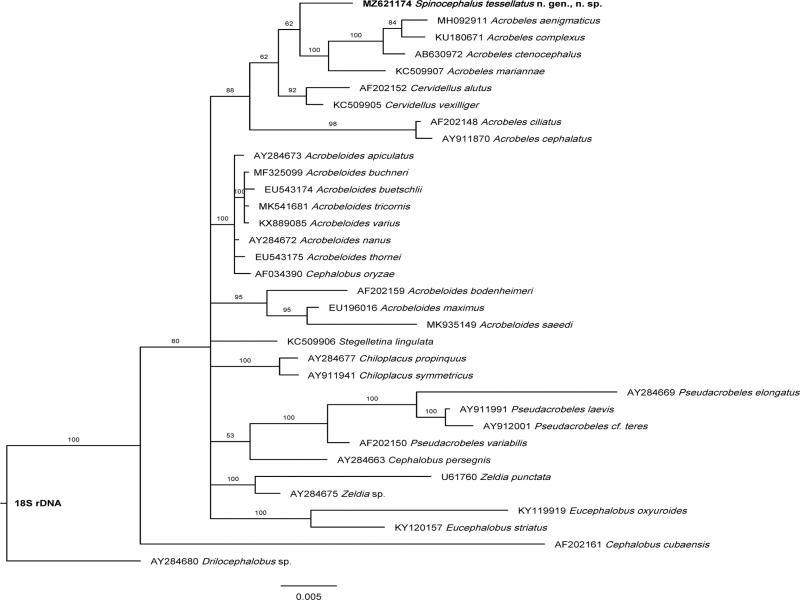
Figure 5:
Bayesian inference tree showing the phylogenetic position of Spinocephalus tessellatus n. gen., n. sp. and its related taxa based on sequences of the 18S rDNA region. Bayesian posterior probabilities (%) are given for each clade. Scale bar shows the number of substitutions per site.
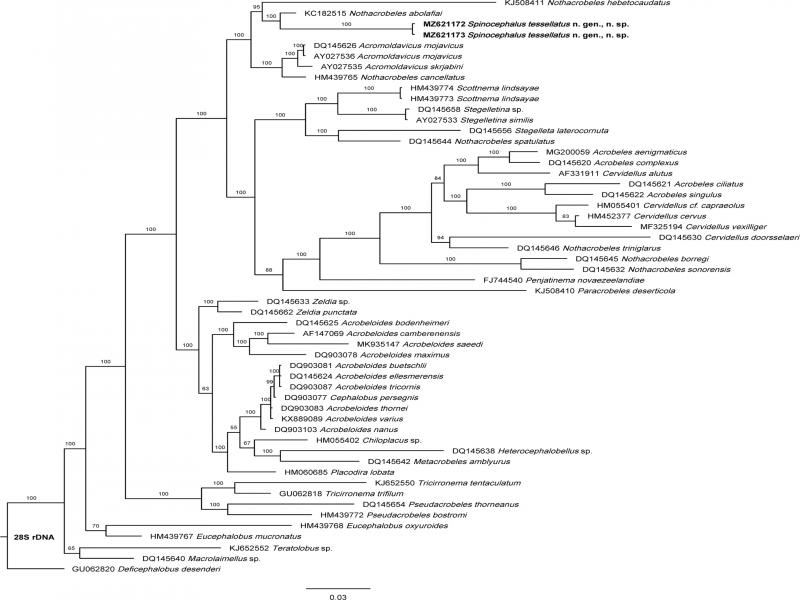
Figure 6:
Bayesian inference tree showing the phylogenetic position of Spinocephalus tessellatus n. gen., n. sp. and its related taxa based on sequences of the 28S rDNA region. Bayesian posterior probabilities (%) are given for each clade. Scale bar shows the number of substitutions per site.
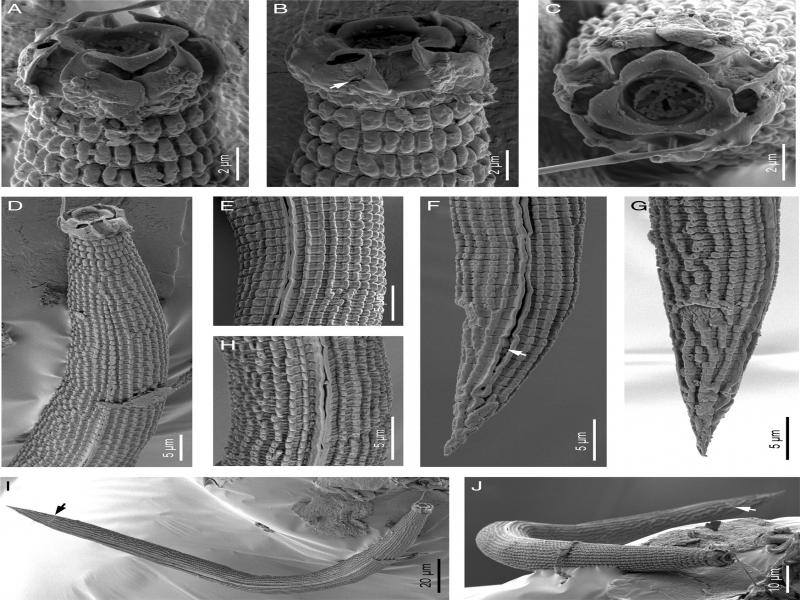
Figure 7:
Acromoldavicus skrjabini (Nesterov and Lisetskaya, 1965) Nesterov, 1970 from Santa Catalina Mountain, Jaén, Spain (scanning electron microscopy, juvenile). A–C: Lip region in dorsal, left lateral and frontal views, respectively; D: Neck region; E, H: Lateral field; F, G: Posterior end in lateral and ventral views, respectively (arrow pointing the phasmid); I, J: Entire body (arrow pointing the anus).
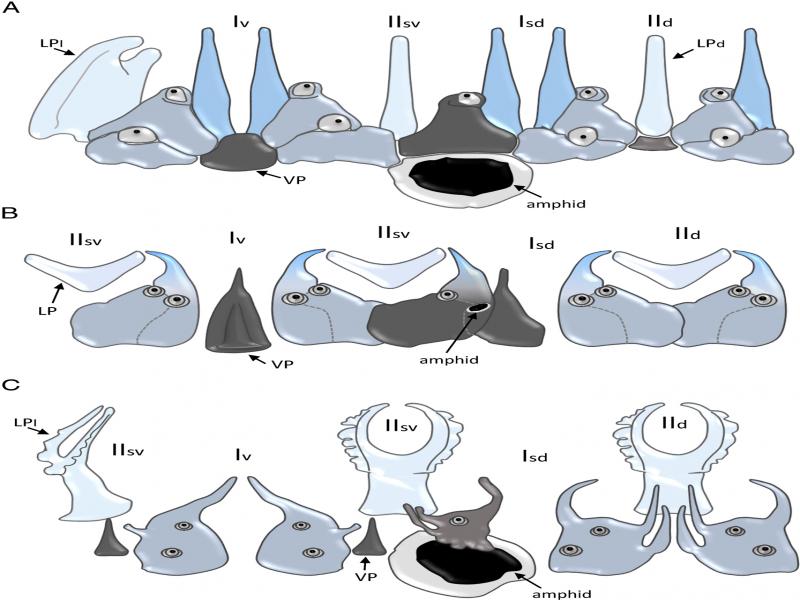
Figure 8:
Schematic pattern of the labial region of Spinocephalus tessellatus n. gen., n. sp. (A), Acromoldavicus skrjabini (Nesterov and Lisetskaya, 1965) Nesterov, 1970 (B) and Chilodellus eremus Boström and Holovachov, 2012 (C). Isd: subdorsal primary axil; Iv: ventral primary axil; IId: dorsal secondary axil; IIsv: subventral secondary axil; LP: labial probola; LPd: labial probolae in dorsal view; LPl: labial probolae in lateral view; VP: ventral process.