
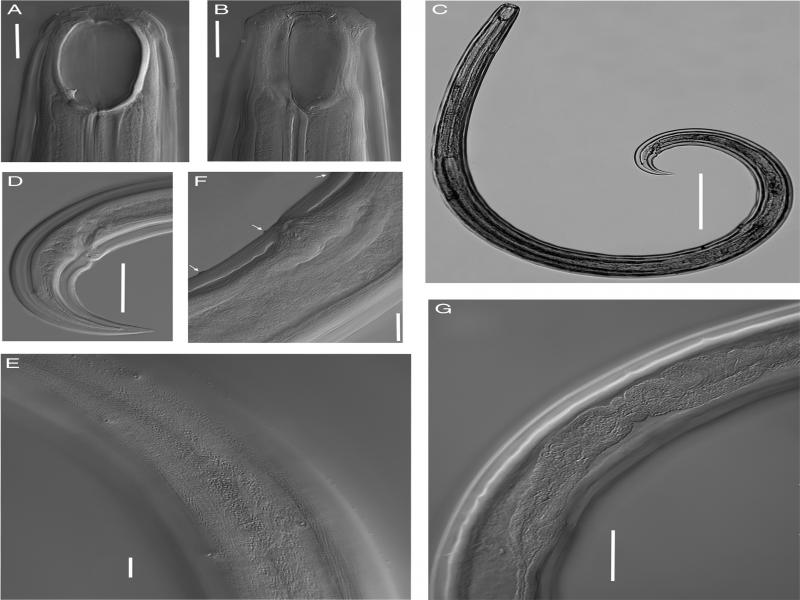
Figure 1:
Light micrographs of Parkellus hagiangensis sp. nov. Female. A. Anterior end, median section with the focus on the dorsal tooth. B. Anterior end, surface view. C. Entire body. D. Tail. E. Vulval region with advulval ventromedian vulval papillae. F. Body pores. G. Anterior genital branch. Scale bar: C = 200 µm, G = 50 µm, D = 45 µm, A, B, E = 20 µm, F = 10 µm.
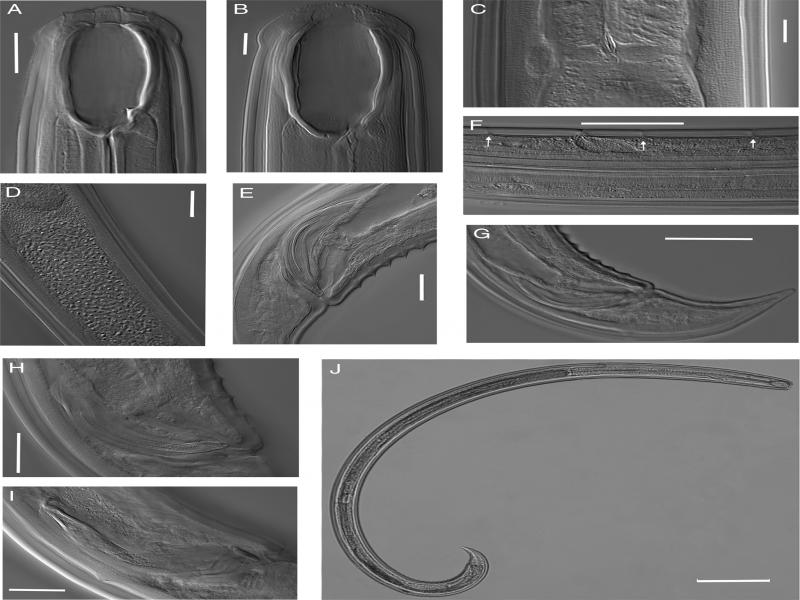
Figure 2:
Light micrographs of Parkellus hagiangensis sp. nov. Male. A. Anterior end, median section, with the focus on the dorsal tooth. B. Anterior end, median section, with the focus on the longitudinal ridge. C. Pharyngo-intestinal junction. D. Sperm cells. E. Distal part of spicules. F. Excretory pore and ventromedian cuticular pores above and below of the excretory pore. G. Tail. H. Lateral guiding pieces. I. Proximal part of spicules. J. Entire body. Scale bar: J = 200 µm, F, G = 50 µm, A, D, E, H, I = 20 µm, B, C = 10 µm.
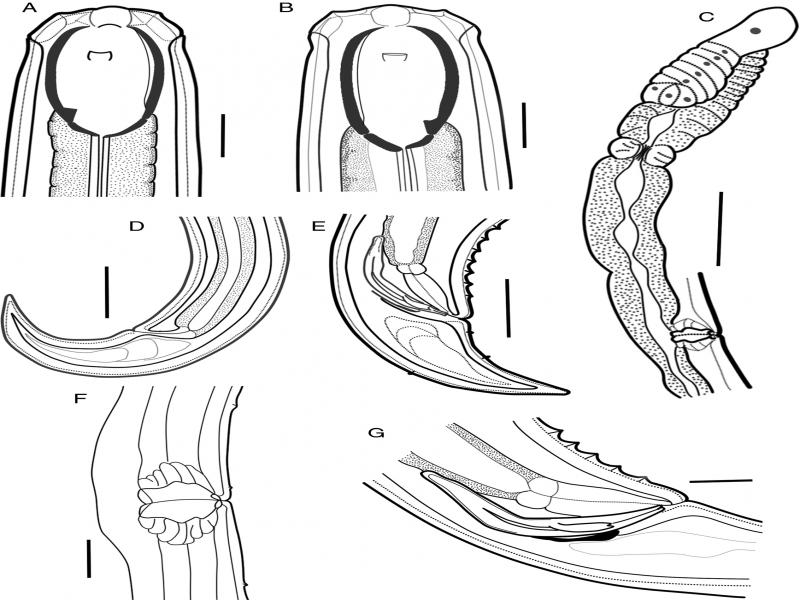
Figure 3:
Line drawings of Parkellus hagiangensis sp. nov. A. Anterior end of female, median section. B. Anterior end of male, median section. C. Female anterior genital branch. D. Female tail. E. Male tail. F. Vulval region with advulval ventromedian papillary structures. G. Male copulatory apparatus. Scale bar: A, B, F, G = 20 µm, C–E = 50 µm.
Table 1.
Morphometrics of females and males of Parkellus hagiangensis sp. nov. from Ha Giang Province, Vietnam.
| Du Gia natural reserve | |||
|---|---|---|---|
| Characters/ratios* | Holotype | Paratypes | |
| n | 1 female | 1 female | 3 males |
| L (µm) | 2,112 | 1,769 | 2,162–2,900 |
| a | 26.0 | 27.2 | 29.0–34.9 |
| b | 3.9 | 3.7 | 3.8–4.1 |
| c | 16.4 | 15.2 | 21.4–23.2 |
| c′ | 2.8 | 2.7 | 1.7–2.1 |
| V | 69 | 70 | |
| Lip region height (µm) | 13.3 | 12.2 | 12.0–13.6 |
| Lip region width (µm) | 40.5 | 40.2 | 44.8–46.4 |
| Buccal cavity length (µm) | 54.4 | 50.8 | 55.4–60.2 |
| Buccal cavity width (µm) | 29.9 | 29.1 | 28.8–31.6 |
| Position of tooth apex (%) from anterior end of buccal cavity | 75 | 76 | 71–74 |
| Nerve ring from anterior end (µm) | 143 | 138 | 152–170 |
| Excretory pore from anterior end (µm) | 173 | 153 | 177–196 |
| Pharynx length (µm) | 539 | 473 | 566–713 |
| Maximum body width (µm) | 78.3 | 65.0 | 74.7–83.0 |
| Anal body width (µm) | 45.5 | 42.7 | 55.0–65.2 |
| Rectum/cloaca length (µm) | 38.7 | 33.4 | 41.0–51.4 |
| Spicules length (µm) | 82.3–97.3 | ||
| Lateral guiding piece length (µm) | 18.2–22.2 | ||
| Tail length (µm) | 128 | 116 | 95–136 |
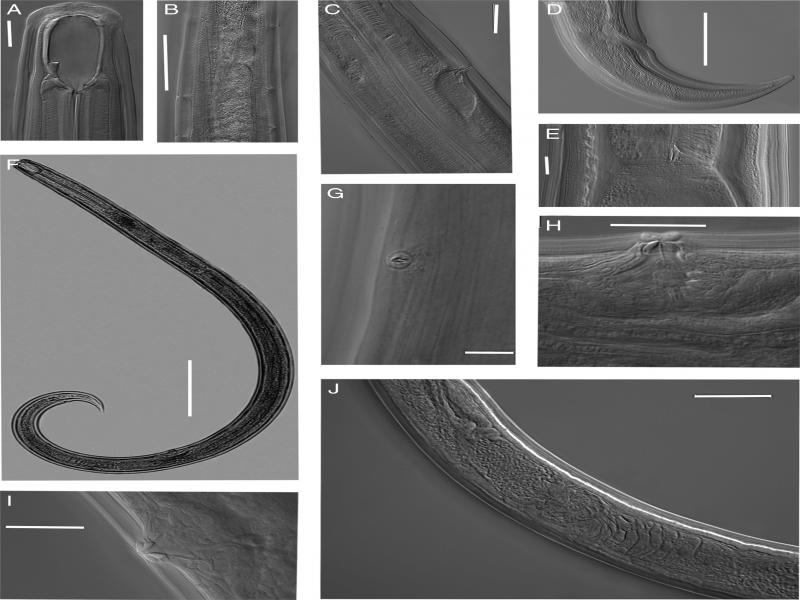
Figure 4:
Light micrographs of Parkellus tuyenquangensis sp. nov. Female. A. Anterior end, median section, with the focus on the dorsal tooth. B. Body pores. C. Anterior genital branch. D. Entire body. E. Excretory pore. F. Tail. G. Pharyngo-intestinal junction. H, J. Vulval region. Scale bar: D = 200 µm, B, C = 50 µm, F = 45 µm, A, E, H–J = 20 µm, G = 10 µm.
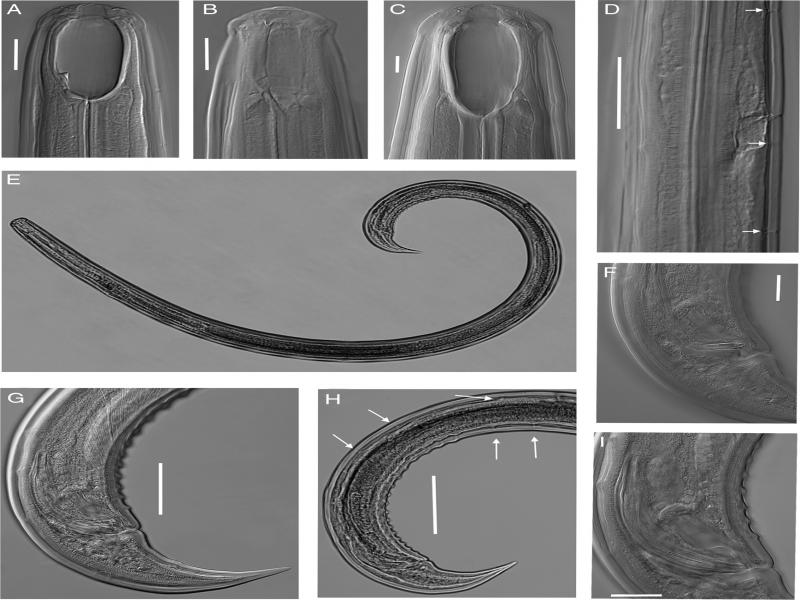
Figure 5:
Light micrographs of Parkellus tuyenquangensis sp. nov. Male. A. Anterior end, median section, with the focus on the dorsal tooth. B. Anterior end, surface view. C. Anterior end, median section, with the focus on the longitudinal ridge. D. Excretory pore and ventromedian cuticular pores above and below of the excretory pores. E. Entire body. F. Lateral guiding pieces. G. Tail. H. Posterior end. I. Proximal part of spicules. Scale bar: E = 200 µm, H = 100 µm, D, G = 45 µm, A, B, F, I = 20 µm, C = 10 µm.
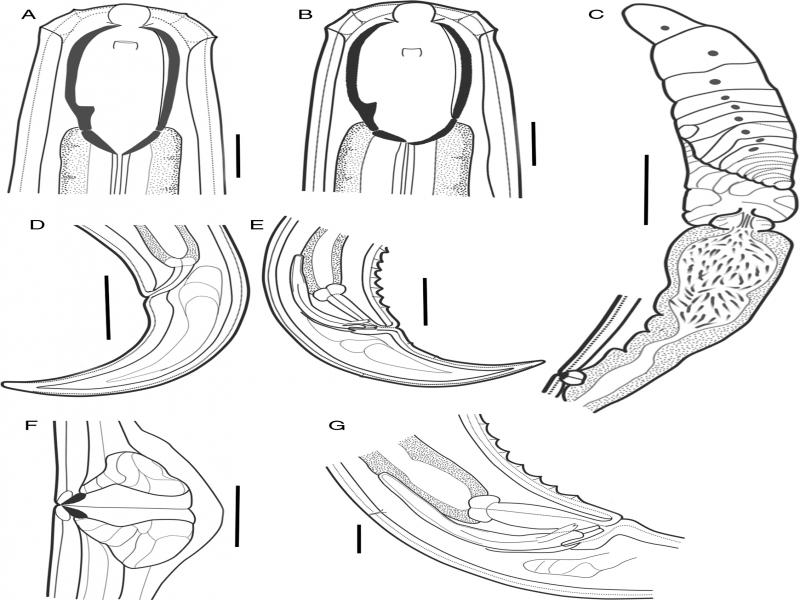
Figure 6:
Line drawings of Parkellus tuyenquangensis sp. nov. A. Anterior end of female, median section. B. Anterior end of male, median section. C. Female anterior genital branch. D. Female tail. E. Male tail. F. Vulval region with advulval ventromedian papillary structures. G. Male copulatory apparatus. Scale bar: A, B, F, G = 20 µm, C–E = 50 µm.
Table 2.
Morphometrics of females and males of Parkellus tuyenquangensis sp. nov. from Tuyen Quang Province, Vietnam.
| Cham Chu natural reserve | |||||
|---|---|---|---|---|---|
| Character | Holotype | Paratypes | Na Hang natural reserve | ||
| n | female | 3 females | 3 males | 11 females | 12 males |
| L (µm) | 2,205 | 2,185–2,487 | 2,235–2,648 | 2,995 ± 221.4 (2,726–3,363) | 2,753 ± 152.8 (2,545–3,067) |
| a | 29.8 | 25.5–31.8 | 28.7–31.7 | 30.5 ± 2.0 (28.0–30.0) | 32.8 ± 2.0 (28.4–34.6) |
| b | 3.6 | 3.8–4.0 | 3.8–4.0 | 4.4 ± 0.2 (4.1–4.7) | 4.2 ± 0.1 (4.0–4.5) |
| c | 17.2 | 18.2–19.8 | 17.3–26.3 | 19.7 ± 1.4 (18.1–22.4) | 21.8 ± 1.1 (19.7–23.5) |
| c′ | 2.6 | 2.5–2.7 | 1.7–2.1 | 2.8 ± 0.2 (2.3–3.0) | 2.1 ± 0.1 (1.9–2.3) |
| V | 68.0 | 69.0 | 68.7 ± 2.9 (67.0–73.0) | ||
| Lip region height (µm) | 12.6 | 11.1–14.6 | 12.3–13.9 | 10.6 ± 0.8 (8.8–11.4) | 11.3 ± 1.2 (9.7–13.2) |
| Lip region width (µm) | 43.1 | 40.9–47.4 | 41.2–43.8 | 45.4 ± 2.8 (41.4–50.2) | 44.8 ± 1.4 (43.0–46.6) |
| Buccal cavity length (µm) | 57.7 | 52.5–60.4 | 53.9–58.7 | 56.6 ± 1.7 (54.6–60.7) | 55.4 ± 1.6 (53.0–58.0) |
| Buccal cavity width (µm) | 28.2 | 28.0–29.3 | 27.7–28.5 | 30.1 ± 0.7 (29.0–30.8) | 29.0 ± 1.0 (27.3–30.8) |
| Position of tooth apex (%) from anterior end of buccal cavity | 64.0 | 60.0–62.0 | 60.0–67.0 | 66.4 ± 1.6 (63.0–68.3) | 66.9 ± 1.8 (64.0–70.0) |
| Nerve ring from anterior end (µm) | 149 | 140–163 | 155–163 | 172 ± 11.5 (151–191) | 170 ± 8.3 (158–180) |
| Excretory pore from anterior end (µm) | 185 | 175–195 | 180–194 | 204 ± 11.0 (189–223) | 199 ± 9.8 (185–216) |
| Pharynx length (µm) | 606 | 543–635 | 569–655 | 686 ± 35.0 (636–750) | 657 ± 26.6 (613–704) |
| Maximum body width (µm) | 73.9 | 78.1–83.4 | 78.0–83.6 | 98.6 ± 9.9 (81.0–110.0) | 86.1 ± 5.9 (76.5–96.8) |
| Anal body width (µm) | 48.3 | 47.6–50.8 | 59.4–62.7 | 55.5 ± 2.5 (49.5–58.5) | 61.2 ± 2.0 (58.5–65.0) |
| Rectum/cloaca length (µm) | 39.9 | 40.1–42.2 | 49.0–60.0 | 46.0 ± 4.2 (38.3–51.8) | 54,7± 3,9 (50.1–64.2) |
| Spicules length (µm) | 97.0–104.8 | 103.7 ± 5.8 (95.0–110.0) | |||
| Lateral guiding piece length (µm) | 12.6–17.8 | 16.3 ± 0.9 (15.0–17.6) | |||
| Tail length (µm) | 128 | 120–127 | 101–129 | 152 ± 13.6 (122–169) | 126.4 ± 7.6 (110–133) |
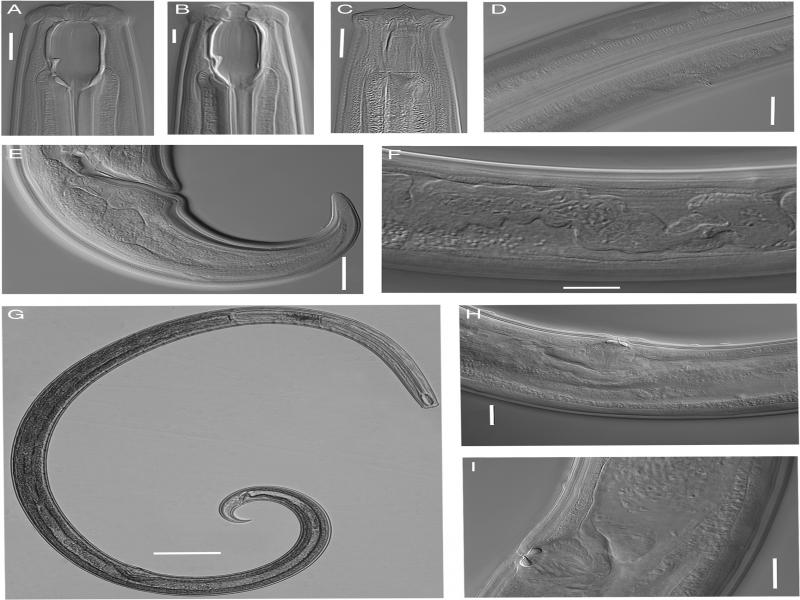
Figure 7:
Light micrographs of Parkellus zschokkei. Female. A. Anterior end, median section, with the focus on the dorsal tooth. B. Anterior end, median section, with the focus on the longitudinal ridge. C. Anterior end, surface view. D. Excretory pore. E. Tail. F. Oviduct-uterus sphincter. G. Entire body. H. Vulval region with advulval ventromedian vulval papillae. I. Vulval region. Scale bar: G = 200 µm, H = 50 µm, A, C–F, I = 20 µm, B = 10 µm.
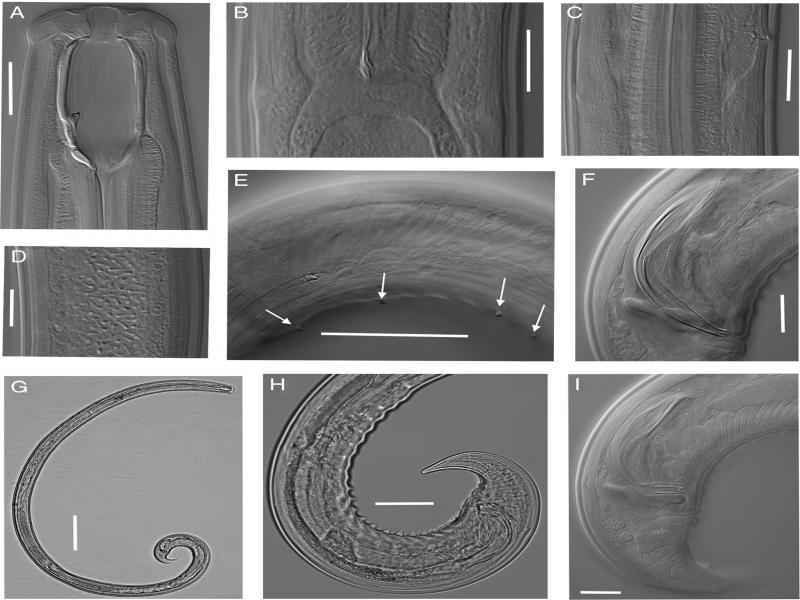
Figure 8:
Light micrographs of Parkellus zschokkei. Male. A. Anterior end, median section, with the focus on the dorsal tooth. B. Pharyngo-intestinal junction. C. Excretory pore. D. Sperm cells. E. Subventral papillae lying parallel to the supplements. F. Spicules. G. Entire body. H. Posterior end. I. Lateral guiding pieces. Scale bar: G = 200 µm, E, H = 50 µm, A–D, F, I = 20 µm.
Table 3.
Morphometrics of females and males of Parkellus zschokkei (Menzel, 1913) from Ukraine.
| Characters/ratios* | Uzhhorod | |
|---|---|---|
| n | 13 females | 11 males |
| L (µm) | 2900 ± 175.3 (2,569–3,174) | 2748 ± 152.5 (2,454–3,012) |
| a | 33.0 ± 2.4 (29.3–38.8) | 36.6 ± 1.4 (34.1–39.7) |
| b | 4.5 ± 0.2 (4.3–4.8) | 4.3 ± 0.1 (4.0–4.5) |
| c | 21.4 ± 1.7 (17.4–23.1) | 23.4 ± 2.1 (21.0–27.8) |
| c′ | 2.5 ± 0.2 (2.2–2.9) | 1.8 ± 0.2 (1.5–2.0) |
| V | 68.0 ± 1.3 (65.0–70.3) | |
| Lip region height (µm) | 12.8 ± 1.1 (10.1–13.9) | 12.4 ± 1.0 (10.6–13.8) |
| Lip region width (µm) | 42.7 ± 2.1 (38.7–46.8) | 42.4 ± 1.9 (39.4–44.7) |
| Buccal cavity length (µm) | 50.8 ± 1.6 (48.3–53.7) | 51.2 ± 1.8 (47.1–54.5) |
| Buccal cavity width (µm) | 24.9 ± 1.0 (23.3–26.6) | 25.0 ± 0.5 (23.8–25.5) |
| Position of tooth apex (%) from anterior end of buccal cavity | 54.5 ± 3.1 (47.4–59.5) | 55.8 ± 2.1 (51.7–58.4) |
| Nerve ring from anterior end (µm) | 189 ± 10.0 (169–202) | 188 ± 8.9 (171–200) |
| Excretory pore from anterior end (µm) | 218 ± 12.0 (197–241) | 218 ± 7.3 (202–229) |
| Pharynx length (µm) | 642 ± 35.2 (579–705) | 641 ± 21.1 (606–667) |
| Maximum body width (µm) | 88.0 ± 5.3 (75.3–93.2) | 74.9 ± 4.8 (65.7–82.1) |
| Anal body width (µm) | 53.4 ± 2.6 (50.8–60.4) | 66.4 ± 5.1 (60.1–75.8) |
| Rectum/cloaca length (µm) | 45.7 ± 2.5 (42.8–50.2) | 54.5 ± 2.6 (50.1–59.0) |
| Spicules length (µm) | 106 ± 2.9 (102–111) | |
| Lateral guiding piece length (µm) | 21.5 ± 1.3 (20.3–24.5) | |
| Tail length (µm) | 136 ± 8.6 (120–151) | 118 ± 10.8 (94–134) |
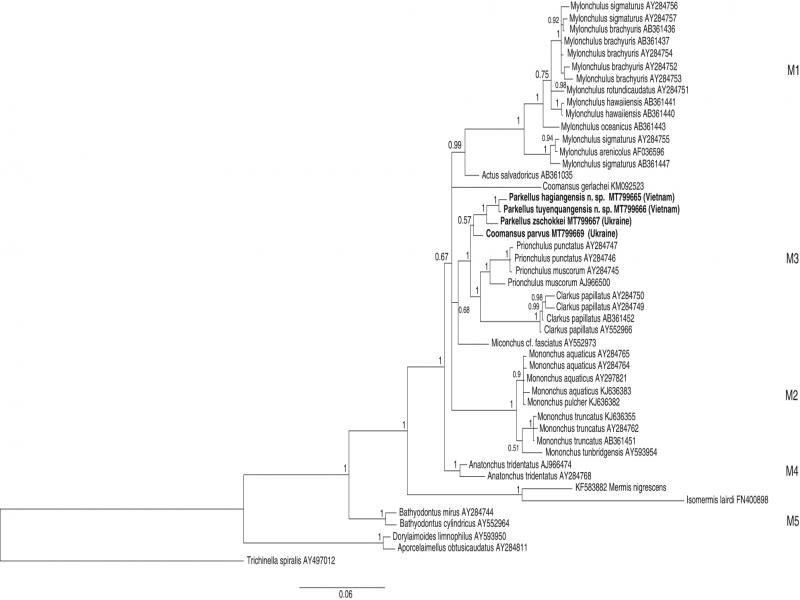
Figure 9:
18S rDNA-based Bayesian phylogeny of the Mononchida. The new Parkellus species and the additionally studied P. zschokkei and Coomansus parvus are indicated in bold. Numbers near nodes indicate posterior probabilities.
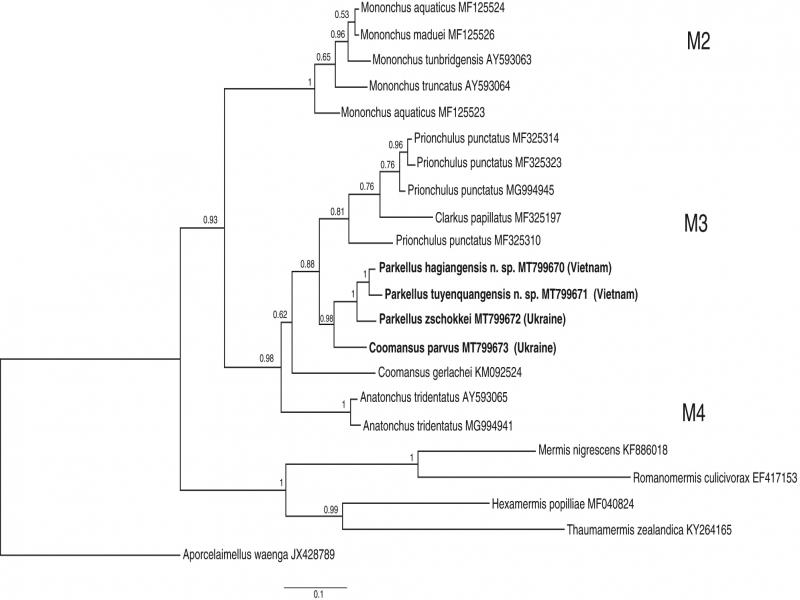
Figure 10:
28S rDNA-based Bayesian phylogeny of the Mononchida. The new Parkellus species and the additionally studied P. zschokkei and Coomansus parvus are indicated in bold. Numbers near nodes indicate posterior probabilities.