Have a personal or library account? Click to login
Meloidogyne incognita management by nematicides in tomato production Cover

Meloidogyne incognita management by nematicides in tomato production

Open Access
|Jul 2021

Figures & Tables

Table 1.

Nematicide treatments in 2018–2020 trials.

TreatmentActive ingredientProductTotal product broadcast rate a Total a.i. broadcast rateTiming/method
  1. 2018

  1. 1

  1. Untreated control

  1. 2

  1. 1,3-dichloropropene (1,3-D)

  1. Telone II

  1. 140 liters/ha

  1. 166 kg/ha

  1. Preplant shank fumigation

  1. 3

  1. 1,3-D

  1. Telone II

  1. 140 liters/ha

  1. 166 kg/ha

  1. Preplant shank fumigation

  1. Fluopyram

  1. Velum Prime

  1. 474 mL/ha

  1. 237 g/ha

  1. Single chemigation 21 DAP

  1. 4

  1. Fluopyram

  1. Velum Prime

  1. 474 mL/ha

  1. 237 g/ha

  1. Single chemigation at planting

  1. 5

  1. Fluopyram

  1. Velum Prime

  1. 474 mL/ha

  1. 237 g/ha

  1. Chemigation (1) at planting and (2) 21 DAP

  1. 2019 and 2020

  1. 1

  1. Untreated control

  1. 2

  1. 1,3-D

  1. Telone II

  1. 140 liters/ha

  1. 166 kg/ha

  1. Preplant shank fumigation

  1. 3

  1. 1,3-D

  1. Telone II

  1. 140 liters/ha

  1. 166 kg/ha

  1. Preplant shank fumigation

  1. Fluopyram

  1. Velum Prime

  1. 474 mL/ha

  1. 237 g/ha

  1. Single chemigation at planting

  1. 4

  1. Fluopyram

  1. Velum Prime

  1. 474 mL/ha

  1. 237 g/ha

  1. Single chemigation at planting

  1. 5

  1. Oxamyl

  1. Vydate L

  1. 3.10 liters/ha

  1. 750 g/ha

  1. Chemigation (1) at planting and (2) 10-12 DAP

1 Note: aFluopyram and oxamyl were chemigated in a 0.61 m bed with 1.83 m row spacing, so rate per treated acre is three times that of the broadcast rate. For 1,3-D application, broadcast and treated rates are the same.

Table 2.

Schedule for data collection. Numbers in parentheses are days before transplanting (DBP) or days after transplanting (DAP).
Item201820192020
Preplant soil samples
  1. 30 July (23 DBP)

  1. 30 July (44 DBP)

  1. 27 July (43 DBP)

  1. Preplant M. incognita J2/100 cm3 soil

  1. 30

  1. 45

  1. 14

  1. Soil fumigation

  1. 1 August (22 DBP)

  1. 30 July (44 DBP)

  1. 27 July (43 DBP)

  1. Date planted

  1. 23 August

  1. 5 September

  1. 8 September

  1. Tomato variety

  1. Grand Marshall

  1. BHN 602

  1. BHN 602

  1. Postplant fluopyam injection

  1. 13 September (21 DAP)

  1. 17 September (12 DAP)

  1. 18 September (10 DAP)

  1. Harvest date(s)

  1. 9 November (78 DAP)

  1. 4 December (90 DAP)

  1. 2 December (87 DAP)

  1. 20 November (89 DAP)

  1. 29 November (98 DAP)

  1. Soil sampling/root rating

  1. 29 November (98 DAP)

  1. 4 December (90 DAP)

  1. 3 December (88 DAP)

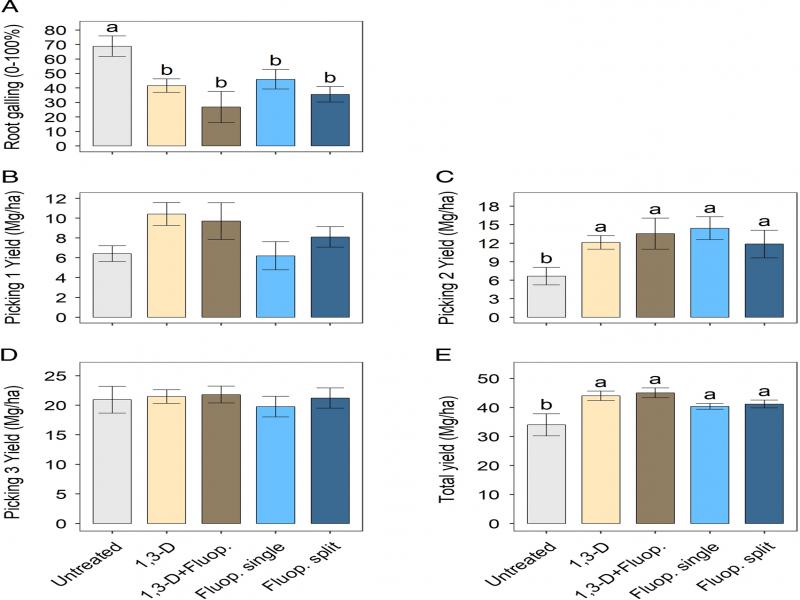
Figure 1:

Nematicide effects on root galling at harvest (A) and tomato yields (B-E) in 2018 trial. Within each subfigure, means with different letters are significantly different (P  < 0.05) based on Fisher’s protected LSD. “1,3-D + Fluop.” indicates preplant 1,3-D followed by fluopyram (237 g a.i./ha) at 3 weeks after planting. “Fluop. single” indicates a single fluopyram chemigation (237 g a.i./ha) at transplanting. “Fluop. split” indicates split fluopyram chemigation with 118.5 g a.i./ha each applied at transplanting and 3 weeks after transplanting.
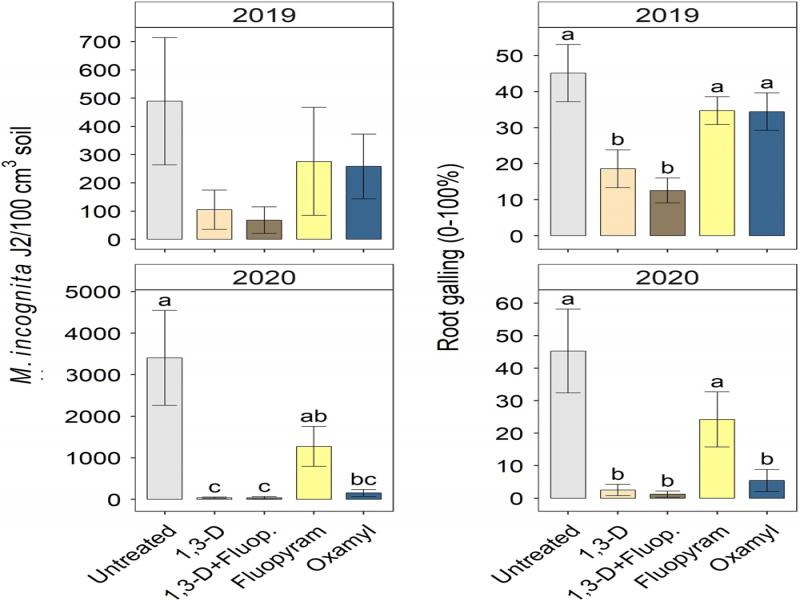
Figure 2:

Nematicide effects on Meloidogyne incognita J2 soil abundances and root galling at harvest in 2019 and 2020 trials. Within each subfigure, means with different letters are significantly different (P < 0.05) based on Fisher’s protected LSD.
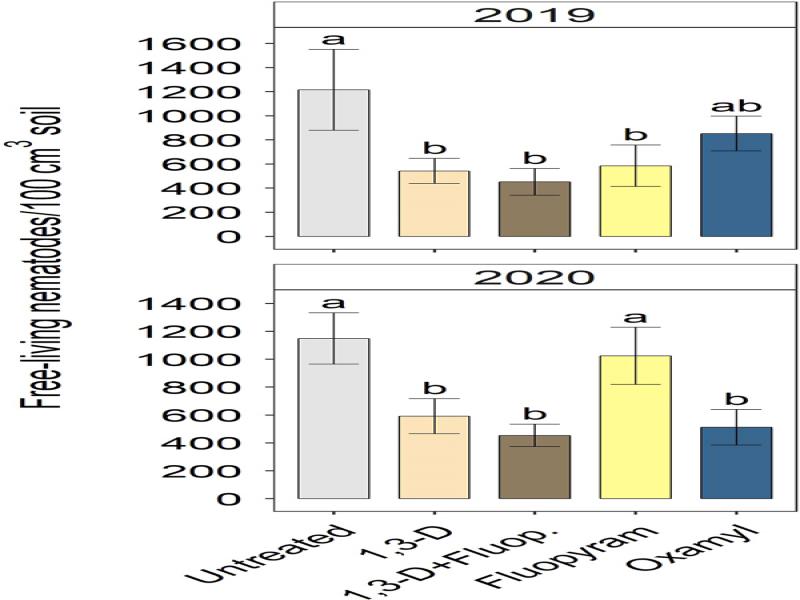
Figure 3:

Nematicide effects on free-living nematode soil abundances in 2019 and 2020 trials. Within each subfigure, means with different letters are significantly different (P  < 0.05) based on Fisher’s protected LSD.

Table 3.

Tomato yield (Mg/ha) in different size categories as affected by nematicide treatments in 2019 and 2020.

TreatmentCull a Small b MediumLargeTotal
  1. 2019

  1. Untreated control

  1. 4.3

  1. 4.2a

  1. 2.2

  1. 0.7

  1. 11.4b

  1. 1,3-D

  1. 6.6

  1. 7.0b

  1. 4.2

  1. 1.4

  1. 19.2a

  1. 1,3-D+Fluopyram

  1. 5.4

  1. 5.2ab

  1. 2.9

  1. 1.0

  1. 14.4ab

  1. Fluopyram

  1. 4.6

  1. 3.7b

  1. 1.6

  1. 0.6

  1. 10.5b

  1. Oxamyl

  1. 6.1

  1. 5.4ab

  1. 2.4

  1. 0.8

  1. 14.8ab

  1. 2020

  1. Untreated control

  1. 11.6

  1. 15.1

  1. 12.2

  1. 6.1

  1. 45.0

  1. 1,3-D

  1. 12.3

  1. 15.0

  1. 12.9

  1. 8.2

  1. 48.4

  1. 1,3-D+Fluopyram

  1. 12.3

  1. 16.5

  1. 12.5

  1. 7.0

  1. 48.3

  1. Fluopyram

  1. 12.7

  1. 16.1

  1. 11.5

  1. 5.9

  1. 46.2

  1. Oxamyl

  1. 12.7

  1. 15.8

  1. 12.4

  1. 7.1

  1. 47.9

1 Notes: aSize diameter (cm) classes for cull, small, medium, and large, respectively, were: < 5.7, 5.7 to 6.3, 6.4 to 7.0, and > 7.0. bTreatments with the same letters within the same column and year are not significantly different (Fisher’s protected LSD, α = 0.05). Columns with no letters have no significant nematicide effects (ANOVA, α = 0.05).
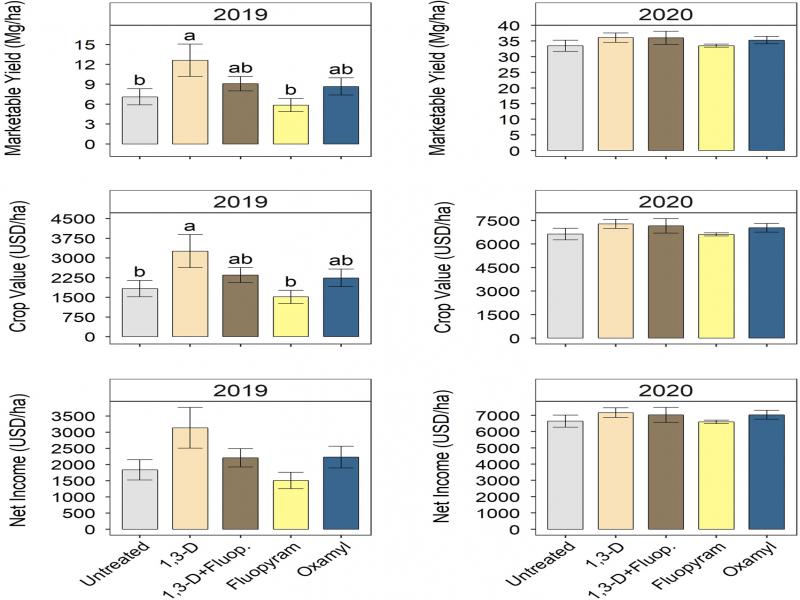
Figure 4:

Nematicide effects on marketable yield, crop value, and net income in 2019 and 2020 trials. USD is United States dollars. Net income is crop value minus nematicide product cost, not including any labor or equipment costs. Within each subfigure, means with different letters are significantly different (P  < 0.05) based on Fisher’s protected LSD.

DOI: https://doi.org/10.21307/jofnem-2021-055 | Journal eISSN: 2640-396X | Journal ISSN: 0022-300X
Language: English
Page range: 1 - 12
Published on: Jul 19, 2021
Published by: Society of Nematologists, Inc.
In partnership with: Paradigm Publishing Services
Publication frequency: 1 issue per year

© 2021 Zane J. Grabau, Chang Liu, Rebeca Sandoval-Ruiz, published by Society of Nematologists, Inc.
This work is licensed under the Creative Commons Attribution 4.0 License.