
Table 1.
Minimum temperature and rainfall data at Nyangati study site in Mwea Sub-county, Kenya.
| Month | Minimum temperature (°C) | Average rainfall (mm) |
|---|---|---|
| March | 14.6 | 245 |
| April | 14.7 | 619.2 |
| May | 14.8 | 299.6 |
| June | 13.3 | 78 |
| July | 12.7 | 51.5 |
| August | 12.3 | 18.8 |
| September | 13.0 | 38.5 |
| October | 14.6 | 51.5 |
| November | 15.5 | 100.1 |
| December | 14.7 | 109.2 |
| January | 13.6 | 46.5 |
| February | 21.6 | 21.6 |
Table 2.
Soil physicochemical characteristics at Nyangati study site in Mwea Sub-county, Kenya.
| Soil property | Mean | Standard error |
|---|---|---|
| Calcium me % | 6.07 | 0.788 |
| Clay % | 44.00 | 4.000 |
| Copper ppm | 2.95 | 0.090 |
| Iron ppm | 23.50 | 3.239 |
| Magnesium me % | 3.63 | 0.135 |
| Manganese me % | 0.97 | 0.114 |
| Phosphorus ppm | 16.67 | 1.667 |
| Potassium me % | 0.75 | 0.096 |
| Sand % | 46.67 | 3.712 |
| Silt % | 9.33 | 0.667 |
| Sodium me % | 0.16 | 0.074 |
| Soil pH | 5.85 | 0.057 |
| Total Nitrogen % | 0.18 | 0.003 |
| Total Organic Carbon % | 2.03 | 0.050 |
| Zinc ppm | 0.20 | 0.029 |
Table 3.
Average number of nematodes in 250 g soil collected from control and decomposition plots during season one.
| Taxa | Cp-class | Control Mean ± SE | Decomposition Mean ± SE | F-value | P-value |
|---|---|---|---|---|---|
| Bacterivores | |||||
| Acrobeles | 2 | 42 ± 9.5 | 58 ± 8.0 | 37.039 | <0.001*** |
| Acrobeloides | 2 | 16 ± 4.4 | 8 ± 3.5 | 9.153 | 0.005** |
| Alaimus | 4 | 31 ± 8.8 | 30 ± 5.7 | 2.331 | 0.137 |
| Aphanolaimus | 1 | 5 ± 2.4 | 2 ± 1.1 | 1.327 | 0.258 |
| Cephalobus | 2 | 107 ± 6.4 | 109 ± 9.9 | 0.106 | 0.747 |
| Cervidellus | 2 | 52 ± 11.3 | 23 ± 3.8 | 0.082 | 0.777 |
| Drilocephalobus | 2 | 0 ± 0.0 | 3 ± 2.0 | 1.946 | 0.173 |
| Eucephalobus | 2 | 91 ± 12.9 | 118 ± 21.1 | 2.92 | 0.098 |
| Geomonhystera | 2 | 10 ± 4.8 | 7 ± 3.6 | 0 | 0.996 |
| Heterocephalobus | 2 | 120 ± 20.9 | 86 ± 13.4 | 1.927 | 0.175 |
| Plectus | 2 | 26 ± 9.0 | 37 ± 7.6 | 7.016 | 0.013* |
| Prismatolaimus | 3 | 18 ± 4.0 | 40 ± 11.0 | 2.586 | 0.118 |
| Rhabditis | 1 | 39 ± 8.0 | 41 ± 12.6 | 0.223 | 0.64 |
| Stegelleta | 2 | 0 ± 0.0 | 1 ± 1.3 | 0.272 | 0.325 |
| Wilsonema | 2 | 31 ± 10.1 | 17 ± 4.2 | 0.679 | 0.417 |
| Fungivores | |||||
| Aphelenchoides | 2 | 16 ± 5.8 | 9 ± 3.2 | 1.088 | 0.305 |
| Aphelenchus | 2 | 143 ± 1.0 | 181 ± 19.0 | 2.479 | 0.126 |
| Ditylenchus | 2 | 13 ± 4.6 | 1 ± 1.3 | 49.301 | <0.001*** |
| Filenchus | 2 | 16 ± 2.2 | 9 ± 2.7 | 9.997 | 0.004** |
| Omnivores | |||||
| Aporcelaimellus | 5 | 0 ± 0.0 | 4 ± 1.9 | 4.719 | 0.038* |
| Eudorylaimus | 4 | 8 ± 2.4 | 3 ± 1.3 | 3.684 | 0.064 |
| Labronema | 4 | 62 ± 4.0 | 65 ± 8.0 | 1.196 | 0.283 |
| Predators | |||||
| Discolaimus | 5 | 8 ± 2.4 | 10 ± 3.3 | 0.076 | 0.784 |
| Nygolaimus | 5 | 36 ± 6.9 | 42 ± 6.4 | 9.345 | 0.005** |
| Seinura | 2 | 0 ± 0.0 | 6 ± 2.4 | 22.167 | <0.001*** |
Table 4.
Average number of nematodes in 250 g soil collected from control and decomposition plots during season two.
| Taxa | Cp-class | Control Mean ± SE | Decomposition Mean ± SE | F-value | P-value |
|---|---|---|---|---|---|
| Bacterivores | |||||
| Acrobeles | 2 | 39 ± 7.5 | 58 ± 12.8 | 6.604 | 0.015* |
| Acrobeloides | 2 | 42 ± 8.0 | 27 ± 6.0 | 1.434 | 0.241 |
| Alaimus | 4 | 8 ± 2.4 | 10 ± 3.9 | 0.059 | 0.81 |
| Cephalobus | 2 | 151 ± 10.4 | 280 ± 26.9 | 25.737 | <0.001*** |
| Cervidellus | 2 | 42 ± 13.5 | 34 ± 12.1 | 0.466 | 0.5 |
| Drilocephalobus | 2 | 5 ± 2.4 | 9 ± 3.2 | 4.225 | 0.049* |
| Eucephalobus | 2 | 101 ± 19.1 | 164 ± 23.8 | 48.172 | <0.001*** |
| Geomonhystera | 2 | 16 ± 3.5 | 8 ± 3.0 | 7.391 | 0.0108* |
| Heterocephalobus | 2 | 57 ± 10.8 | 129 ± 14.8 | 68.576 | <0.001*** |
| Mesorhabditis | 1 | 0 ± 0.0 | 14 ± 4.9 | 37.891 | <0.001*** |
| Panagrolaimus | 1 | 3 ± 1.2 | 5 ± 2.0 | 0.486 | 0.491 |
| Plectus | 2 | 10 ± 3.5 | 27 ± 4.7 | 96.111 | <0.001*** |
| Prismatolaimus | 3 | 16 ± 3.5 | 24 ± 4.2 | 3.989 | 0.055 |
| Rhabditis | 1 | 21 ± 7.0 | 73 ± 34.4 | 2.592 | 0.118 |
| Wilsonema | 2 | 3 ± 1.2 | 3 ± 1.5 | 0.207 | 0.652 |
| Fungivores | |||||
| Aphelenchoides | 2 | 29 ± 6.1 | 98 ± 29.5 | 13.911 | <0.001*** |
| Aphelenchus | 2 | 164 ± 20.9 | 320 ± 47.2 | 18.84 | <0.001*** |
| Filenchus | 2 | 21 ± 4.8 | 16 ± 6.0 | 2.041 | 0.163 |
| Omnivores | |||||
| Aporcelaimellus | 5 | 0 ± 0.0 | 1 ± 1.3 | 1 | 0.325 |
| Eudorylaimus | 4 | 26 ± 4.2 | 22 ± 5.2 | 1.34 | 0.256 |
| Dorylaimellus | 5 | 0 ± 0.0 | 1 ± 0.7 | 1 | 0.325 |
| Labronema | 4 | 39 ± 7.1 | 47 ± 7.1 | 2.561 | 0.12 |
| Mesodorylaimus | 4 | 23 ± 3.5 | 10 ± 2.9 | 13.006 | 0.001** |
| Prodorylaimus | 4 | 0 ± 0.0 | 3 ± 1.5 | 3.649 | 0.066 |
| Predators | |||||
| Discolaimus | 5 | 8 ± 1.5 | 8 ± 2.0 | 0.051 | 0.823 |
| Mononchus | 4 | 5 ± 1.5 | 4 ± 2.7 | 4.741 | 0.037* |
| Nygolaimus | 5 | 78 ± 10.3 | 54 ± 9.9 | 5.483 | 0.026* |
Table 5.
Nematode ecological and functional indices in control and decomposition plots during season 1 and 2.
| Control | Decomposition | |||
|---|---|---|---|---|
| Index name | Mean ± SE | Mean ± SE | F-values | P-value |
| Season 1 | ||||
| Maturity Index (MI) | 2.41a ± 0.038 | 2.43a ± 0.040 | 0.38 | 0.542 |
| Maturity Index (MI2-5) | 2.47a ± 0.044 | 2.49a ± 0.036 | 0.409 | 0.528 |
| Channel Index (CI) | 60.35a ± 5.95 | 65.66a ± 5.948 | 0.985 | 0.329 |
| Basal Index (BI) | 37.82a ± 2.016 | 35.72a ± 1.652 | 1.452 | 0.238 |
| Enrichment Index (EI) | 34.52a ± 1.455 | 33.03a ± 2.472 | 0.511 | 0.481 |
| Structure Index (SI) | 53.19a ± 2.537 | 55.73a ± 2.224 | 1.435 | 0.24 |
| Season 2 | ||||
| Maturity Index (MI) | 2.54a ± 0.033 | 2.26b ± 0.036 | 64.715 | <0.001*** |
| Maturity Index (MI2-5) | 2.57a ± 0.031 | 2.33b ± 0.029 | 68.996 | <0.001*** |
| Channel Index (CI) | 81.01a ± 4.923 | 68.37b ± 5.864 | 12.359 | <0.001*** |
| Basal Index (BI) | 34.44b ± 1.267 | 42.47a ± 1.495 | 65.944 | <0.001*** |
| Enrichment Index (EI) | 28.14b ± 2.519 | 35.06a ± 2.941 | 15.409 | <0.001*** |
| Structure Index (SI) | 59.91a ± 1.535 | 42.21b ± 2.689 | 41.205 | <0.001*** |
Table 6.
Metabolic footprints in control and decomposition plots during season 1 and 2.
| Control | Decomposition | |||
|---|---|---|---|---|
| Metabolic footprints | Mean ± SE | Mean ± SE | F-values | P-value |
| Season 1 | ||||
| Composite footprint | 5.67a ± 3.444 | 5.77a ± 3.421 | 2.482 | 0.126 |
| Omnivore footprint | 4.55a ± 1.750 | 4.35a ± 2.558 | 0.825 | 0.371 |
| Structure footprint | 4.99a ± 2.345 | 5.07a ± 2.702 | 1.272 | 0.268 |
| Predator footprint | 3.15b ± 2.127 | 3.82a ± 2.110 | 19.678 | <0.001*** |
| Fungivore footprint | 2.91a ± 1.243 | 2.94a ± 1.101 | 0.126 | 0.725 |
| Enrichment footprint | 4.326a ± 2.797 | 4.196a ± 3.262 | 0.556 | 0.462 |
| Bacterivore footprint | 4.734a ± 3.267 | 4.918a ± 3.303 | 2.441 | 0.129 |
| Season 2 | ||||
| Composite footprint | 5.68b ± 3.242 | 5.95a ± 4.301 | 11.018 | 0.002** |
| Omnivore footprint | 4.23a ± 2.479 | 4.33a ± 2.657 | 0.679 | 0.417 |
| Structure footprint | 5.22a ± 2.314 | 5.05b ± 2.870 | 4.500 | 0.042* |
| Predator footprint | 4.48a ± 2.485 | 3.87b ± 2.515 | 5.894 | 0.021* |
| Fungivore footprint | 2.89b ± 1.260 | 3.52a ± 1.972 | 21.683 | <0.001*** |
| Enrichment footprint | 3.51b ± 2.755 | 4.43a ± 4.249 | 27.425 | <0.001*** |
| Bacterivore footprint | 4.39b ± 2.945 | 5.10a ± 4.269 | 30.782 | <0.001*** |
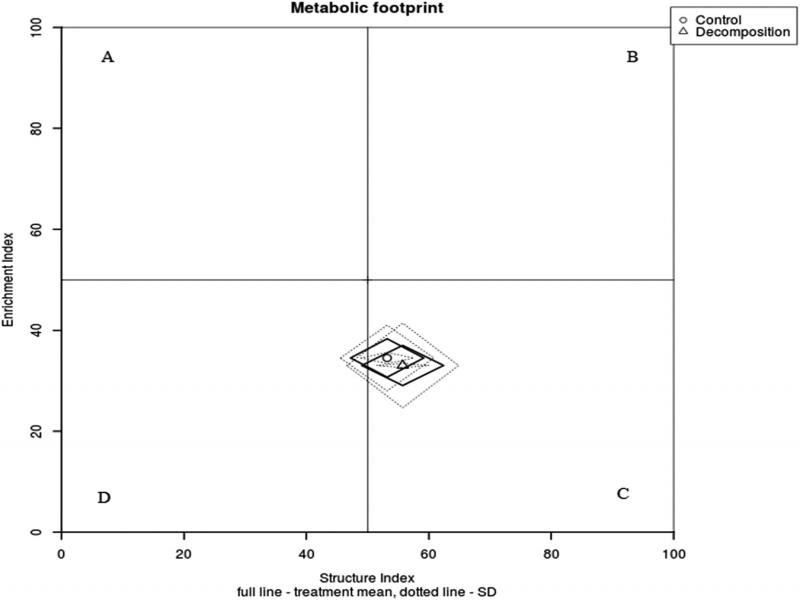
Figure 1:
Functional metabolic footprint of nematodes in control and decomposition plots during the first season. The point at the middle of the rhomboid represents the intersection of the enrichment and structure index. The length of the vertical axis and horizontal axis of the rhombus represents the enrichment and structure footprints, respectively. The functional nematode metabolic footprint is represented by the total area of the functional enrichment and structure footprints.
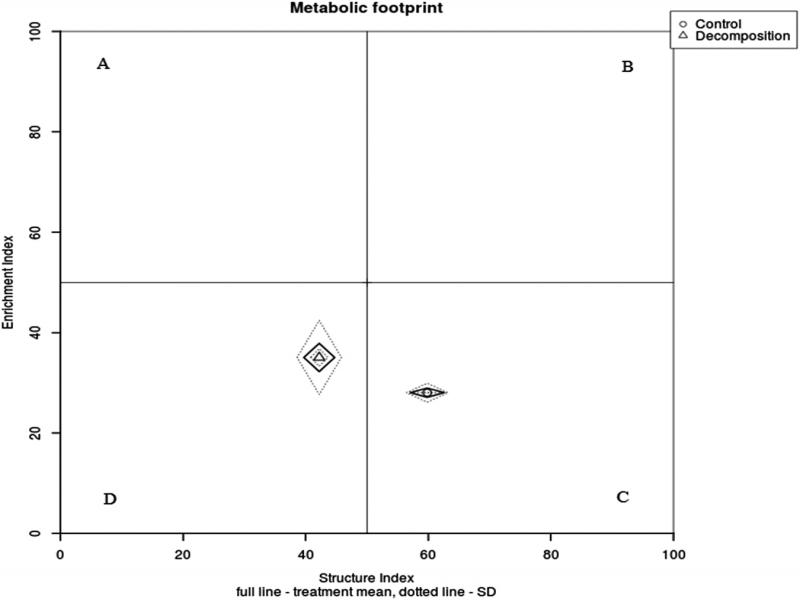
Figure 2:
Functional metabolic footprint of nematodes in control and decomposition plots during the second season. The point at the middle of the rhomboid represents the intersection of the enrichment and structure index. The length of the vertical axis and horizontal axis of the rhombus represents the enrichment and structure footprints, respectively. The functional nematode metabolic footprint is represented by the total area of functional enrichment and structure footprints.