
Table 1.
Morphometric data for fixed female Rotylenchus wimbii n. sp. specimens mounted in glycerin.
| Female character | |
|---|---|
| n | 19 |
| Body length (L) | 690 ± 44 (620-760) |
| a = L/MBD | 27.3 ± 3.0 (23.0-33.0) |
| b = L/Anterior end to pharynx-intestine junction | 5.8 ± 0.3 (5.0-6.0) |
| b′ = L/Anterior end to end of pharyngeal gland | 5.1 ± 0.4 (4.5-6.1) |
| c = L/Tail length | 66.0 ± 12.0 (49.0-91.0) |
| c′ = Tail length/ABD | 0.6 ± 0.1 (0.3-0.8) |
| V = Anterior end to vulva opening/L × 100 | 58 ± 1 (55-60) |
| Lip region height | 4.6 ± 0.3 (4.2-5.3) |
| Lip region width | 8.2 ± 0.3 (7.7-8.7) |
| Stylet length | 25.3 ± 0.9 (22.5-26.6) |
| Cone length | 12.5 ± 0.7 (10.8-13.7) |
| Shaft length | 10.3 ± 0.5 (9.4-11.2) |
| Stylet knob height | 2.6 ± 0.4 (1.9-3.4) |
| Cone % Stylet | 49.3 ± 1.8 (44.8-52.6) |
| Dorsal gland opening from stylet base | 5.4 ± 0.6 (4.1-6.3) |
| Anterior end to secretory-excretory pore | 107 ± 6.2 (93.2-118) |
| Anterior end to pharynx-intestine junction | 118 ± 5.3 (105-128) |
| Anterior end to pharyngeal gland end | 135 ± 6.0 (121-144) |
| Anterior end to vulva opening | 400 ± 24.8 (341-408) |
| Maximum body diameter (MBD) | 25.5 ± 2.9 (21.5-31.7) |
| Anal body diameter (ABD) | 16.9 ± 1.4 (15.2-19.9) |
| Tail length | 10.8 ± 2.1 (6.9-13.4) |
| Phasmid to tail tip length | 31.6 ± 3.1 (25.1-36.3) |
| Number of annuli between phasmid and tail tip | 20 ± 3 (12-26) |
| Number of tail annuli | 7 ± 1 (5-9) |
Table 2.
Comparison of some important female characters and information on availability of males of 23 Rotylenchus species reported from Africa.
| Species | Body length (mm) | Lip region | Lip annuli number | Stylet length (µm) | Cone% of stylet | Spermatheca in matured females | V% | Male | Tail annuli number | Phasmid position |
|---|---|---|---|---|---|---|---|---|---|---|
| R. abnormecaudatus | 0.6-0.7 | Broadly rounded, setoff to continuous | 4-5 | 24-25 | 42-45 | Not seen | 56-59 | Not found | 8-11 | 8-14 annuli anterior to anus |
| R. acuspicaudatus | 0.8-1.0 | Broadly rounded, slightly setoff | 4-5 | 26-28 | 43-51 | Rounded, filled with sperms | 54-57 | Found | 13-16 | 7-15 annuli anterior to anus |
| R. alius | 0.5-0.9 | Truncate, blunt anterior, not setoff | 4-5 | 20-31 | 42-51 | Rounded, filled with sperms | 54-66 | Found | 8-15 | 3-4 annuli posterior to anus |
| R. bialaebursus | 0.6-0.8 | Rounded, not setoff | 4 | 26-29 | 46-50 | Rounded, filled with sperms | 54-59 | Found | 6-8 | 9-12 annuli anterior to anus |
| R. brevicaudatus | 0.5-0.8 | Broad, rounded, not setoff | 4-5 | 18-26 | – | Present | 52-62 | Found | 5-11 | 8-14 annuli anterior to anus |
| R. capensis | 0.7-1.2 | Hemispherical, slightly setoff | 5-7 | 25-35 | 39-45 | Rounded, filled with sperms | 54-59 | Found | 9-14 | 1-3 annuli anterior to anus |
| R. catharinae | 0.8-1.1 | Hemispherical, slightly setoff | 7-8 | 30-33 | 45-48 | Rounded, filled with sperms | 55-56 | Found | 13-14 | 1-4 annuli anterior to anus |
| R. caudaphasmidius | 0.6-0.9 | Hemispherical, not setoff | 5 | 24-32 | – | Rounded, filled with sperms | 55-63 | Found | 12 | 5 annuli posterior to anus |
| R. cypriensis | 0.5-0.8 | Hemispherical, well setoff | 3-4 | 21-28 | – | Small and empty | 57-67 | Not found | 6-7 | 7-14 annuli anterior to anus |
| R. devonensis | 0.7-0.9 | Conoid, blunt, not setoff | 4 | 25-34 | 43-46 | Rounded, filled with sperms | 53-64 | Found | 7-9 | 8-14 annuli anterior to anus |
| R. wimbii n. sp. | 0.6-0.8 | Hemispherical, not setoff | 4 | 23-27 | 45-53 | Indistinct to empty | 55-60 | Not found | 5-9 | 7-17 annuli anterior to anus |
| R. gracilidens | 0.9-1.2 | Hemispherical, slightly setoff | 4 | 29-35 | – | Rounded, filled with sperms | 53-59 | Found | 8-12 | 15-20 annuli anterior to anus |
| R. incultus | 0.6-1.0 | Hemispherical, not setoff | 4-5 | 22-32 | – | Developed, filled with sperms | 53-61 | Found | ca 8 | 13-14 annuli anterior to anus |
| R. karooensis | 0.7-1.0 | Rounded, slightly setoff | 4-5 | 21-27 | 43-47 | Rounded, filled with sperms | 51-60 | Found | 7-15 | 1-6 annuli anterior to anus |
| R. kenti | 0.5-0.7 | Rounded, not setoff | 4-5 | 21-25 | 44-52 | Rounded, filled with sperms | 60-66 | Found | 9-17 | 3-4 annuli anterior to anus |
| R. mabelei | 0.9-1.1 | Hemispherical, slightly setoff | 4-5 | 27-30 | 43-50 | Empty | 48-57 | Not found | 14-18 | 3 annuli anterior to 5 annuli posterior of anus |
| R. minutus | 0.5-0.8 | Angularly hemispherical, slightly setoff | 3-4 | 20-27 | 56-58 | Rounded, filled with sperms | 53-66 | Found | 9-14 | 1 annule anterior to 4 annuli posterior of anus |
| R. mirus | 0.6-0.7 | Hemispherical, setoff | 4-5 | 20-23 | 43-50 | Rounded, filled with sperms | 55-58 | Found | 6-10 | 5-12 annuli anterior to anus |
| R. robustus | 0.9-1.6 | Hemispherical, well setoff | 6-7 | 33-50 | 50-56 | Rounded, filled with sperms | 52-58 | Found | 8-17 | 7 annuli anterior to 3 annuli posterior of anus |
| R. rugatocuticulatus | 1.0-1.3 | Rounded, slightly setoff | 4 | 35-42 | – | Developed, filled with sperms | 51-56 | Found | 12 | 8-10 annuli anterior to anus |
| R. triannulatus | 0.6-0.8 | Rounded, well setoff | 3 | 24-25 | 43-48 | Rounded, filled with sperms | 56-60 | Found | 10-11 | Anal level to 8 annuli anterior |
| R. unisexus | 0.5-0.9 | Hemispherical, not setoff | 4 | 20-29 | – | Not seen | 47-59 | Not found | 9-13 | 6-7 annuli anterior to anus |
| R. usitatus | 1.1-1.2 | Flattened anteriorly, not setoff | 4-5 | 29-29 | 43-47 | Rounded, filled with sperms | 45-55 | Found | 10-16 | 8-14 annuli anterior to anus |
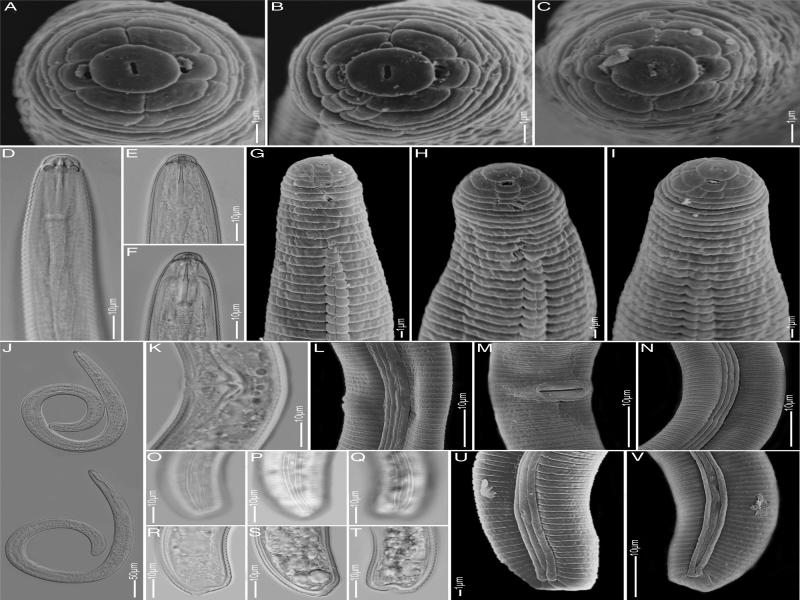
Figure 1:
Light microscopy and scanning electron microscopy images of Rotylenchus wimbii n. sp. female. A to C: En face view; D to I: Anterior part of the body showing lip and neck region; J: Whole female body; K to N: Vulva region; O to V: Tail region.
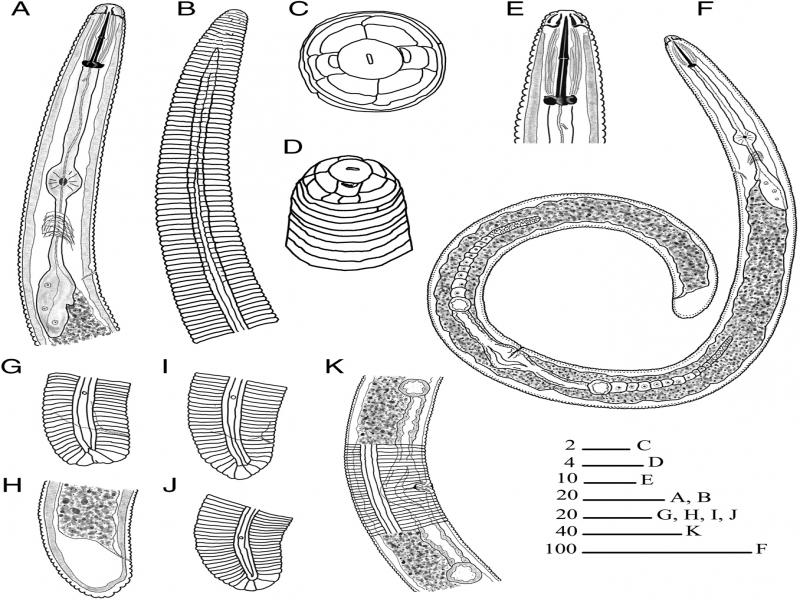
Figure 2:
Illustrations of Rotylenchus wimbii n. sp. female. A, B: Anterior part of the body showing lip and neck region; C: En face view; D, E: Lip region; F: Whole body; G to J: Tail region; K: Vulva region. Scales are given in µm.
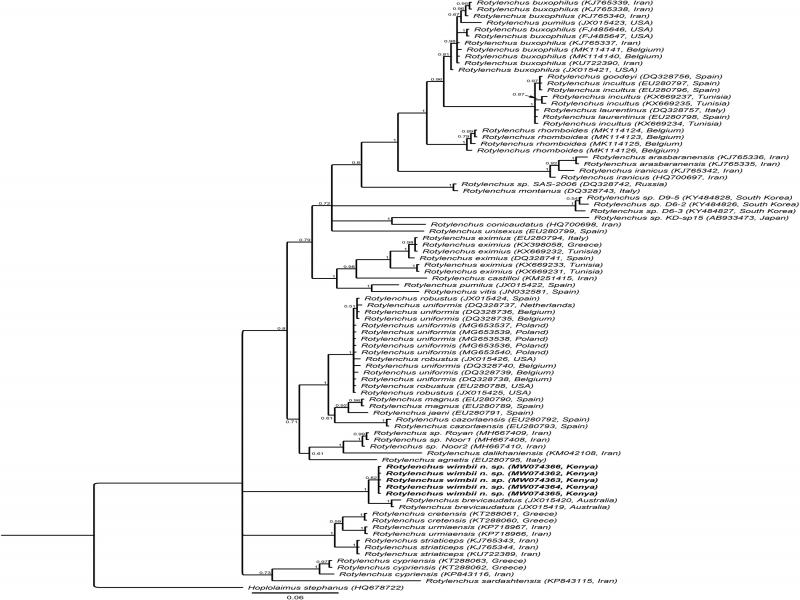
Figure 3:
BI phylogenetic tree generated from the analysis of D2-D3 of 28S rDNA sequences using GTR + G + I nucleotide substitution model. Bayesian posterior probabilities are given next to each node and sequences of Rotylenchus wimbii n. sp. are in bold.
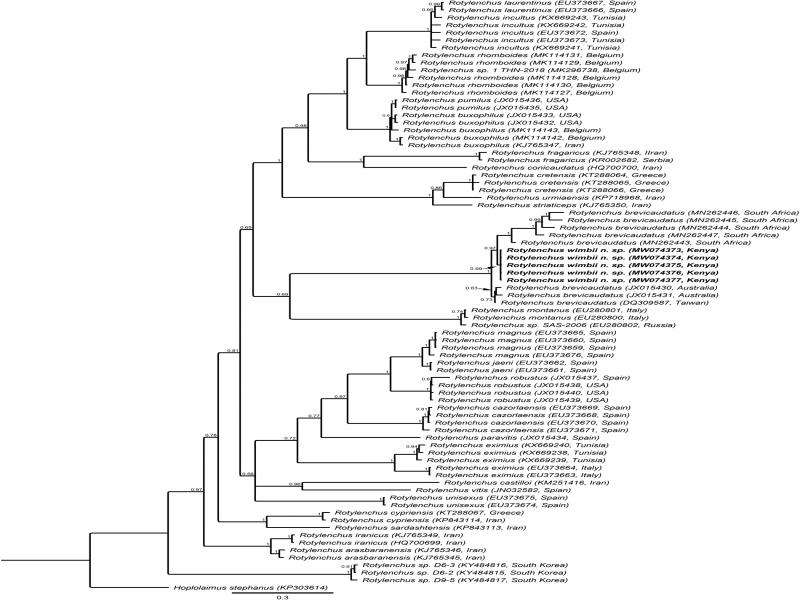
Figure 4:
BI phylogenetic tree generated from the analysis of ITS of rDNA sequences using GTR + G + I nucleotide substitution model. Bayesian posterior probabilities are given next to each node and sequences of Rotylenchus wimbii n. sp. are in bold.
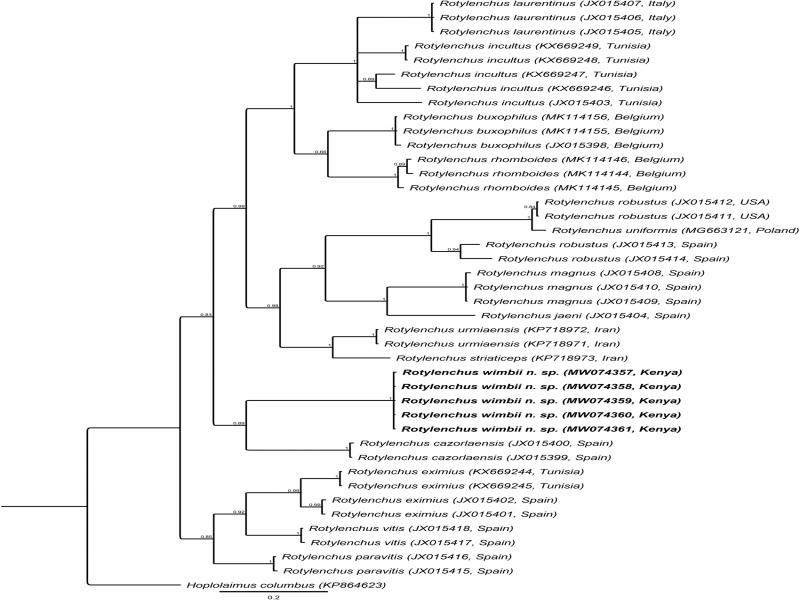
Figure 5:
BI phylogenetic tree generated from the analysis of COI of mtDNA sequences using GTR + G + I nucleotide substitution model. Bayesian posterior probabilities are given next to each node and sequences of Rotylenchus wimbii n. sp. are in bold.