
Table 1.
Morphometric data of Meloidogyne javanica from different populations.
| Population from ginger in Vietnam | Population from long coriander in Vietnam | Population from sugar cane in Indonesia (Whitehead, 1968) | Population from tomato in Iran (Ghaderi et al., 2020) | |||||
|---|---|---|---|---|---|---|---|---|
| Diagnostic characters | J2 | Female | J2 | Female | J2 | Female | J2 | Female |
| n | 20 | 10 | 20 | 10 | 25 | 20 | 50 | 15 |
| L | 395 ± 18.7 (341-418) | 693 ± 110 (570-882) | 402 ± 42 (300-521) | 554 ± 31 (522-584) | 417 ± 22 (387-459) | 657 ± 67 (541-804) | 464 ± 19 (429-497) | 686 ± 127 (506-1.01) |
| Lip height | 2.6 ± 0.2 (2.2-2.9) | 2.7 ± 0.6 (1.9-3.9) | 2.9 ± 0.4 (2.2-4.1) | 3.3 ± 0.3 (2.9-3.6) | – | – | – | – |
| Lip width | 3.7 ± 0.4 (3.2-4.7) | 6.3 ± 1.2 (4.6-8.6) | 4.1 ± 0.4 (3.2-5.0) | 6.2 ± 0.9 (5.2-7.7) | – | – | – | – |
| Stylet | 11.3 ± 0.8 (9.9-12.5) | 16.2 ± 0.7 (15.1-17.2) | 11.0 ± 0.8 (9.0-13.2) | 15.0 ± 1.7 (12.6-17.3) | 10.4 ± 0.5 (9.4-11.4) | 15 (14-18) | 10 ± 0.5 (9-12) | 15 ± 2 (13-18) |
| DGO | 3.0 ± 0.4 (2.4-3.8) | 5.1 ± 1.2 (3.0-6.6) | 3.3 ± 0.6 (2.4-5.3) | 6.1 ± 0.5 (5.5-6.6) | – | 3 (2-5) | 2.2 ± 0.5 (1.5-3.7) | 3.1 ± 0.6 (2.0-3.9) |
| Distance from anterior end to median bulb | 54.3 ± 2.5 (50-59) | – | 53 ± 6.8 (39-74) | – | – | – | – | – |
| Distance from anterior end to pharyngo-intestinal junction | 84 ± 5.0 (76-92) | – | 76 ± 10.7 (53-98) | – | – | – | – | – |
| Distance from anterior end to excretory pore | 82 ± 6.5 (65-94) | 34 ± 3.2 (29-40) | 80 ± 8.0 (60-98) | 38 ± 5.8 (34-48) | – | – | – | 190 ± 30 (145-270) |
| Maximum body diameter | 14.3 ± 0.8 (12.7-15.9) | 445 ± 1,123 (269-602) | 13.1 ± 1.8 (8.8-17.2) | 271 ± 35 (237-306) | – | 431 ± 63 (311-581) | 15 ± 1.5 (12-18) | 420 ± 99 (274-568) |
| Body diameter at anus | 10.3 ± 0.8 (9.0-11.2) | – | 9.7 ± 1.0 (7.3-12.0) | – | – | – | – | – |
| Tail length | 50 ± 4.2 (42-57) | – | 48 ± 6 (31-63) | – | 49 ± 4 (36-56) | – | 55 ± 5 (40-66) | – |
| Hyaline | 13 ± 2.2 (9.1-17) | – | 13.7 ± 2.0 (9.1-17) | – | – | – | 13 ± 4 (7-20) | – |
| Distance from anterior end to end of pharynx | 165 ± 14.6 (135-183) | – | 150 ± 20 (103-210) | – | – | – | 193 ± 23 (90-216) | – |
| a | 28 ± 1.8 (24-32) | 1.6 ± 0.3 (1.2-2.1) | 31.1 ± 4.9 (22-50) | 2.1 ± 0.1 (1.9-2.2) | 30.6 ± 2.07 (27.1-35.9) | – | 31 ± 3 (25-39) | 1.7 ± 0.4 (1.2-2.6) |
| b | 4.8 ± 0.4 (3.7-5.4) | – | 5.4 ± 0.6 (3.7-7.2) | – | 2.42 ± 0.291 (2.1-3.35) | – | 5.2 ± 1.4 (4.3-12.4) | – |
| b′ | 2.4 ± 0.3 (2.0-3.1) | – | 2.7 ± 0.4 (2.0-3.6) | – | – | – | 2.5 ± 0.5 (2.0-5.2) | – |
| c | 8.0 ± 0.6 (7.3-9.4) | – | 8.4 ± 1.0 (6.8-10.8) | – | 8.5 ± 0.68 (7.3-11.1) | – | 8.5 ± 0.8 (7.2-11.3) | – |
| c′ | 4.8 ± 0.5 (3.8-5.9) | – | 4.9 ± 0.6 (3.8-6.9) | – | – | – | 5.7 ± 0.5 (4.7-7.2) | – |
| Neck length | – | 204 ± 50 (139-279) | – | 272 ± 36 (235-307) | – | – | – | 259 ± 87 (153-540) |
| Ratio of body length to length of neck | – | 3.6 ± 0.8 (2.0-4.6) | – | 2.1 ± 0.2 (1.9-2.2) | – | – | – | – |
| Vulva slit length | – | 18.4 ± 1.9 (15.6-21.6) | – | 19.8 ± 1.0 (18.2-20.9) | – | – | – | 21 ± 3 (15-27) |
| Vulva–anus distance | – | 15.2 ± 1.0 (13.1-16.2) | – | 16.4 ± 1.0 (15.6-18.0) | – | – | – | 16 ± 4 (12-28) |
| Anus-tail tip distance | – | 12.3 ± 2 (9.3-15.8) | – | 10.6 ± 2.6 (8-14.8) | – | – | – | – |
| Distance between two phasmids | – | 16.8 ± 3.4 (13-24.4) | – | 20 ± 3.2 (17-24) | – | 24.4 ± 0.3 (15-34) | – | 78 ± 16 (58-108) |
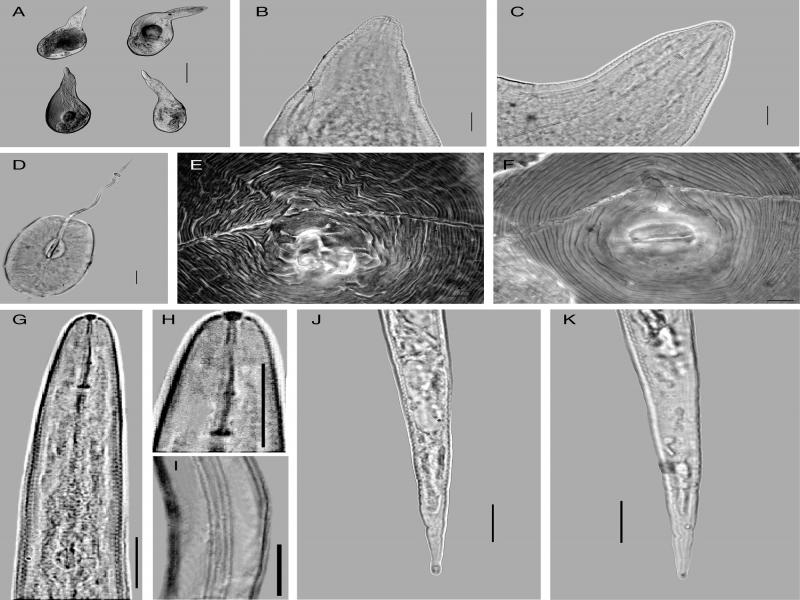
Figure 1:
Meloidogyne javanica (Chitwood, 1949; Treub, 1885) from Zingiber officinale Roscoe and Eryngium foetidum L. in Vietnam. A to F: Females. A: Entire body; B, C: Anterior end regions; D: Stylet and median bulb extracted from female; E, F: Perineal patterns. G to K: Second-stage juvenile. G, H: Anterior end region; I: Lateral field; J, K: Tail regions. (Scale bar: A: 200 µm; B-K: 10 µm).
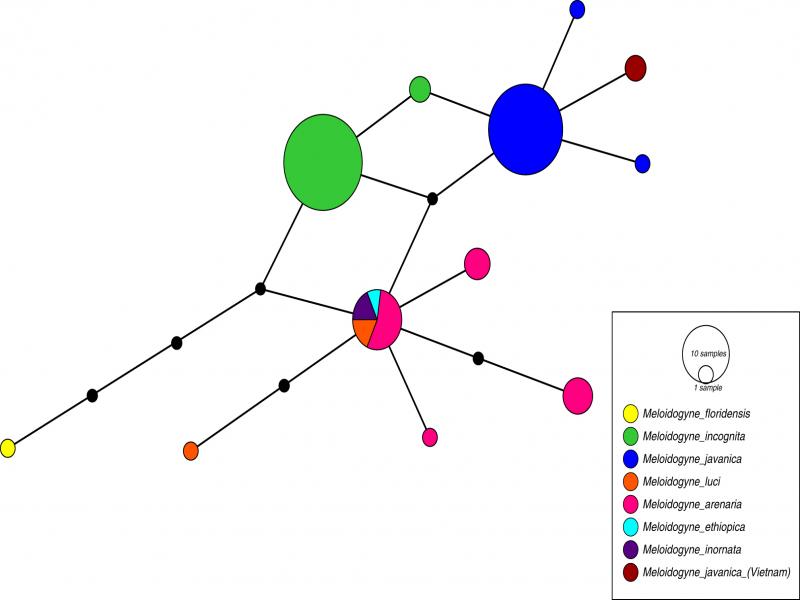
Figure 2:
The haplotype network shows the relationships between different haplotypes, circle size is equivalent to the number of studied populations and branch length is equivalent to the number of mutations (shown as small black circles). All populations from the same species are displayed by the same colors (except for the populations of M. javanica from Vietnam in this study).