
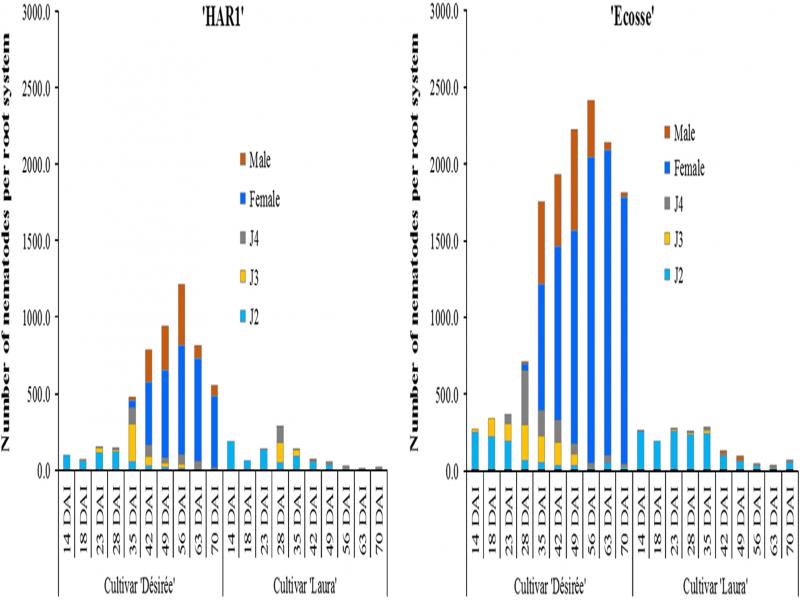
Figure 1:
Figure showing the mean number of different developmental stages of Globodera rostochiensis, ‘HAR1’ and ‘Ecosse’ populations in resistant cv. ‘Laura’ and susceptible cv. ‘Désirée’ in the glasshouse during the first experiment.
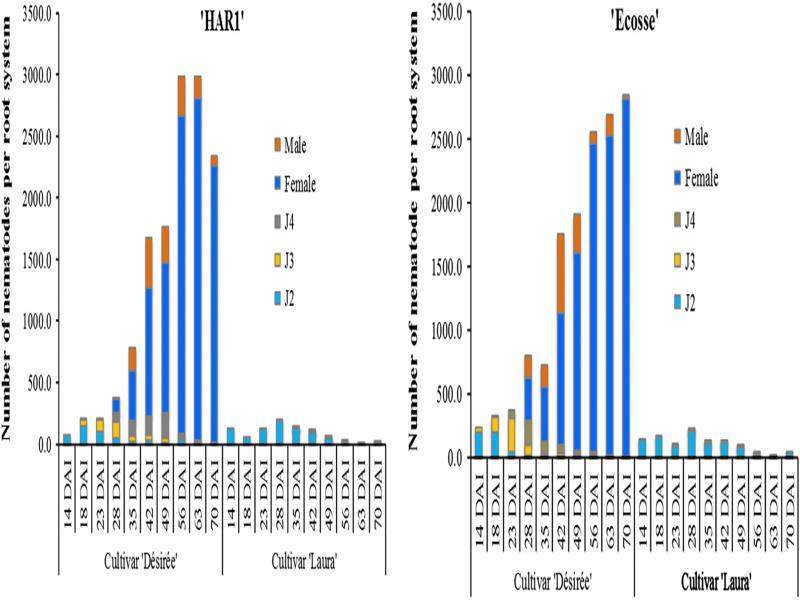
Figure 2:
Figure showing the mean number of different developmental stages of Globodera rostochiensis, of ‘HAR1’ and ‘Ecosse’ populations in resistant cv. ‘Laura’ and susceptible cv. ‘Désirée’ in the glasshouse in the second experiment.
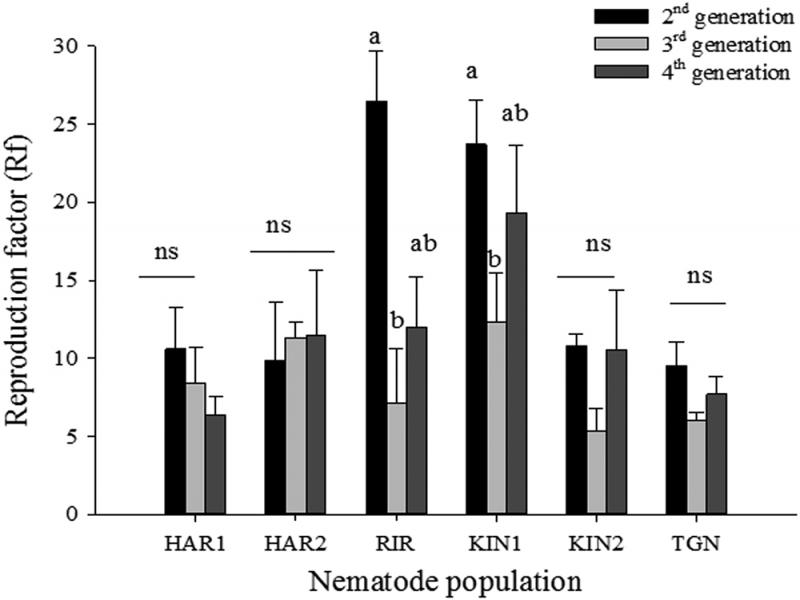
Figure 3:
Mean reproduction factor (±SE) of six populations of Globodera rostochiensis from Kenya on the susceptible cultivar ‘Désirée’ for three successive generations without diapause. Vertical bars show the standard error of the mean (n = 6). Means within a population with the same small letter are not significantly different (p > 0.05).
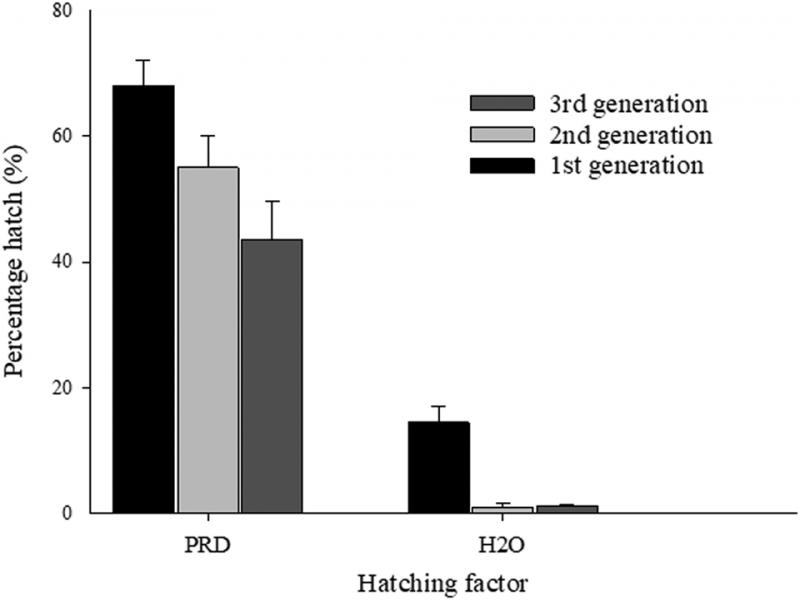
Figure 4:
Percentage hatch of Globodera rostochiensis ‘HAR1’ population in PRD for three successive generations of cysts without diapause. Vertical bars are mean percentage ± standard error (n = 4).
Table 1.
The reproduction factor (Rf) of Globodera rostochiensis populations ‘HAR1’ and ‘Ecosse’ on six differential potato clonesa.
| Population | Statusc | ||||
|---|---|---|---|---|---|
| Potato clones | Resistanceb | ‘HAR1’ | ‘Ecosse’ | ‘HAR1’ | ‘Ecosse’ |
| S. tuberosum cv. ‘Désirée’ | None | 61.4 | 46.6 | + | + |
| S. tuberosum cv. ‘Laura’ | Ro1,4 | 0.0 | 0.0 | – | – |
| S. kurtzianum, 60.21.19 | Ro1,2 | 1.1 | 0.4 | + | – |
| S. vernei, 58.1642.4 | Ro1,2,3 | 0.1 | 0.1 | – | – |
| S. vernei, 62.33.3 | Ro1,2,3,4 | 3.2 | 2.4 | + | + |
| S. vernei, 65.346.19 | Ro1,2,3,4,5 | 0.0 | 0.0 | – | – |
1 Notes: aThe table shows the reproduction factor of ‘HAR1’ population from Kenya and ‘Ecosse’ reference population on six differential potato clones according to Kort et al. (1977). Data are means of two experiments (n = 10); bRo1, 2, 3, 4, and 5 refers to the five pathotypes of R. rostochiensis according to Kort et al. (2077); c(+) indicates a reproduction factor (Rf > 1.0 (susceptible), and (−) indicates a Rf < 1.0 (resistant).
Table 2.
Response of seven potato cultivars to four populations of Globodera rostochiensis under greenhouse conditions.
| Cultivar | ‘Ecosse’ | ‘HAR2’ | ‘KIN1’ | ‘TGN’ |
|---|---|---|---|---|
| Experiment 1 | ||||
| ‘Désirée’ | 28.43d ± 12.0a,A | 14.73 ± 9.6a,B | 24.97 ± 10.5a,A | 37.27 ± 22.7a,A |
| ‘Connect’ | 31.70 ± 9.3a,A | 18.43 ± 5.2a,B | 30.84 ± 15.3a,A | 21.80 ± 9.4a,A |
| ‘Performer’ | 2.37 ± 1.3b,A | 1.74 ± 1.3bA,B | 2.45 ± 1.9b,AB | 1.18 ± 0.9b,B |
| ‘Rossini’ | 0.02 ± 0.1c | 0.00 ± 0.0c | 0.00 ± 0.0c | 0.01 ± 0.0c |
| ‘Caruso’ | 0.02 ± 0.1c | 0.00 ± 0.0c | 0.00 ± 0.0c | 0.02 ± 0.1c |
| ‘Amanda’ | 0.00 ± 0.0c | 0.01 ± 0.0c | 0.02 ± 0.1c | 0.05 ± 0.1c |
| ‘Laura’e | 0.00 ± 0.0 | 0.00 ± 0.0 | 0.00 ± 0.0 | 0.00 ± 0.0 |
| Experiment 2 | ||||
| ‘Désirée’ | 10.07 ± 1.5a,A | 8.11 ± 1.5a,A | 3.53 ± 0.3a,B | 12.92 ± 0.8a,A |
| ‘Connect’ | 7.47 ± 1.1a,A | 13.31 ± 1.9a,A | 2.42 ± 0.3a,B | 12.25 ± 2.7a,A |
| ‘Performer’ | 0.53 ± 0.1b,AB | 0.35 ± 0.1b,B | 0.85 ± 0.2b,A | 1.00 ± 0.3b,A |
| ‘Rossini’ | 0.00 ± 0.0c | 0.00 ± 0.0c | 0.04 ± 0.1c | 0.01 ± 0.0c |
| ‘Caruso’ | 0.00 ± 0.0c | 0.08 ± 0.3c | 0.00 ± 0.0c | 0.02 ± 0.1c |
| ‘Amanda’ | 0.00 ± 0.0c | 0.00 ± 0.0c | 0.00 ± 0.0c | 0.05 ± 0.0c |
| ‘Laura’e | 0.00 ± 0.0 | 0.00 ± 0.0 | 0.00 ± 0.0 | 0.00 ± 0.0 |
1 Notes: dReproduction factor (Rf) ± SE. Data are means of two experiments (n = 10). Means of Rf within the same column in each experiment followed with similar lowercase letters are not significantly different (p > 0.05). Similarly, means of Rf within the same row in each experiment followed with similar capital letters are not significantly different (p > 0.05); eReproduction on cv. ‘Laura’ was tested using eye-plugs due to lack of in vitro plants of this cultivar.
Table 3.
Mean relative susceptibility (Rs %) of six potato cultivars to four G. rostochiensis populations: ‘Ecosse’, ‘HAR2’, ‘KIN1’, and ‘TGN’a.
| ‘Ecosse’ | ‘HAR2’ | ‘KIN1’ | ‘TGN’ | |||||
|---|---|---|---|---|---|---|---|---|
| Cultivar | Rs (%)a | Score | Rs (%) | Score | Rs (%) | Score | Rs (%) | Score |
| ‘Connect’ | 92.9 | 2 | 144.6 | 1 | 96.1 | 2 | 76.7 | 2 |
| ‘Performer’ | 6.8 | 6 | 8.1 | 6 | 17.0 | 4 | 5.5 | 6 |
| ‘Rossini’ | 0.1 | 9 | 0.0 | 9 | 0.6 | 9 | 0.1 | 9 |
| ‘Caruso’ | 0.1 | 9 | 0.5 | 9 | 0.0 | 9 | 0.2 | 9 |
| ‘Amanda’ | 0.0 | 9 | 0.1 | 9 | 0.1 | 9 | 0.3 | 9 |
| ‘Laura’b | 0.0 | 9 | 0.0 | 9 | 0.0 | 9 | 0.0 | 9 |
1 Notes: The table shows percentage relative susceptibility (Rs) and the resistance ranking of seven potato cultivars. Data are from two experiments with ten replications per experiment. aRs (%) = Pftest cultivar/Pfstandard susceptible control cultivar × 100 and the resistance level (score) determined using the EPPO score scale (1 (>100), 2 (50.1-100%), 3 (25.1-50%), 4 (15.1-25%), 5 (10.1-15%), 6 (5.1-10%), 7 (3.1-5%), 8 (1.1-3%), 9 (≤1%)), where 9 represent the highest level of resistance and 1 represent the least resistant; bReproduction on cv. ‘Laura’ was tested using eye-plugs due to lack of in vitro plants of this cultivar.
Table 4.
Response of seven potato cultivars to ‘HAR1’ and ‘Ecosse’ populations of Globodera rostochiensis under glasshouse conditionsa.
| ‘HAR1’ | ‘Ecosse’ | |||||
|---|---|---|---|---|---|---|
| Cultivars | Rf ± se | RS (%) | Score | Rf ± se | RS (%) | Score |
| ‘Désirée’ | 56.56 ± 8.51* | 100 | 1 | 51.07 ± 4.37* | 100 | 1 |
| ‘Albatros’ | 0.09 ± 0.07 | 0.16 | 9 | 0.02 ± 0.02 | 0.04 | 9 |
| ‘Belana’ | 0.10 ± 0.05 | 0.18 | 9 | 0.00 ± 0.00 | 0.00 | 9 |
| ‘Ribera’ | 0.08 ± 0.03 | 0.14 | 9 | 0.00 ± 0.00 | 0.00 | 9 |
| ‘Amado’ | 0.00 ± 0.00 | 0.00 | 9 | 0.00 ± 0.00 | 0.00 | 9 |
| ‘Seresta’ | 0.00 ± 0.00 | 0.00 | 9 | 0.00 ± 0.00 | 0.00 | 9 |
| ‘Papageno’ | 0.01 ± 0.02 | 0.02 | 9 | 0.00 ± 0.00 | 0.00 | 9 |