
Table 1.
Mean and range of nematode data on roots of pea, dill, and alfalfa inoculated with 40 females or 40 males.
| Pea | Dill | Alfalfa | ||||
|---|---|---|---|---|---|---|
| Female | Male | Female | Male | Female | Male | |
| Total nematodes/Petri dish | 25 (14-32) | 25 (15-35) | 35 (29-39) | 32 (28-36) | 30 (26-35) | 31 (26-34) |
| Average nematode/lesion | 1.1 (0.6-1.9) | 2.5** (1.6-4.2) | 2.7 (2.0-4.7) | 2.6 (1.0-4.3) | 1.5 (1.0-2.2) | 3.3** (1.7-4.6) |
| Endoparasites | 24 (14-32) | 22 (15-13) | 31 (24-36) | 27 (22-33) | 27 (24-32) | 28 (23-33) |
| Ectoparasites | – | – | 0.6 (0-1) | 1.8* (0-6) | 0.5 (0-2) | 1.1 (0-2) |
| Egressed nematodes | 0.7 (0-4) | 2.7* (0-12) | 3.8 (2-6) | 5.3 (1-12) | 3.9 (1-10) | 3.1 (1-6) |
| Survival rate (%) | – | – | 97 | 96 | 100 | 94 |
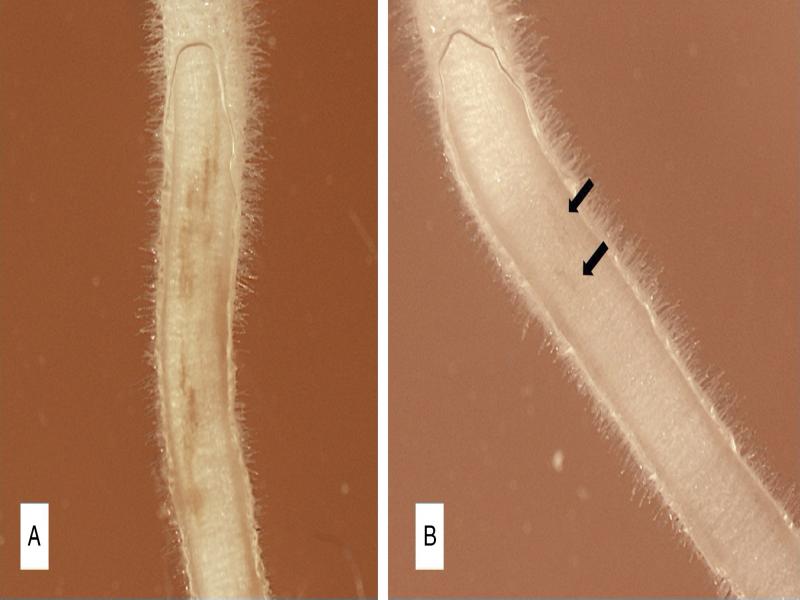
Figure 1:
Lesions formed by Pratylenchus penetrans females (A) and males (B) on root explants of pea at 14 days after the introduction of the nematodes. The arrow points at lesions on the male-inoculated root.
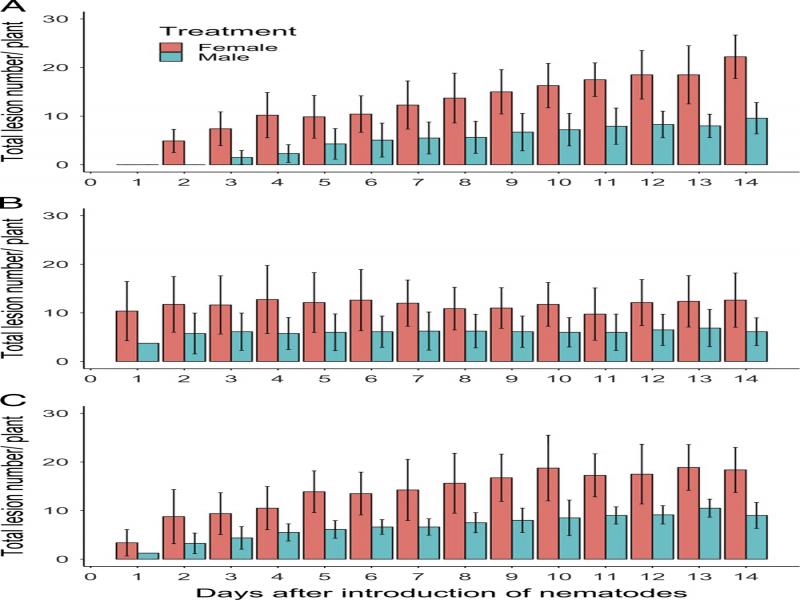
Figure 2:
Relationship between time and the number of lesions per plant for roots of pea (A), dill (B), and alfalfa (C) inoculated with 40 Pratylenchus penetrans males or 40 P. penetrans females. Data bars represent the mean ± SE of three trials for pea and two trials for dill and alfalfa.
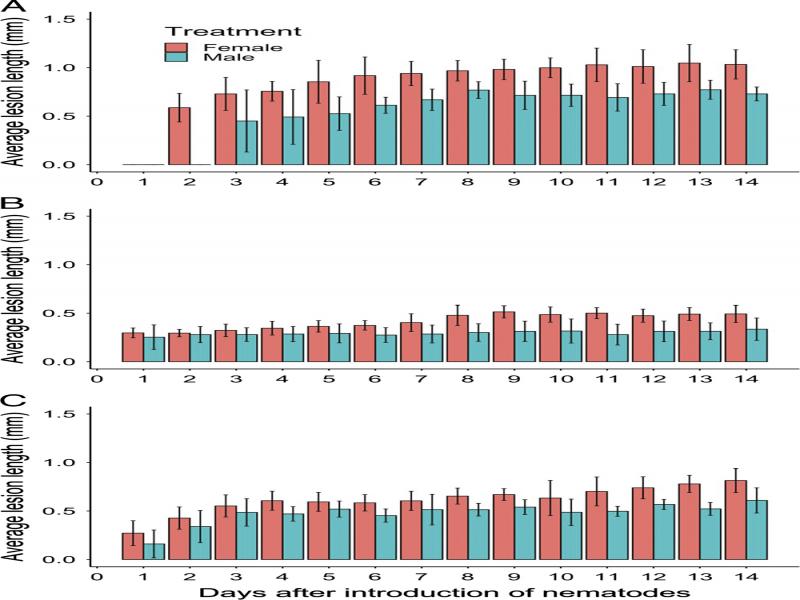
Figure 3:
Relationship between time and the average lesion length (mm) for roots of pea (A), dill (B), and alfalfa (C) inoculated with 40 Pratylenchus penetrans males or 40 P. penetrans females. Data bars represent the mean ± SE of three trials for pea and two trials for dill and alfalfa.
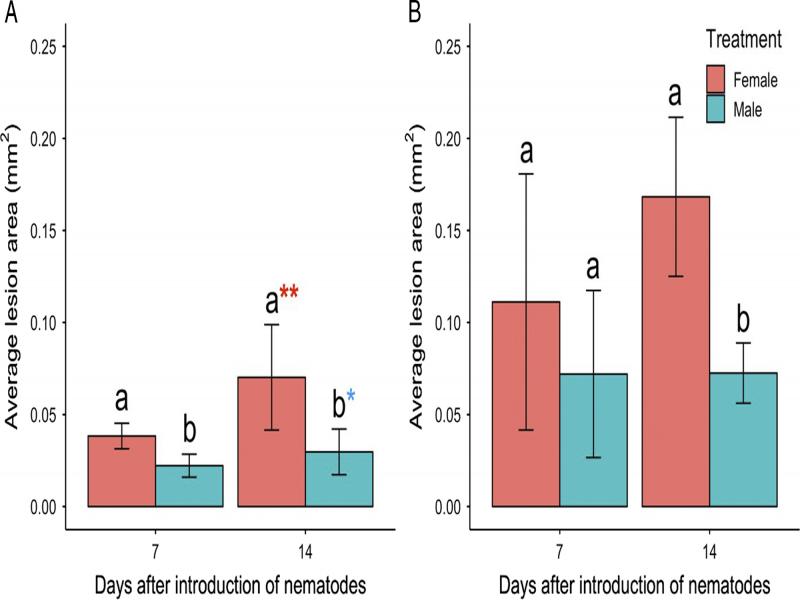
Figure 4:
Relationship between time and the average lesion area (mm2) for roots of dill (A) and alfalfa (B) inoculated with 40 Pratylenchus penetrans males or 40 P. penetrans females. Data bars represent the mean ± SE of two trials. Letters represent statistically significant differences between female and male on each day (P< 0 .05). Asterisks denote difference between time points at day 7 and day 14.