
The foliar nematode, Aphelenchoides fragariae (Ritzema Bos) Christie, is a quarantined endo- and ecto-parasite that infects a broad range of herbaceous and woody host plants (Jagdale and Grewal, 2002; McCuiston et al., 2007; Kohl et al., 2010; Fu et al., 2012; Sanchez-Monge et al., 2015). It enters plant leaves through wounds and stomata, where it feeds on mesophyll cells and causes characteristic vein-delimited lesions that reduce the appearance and marketability of ornamental plants (Wallace, 1959; Kohl et al., 2010; Fu et al., 2012). Previous work in our lab has demonstrated its ability to survive extreme desiccation, although the molecular mechanisms underlying its desiccation tolerance have not been characterized (Fu et al., 2012).
The foliar nematode survives overwinter in soil, dormant buds, and abscised leaves, where its desiccation tolerance allows it to endure freezing temperatures and low relative humidity (Jagdale and Grewal, 2006). Like a number of other nematode species, A. fragariae is capable of entering an anhydrobiotic state in which it loses >99% of detectable body water and suspends both metabolism and aging (Crowe and Madin, 1975; Crowe et al., 1992). Anhydrobiosis has been demonstrated in several Antarctic nematode species (Wharton, 2003), as well as animal parasitic, plant parasitic, and entomopathogenic nematodes (Patel et al., 1997; Wharton and Worland, 2001; Karim et al., 2009; Anbesse et al., 2013; Nimkingrat et al., 2013; Chylinski et al., 2014; Shapiro-Ilan et al., 2014). An extreme example is the stem and bulb nematode Ditylenchus dipsaci, which has been shown to survive up to 23 yr in dry storage (Fielding ,1951).
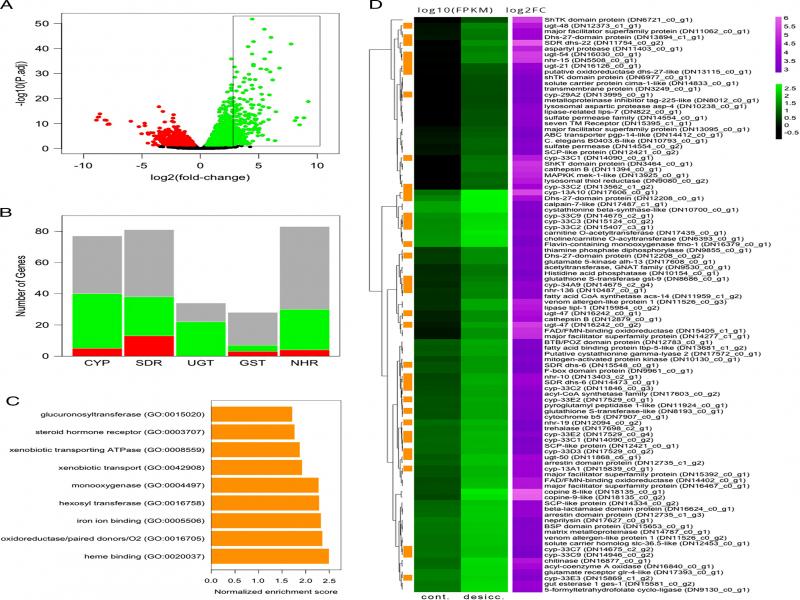
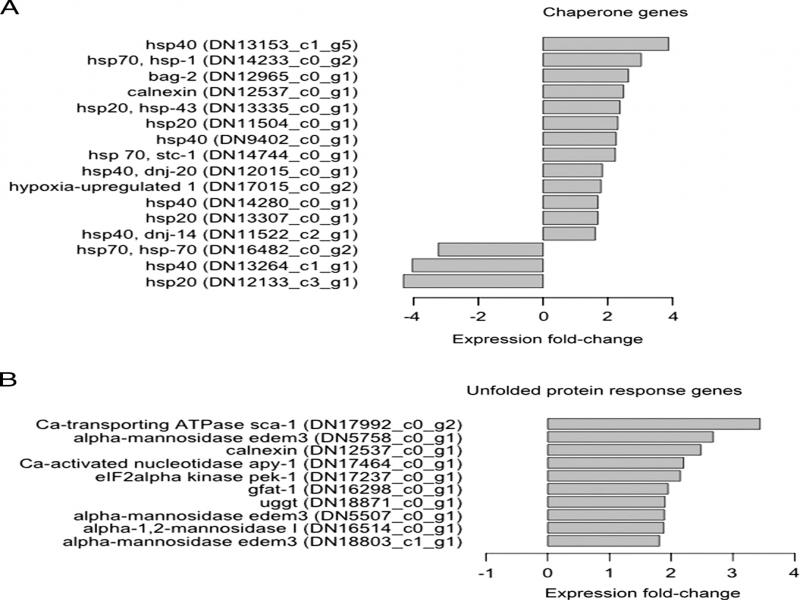
We have previously documented the remarkable anhydrobiotic behavior of A. fragariae, which displays significantly greater survivorship and faster recovery from desiccation than the model anhydrobiotic nematode, Aphelenchus avenae (Fu et al., 2012). In response to dehydration, A. fragariae aggregated into compact clusters and increased the expression of glutaredoxin and trehalose phosphate synthase genes (Fu et al., 2012). However, it is not entirely clear what other molecular mechanisms are involved in foliar nematode desiccation. Here, we report the de novo assembly of an A. fragariae transcriptome constructed from well-hydrated and 24-hr-desiccated nematodes. The most striking result was the wholesale upregulation of multiple genes encoding Phase I and II detoxification enzymes: numerous cytochrome p450s (CYPs), short chain dehydrogenase/reductases (SDRs), UDP-glucuronosyltransferases (UGTs), and glutathione-S-transferases (GSTs), as well as related multi-drug resistance transporters. Heat shock proteins, enzymes of the unfolded protein response, and intrinsically disordered proteins (IDPs) were also strongly induced by dehydration, suggesting that the prevention and mitigation of protein damage is a central feature of A. fragariae’s desiccation response.
Materials and methods
Nematodes
Aphelenchoides fragariae were obtained from the Clemson University Nematode Collection where they had been cultured on Cylindrocladium sp. in potato dextrose agar (PDA, HiMedia Laboratories, India). They were harvested using a Baermann funnel and resuspended in sterile tap water (Baermann, 1917). A 20 ml suspension of approximately 50,000 nematodes (mixed life stages) was exposed to reduced relative humidity by vacuum filtration onto a 4.7 cm Nuclepore membrane with 5 μm pores (Whatman, Piscataway, NJ). The membrane was transferred to an uncovered petri dish in an airtight glass chamber containing a 72% glycerol solution to maintain a relative humidity of 60 ± 2% (Forney and Brandl, 1992). A MicroRHTemp Data Logger (Madgetech, Warner, NH) was placed in the chamber to collect relative humidity and temperature data, and the chamber was incubated at room temperature (23 ± 2°C) for 24 hr. Nematodes formed dried aggregates or “nematode wool” on the membrane after 24 hr (Fig. 1); these aggregates were collected into a microcentrifuge tube for subsequent RNA isolation. Previous experiments have shown that aggregated A. fragariae are capable of rapidly resuming physiological activity upon rehydration (Fu et al., 2012). An equal number of nematodes were maintained for 24 hr in sterile tap water to serve as the fully hydrated control. Given that the number of airtight chambers was a limiting factor, we set up each pair of dehydration and control in three different times, serving as three biological replicates. Nematodes were harvested from three biological replicates of each treatment condition.
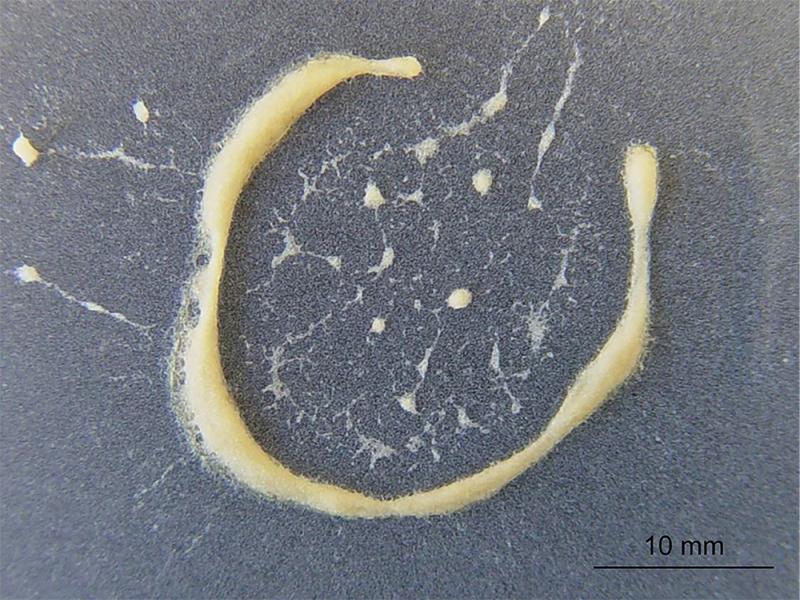
Figure 1:
A. fragariae aggregated into a compact, dried cluster of “nematode wool” following 24-hr desiccation treatment at 60 ± 2% relative humidity and 23 ± 2°C.
RNA isolation and transcriptome sequencing
Total RNA was extracted from approximately 5,000 nematodes harvested from each biological replicate using the PureLink RNA mini Kit (Life Technologies, Austin, TX) following the manufacturer’s instructions. Total RNA was treated with RNase-Free DNase (Qiagen, Germantown, MD) to remove any contaminating DNA. RNA quality and integrity were verified on an Agilent RNA 6000 Nano LabChip using the Agilent 2100 Bioanalyzer (Agilent Technologies, Santa Clara, CA). Six RNA samples were sent to the Clemson University Genomics Institute (Clemson, SC) for strand-specific, paired-end 125-bp library preparation with the Illumina TruSeq stranded mRNA library kit, followed by sequencing on the Illumina HiSeq 2000 platform (Illumina, San Diego, CA). Raw sequence data were uploaded to the NCBI Sequence Read Archive under accession number SRP148503.
Transcriptome assembly and annotation
Read quality was assessed with FastQC (https://www.bioinformatics.babraham.ac.uk/projects/fastqc/), followed by adaptor trimming and content-dependent quality trimming with Cutadapt v1.1.2 (quality threshold 20, minimum length 50 bp; Martin, 2011). The average per-read PHRED quality score after trimming and filtering was 36. Trimmed reads from all biological samples were combined for de novo transcriptome assembly using default settings of Trinity v2.6.6 (Grabherr et al., 2011; Haas et al., 2013). The set of Trinity contigs with open reading frames of at least 200 base pairs was considered to represent the protein-coding transcriptome. The transcriptome contained 48,541 putative protein-coding genes and 147,621 alternative isoforms of these genes.
The longest isoform per gene was extracted using a utility script bundled with Trinity v2.6.6 (get_longest_isoform_seq_per_trinity_gene.pl). A fasta file of these transcripts is presented as Supplementary File 1, https://doi.org/10.5061/dryad.8pk0p2njc. Functional annotation of the assembled transcripts was performed with Blast2GO 5.0, which executes a blastx search against the NCBI non-redundant database (E ≤ 1.0−3; Pruitt et al., 2006) and assigns GO terms, InterPro IDs, enzyme codes, and KEGG pathways to each transcript (Conesa et al., 2005). Blast2GO annotations of the transcriptome are presented in Supplementary File 2, https://doi.org/10.5061/dryad.8pk0p2njc. Disorder and hydropathy predictions were generated for a subset of unannotated proteins using PONDR with the VSL2 predictor (http://www.pondr.com) and the GRAVY hydropathy calculator (http://www.gravy-calculator.de). Nucleotide sequences of these proteins were also used as blastx queries against the Late Embryogenesis Abundant Protein database (Hunault and Jaspard, 2010).
Differential gene expression analysis
Trimmed reads from each sample were aligned back to the assembled transcriptome using Bowtie2 (Langmead and Salzberg, 2012), and transcript abundances in each sample were estimated using RSEM (Li and Dewey, 2011). Reads from all splice forms of a given gene were pooled for downstream analysis. Differential gene expression analysis was performed using edgeR, including only those genes that had counts-per-million above 0.5 in least three samples (Robinson et al., 2010; Chen et al., 2016). Genes whose expression differed significantly between desiccated and control samples were identified using the exact test model in edgeR (Robinson et al. 2010; false discovery rate = 0.05). R package pheatmap was used to run hierarchical clustering with “complete” method for a subset of differentially expressed genes (Kolde and Kolde, 2018). Expression data for all genes are presented in Supplementary File 3, https://doi.org/10.5061/dryad.8pk0p2njc.
Gene set enrichment analysis (GSEA v.2.1.0) was performed to identify pre-defined gene sets that showed significant, concordant differences in expression between control and desiccated samples (Mootha et al., 2003; Subramanian et al., 2005). While edgeR identifies individual genes with large, significant fold-changes, GSEA identifies gene sets whose members show concordant, but potentially smaller, changes in expression. A custom GSEA database of 5,988 gene sets, each containing between 5 and 1,500 genes, was created from GO terms and enzyme code annotations of the assembled transcripts. Gene sets whose expression was enriched or depleted in desiccated nematodes were identified using a false discovery rate of 0.05 (Supplementary File 4, https://doi.org/10.5061/dryad.8pk0p2njc).
Results and discussion
Transcriptome sequencing and de novo assembly
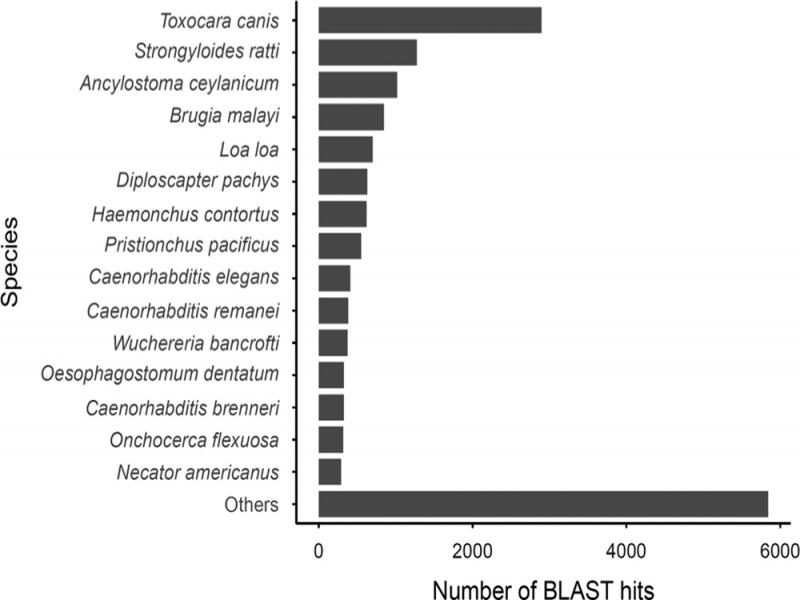
Illumina sequencing of RNA samples from desiccated and control nematodes generated 325 million reads with a mean length of 125 bp and an average GC content of 42%. After filtering and trimming, reads from all samples were combined for de novo assembly with the Trinity pipeline. The final protein-coding transcriptome contained 48,541 putative protein-coding genes with 147,621 alternate splice forms and an N50 of 1293 bp (Table S1). In all, 35% of the assembled genes had at least one hit against the NCBI nr database, and 23% were annotated with at least one GO term in Blast2GO (Table S1). The most common top hit species were Toxocara canis, Strongyloides ratti, and Ancylostoma ceylanicum, all of which are fully sequenced animal parasitic nematodes (Fig. S1 https://doi.org/10.5061/dryad.8pk0p2njc).
Table S1.
Summary statistics for Aphelenchoides fragariae transcriptome assembly.
| Basic sequence statistics | Number | |||||||
|---|---|---|---|---|---|---|---|---|
| Total raw reads | 324,895,970 | |||||||
| Mean read length (bp) | 125 | |||||||
| Raw read GC content | 42% | |||||||
| Mean read PHRED score after filtering and trimming | 36 | |||||||
| Number of genes | 48,541 | |||||||
| Number of isoforms | 147,621 | |||||||
| Assembly N50 (of all isoforms) | 1293 bp | |||||||
| Ex90N50 | 1470 bp | |||||||
| Mean length of all isoforms | 882 bp | |||||||
| Top BLASTx-hit species | Toxocara canis | |||||||
| Percent of gene with at least one BLASTx hit (E ≤ 1.0-3) | 35% | |||||||
| Percent of gene with at least one GO annotation | 23% |
| Gene ID | Predicted length (aa) | Mean FPKM desiccated | Mean FPKM control | Fold-change | Adjusted P-value | % disordered residues | GRAVY hydropathy value | Blastx hits to LEA database |
|---|---|---|---|---|---|---|---|---|
| DN15064_c0_g1 | 175 | 398.8 | 0.4 | 1020.9 | 3.15E−64 | 88.1 | −1.836 | − |
| DN14203_c3_g3 | 119 | 45.4 | 0.5 | 88.7 | 1.92E−15 | 74.8 | −0.977 | − |
| DN10042_c0_g2 | 128 | 366.8 | 5.0 | 72.9 | 3.61E−28 | 82.8 | −0.108 | Sophora davidii dehydrin DHN, E = 2e−13 |
| DN10455_c1_g1 | 191 | 928.2 | 14.0 | 64.1 | 9.30E−99 | 90.6 | −0.503 | Sophora davidii dehydrin DHN, E = 8e−09 |
| DN9957_c2_g1 | 335 | 7.9 | 0.2 | 41.1 | 1.66E−17 | 94.6 | −1.104 | Sorghum bicolor dehydrin-like SORBIDRAFT_10g003700, E = 2e−14 |
| DN10923_c0_g1 | 171 | 17.0 | 0.7 | 25.5 | 1.23E−12 | 81.9 | −1.607 | Trifolium repens dehydrin b, E = 0.002 |
| DN9863_c0_g1 | 250 | 21.7 | 0.9 | 23.4 | 1.70E−43 | 85.2 | −0.951 | Arabidopsis thaliana dehydrin rab18, E = 2e−10 |
| DN9710_c0_g1 | 167 | 28.1 | 1.3 | 20.6 | 4.50E−07 | 93.5 | −1.185 | − |
| DN12711_c2_g2 | 131 | 92.8 | 6.4 | 13.8 | 4.35E−12 | 77.1 | −0.204 | Sophora davidii dehydrin DHN, E = 7e−07 |
| DN11488_c0_g1 | 192 | 16.40 | 1.30 | 11.50 | 2.52E−03 | 86.5 | −1.167 | − |
| DN12459_c0_g4 | 172 | 173.6 | 14.4 | 11.5 | 7.31E−17 | 98.3 | −0.793 | Eucalyptus grandis dehydrin 1, E = 5e−07 |
| DN15965_c0_g1 | 140 | 294.5 | 25.7 | 10.7 | 2.28E−10 | 72.9 | −0.450 | Hordeum vulgare dehydrin dhn4, E = 8e−12 |
| DN12325_c1_g1 | 96 | 15.5 | 1.9 | 8.1 | 1.38E−17 | 75.0 | −0.672 | − |
| DN9469_c2_g1 | 133 | 46.8 | 9.7 | 4.7 | 1.44E−14 | 100.0 | −1.520 | Phaseolis vulgaris dehydrin PHAVU_009G004400g, E = 3e−05 |