
Table 1.
Reproduction of Meloidogyne javanica, M. incognita race 3, and M. arenaria race 1 on oilseed radish, white (Tachiibuki) and black (Pratex) oats under greenhouse conditions.
| M. javanica | M. incognita race 3 | M. arenaria race 1 | ||||
|---|---|---|---|---|---|---|
| Cultivar | Rfy | Host statusz | Rf | Host status | Rf | Host status |
| Tomatox | 24.0 a | Good | 11.1 a | Good | 16.5 a | Good |
| Cannavaro | 22.1 a | Good | 2.7 cde | Good | 3.1 c | Good |
| Final | 22.0 a | Good | 2.5 bc | Good | 10.2 b | Good |
| Control | 11.0 b | Good | 0.3 e | Poor | 1.7 c | Maintenance |
| Image | 8.2 bc | Good | 7.7 ab | Good | 8.2 b | Good |
| Eco-Till | 7.7 bc | Good | 3.5 cde | Good | 12.5 ab | Good |
| Pratex | 7.1 bc | Good | 3.9 cd | Good | 9.7 b | Good |
| Cardinal | 4.4 bc | Good | 1.2 de | Good | 1.9 c | Maintenance |
| Tachiibuki | 3.6 bc | Good | 0.2 e | Poor | 0.3 c | Poor |
| Karakter | 1.9 bc | Maintenance | 1.1 e | Maintenance | 0.9 c* | Poor |
| Concorde | 1.8 bc | Maintenance | 1.7 de | Maintenance | 2.5 c | Good |
| Carwoodi | 1.0 c* | Poor | 0.2 e | Poor | 0.2 c | Poor |
1 Notes: Data are the mean of two trials with ten replicates. Means followed by the same letter(s) within columns are not significantly different (P = 0.05) based on Tukey’s test. The asterisks illustrate the Rf is not different from 1 according to LS-means t-tests. xTomato cv. Rutgers was used a susceptible control to compare nematode reproduction variability on crops; yRf, reproductive factor = final nematode counts extracted from roots/initial number of nematodes (1,000 J2) inoculated to plants at the beginning of experiment. zHost status was determined as follows; Rf < 0.1, nonhost (highly resistant); 0.1 ≤ Rf < 1, poor host (resistant); 1 ≤ Rf < 2, maintenance host (susceptible); and Rf ≥ 2, good host (Highly susceptible).
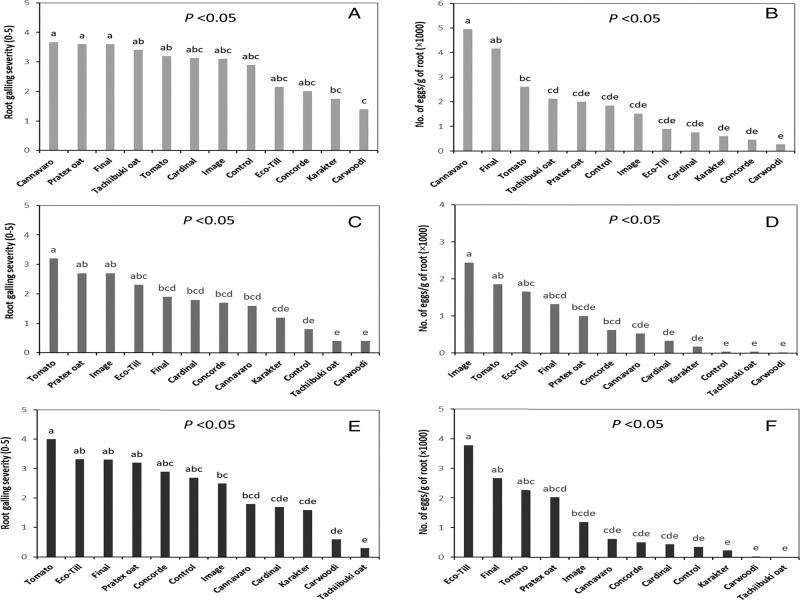
Figure 1:
Gall and egg formation of Meloidogyne javanica (A and B), M. incognita race 3 (C and D), and M. arenaria race 1 (E and F) on cultivars of oilseed radish, white (Tachiibuki) and black (Pratex) oats under greenhouse conditions. Tomato cv. Rutgers was used as a susceptible host. Gall severity was assessed based on a scale 0 to 5 where 0 = no galls, and 5 ≥ 100 galls on roots. Data are the mean of two trials with ten replicates. Bars with the same letter(s) are not significantly different based on the Tukey’s test.
Table 2.
Number of second-stage juveniles (J2), and young and adult (egg-laying) females of Meloidogyne spp. in roots of oilseed radish (Eco-Till, susceptible; Carwoodi, resistance) at early-stage of infection (1, 3, and 5 days after inoculation; DAI) and at 28 DAI in the greenhouse.
| J2 | J2 | J2 | Young female | Adult female | |
|---|---|---|---|---|---|
| Nematode/Cultivar | 1 DAI | 3 DAI | 5 DAI | 28 DAI | 28 DAI |
| M. javanica | |||||
| Eco-Till | 8.5 a | 19.7 a | 30.6 a | 20.7 a | 17.6 a |
| Carwoodi | 2.7 a | 12.3 a | 27.0 a | 6.6 b | 4.2 b |
| M. incognita race 3 | |||||
| Eco-Till | 7.0 a | 19.6 a | 31.3 a | 12.0 a | 9.6 a |
| Carwoodi | 3.1 a | 12.3 a | 27.1 a | 3.6 b | 1.6 b |
| M. arenaria race 1 | |||||
| Eco-Till | 7.5 a | 16.3 a | 28.0 a | 10.3 a | 18.0 a |
| Carwoodi | 5.0 a | 21.6 a | 23.6 a | 3.0 b | 1.8 b |
Table 3.
Number of second-stage juveniles (J2), and young and adult (egg-laying) females of Meloidogyne spp. in roots of oat (Pratex, susceptible; Tachiibuki, resistance) cultivars at early-stage of infection (1, 3, and 5 days after inoculation; DAI) and at 28 DAI in the greenhouse.
| J2 | J2 | J2 | Young female | Adult female | |
|---|---|---|---|---|---|
| Nematode/Cultivar | 1 DAI | 3 DAI | 5 DAI | 28 DAI | 28 DAI |
| M. javanica | |||||
| Pratex | 4.7 a | 15.0 a | 28.1 a | …x | … |
| Tachiibuki | 6.0 a | 14.3 a | 24.3 a | … | … |
| M. incognita race 3 | |||||
| Pratex | 5.6 a | 11.0 a | 23.5 a | 17.4 a | 20.5 a |
| Tachiibuki | 3.6 a | 8.3 a | 18.0 a | 2.3 b | 1.6 b |
| M. arenaria race 1 | |||||
| Pratex | 8.0 a | 15.3 a | 25.3 a | 16.0 a | 12.3 a |
| Tachiibuki | 6.3 a | 14.0 a | 29.1 a | 3.5 b | 2.6 b |
1 Notes: Each plant was inoculated with 200 second-stage juveniles of each nematode species. Data are the mean of two trials with six replicates. Means followed by the same letter within columns are not significantly different (P = 0.05) based on Tukey’s test. xPratex and Tachiibuki were susceptible to M. javanica and thus not examined at 28 DAI.
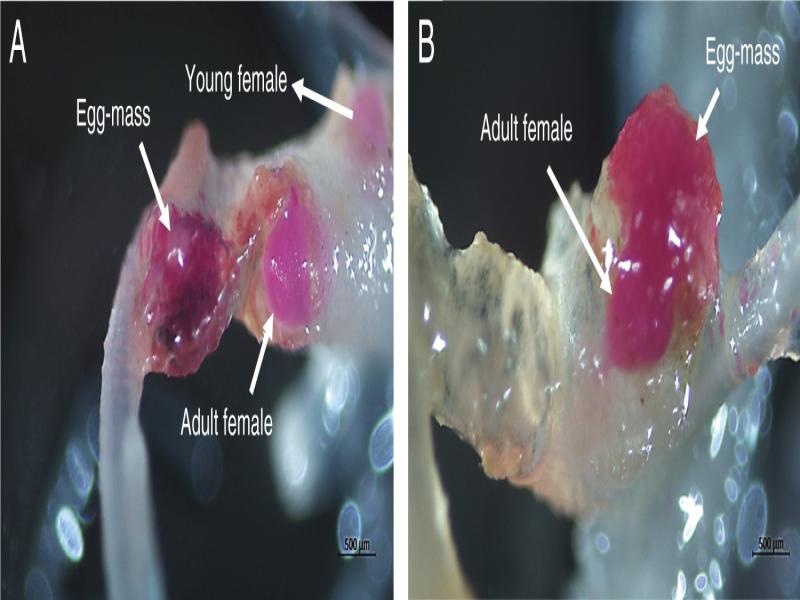
Figure 2:
Representative images of roots of oilseed radish cv. Eco-Till (A) and oat cv. Pratex (B) infected with Meloidogyne arenaria at 28 days after inoculation.
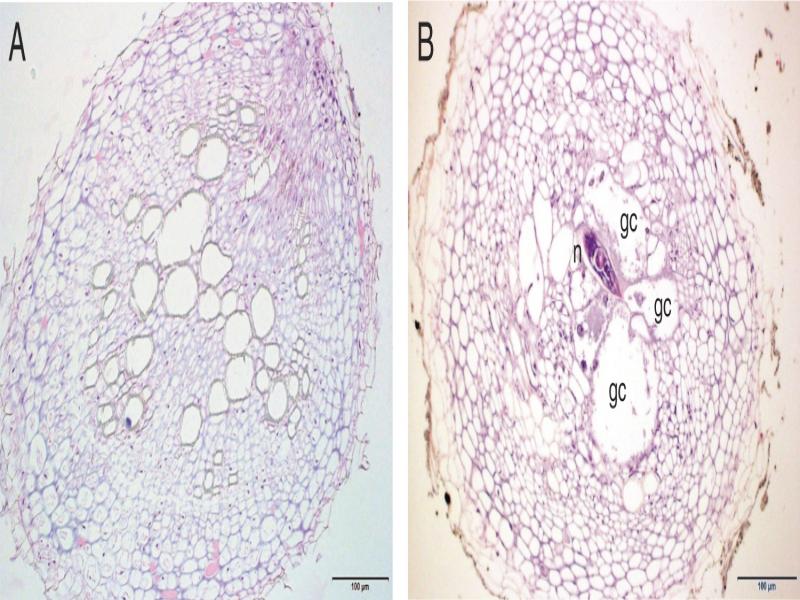
Figure 3:
Hematoxylin-Eosin stained cross sections of root tissues of oilseed radish cv. Carwoodi (A) and Eco-Till (B) infected with Meloidogyne incognita at 28 days after inoculation. N, female nematode; GC, giant cell.
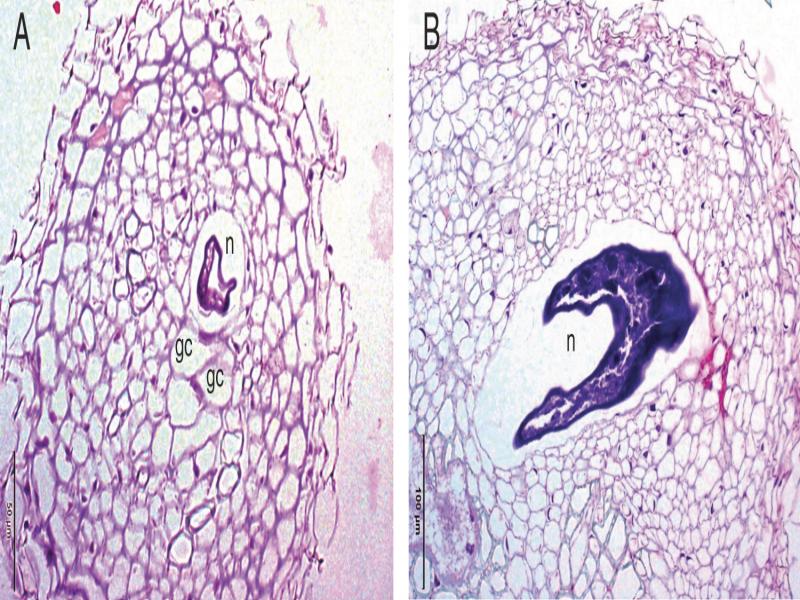
Figure 4:
Cross sections of root tissues of oat cv. Pratex (A) and Tachiibuki (B) infected with Meloidogyne javanica at 28 days after inoculation. N, female nematode; GC, giant cell.