
Table 1.
Nematode samples used in this research.
| Nematode species | Code | Geographical origina | Origin | Accession number | AB-ID37 LAMPb | AbF5/AbR5 PCRb |
|---|---|---|---|---|---|---|
| Aphelenchoides besseyi | HW | Yunlin, TW | Rice (Oryza sativa) | MF669509 | + | + |
| Aphelenchoides besseyi | GD | Taipei, TW | Rice (Oryza sativa) | MF669510 | + | + |
| Aphelenchoides besseyi | TG9 | Taoyuan, TW | Rice (Oryza sativa) | MF669506 | + | + |
| Aphelenchoides besseyi | YL | Changhua, TW | Rice (Oryza sativa) | MF669504 | + | + |
| Aphelenchoides besseyi | YG | Changhua, TW | Rice (Oryza sativa) | MF669505 | + | + |
| Aphelenchoides besseyi | YLI | Hualien, TW | Rice (Oryza sativa) | MF669503 | + | + |
| Aphelenchoides besseyi | GK | Yunlin, TW | Nest fern (Asplenium spp.) | MF669514 | − | + |
| Aphelenchoides besseyi | HL1 | Hualien, TW | Nest fern (Asplenium spp.) | MF669515 | − | + |
| Aphelenchoides besseyi | HL2 | Hualien, TW | Nest fern (Asplenium spp.) | MF668516 | − | + |
| Aphelenchoides besseyi | HL3 | Hualien, TW | Nest fern (Asplenium spp.) | MF669517 | − | + |
| Aphelenchoides bicaudatus | ABC | Taichung, TW | Peat moss | MF669511 | − | − |
| Aphelenchoides fragariae | SP | Taichung, TW | Nest fern (Asplenium spp.) | MF669507 | − | − |
| Aphelenchoides fujianensis | AS | Taichung, TW | Strawberry (Fragaria × ananassa Duch) | MF669502 | − | − |
| Aphelenchoides spp. | 630–2 | Germany | Peat Moss | MF669501 | − | − |
| Bursaphelenchus xylophilus | B2 | Kinmen, TW | Pine (Pinus spp.) | MF669500 | − | − |
| Ditylenchus spp. | JB2 | Japan | Black pine (Pinus thunbergii) | MF669508 | − | − |
| Ditylenchus spp. | 68–3 | Germany | Peat moss | MF669512 | − | − |
| Ditylenchus spp. | 3010 | Lithuania | Peat moss | MF669513 | − | − |
Table 2.
List of primers and probe for LAMP assay and conventional PCR assay for A. besseyi detection in this study.
| Set/target | Primer/probe | Sequence | Reference |
|---|---|---|---|
| AB-ID37 | F3 | 5′-CGTCTAAATAATTTGAGGTTTTGGT-3′ | This study |
| B3 | 5′-ACCTAAAATAGAACTAATCCCAG-3′ | ||
| Biotin-FIP | 5′-TCTTGTTCCTGCACCCATATCT-TGCCTGTAGCTTTATTTTTGC-3′ | ||
| BIP | 5′-ATCCTCCTTTAAGAACTCTTGGTCA-CACAATGAAGCCTAAAAATGG-3′ | ||
| Probe 17 | 5′-AACTCTTGGTCATCCTGGAAGAAG-3′ | ||
| AbF5/R5 | AbF5 | 5′-ATGTGTAAGTAGAGCGTTATA-3′ | Devran et al. (2017) |
| AbR5 | 5′-ATTCGCCGTTTTTAAGGCG-3′ |
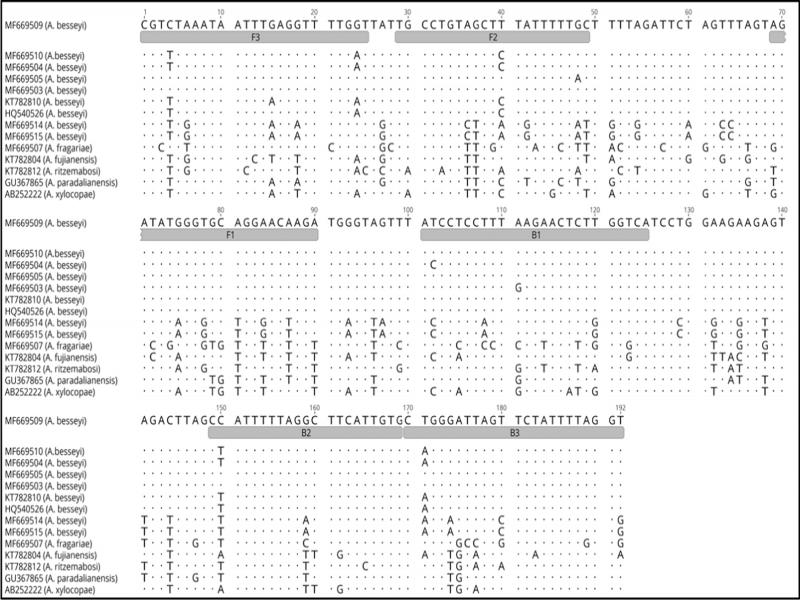
Figure 1:
Multiple sequence alignment of partial mitochondria COI gene of A. besseyi and selected closely related species. The isolate HW was chosen as the A. besseyi reference sequence. In the aligned sequences, a dot indicates a match, a letter indicates a mismatch compared to the reference sequence. The gray arrows under the reference sequence indicate the binding locations of the designed LAMP primer set AB-ID37.
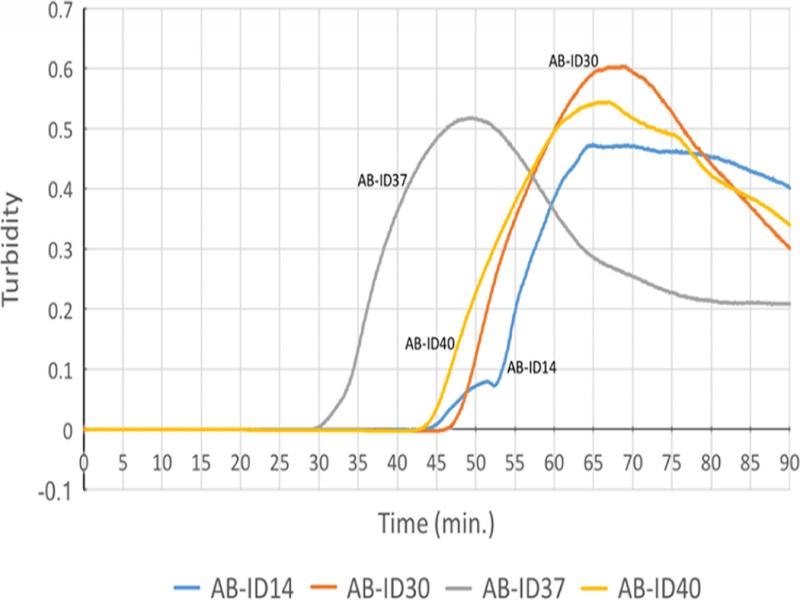
Figure 2:
The efficiency test result of four LAMP primer sets. The colorful curves represent different LAMP primer sets. 106 copies/μl A. besseyi cloned plasmids were used as template.
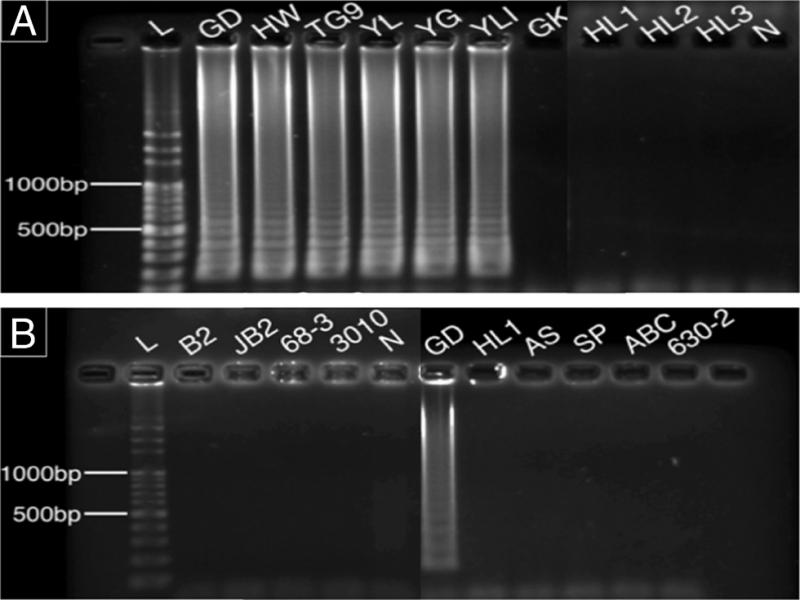
Figure 3:
The A. besseyi specific AB-ID37 LAMP assay specificity on aboveground plant-parasitic nematodes with gel electrophoresis analysis. L: ladder, N: negative control. (A) Examine with A. besseyi isolates from rice (GD, HW, TG9, YL, YG and YL1) and nest fern (GK, HL1-3). (B) Examine with different species of aboveground plant-parasitic nematodes.
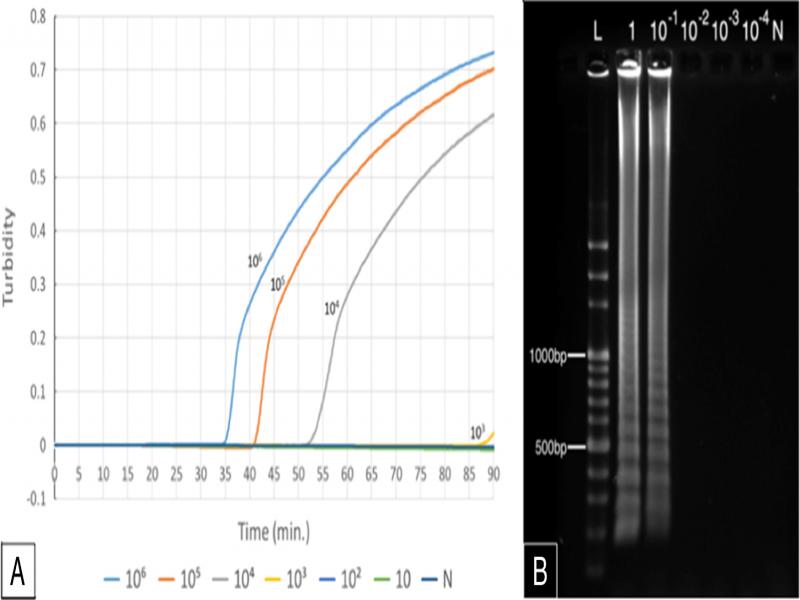
Figure 4:
Sensitivity examination of the A. besseyi specific AB-ID37 LAMP assay. (A) The turbidity detection using 106~101 copies/μl target sequence cloned plasmids as template. (B) The electrophoresis gel result when used 10-fold dilutions of single nematode crude DNA. L: ladder, N: negative control.
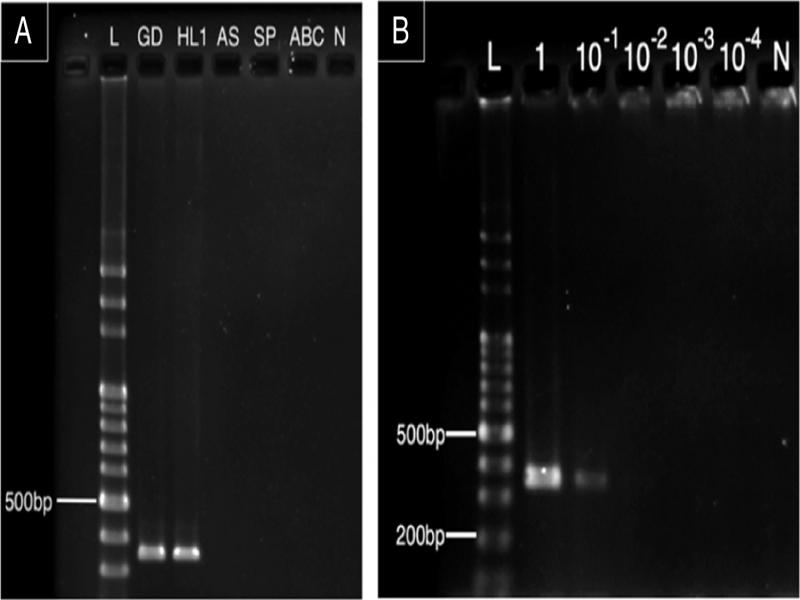
Figure 5:
The specificity and sensitivity test result of PCR primer pair AbF5/AbR5. L: ladder, N: negative control. (A) Aphelenchoides spp. were examined. GD: A. besseyi isolate from rice, HL1: A. besseyi isolate from nest fern, AS: A. fujianensis, SP: A. fragariae and ABC: A. bicaudatus. (B) Using serial 10-fold dilutions of single nematode crude DNA as template.
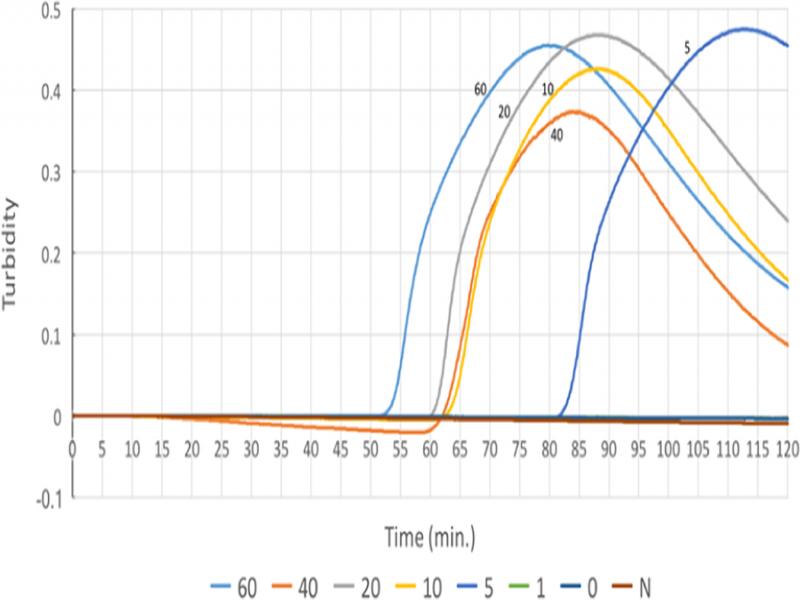
Figure 6:
The application sensitivity exam on total DNA of A. besseyi-inoculated rice seedlings with the A. besseyi specific AB-ID37 LAMP assay. The colorful curves indicate different amount of nematode inoculated on a single rice seedling, ranging from 60, 40, 20, 10, 5, 1 to 0. N: negative control.
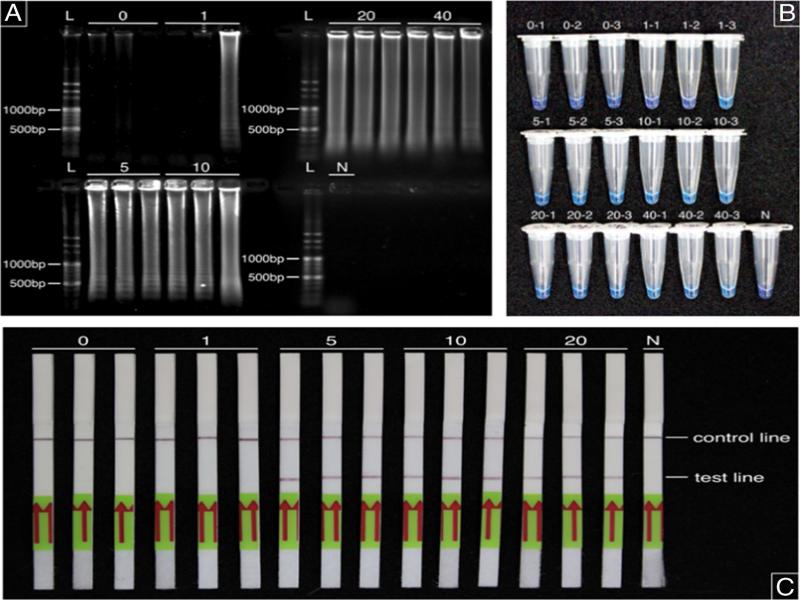
Figure 7:
Different visualization options for the application of the A. besseyi specific AB-ID37 LAMP assay on total DNA of A. besseyi-inoculated rice seedlings. Triplicate of samples inoculation nematode numbers 40, 20, 10, 5, 1, 0 per seedling were tested. N: negative control. (A) Gel electrophoresis. L: ladder, N: negative control. (B) HNB staining. The sky-blue color indicates positive amplification. (C) Lateral flow dipstick (LFD). The purple color appearance at both control line and test line indicates a successful detection of target from LAMP PCR reaction. The test results with 40 nematodes are not shown.