
Table 1.
Morphometric data of studied populations for R. reniformis.
| Rotylenchulus reniformis | Rotylenchulus reniformis | Rotylenchulus reniformis | ||||
|---|---|---|---|---|---|---|
| Locality/crop | Bolo – Palmira (Valle del Cauca)-Banana* | Rozo – Palmira (Valle del Cauca)-Plantain* | Minas Gerais – Brasil Banana* | |||
| Sex | Immature female | Male | Immature female | Male | Immature female | Male |
| n = 15 | n = 7 | n = 5 | n = 4 | n = 20 | n = 5 | |
| L | 367.2 ± 23.8 (345.0–425.0) | 366.6 ± 23.6 (335.0 –399.0) | 367.5 ± 23.7 (332.5–390.0) | 384.4 ± 23.1 (350.0–400.0) | 392.0 ± 26.3 (342.5–430.0) | 385.5 ± 34.8 (327.5–415.0) |
| a | 23.8 ± 1.1 (21.8–26.6) | 25.9 ± 1.1 (23.9–27.3) | 23.0 ± 0.9 (22.2–24.4) | 27.1 ± 2.3 (25.0–30.4) | 24.8 ± 1.5 (21.9–27.0) | 27.1 ± 2.3 (23.4–29.6) |
| b’ | 2.9 ± 0.2 (2.5–3.1) | 3.9 ± 0.2 (3.4–4.1) | 2.9 ± 0.2 (2.6–3.2) | 3.8 ± 0.1 (3.7–4.0) | 3.0 ± 0.2 (2.6–3.4) | 3.8 ± 0.1 (3.6–3.9) |
| c | 16.1 ± 1.1 (14.1–17.6) | 16.8 ± 1.2 (15.3–19.1) | 17.3 ± 1.9 (15.0–19.6) | 17.5 ± 0.5 (17.1–18.2) | 16.6 ± 1.2 (14.2–19.0) | 18.4 ± 2.2 (15.6–21.4) |
| c’ | 2.3 ± 0.3 (2.0–2.8) | 2.1 ± 0.2 (1.8–2.5) | 2.1 ± 0.4 (1.7–2.6) | 1.9 ± 0.3 (1.7–2.3) | 2.4 ± 0.2 (2.0–2.9) | 1.8 ± 0.3 (1.5–2.3) |
| DGO | 16.4 ± 2.0 (13.0–20.0) | – | 17.0 ± 1.0 (16.0–18.0) | – | 17.2 ± 1.2 (15.0–19.0) | – |
| V or T | 72.0 ± 0.9 (71.0–73.8) | – | 72.2 ± 1.4 (70.9–74.4) | – | 71.7 ± 1.1 (69.5–73.7) | – |
| Stylet length | 16.0 ± 0.6 (15.0–17.0) | 10.5 ± 0.6 (10.0–11.0) | 15.4 ± 0.5 (15.0–16.0) | 11.0 ± 0.8 (10.0–12.0) | 15.8 ± 0.5 (15.0–17.0) | 10.6 ± 0.5 (10.0–11.0) |
| Pharynx length | 128.5 ± 8.3 (114.0–142.0) | 95.0 ± 6.1 (85.0–103.0) | 126.8 ± 8.7 (116.0–136.0) | 100.3 ± 4.3 (95.0–105.0) | 131.8 ± 9.5 (110.0–150.0) | 100.2 ± 6.7 (90.0–108.0) |
| Excretory pore | 77.7 ± 4.0 (72.0–84.0) | 70.7 ± 4.1 (65.0–74.0) | 81.0 ± 6.3 (73.0–89.0) | 73.0 ± 2.4 (70.0–76.0) | 79.9 ± 4.3 (72.0–88.0) | 71.8 ± 4.0 (66.0–77.0) |
| Maximum body diam. | 15.9 ± 1.2 (15.0–19.0) | 14.1 ± 0.7 (13.0–15.0) | 16.0 ± 0.7 (15.0–17.0) | 14.3 ± 1.0 (13.0–15.0) | 15.8 ± 0.5 (15.0–17.0) | 14.2 ± 0.4 (14.0–15.0) |
| Anal body diam. | 9.9 ± 1.1 (8.0–12.0) | 10.3 ± 0.5 (10.0–11.0) | 10.3 ± 0.5 (10.0–11.0) | 11.8 ± 1.3 (10.0–13.0) | 10.2 ± 0.5 (9.0–11.0) | 11.6 ± 1.1 (10.0–13.0) |
| Lip region height | 3.3 ± 0.5 (3.0–4.0) | 6.1 ± 0.4 (6.0–7.0) | 3.4 ± 0.5 (3.0–4.0) | 3.5 ± 0.6 (3.0–4.0) | 3.3 ± 0.5 (3.0–4.0) | 3.2 ± 0.4 (3.0–4.0) |
| Lip region width | 7.5 ± 0.6 (7.0–9.0) | 3.6 ± 0.8 (3.0–5.0) | 7.8 ± 0.4 (7.0–8.0) | 6.0 ± 0.0 (6.0–6.0) | 7.3 ± 0.5 (7.0–8.0) | 6.0 ± 0.0 (6.0–6.0) |
| Tail length | 22.8 ± 2.3 (20.0–27.0) | 21.9 ± 1.9 (20.0–25.0) | 21.8 ± 3.8 (17.0–26.0) | 22.0 ± 1.4 (20.0–23.0) | 23.7 ± 1.9 (21.0–27.0) | 21.2 ± 3.6 (17.0–25.0) |
| h | 7.3 ± 1.4 (5.0–11.0) | 6.9 ± 1.2 (6.0–9.0) | 8.3 ± 2.1 (6.0–11.0) | 6.5 ± 1.3 (5.0–8.0) | 7.1 ± 1.2 (5.0–10.0) | 6.6 ± 1.5 (5.0–9.0) |
| Spicule length | – | 17.4 ± 2.1 (15.0–21.0) | – | 20.8 ± 1.0 (20.0–22.0) | – | 20.6 ± 2.1 (18.0–23.0) |
| Gubernaculum length | – | 6.9 ± 0.7 (6.0–8.0) | – | 7.3 ± 1.3 (6.0–9.0) | – | 7.3 ± 1.0 (6.0–8.0) |
1 Notes: L, total body length; a, total body length divided maximum body diameter; b’, total body length divided by distance from anterior end of body to posterior end of pharyngeal glands; c, total body length divided by tail length; c’, tail length divided by body diameter at the anal/cloacal aperture; DGO, dorsal esophageal gland orifice; V or T, position of vulva or testis from anterior end expressed as percentage of body length; h, tail hyaline length. *Measurements in μm; mean ± SD (range).
Table 2.
Correlations between the seven principal components and the morphometric parameters for immature females in Rotylenchulus spp.
| Vector | Diagnostic character | 1 | 2 | 3 | 4 | 5 | 6 | 7 |
|---|---|---|---|---|---|---|---|---|
| 1 | L | − 0.50 | −0.08 | 0.01 | 0.36 | −0.21 | 0.64 | 0.40 |
| 2 | a | − 0.45 | −0.28 | 0.26 | −0.06 | −0.58 | −0.56 | 0.03 |
| 3 | b | −0.31 | −0.47 | 0.28 | −0.61 | 0.42 | 0.23 | −0.09 |
| 4 | c | −0.43 | 0.32 | −0.36 | −0.15 | −0.18 | 0.18 | −0.71 |
| 5 | c’ | 0.21 | − 0.59 | 0.15 | 0.53 | −0.01 | 0.13 | −0.54 |
| 6 | V | 0.08 | 0.46 | 0.83 | 0.02 | −0.11 | 0.19 | −0.2 |
| 7 | Stylet | −0.47 | 0.18 | 0.09 | 0.44 | 0.63 | −0.37 | −0.03 |
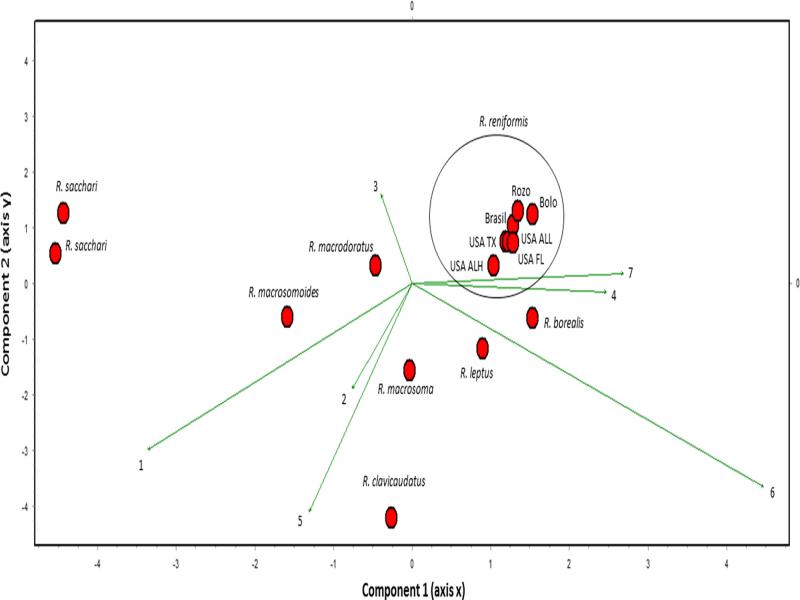
Figure 1:
Biplot for Colombian and Brazilian populations of Rotylenchulus reniformis associated with banana and other species of the genus. The two first axes of a principal components analysis (PCA) are shown.
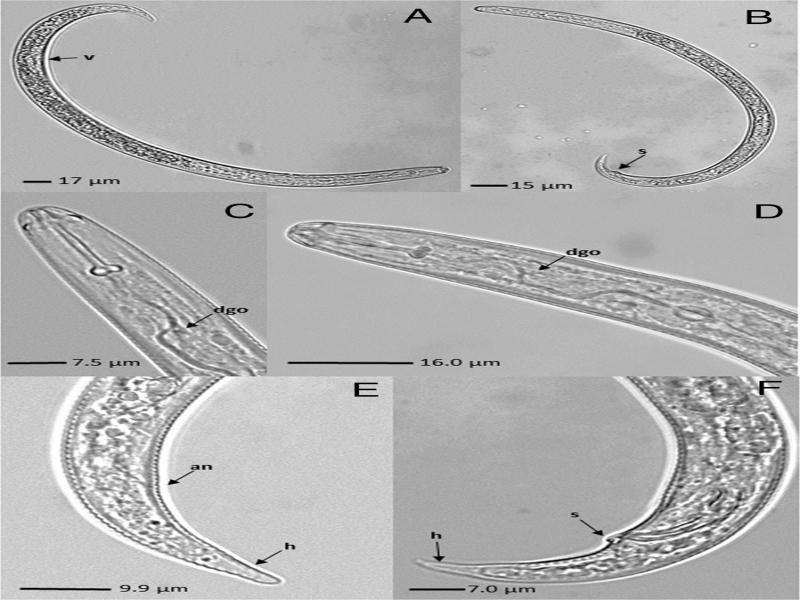
Figure 2:
Rotylenchulus reniformis. (A) immature female; (B) male; (C and D) anterior region of body; (E) posterior region of immature female; and (F) posterior region of male. V = vulva; s = spicule; dgo = dorsal esophageal gland orifice; an = anus; h = tail hyaline.
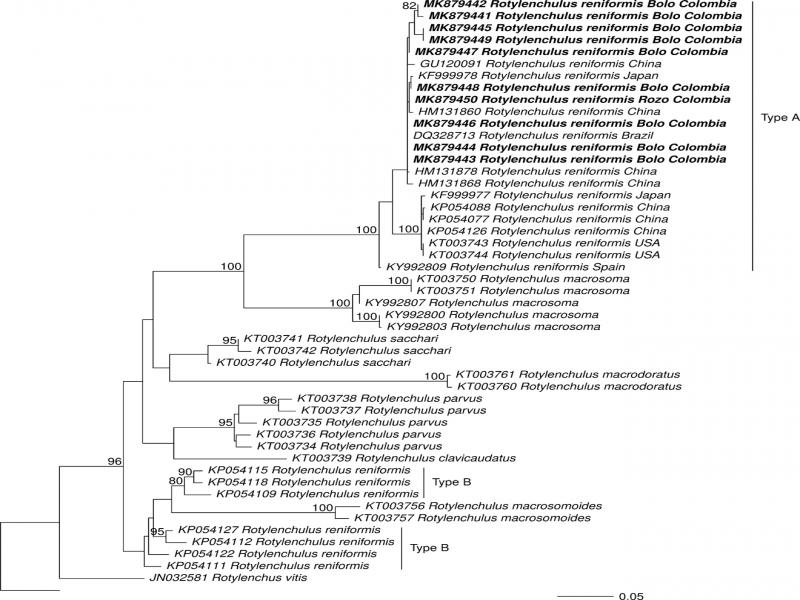
Figure 3:
Maximum likelihood phylogenetic tree of Rotylenchulus based on D2-D3 expansion segment of 28 S ribosomal DNA and 250 bootstraps. The outgroup (Hoplolaimus seinhorsti) is shown in gray font; the sequences that were obtained in this study appear in bold typeface. Values at the nodes represent the posterior probability. The scale represents the number of substitutions per site.
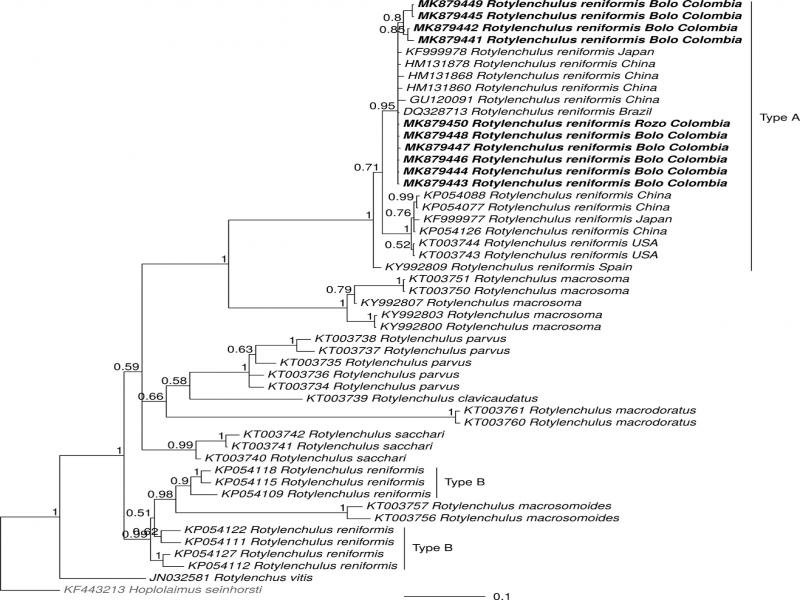
Figure 4:
Bayesian phylogenetic tree of Rotylenchulus based on D2-D3 expansion segment of 28 S ribosomal DNA. The phylogeny is a consensus tree from a posterior distribution of 1,600 trees that were inferred in MrBayes. The outgroup (Hoplolaimus seinhorsti) is shown in gray font; the sequences that were obtained in this study appear in bold typeface. Values at the nodes represent the posterior probability. The scale represents the number of substitutions per site.
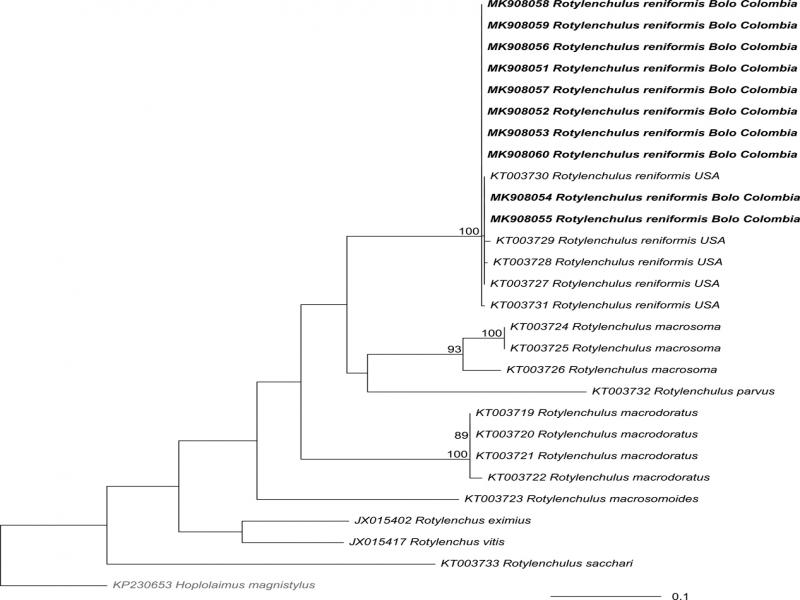
Figure 5:
Maximum likelihood phylogenetic tree of Rotylenchulus based on mitochondrial cytochrome oxidase subunit I (COI) and 250 bootstraps. The outgroup (Hoplolaimus magnystilus) is shown in gray font; the sequences that were obtained in this study appear in bold typeface. Values at the nodes represent the posterior probability. The scale represents the number of substitutions per site.
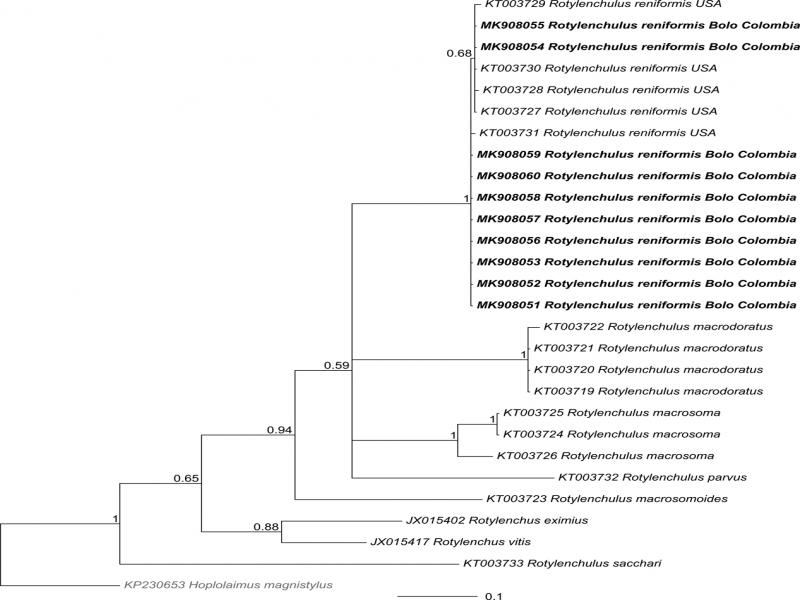
Figure 6:
Bayesian phylogenetic tree of Rotylenchulus based on mitochondrial cytochrome oxydase subunit I (COI). The phylogeny is a consensus tree from a posterior distribution of 1,600 trees that were inferred in MrBayes. The outgroup (Hoplolaimus magnystilus) is shown in gray font; the sequences that were obtained in this study appear in bold typeface. Values at the nodes represent the posterior probability. The scale represents the number of substitutions per site.