
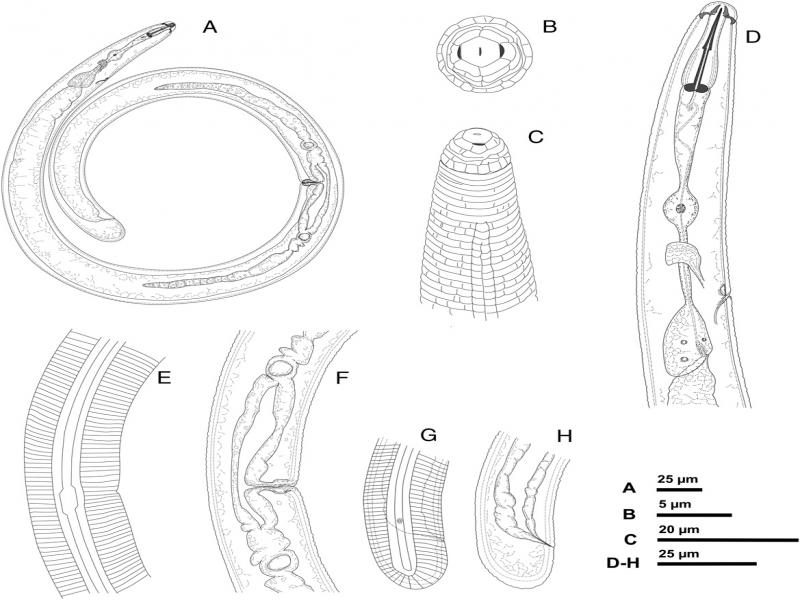
Figure 1
Rotylenchus rhomboids n. sp., (drawings ♀). (A) entire body; (B) en face view; (C) head region; (D) esophageal region; (E) lateral field at vulva region; (F) vulva region; (G) tail region; (H) lateral field at tail region. (B, C based on SEM illustrations) (A, E, F, G, H: Holotype) (Scale bar: A: 25 µm; B: 5 µm; C: 20 µm; D–H: 25 µm).
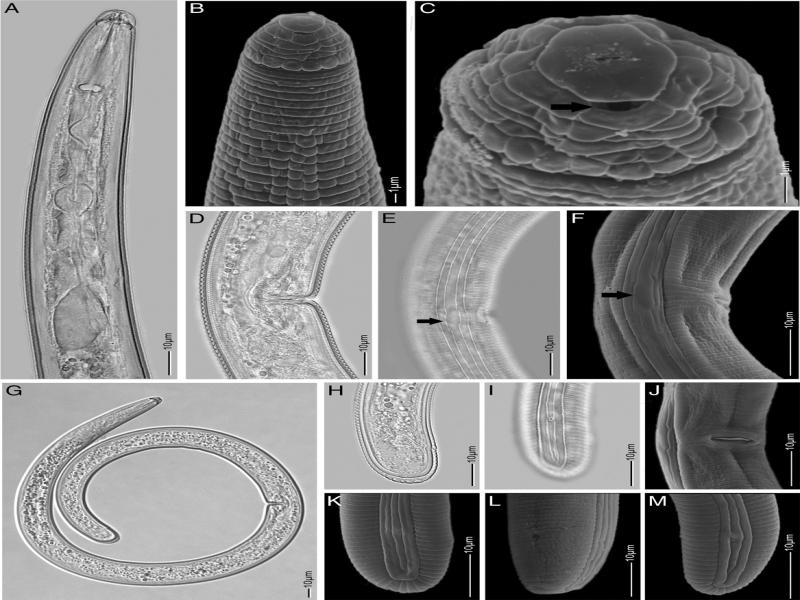
Figure 2
Rotylenchus rhomboides n. sp. (LM ♀). (A) esophageal region; (D) vulva region; (E) lateral field at vulva region with a rhomboid widening (see arrow); (G) entire body; (H) tail region; (I) lateral field with phasmid at tail region (SEM ♀); (B) anterior body region, lateral view; (C) en face view (arrow indicates amphid aperture); (F) vulva region, lateral view; (J) vulva region, ventral view; (K) tail region of female, lateral view; (L) tail region of female, oblique ventral view; (M) tail region of juveniles (D, E, G, H, I: Holotype; others paratypes) (Scale bar: B, C: 1 µm; A, D–M: 25 µm).
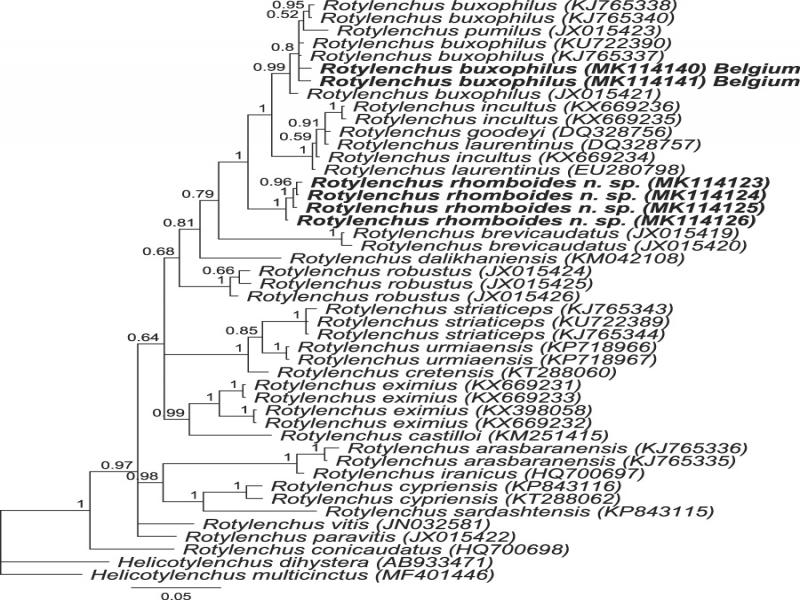
Figure 3
BI phylogenetic tree generated from the D2-D3 of 28S rDNA region data set with the HKY + G model (94 parameters). Bayesian posterior probabilities are given next to each node. Sequences of Rotylenchus rhomboides n. sp. and R. buxophilus (Belgium) are in bold.
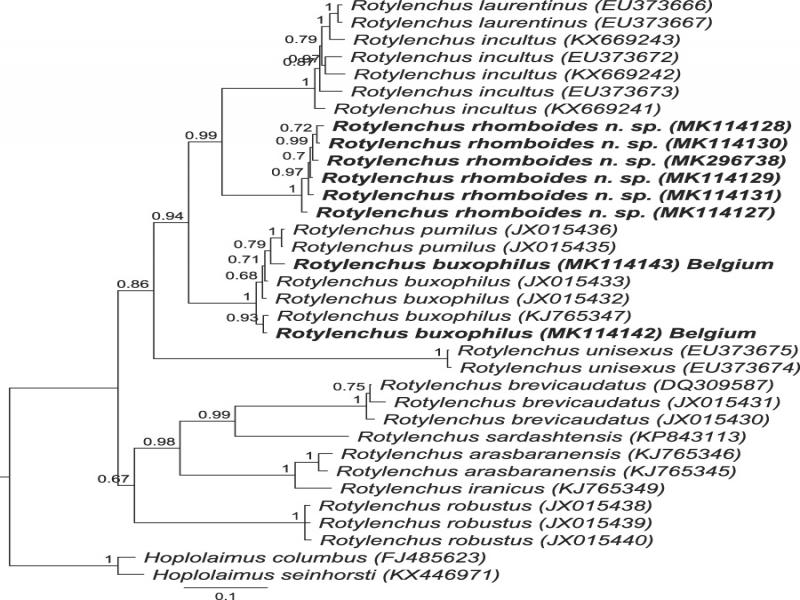
Figure 4
BI phylogenetic tree generated from ITS sequences with HKY + G model (70 parameters). Bayesian posterior probabilities are given next to each node. Sequences of Rotylenchus rhomboides n. sp. and R. buxophilus (Belgium) are in bold.
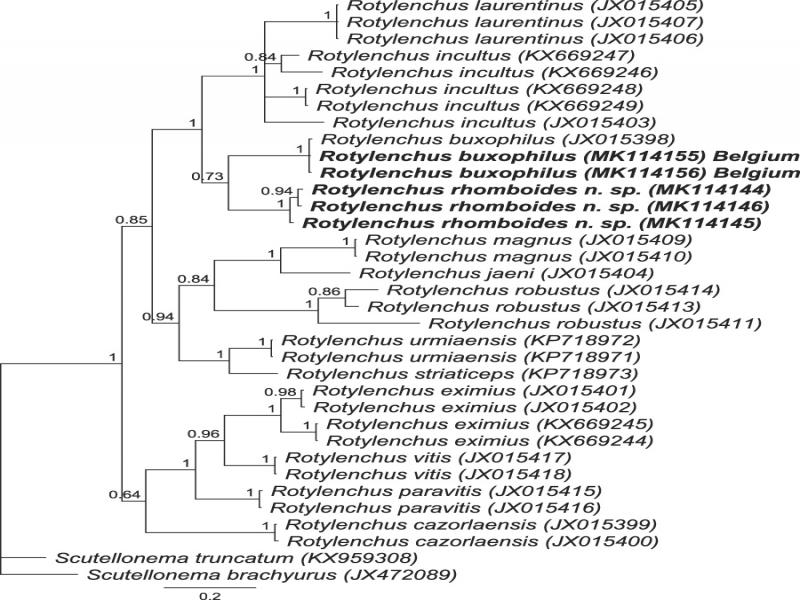
Figure 5
BI phylogenetic tree generated from COI sequences with the GTR +G + I model (77 parameters). Bayesian posterior probabilities are given next to each node. Sequences of Rotylenchus rhomboides n. sp. and R. buxophilus (Belgium) are in bold.
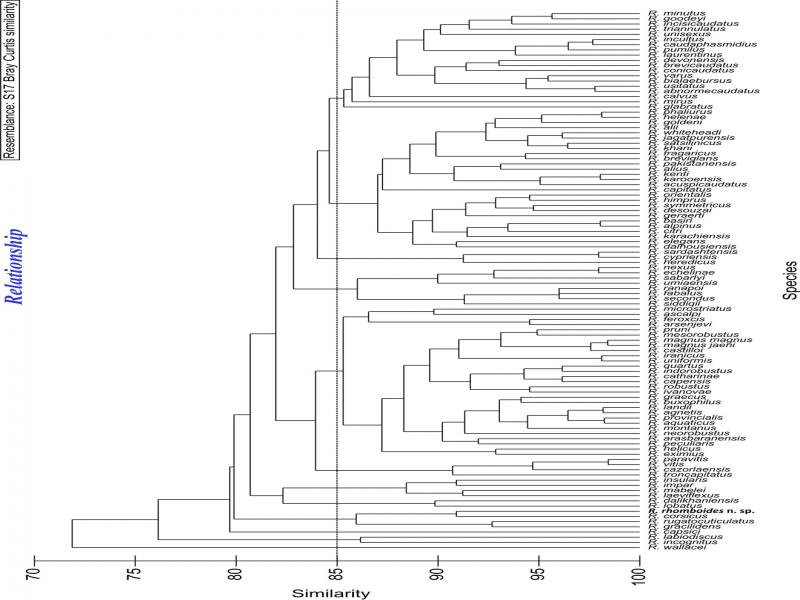
Figure 6
The cluster analysis of 104 species (included Rotylenchus n. sp.) based on Bray–Curtis similarity measure of 11 ranked features. Rotylenchus rhomboides n. sp. is in bold. The dotted line indicates 85% similarity.
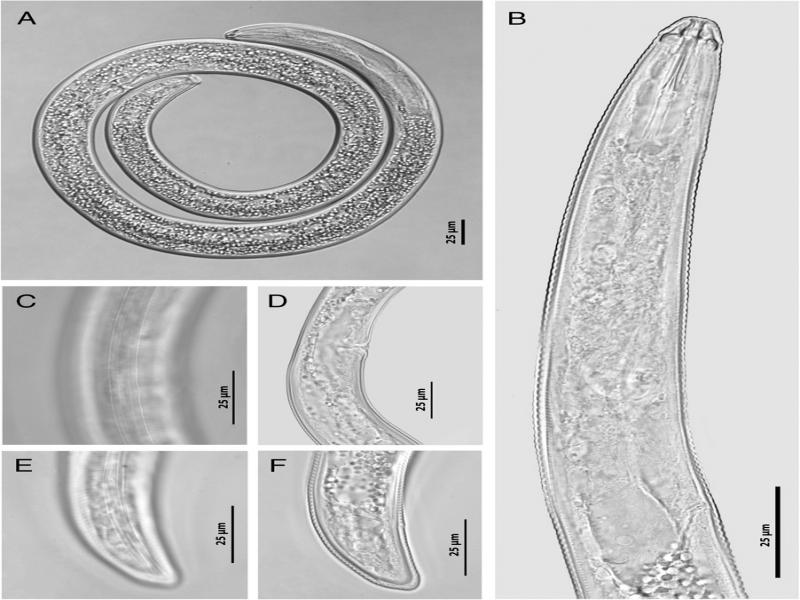
Figure 7
Belgian population of Rotylenchus buxophilus (LM ♀). (A) entire body; (B) esophageal region; (C) lateral field at vulva region; (D) vulva region; (E) lateral field with phasmid at tail region; (F) tail region (Scale bar: A–F: 25 µm).
Table 1
Morphometric data of Rotylenchus rhomboides n. sp. All measurements are in μm (except for ratio) and in the form: mean ± sd (range).
| Character | Holotype female | Paratype females |
|---|---|---|
| n | 1 | 12 |
| Body length (L) | 827 | 861 ± 101 (634–1049) |
| a = L/MBD | 28.5 | 31.8 ± 2.8 (27.8–35.1) |
| b’ = L/Anterior end to the end of esophageal gland | 7.6 | 6.9 ± 0.5 (5.6–7.6) |
| c = L/Tail length | 55 | 63.3 ± 10.7 (50.3–85.5) |
| c’ = Tail length/ABD | 68 | 0.7 ± 0.1 (0.5–0.8) |
| V = Anterior end to vulva/L × 100 | 59 | 56 ± 2.6 (53–61) |
| Lip height | 6 | 6 ± 0.7 (5–7) |
| Lip width | 11 | 10 ± 0.8 (8–11) |
| Stylet length | 35 | 33 ± 1.5 (31–37) |
| Conus length | 17 | 17 ± 0.8 (16–18) |
| Shaft length | 14 | 13 ± 0.9 (12–14) |
| Knob height | 3 | 3 ± 0.4 (3–4) |
| Dorsal gland opening from stylet base | 4 | 3 ± 0.9 (2–5) |
| Anterior end to secretory-excretory pore | 100 | 107 ± 10.6 (77–123) |
| Anterior end to nerve ring | 78 | 86 ± 9.9 (60–96) |
| Anterior end to esophageal gland end | 108 | 125 ± 10.5 (108–146) |
| Esophagus overlapping | 12 | 14 ± 2.3 (9–19) |
| Max body diameter (MBD) | 29 | 27 ± 2.3 (23–31) |
| Anal body diameter (ABD) | 22 | 20 ± 1.8 (16–23) |
| Tail length | 15 | 14 ± 2.0 (9–16) |
| Tail annuli number | 11 | 10 ± 1.0 (8–11) |
Table 2
Comparison of the matrix code of Rotylenchus rhomboides n. sp. with other closely related species.
| Species | A | B | C | D | E | F | G | H | I | J | K |
|---|---|---|---|---|---|---|---|---|---|---|---|
| Rotylenchus rhomboides n. sp. | 3–4 | 2 | 1 | 2 | 2 | 2 | 2 | 1–2 | 2 | 2 | 2 |
| R. buxophilus from Belgium | 4 | 1 | 1 | 4 | 2 | 2 | 3 | 3 | 2 | 2 | 1 |
| R. buxophilus | 4 | 1 | 1 | 4 | 2 | 2 | 3 | 3 | 2 | 2 | 1 |
| R. corsicus | 4 | 1 | 1 | 2 | 2 | 2 | 2 | 3 | 2 | 2 | 1 |
| R. goodeyi | 3 | 1 | 1 | 4 | 2 | 2 | 4 | 2 | 2 | 1 | 2 |
| R. gracilidens | 3 | 1 | 1 | 2 | 2 | 2 | 3 | 1 | 2 | 1 | 1 |
| R. incultus | 4 | 1 | 1 | 4 | 1 | 2 | 3 | 1 | 2 | 1 | 1 |
| R. laurentinus | 4 | 1 | 1 | 3 | 2 | 2 | 3 | 1 | 2 | 1 | 2 |
| R. pumilus | 4 | 1 | 1 | 4 | 1 | 2 | 2 | 1 | 2 | 1 | 2 |
| R. rugatocuticulatus | 3 | 2 | 1 | 2 | 3 | 2 | 4 | 1 | 2 | 1 | 1 |
Table 3
Rotylenchus species and populations used and sequenced in the present study.
| Accession number | |||||
|---|---|---|---|---|---|
| Species | 28S | ITS | COI | Host | Locality |
| H. dihystera | AB933471 | Sugarcane | Japan | ||
| H. multicinctus | MF401446 | Banana | Greece | ||
| H. columbus | FJ485623 | Unknown | USA | ||
| H. seinhorsti | KX446971 | Unknown | China | ||
| R. arasbaranensis | KJ765335 | KJ765345 | Grasses | Iran | |
| KJ765336 | KJ765346 | Grasses | Iran | ||
| R. brevicaudatus | JX015419 | Grasses | Australia | ||
| JX015420 | Grasses | Australia | |||
| JX015431 | Grasses | Australia | |||
| R. buxophilus | JX015421 | – | USA | ||
| KJ765337 | Euonymus sp. | Iran | |||
| KJ765338 | Euonymus sp. | Iran | |||
| KJ765340 | Euonymus sp. | Iran | |||
| KU722390 | – | Iran | |||
| JX015432 | Unknown | USA | |||
| JX015433 | Unknown | USA | |||
| KJ765347 | Euonymus sp. | Iran | |||
| R. buxophilus | MK114140 | MK114142 | MK114155 | Dioscorea tokoro | Belgium |
| MK114141 | MK114143 | MK114156 | Dioscorea tokoro | Belgium | |
| R. castilloi | KM251415 | Fagus orientalis Lipsky (oriental beech tree) | Iran | ||
| R. cazorlaensis | JX015399 | Quercus faginea (Portuguese oak) | Spain | ||
| JX015400 | Quercus faginea (Portuguese oak) | Spain | |||
| R. conicaudatus | HQ700698 | Grasses | Iran | ||
| R. cretensis | KT288060 | Olive | Greece | ||
| R. cypriensis | KP843116 | Prunus sp. | Iran | ||
| KT288062 | Olive | Greece | |||
| R. dalikhaniensis | KM042108 | Ruscus hyrcanus Woronow | Iran | ||
| R. eximius | KX398058 | Tamarix smyrnensis | Greece | ||
| KX669231 | KX669244 | Olive | Tunisia | ||
| KX669232 | Olive | Tunisia | |||
| KX669233 | KX669245 | Olive | Tunisia | ||
| JX015401 | Pistacia lentiscus (lentisc) | Italy | |||
| JX015402 | Pistacia lentiscus (lentisc) | Italy | |||
| R. goodeyi | DQ328756 | Olea europaea subsp. silvestris (wild olive) | Spain | ||
| R. incultus | KX669234 | Olive | Tunisia | ||
| KX669235 | Olive | Tunisia | |||
| KX669236 | Olive | Tunisia | |||
| JX015403 | Vitis vinifera (grapevine) | Spain | |||
| KX669246 | Olive | Tunisia | |||
| KX669247 | Olive | Tunisia | |||
| KX669248 | Olive | Tunisia | |||
| KX669249 | Olive | Tunisia | |||
| R. iranicus | HQ700697 | Unidentified forest tree | Iran | ||
| R. jaeni | JX015404 | Quercus suber (cork tree) | Spain | ||
| R. laurentinus | DQ328757 | JX015405 | Pistacia lentiscus (lentisc) | Italy | |
| JX015406 | Pistacia lentiscus (lentisc) | Italy | |||
| JX015407 | Pistacia lentiscus (lentisc) | Italy | |||
| EU280798 | Pistacia lentiscus (lentisc) | Spain | |||
| R. magnus | JX015409 | Ilex aquifolium (holly) | Spain | ||
| JX015410 | Ilex aquifolium (holly) | Spain | |||
| R. paravitis | JX015422 | JX015415 | Helianthus annuus (sunflower) | Spain | |
| JX015416 | Helianthus annuus (sunflower) | Spain | |||
| R. pumilus | JX015423 | JX015435 | Urtica sp. | USA | |
| JX015436 | Urtica sp. | USA | |||
| R. rhomboides n. sp. | MK114123 | MK114127 | MK114144 | Musa basjoo | Belgium |
| MK114124 | MK114128 | MK114145 | Musa basjoo | Belgium | |
| MK114125 | MK114129 | MK114146 | Musa basjoo | Belgium | |
| MK114126 | MK114130 | Musa basjoo | Belgium | ||
| MK114131 | Musa basjoo | Belgium | |||
| MK296738 | Musa basjoo | Belgium | |||
| R. robustus | JX015424 | JX015413 | Pinus pinea (stone pine) | Spain | |
| JX015425 | JX015438 | Grasses | USA | ||
| JX015426 | JX015439 | JX015411 | Grasses | USA | |
| JX015440 | Grasses | USA | |||
| JX015414 | Pinus pinea (stone pine) | Spain | |||
| R. sardashtensis | KP843115 | KP843113 | Unidentified grasses | Iran | |
| R. striaticeps | KJ765343 | Unidentified forest tree | Iran | ||
| KJ765344 | Unidentified forest tree | Iran | |||
| KU722389 | Unknown | Iran | |||
| KP718973 | Unknown | Iran | |||
| R. unisexus | EU373674 | Citrus aurantium (citrus) | Spain | ||
| EU373675 | Citrus aurantium (citrus) | Spain | |||
| R. urmiaensis | KP718966 | KP718971 | Corylus spp. | Iran | |
| KP718967 | KP718972 | Corylus spp. | Iran | ||
| R. vitis | JN032581 | JX015417 | Vitis vinifera (grapevine) | Spain | |
| JX015418 | Vitis vinifera (grapevine) | Spain | |||
| S. brachyurus | JX472089 | Sansevieria laurentii | USA | ||
| S. truncatum | KX959308 | Unknown | USA | ||
Table 4
Morphometric data of Rotylenchus buxophilus from Belgium. All measurements are in μm (except for ratio) and in the form: mean ± sd (range).
| Character | Females |
|---|---|
| n | 15 |
| Body length (L) | 972 ± 87 (818–1065) |
| a = L/MBD | 30.1 ± 1.9 (27.2–32.5) |
| b″ = L/Anterior end to the end of esophageal gland | 7.0 ± 0.8 (5.3–8.2) |
| c = L/Tail length | 40.1 ± 4.1 (34.6–49.8) |
| c″ = Tail length/ABD | 1.2 ± 0.1 (1.0–1.4) |
| V = Anterior end to vulva/L × 100 | 53 ± 3 (48–58) |
| Lip height | 7 ± 0.3 (6–8) |
| Lip width | 11 ± 0.6 (10–12) |
| Stylet length | 36 ± 1.6 (32–38) |
| Conus length | 18 ± 1.1 (16–20) |
| Shaft length | 14 ± 0.7 (13–14) |
| Knob height | 4 ± 0.6 (3–5) |
| Dorsal gland opening from stylet base | 4 ± 1.2 (3–7) |
| Anterior end to secretory-excretory pore | 123 ± 10 (105–139) |
| Anterior end to nerve ring | 99 ± 7 (87–109) |
| Anterior end to esophageal gland end | 140 ± 11 (124–157) |
| Esophagus overlapping | 22 ± 5 (18–28) |
| Max body diameter (MBD) | 32 ± 2 (29–37) |
| Anal body diameter (ABD) | 21 ± 1.6 (19–24) |
| Tail length | 24 ± 3.1 (18–28) |
| Tail annuli number | 14 ± 1.3 (12–16) |
Table 5
The measurements of known and new populations of Rotylenchus buxophilus.
| Female | R. buxophilus (Belgian population) | R. buxophilus Golden (1956) | R. buxophilus Sher (1965) | R. buxophilus = R. sheri Jairajpuri (1963) | R. buxophilus Geraert and Barooti (1996) | R. buxophilus Wouts and Sturhan (1999) |
|---|---|---|---|---|---|---|
| Host, location | Yam (Dioscorea tokoro), Belgium | English boxwood (Buxus sempervirens var. suffruticosa L.), USA | camellia (Camellia japonica L.), France | Cedrus libani var. deodara, India | Magnolia sp. L., Iran | Cabbage tree (Cordyline sp. Comm, ex R.Br.), New Zealand |
| n | 15 | 20 | 20 | 10 | 4 | 6 |
| L | 972 (818–1065) | 1,090 | 920–1,310 | 900–1,200 | 850–1,070 | 1,020–1,250 |
| V | 53 (48–58) | 55 | 52–58 | 52–56 | 54–58 | 55–58 |
| STL | 36 (32–38) | 33.5 | 34–38 | 35–39 | 34 | 38–40 |
| a | 30.1 (27.2–32.5) | 31 | 28–38 | 27–35 | 25–32 | 32–43 |
| b | 7.0 (5.3–8.2) | 7 | 6.4–8.9 | 5.5–7.0 | 6–8 | 7.3–8.7 |
| c | 40.1 (34.6–49.8) | 43 | 36–48 | 38–47 | 33–45 | 41–58 |
| c′ | 1.2 (1.0–1.4) | – | – | – | 1.1–1.4 | 0.8–1.2 |