
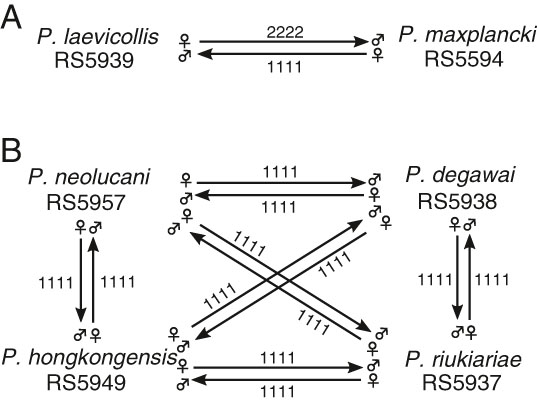
Figure 1
Results of mating experiments of all five new species with P. maxplancki. A: Mating between P. laevicollis sp. n. and P. maxplancki; B: Mating between the four new species, P. honkongensis sp. n., P. degawai sp. n., P. neolucani sp. n. and P. riukiariae sp. n. Numbers indicate the results of four replicates of mating experiments. Production of no F1 progeny is indicated as “1,” the formation of viable, sterile F1 progeny is indicated as “2.”
Table 1
Morphometrics of P. laevicollis sp. n.
| Character | P. laevicollis RS5939 stenostomatous male | Stenostomatous female |
|---|---|---|
| n | 10 | 10 |
| L | 834 ± 104 (662–971) | 1104 ± 209 (746–1325) |
| L’ | 705 ± 89.6 (566–836) | 908 ± 179 (595–1126) |
| a | 15 ± 1 (13–17) | 13 ± 0.8 (12–15) |
| b | 6.5 ± 0.5 (5.9–7.4) | 7.6 ± 0.8 (5.8–8.6) |
| c | 6.5 ± 0.4 (5.9–7.2) | 5.7 ± 0.7 (4.6–6.9) |
| c’ | 3.9 ± 0.4 (3–4.3) | 5.8 ± 0.7 (4.9–7.1) |
| T or V | 59 ± 2 (56–62) | 46 ± 2.1 (42–49) |
| Maximum body diam. | 57 ± 7.4 (47–66) | 83 ± 14.8 (57–97) |
| Stoma length | 9.4 ± 1 (7.7–10.6) | 11.1 ± 1.1 (9–12.5) |
| Stoma diam. | 5.6 ± 0.7 (4–6.4) | 6.4 ± 0.7 (5.5–8.0) |
| Pharynx length (head to base of pharynx) | 118 ± 9.5 (103–132) | 137 ± 15.5 (113–154) |
| Anterior pharynx (pro– + metacorpus) | 72 ± 6.7 (61–81) | 84 ± 8.7 (71–93) |
| Posterior pharynx (isthmus + basal bulb) | 46 ± 2.9 (42–51) | 53 ± 7.1 (42–63) |
| Ant/total pharynx % | 61 ± 1 (58–61) | 61 ± 1.2 (59–63) |
| Median bulb diam. | 20 ± 2.1 (16–22) | 27 ± 3.1 (22–30) |
| Terminal bulb diam. | 19 ± 1.7 (16–21) | 25 ± 3.8 (19–31) |
| Testis length | 490 ± 72.5 (370–570) | – |
| Ant. end to vulva | – | 504±86.2 (365–613) |
| Vulva to anus distance | – | 410 ± 78.9 (275–523) |
| Cloacal or anal body diam. | 33 ± 2.3 (28–36) | 34 ± 4.5 (32–60) |
| Tail length | 129 ± 17.4 (96–152) | 196 ± 47.1 (138–285) |
| Spicule length (curve) | 44 ± 2.5 (40–47) | – |
| Spicule length (chord) | 35 ± 2.1 (31–38) | – |
| Gubernaculum length | 16 ± 1 (14–17) | – |
Table 2
Morphometrics of P. honkongensis sp. n. and P. neolucani sp. n.
| Character | P. hongkongensis RS5957 stenostomatous male | Stenostomatous female | P. neolucani RS5949 stenostomatous male | Stenostomatous female |
|---|---|---|---|---|
| n | 10 | 10 | 10 | 10 |
| L | 1014 ± 185 (700–1302) | 1181 ± 315 (918–2008) | 871 ± 49.6 (775–951) | 1060 ± 111.1 (930–1297) |
| L’ | 847 ± 184 (560–1125) | 940 ± 288 (703–1700) | 745 ± 50.7 (658–826) | 864 ± 103.2 (743–1080) |
| a | 14 ± 3.7 (11–24) | 13 ± 0.9 (12–15) | 15 ± 1 (14–16) | 14 ± 0.7 (13–15) |
| b | 6 ± 1 (4.6–7.7) | 6.6 ± 1.1 (5.6–9.5) | 5.4 ± 0.6 (4.7–6.6) | 5.5 ± 0.4 (4.8–6.5) |
| c | 6.1 ± 1.3 (5–8.5) | 4.8 ± 0.7 (4.3–6.5) | 7 ± 0.9 (6.1–9.2) | 5.4 ± 0.5 (4.5–6.1) |
| c’ | 4.2 ± 0.9 (3–5.9) | 6.3 ± 0.5 (5.1–6.9) | 3.7 ± 0.7 (2.6–4.9) | 6.1 ± 0.9 (5–7.8) |
| T or V | 53 ± 4.8 (51–68) | 45 ± 2.6 (42–50) | 53 ± 7.5 (33–59) | 47 ± 1.3 (45–48) |
| Maximum body diam. | 73 ± 14.9 (51–96) | 92 ± 29.4 (67–170) | 57 ± 5.8 (49–67) | 75 ± 9 (63–95) |
| Stoma length | 12.6 ± 1 (11.4–14.6) | 13.3 ± 1.6 (10.3–16) | 10.4 ± 1 (8.7–12) | 11 ± 0.9 (10.2–13) |
| Stoma diam. | 7.2 ± 0.7 (6.1–8.5) | 7.7 ±1.1 (6.5–9.7) | 6.0 ± 0.7 (5.3–7.6) | 7.1 ± 0.7 (6.3–8.4) |
| Pharynx length (head to base of pharynx) | 155 ± 9.7 (140–172) | 168 ± 14 (154-202) | 151 ± 11.9 (129-169) | 182 ± 14.9 (149-194) |
| Anterior pharynx (pro- + metacorpus) | 98 ± 5.4 (90–106) | 106 ± 7.4 (94–117) | 95 ± 10.2 (76–112) | 116 ± 9.2 (97–128) |
| Posterior pharynx (isthmus + basal bulb) | 57 ± 5.9 (49–66) | 62 ± 8.4 (56–85) | 56 ± 5.3 (51–69) | 66 ± 7.1 (52–75) |
| Ant/total pharynx % | 63 ± 2 (60–66) | 63 ± 2.5 (58–66) | 63 ± 3.2 (59–67) | 64 ± 1.8 (61– 66) |
| Median bulb diam. | 27 ± 2 (24–31) | 31 ± 3.6 (26–38) | 25 ± 1 (24–27) | 31 ± 2.9 (27–36) |
| Terminal bulb diam. | 26 ± 2.2 (22–28) | 29 ± 6.6 (24–47) | 25 ± 1.3 (22–27) | 29 ± 1.7 (27–33) |
| Testis length | 540 ± 141 (366–765) | – | 467±43 (425–561) | – |
| Ant. end to vulva | – | 539 ± 172 (384–995) | – | 493 ± 50.9 (420–581) |
| Vulva to anus distance | – | 419 ± 149 (320–815) | – | 371 ± 47 (290–447) |
| Cloacal or anal body diam. | 41 ± 5.4 (30–50) | 39 ± 8 (32–60) | 35 ± 4.8 (27–43) | 32 ± 3.8 (27–38) |
| Tail length | 167 ± 21.6 (140–206) | 241 ± 30 (215–308) | 125 ± 13.2 (99–148) | 196 ± 19 (175–228) |
| Spicule length (curve) | 53 ± 4.2 (44–57) | – | 47±2.3 (43–51) | – |
| Spicule length (chord) | 45 ± 3.7 (37–49) | – | 36 ± 1.7 (34–39) | – |
| Gubernaculum length | 19 ± 1.8 (17–22) | – | 17 ± 1.5 (14–19) | – |
Table 3
Morphometrics of P. riukiariae sp. n. and P. degawai sp. n.
| Character | P. riukiariae RS5937 stenostomatous male | Stenostomatous female | P. degawai RS5938 stenostomatous male | Stenostomatous female |
|---|---|---|---|---|
| n | 10 | 10 | 10 | 10 |
| L | 918 ± 162 (663–1180) | 1362 ± 211 (1025–1700) | 872 ± 142.2 (710–1105) | 1184 ± 310.5 (811–1853) |
| L’ | 780 ± 151 (553–1010) | 1142 ± 201 (835–1466) | 727 ± 134.6 (585–961) | 986 ± 282 (652–1600) |
| a | 12 ± 2.5 (9.4–15) | 14 ± 1.5 (11–16) | 16 ± 2 (13–19) | 16 ± 3 (132–23) |
| b | 5.7 ± 0.8 (5–7.5) | 8.4 ± 1.5 (5.9–10.8) | 5.3 ± 0.6 (4.6–6.4) | 6.6 ± 1.2 (5.1–8.6) |
| c | 6.8 ± 1.2 (5.4–9.3) | 6.2 ± 0.7 (5–7.3) | 6 ± 0.8 (5.4–7.7) | 6 ± 0.9 (4.7–7.3) |
| c’ | 3.4 ± 0.4 (2.7–4.2) | 5.2 ± 0.6 (4.5–6.1) | 4.1 ± 0.5 (3.3–4.7) | 5.2 ± 1 (3.8–7.3) |
| T or V | 51 ± 5.3 (41–59) | 45 ± 11.1 (32–72) | 45 ± 5 (40–56) | 51 ± 5.5 (45–63) |
| Maximum body diam. | 78 ± 13.2 (62–97) | 99 ± 19.4 (65–128) | 56 ± 14.4 (40–80) | 80 ± 28.6 (37–138) |
| Stoma length | 11.1 ± 1 (9.7–12.5) | 11.8 ± 1.3 (9.2–14) | 11.4 ± 0.8 (10–12.3) | 12.1 ± 0.9 (11–13.4) |
| Stoma diam. | 6.5 ± 0.8 (5.4–7.6) | 7.3 ±0.7 (6.2–8.4) | 6.7 ± 0.3 (6.3–7) | 7.6 ± 0.6 (6.9–8.7) |
| Pharynx length (head to base of pharynx) | 143 ± 17.6 (111–167) | 156 ± 12.2 (136–178) | 152 ± 10.1 (143–176) | 169 ± 16.3 (148–207) |
| Anterior pharynx (pro– + metacorpus) | 94 ± 11 (78–111) | 97 ± 8.8 (86–116) | 95 ± 4.2 (89–103) | 106 ± 8.4 (96–122) |
| Posterior pharynx (isthmus + basal bulb) | 54 ± 5.8 (43–63) | 58 ± 7 (40–66) | 58 ± 7.1 (47–73) | 62 ± 9.6 (51–85) |
| Ant/total pharynx % | 67 ± 11.9 (59–100) | 62 ± 3.4 (60–71) | 62 ± 2.4 (59–67) | 64 ± 2.3 (60– 68) |
| Median bulb diam. | 27 ± 2.2 (23–31) | 31 ± 1.4 (29–33) | 26 ± 3 (22–32) | 30 ± 4.6 (24–41) |
| Terminal bulb diam. | 24 ± 2.8 (19–28) | 28 ± 2.3 (24–32) | 25 ± 4 (19–33) | 28 ± 4.8 (22–39) |
| Testis length | 468 ± 116.4 (295–677) | – | 397 ± 105.7 (285–580) | – |
| Ant. end to vulva | – | 624 ± 199 (415–1040) | – | 601 ± 173.3 (416–1043) |
| Vulva to anus distance | – | 510 ± 94.6 (332–665) | – | 365 ± 72.8 (255–487) |
| Cloacal or anal body diam. | 41 ± 4.5 (32–46) | 43 ± 6.1 (31–52) | 35 ± 5.6 (30–44) | 39 ± 8.7 (22–55) |
| Tail length | 137 ± 21.2 (104–170) | 220 ± 14.3 (190–241) | 145 ± 14.5 (125–180) | 198 ± 36.8 (150–253) |
| Spicule length (curve) | 53 ± 5.5 (40–60) | – | 47±7.6 (37–57) | – |
| Spicule length (chord) | 43 ± 3.4 (36–47) | – | 40 ± 6.9 (32–50) | – |
| Gubernaculum length | 12 ± 2.5 (9.4–15) | – | 16 ± 2.4 (13–19) | – |
Table 4
Summary of diagnostic characters of the Pristionchus pacificus complex sensu stricto.
| Stenostomatous form | Eurystomatous form | ||||||
|---|---|---|---|---|---|---|---|
| Species | Reproductive mode | Right subventral plate | Left subventral plate | Right subventral tooth | Left subventral cusps | Genital papillae | Other characteristic feature(s) |
| pacificus | H | Single peak | Three bumps | Claw-like | Three large cusps each sometimes split into two (= 3-6 peaks) | Type 1: v1-v2d = v2d-v4; v2d and v3 are close to each other | |
| Exspectatus | G | Single peak | Three bumps | Claw-like | three large cusps each sometimes split into two (= 3-6 peaks) | Type 1: v1-v2d = v2d-v4; v2d and v3 are close to each other | |
| Occultus | G | single peak | three bumps | claw-like | Three large cusps each sometimes split into two to three (= 3-9 peaks) | Type 1: v1-v2d = v2d-v4; v2d and v3 are close to each other | |
| Sikae | G | Single peak | Three bumps | Claw-like with or without blunt projection | Three large cusps each sometimes split into two (= 3-6 peaks) | Type 1: v1-v2d = v2d-v4; v2d and v3 are close to each other | |
| Arcanus | G | Single peak | Three bumps | Claw-like | Three large cusps each sometimes split into two (= 3-6 peaks) | Type 2: v1-v2d > v2d-v4; v2d and v3 are close to each other | |
| Kurosawai | G | Single peak | Three bumps | Claw-like | Three large cusps each sometimes split into two (= 3-6 peaks) | Type 1: v1-v2d = v2d-v4; v2d and v3 are close to each other | |
| Taiwanensis | G | Single peak | Three bumps | Claw-like with blunt projection | Three large cusps each sometimes split into two (= 3-6 peaks) | Type 1: v1-v2d = v2d-v4; v2d and v3 are close to each other | |
| Laevicollis n. sp. | G | Single peak | Three bumps | Claw-like | Three large cusps each sometimes split into two (= 3-6 peaks) | Type 3: v1-v2 = v2-v4; v2 and v3d are separated | |
| maxplancki | G | 1-2 peaks | with minute denticles | claw-like | three large cusps each sometimes split into two (= 3-6 peaks) | Type 3: v1-v2 = v2-v4; v2 and v3d are separated | |
| Japonicus | G | Single peak | Three bumps | Claw-like | Three large cusps each sometimes split into two (= 3-6 peaks) | Type 4: v1-v2 < v2-v4; v2 and v3d are separated | |
| Riukiariae n. sp. | G | Two peaks | Three bumps | Two large ridges or multiple small denticles | Three large cusps each sometimes split into two to three (= 3-9 peaks) | Type 1: v1-v2d = v2d-v4; v2d and v3 are close to each other | |
| Neolucani n. sp. | G | Single peak | Three bumps | Claw-like | Three large cusps each sometimes split into two (= 3-6 peaks) | Type 1: v1-v2d = v2d-v4; v2d and v3 are close to each other | |
| Degawai n. sp. | G | Single peak | Three bumps | Claw-like | Three large cusps each sometimes split into two (= 3-6 peaks) | v1-v2d = v2d-v4; v2d and v3 are close to each other | v2 and v3 are very close, and sometimes third pair is directed sublaterally (v3d) |
| Hongkongensis n. sp. | G | Single peak | Three bumps | Claw-like | Three large cusps each split into three or more (= more than 9 peaks) | v1-v2 < v2-v4; v2 and v3d are separated | Comparatively large and slightly more barrel-shaped stoma in eurystomatous form |
| Quatrusdecimus | G | 1-2 peaks | Three bumps | Claw-like | Three large cusps each sometimes split into two (= 3-6 peaks) | v1-v2 < v2-v4; v2 and v3d are separated | |
Table 5
The table shows the number of molecular differences in the 1.6kb SSU rRNA sequence for every pairwise comparison in the pacificus species-complex.
| P. pacificus | P. exspectatus | P. occultus | P. sikae | P. arcanus | P. kurosawai | P. taiwanensis | P. laevicollis sp. n. | P. maxplancki | P. riukiariae sp. n. | P. neolucani sp. n. | P. degawai sp. n. | P. hongkongensis sp. n. | P. quartusdecimus | |
|---|---|---|---|---|---|---|---|---|---|---|---|---|---|---|
| P. pacificus | 0 | 8 | 5 | 10 | 6 | 3 | 6 | 21 | 16 | 35 | 25 | 31 | 42 | 36 |
| P. exspectatus | – | 0 | 6 | 12 | 8 | 5 | 8 | 23 | 16 | 34 | 27 | 33 | 43 | 38 |
| P. occultus | – | – | 0 | 1 | 4 | 2 | 5 | 18 | 14 | 27 | 21 | 27 | 38 | 33 |
| P. sikae | – | – | – | 0 | 10 | 1 | 4 | 18 | 14 | 32 | 21 | 27 | 38 | 33 |
| P. arcanus | – | – | – | – | 0 | 3 | 4 | 19 | 14 | 31 | 24 | 30 | 41 | 35 |
| P. kurosawai | – | – | – | – | – | 0 | 3 | 18 | 13 | 28 | 22 | 28 | 39 | 33 |
| P. taiwanensis | – | – | – | – | – | – | 0 | 19 | 14 | 29 | 24 | 30 | 41 | 35 |
| P. laevicollis sp.n. | – | – | – | – | – | – | – | 0 | 18 | 35 | 34 | 36 | 47 | 42 |
| P. maxplancki | – | – | – | – | – | – | – | – | 0 | 29 | 28 | 30 | 41 | 39 |
| P. riukiariae sp.n. | – | – | – | – | – | – | – | – | – | 0 | 5 | 4 | 14 | 19 |
| P. neolucani sp.n. | – | – | – | – | – | – | – | – | – | – | 0 | 6 | 17 | 18 |
| P. degawai sp.n. | – | – | – | – | – | – | – | – | – | – | – | 0 | 14 | 19 |
| P. hongkongensis sp.n. | – | – | – | – | – | – | – | – | – | – | – | – | 0 | 23 |
| P. quartusdecimus | – | – | – | – | – | – | – | – | – | – | – | – | – | 0 |
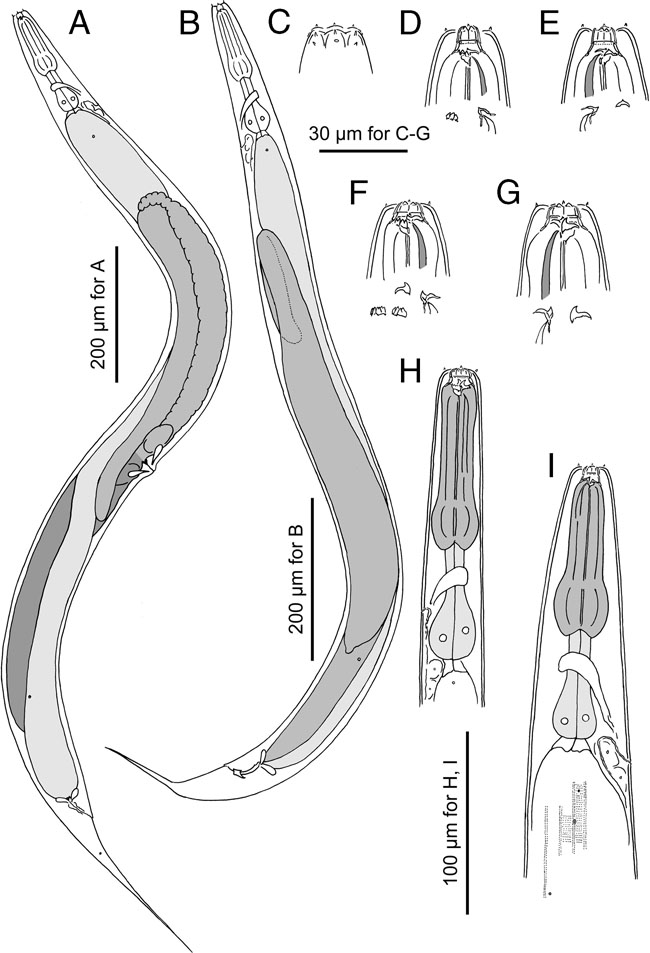
Figure 2
Adults of Pristionchus laevicollis sp. n. A: Female in right lateral view; B: Male in left lateral view; C: Surface of male lip region in left lateral view; D: Stomatal region of stenostomatal male in left lateral view; E: Stomatal region of stenostomatal male in right lateral view; F: Stomatal region of eurystomatal female in left lateral view; G Stomatal region of eurystomatal female in right lateral view; H: Anterior part of eurystomatous female in left lateral view; I: Anterior region of stenostomatous female in right lateral view.
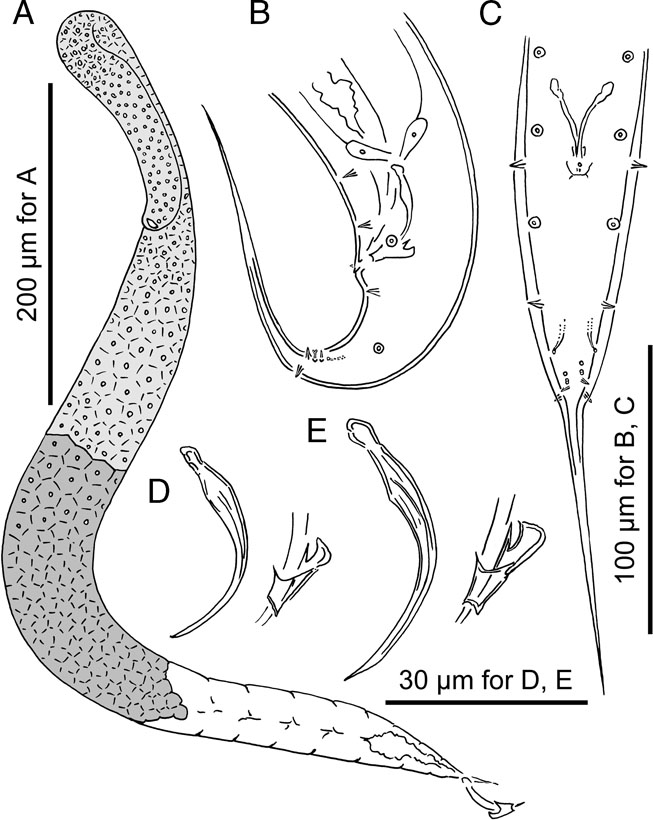
Figure 3
Adult male of Pristionchus laevicollis sp. n. A: Gonadal system in right lateral view; B, C: Tail region in left lateral (B) and ventral (C) views; D, E: Spicule and gubernaculum showing the variation in the size among individuals.
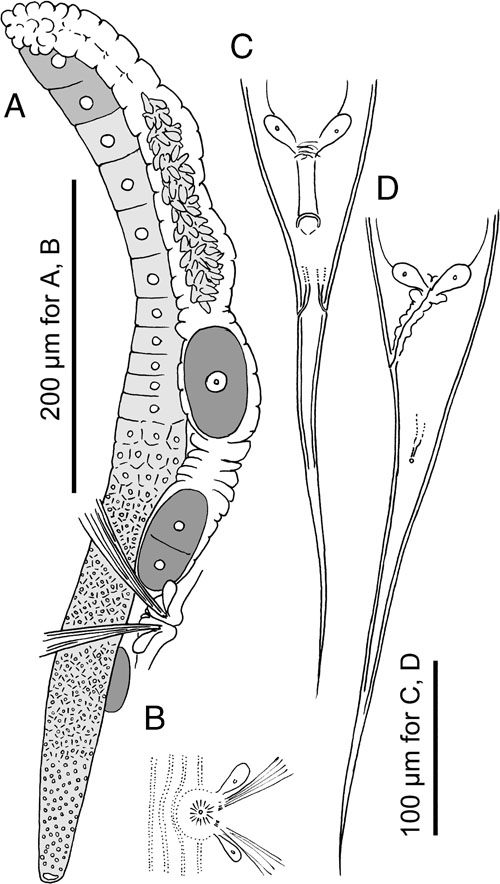
Figure 4
Adult female of Pristionchus laevicollis sp. n. A: Gonadal system in right lateral view; B: Ventral view of vulval region; C, D: ventral (C) and left lateral (D) and views.
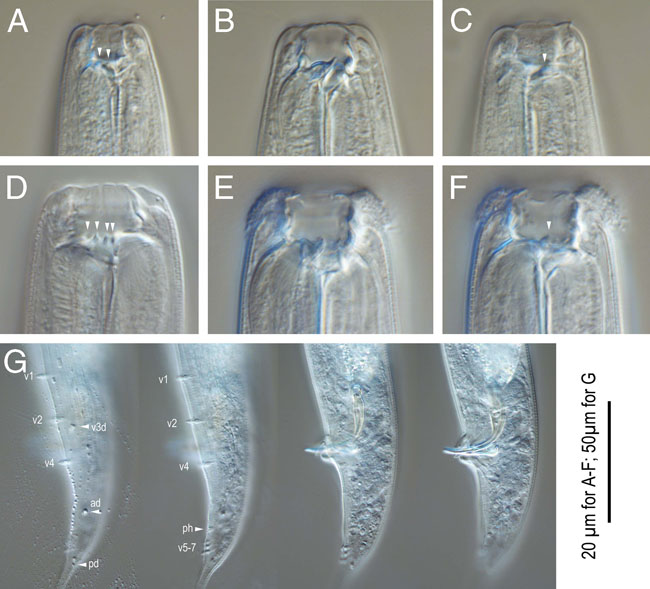
Figure 5
Pristionchus laevicollis n. sp. A-C: Stomatal region of stenostomatous form showing left subventral denticles (arrowheads in A), dorsal tooth (B) and right subventral ridge (arrowhead in C); D-F: Stomatal region of eurystomatous form showing left subventral cusps (arrowheads in D), Dorsal tooth (E) and right subventral tooth (arrowhead in F); G: Male tail in four different focal planes showing genital papillae (v+number), phasmid (ph), and spicule and gubernaculum shape. 20 µm for A-F; 50 µm for G.
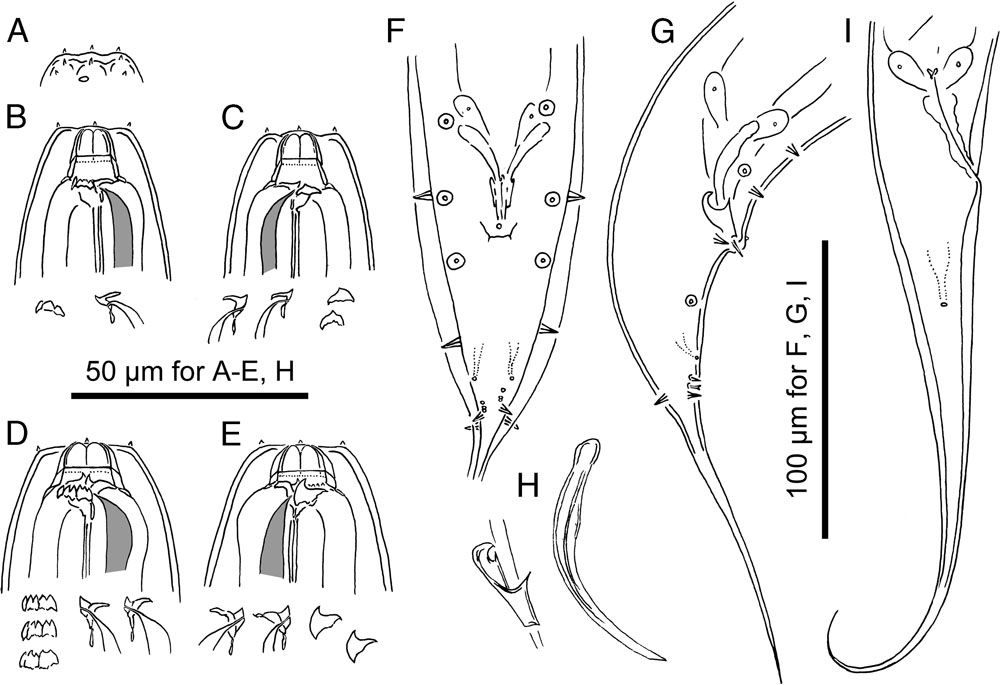
Figure 6
Adults of Pristionchus neolucani sp. n. A: Surface of male lip region in right lateral view; B: Stomatal region of stenostomatal male in left lateral view; C: Stomatal region of stenostomatal male in right lateral view; D: Stomatal region of eurystomatal female in left lateral view; E Stomatal region of eurystomatal female in right lateral view; F, G: Male tail region in ventral (F) and right lateral (G) views; H: Spicule and gubernaculum in right lateral view; I: Female tail region in right lateral view.
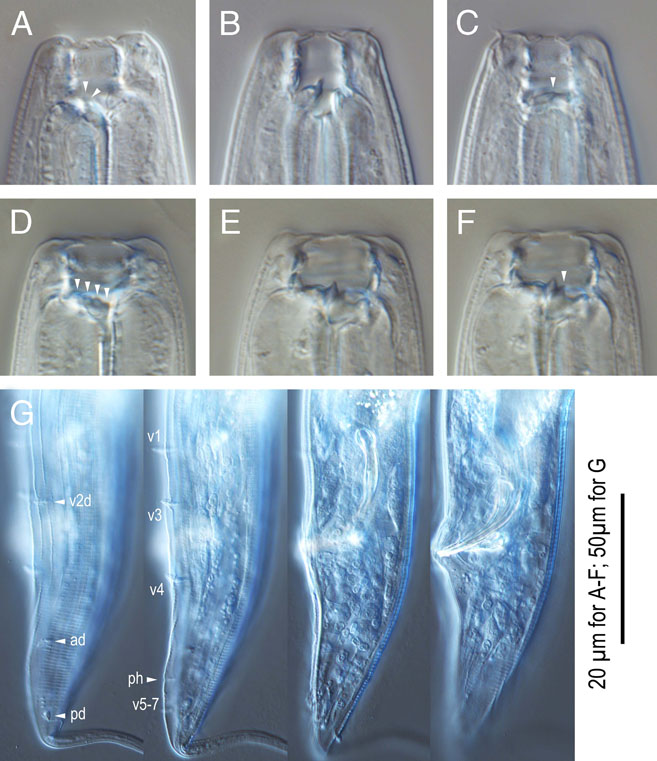
Figure 7
Pristionchus neolucani n. sp. A-C: Stomatal region of stenostomatous form showing left subventral denticles (arrowheads in A), dorsal tooth (B) and right subventral ridge (arrowhead in C); D-F: Stomatal region of eurystomatous form showing left subventral cusps (arrowheads in D), Dorsal tooth (E) and right subventral tooth (arrowhead in F); G: Male tail in four different focal planes showing genital papillae (v+number), phasmid (ph), and spicule and gubernaculum shape. 20 µm for A-F; 50 µm for G.
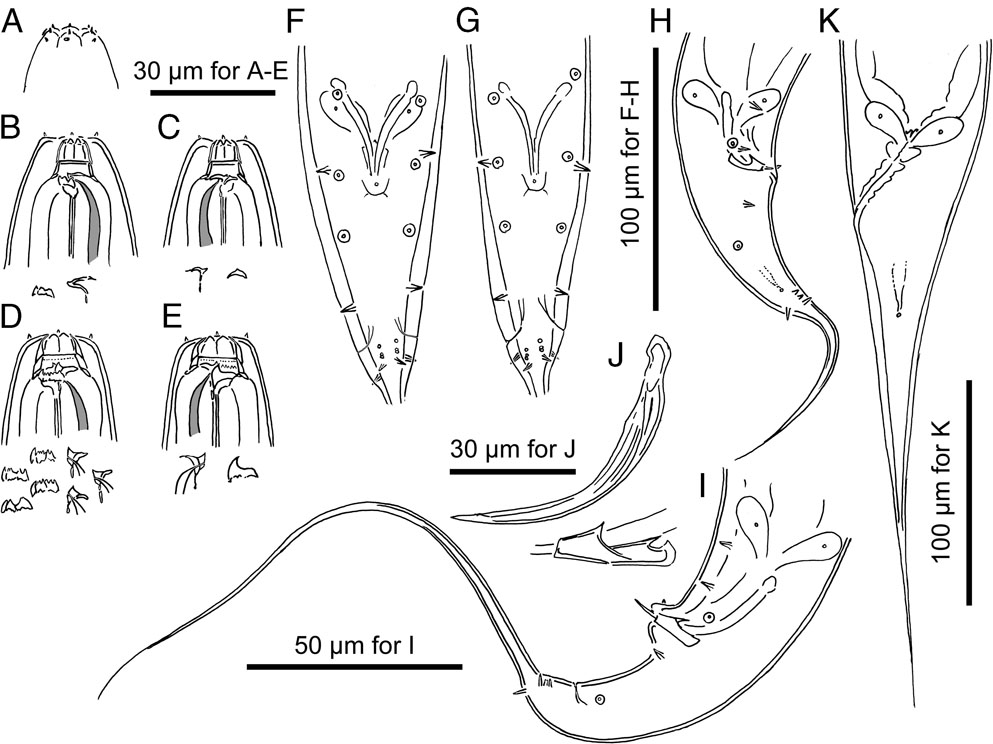
Figure 8
Adults of Pristionchus degawai sp. n. A: Surface of male lip region in right lateral view; B: Stomatal region of stenostomatal male in left lateral view; C: Stomatal region of stenostomatal male in right lateral view; D: Stomatal region of eurystomatal female in left lateral view; E Stomatal region of eurystomatal female in right lateral view; F, G: Male tail region in ventral view showing the variation in the arrangement of genital papillae; H, I: Male tail region in right lateral (H) and left lateral (I) views showing the variation in body size and arrangement of genital papillae; J: Spicule and gubernaculum in left lateral view; K: Female tail region in left lateral view.
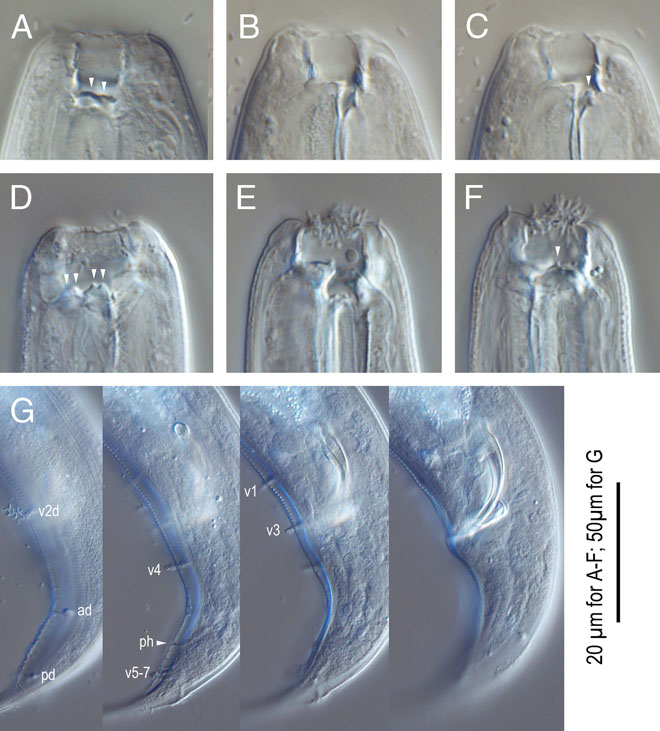
Figure 9
Pristionchus degawai n. sp. A-C: Stomatal region of stenostomatous form showing left subventral denticles (arrowheads in A), dorsal tooth (B) and right subventral ridge (arrowhead in C); D-F: Stomatal region of eurystomatous form showing left subventral cusps (arrowheads in D), Dorsal tooth (E) and right subventral tooth (arrowhead in F); G: Male tail in four different focal planes showing genital papillae (v+number), phasmid (ph), and spicule and gubernaculum shape. 20 µm for A-F; 50 µm for G.
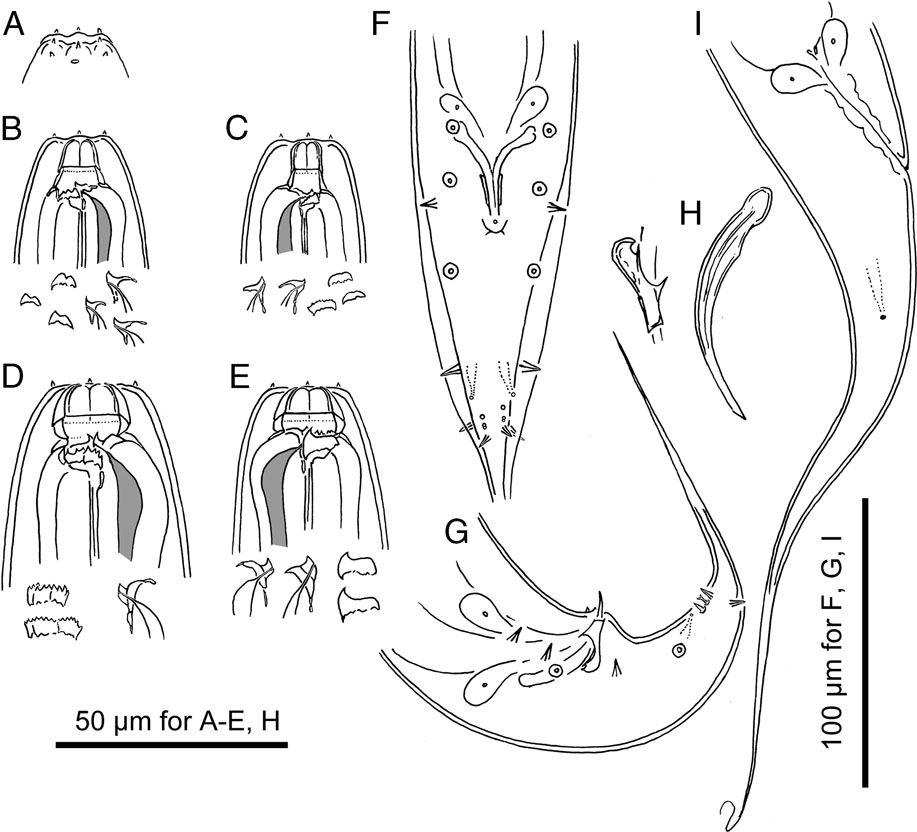
Figure 10
Adults of Pristionchus hongkongensis sp. n. A: Surface of male lip region in right lateral view; B: Stomatal region of stenostomatal male in left lateral view; C: Stomatal region of stenostomatal male in right lateral view; D: Stomatal region of eurystomatal female in left lateral view; E Stomatal region of eurystomatal female in right lateral view; F, G: Male tail region in ventral (F) and right lateral (G) views; H: Spicule and gubernaculum in right lateral view; I: Female tail region in right lateral view.
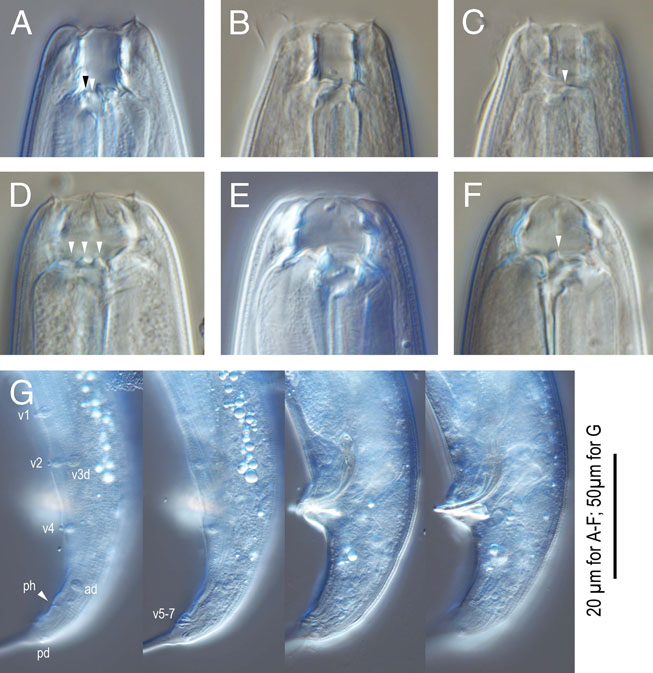
Figure 11
Pristionchus hongkongensis n. sp. A-C: Stomatal region of stenostomatous form showing left subventral denticles (arrowheads in A), dorsal tooth (B) and right subventral ridge (arrowhead in C); D-F: Stomatal region of eurystomatous form showing left subventral cusps (arrowheads in D), Dorsal tooth (E) and right subventral tooth (arrowhead in F); G: Male tail in four different focal planes showing genital papillae (v+number), phasmid (ph), and spicule and gubernaculum shape. 20 µm for A-F; 50 µm for G.
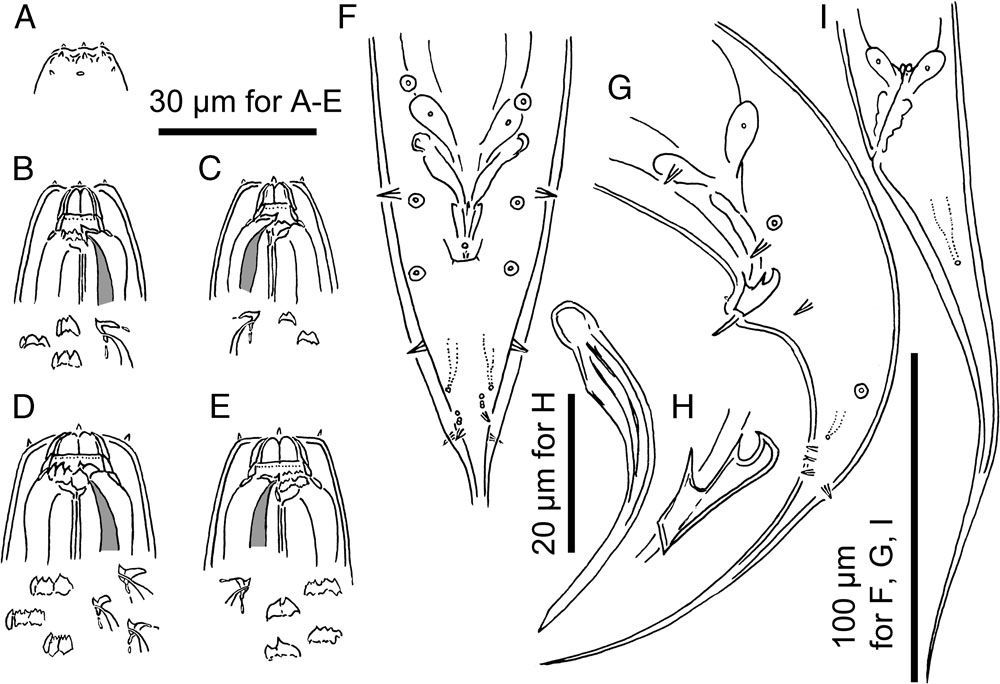
Figure 12
Adults of Pristionchus riukiariae sp. n. A: Surface of male lip region in right lateral view; B: Stomatal region of stenostomatal male in left lateral view; C: Stomatal region of stenostomatal male in right lateral view; D: Stomatal region of eurystomatal female in left lateral view; E Stomatal region of eurystomatal female in right lateral view; F, G: Male tail region in ventral (F) and left lateral (G) views; H: Spicule and gubernaculum in left lateral view; I: Female tail region in left lateral view.
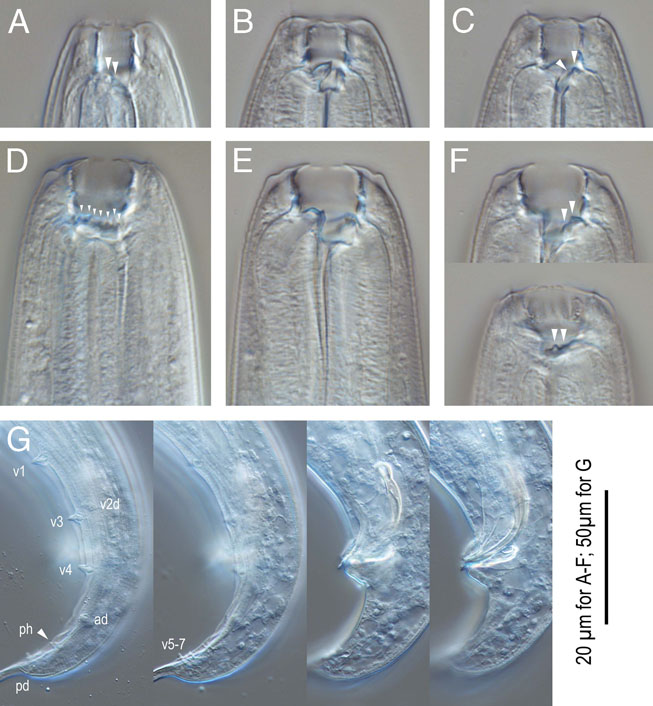
Figure 13
Pristionchus riukiariae n. sp. A-C: Stomatal region of stenostomatous form showing left subventral denticles (arrowheads in A), dorsal tooth (B) and right subventral ridge (arrowhead in C); D-F: Stomatal region of eurystomatous form showing left subventral cusps (arrowheads in D), Dorsal tooth (E) and right subventral dinticles in two different focal planes (arrowheads in F); G: Male tail in four different focal planes showing genital papillae (v+number), phasmid (ph), and spicule and gubernaculum shape. 20 µm for A-F; 50 µm for G.
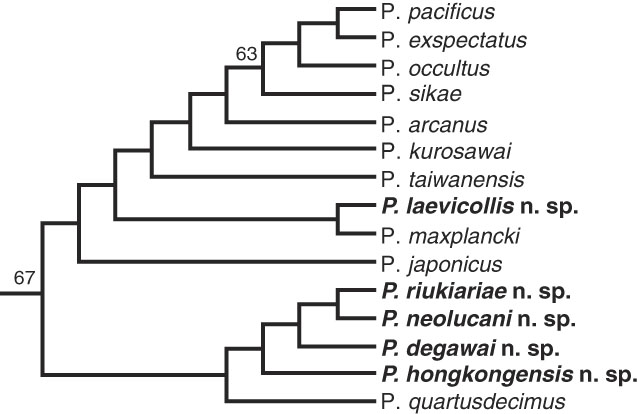
Figure 14
Phylogenetic relationship among all members in the pacificus species-complex. The schematic tree is part of a phylogeny that was generated from transcriptome data of all cultivable Pristionchus species (Rödelsperger et al., 2018). Inner nodes are labeled with bootstrap support values and stars indicate full bootstrap support (100 replicates).