
The term DNA-barcoding has multiple definitions. The earliest mention of barcoding in nematology was in 1998 by Dr Mark Blaxter, then of Edinburgh University, referring to the “(d)evelopment of a molecular barcode system for soil nematode identification” in the first volume of the Natural Environment Research Council Soil Biodiversity Newsletter (http://soilbio.nerc.ac.uk/newsletters.htm). The barcode he was referring to was the 18S nuclear (small subunit) ribosomal gene. Other gene regions proposed for DNA-barcoding soon followed, creating a broader definition that generally applied to the use of DNA sequences for species identification (Floyd et al., 2002; Blaxter, 2004; Powers, 2004). In 2003 a widely cited paper by Hebert et al. (2003) proposed a standardization of the barcode definition linked to the amplification of a 658 bp gene region within the cytochrome oxidase subunit 1 mitochondrial gene. The goal of this conceptual paper was the development of a global bioidentification system for animals. Considerable controversy immediately followed this publication with criticism ranging from theoretical concerns about the use of a single gene, the ability of an organelle gene to track species boundaries, and barcoding’s impact on the process of taxonomic investigation (DeSalle et al., 2005; Will et al., 2005). Practical concerns were expressed about lack of amplification with some groups, the designation of types, taxonomic resolution, and economic cost at the expense of traditional taxonomic approaches (Meyer and Paulay, 2005; Rubinoff et al., 2006; McFadden et al., 2011). Now, 15 years later, DNA-barcoding has become a component within the broader scope of integrated taxonomy and a routine tool for identification (Hodgetts et al., 2016; Janssen et al., 2016). As a diagnostic and discovery enterprise, DNA barcoding has generated thousands of publications, features biennial international conferences, has a dedicated database – BOLD, the Barcode of Life Database – and has multiple administrative structures such as the International Barcode of Life (IBOLD) and its affiliates (www.boldsystems.org/index.php/default).
Nematology was slow to adopt this formalized version of barcoding, perhaps due to poor amplification with the original “Folmer” primer sets (Folmer et al., 1994). Now multiple primer sets for amplification of nematode cytochrome oxidase c subunit 1 (COI) are available (Derycke et al., 2005, 2010; Prosser et al., 2013; Kiewnick et al., 2014; Powers et al., 2014; Janssen et al., 2016). These primer sets typically have limited taxonomic scope with amplifications specific for genera or in some cases extending across families and superfamilies (Powers et al., 2014). The objective of this study is to present a primer set used for the amplification of 721 to 724 bp of COI sequence from Meloidogyne. A maximum likelihood (ML) tree is provided to illustrate the ability of this gene region to discriminate among many described Meloidogyne species. The primers also function as a means to amplify DNA from juvenile stages in community analyses, possibly leading to new species discoveries. Contributions to a COI reference library should aid future taxonomic and ecological research in the genus.
Materials and Methods
Nematode collection
Most of the specimens DNA barcoded in this study were either specimens submitted to the UNL Nematology Diagnostics Clinic, specimens contributed by colleagues, or specimens collected during grant funded surveys (NSF projects DEB-1145440; USDA Multistate Project W3186).
Primer sequences
The primer set for amplification of the COI gene region were:
COI-F5-Mel – 5′-TGATTGATTTAGGTTCTGGAACTKSWTGAAC-3′
COI-R9-Mel – 5′-CATAATGAAAATGGGCAACAACATAATAAGTATC-3′
After removal of the primer sequences, amplification products from the Meloidogyne specimens were either 721 or 724 bp. GenBank sequences used in this study generally were 100 to 300 nucleotides shorter than sequences generated with the new primer set.
Amplification conditions
Nematodes amplified at the UNL Nematology Laboratory were individually smashed in 18 ul of sterile H20 with a transparent microfuge micropipette tip on a coverslip and added to a 0.5 ml microfuge tube. Nematode lysate was either amplified immediately or stored at −20°C. Amplification conditions were as follows: denaturation at 94°C for 5 min, followed by 45 cycles of denaturation at 94°C for 30 sec, annealing at 48.0°C for 30 sec, and extension at 72°C for 90 sec with a 0.5° per second ramp rate to 72°C. A final extension was performed at 72 °C for 5 min as described by Powers et al. (2014) and Olson et al. (2017). Polymerase chain reaction (PCR) products were separated and visualized on 1% agarose using 0.5XTBE and stained with ethidium bromide. PCR products of sufficiently high quality were cleaned and sent for sequencing of both strands by University of California–Davis DNA sequencing facility.
Data storage
Nucleotide sequences have been submitted to GenBank (accession numbers MH128384–MH128585) and the Barcode of Life Database (BOLD).
Phylogenetic analysis
Phylogenetic trees were constructed under ML and Neighbor Joining (NJ) criteria in MEGA version 6. Sequences were edited using CodonCode Aligner version 7.1 (www.codoncode.com/) and aligned using Muscle within MEGA version 6 (Tamura et al., 2013). Gap opening penalty was set at –400 with a gap extension penalty of –200. The General Time Reversible Model with Gamma distributed rates (GTR+G) was determined to be the best substitution model by Bayesian Information Criterion using the Best Fit Substitution Model tool in MEGA 6.0. ML trees used a use all sites option for gaps and 200 bootstrap replications to assess clade support.
Results
Figure 1 displays a ML tree of 322 Meloidogyne sequences including 117 sequences from GenBank and 205 sequences from the University of Nebraska–Lincoln Nematology Laboratory. ML partitions these sequences into 19 groups with bootstrap support values from 93 to 100 (Tables 1, 2, Fig. 1). Three unique GenBank sequences represent Meloidogyne haplanaria Eisenback et al., 2004, Meloidogyne duytsi Karssen et al., 1998, and Meloidogyne artiellia Franklin, 1961 as distinct from other sequences in the dataset, but without additional supporting sequences.
Table 1
COI sequence collection data for groups 2 to 19.
| NID | Group | Species | Locality | Host/habitat | GenBank accession # | |
|---|---|---|---|---|---|---|
| P203060 | 3 | Meloidogyne enterolobii | Florida | Ornamentals-Nursery | MH128522 | |
| P179069 | 3 | M. enterolobii | Florida | Ornamentals-Nursery | MH128519 | |
| P179070 | 3 | M. enterolobii | Florida | Ornamentals-Nursery | MH128520 | |
| P196090 | 3 | M. enterolobii | Florida | Ornamentals-Nursery | MH128521 | |
| P210013 | 3 | M. enterolobii | Florida | Ornamentals-Nursery | MH128523 | |
| P210014 | 3 | M. enterolobii | Florida | Ornamentals-Nursery | MH128524 | |
| P210071 | 3 | M. enterolobii | Florida | Ornamentals-ursery | MH128529 | |
| P210059 | 3 | M. enterolobii | Florida | Ornamentals-Nursery | MH128527 | |
| P210057 | 3 | M. enterolobii | Florida | Ornamentals-Nursery | MH128525 | |
| P210058 | 3 | M. enterolobii | Florida | Ornamentals-Nursery | MH128526 | |
| P210072 | 3 | M. enterolobii | Florida | Ornamentals-Nursery | MH128530 | |
| P210065 | 3 | M. enterolobii | Florida | Ornamentals-Nursery | MH128528 | |
| N4314 | 4 | Meloidogyne sp. | Lance Rosier Unit, BITHa | Loblolly pine | MH128531 | |
| N4321 | 4 | Meloidogyne sp. | Lance Rosier Unit, BITHa | Loblolly pine | MH128532 | |
| N4379 | 5 | Meloidogyne sp. | Cove Mtn. Trail, GRSMb | Chestnut | MH128537 | |
| N4388 | 5 | Meloidogyne sp. | Cove Mtn. Trail, GRSMb | Chestnut | MH128538 | |
| N2110 | 5 | Meloidogyne sp. | GWMPc | Fort Marcy earthworks | MH128533 | |
| N3952 | 5 | Meloidogyne sp. | Turkey Creek, BITHa | Baygall community | MH128534 | |
| N4285 | 5 | Meloidogyne sp. | Canyonlands South, BITHa | Magnolia | MH128535 | |
| N4291 | 5 | Meloidogyne sp. | Canyonlands South, BITHa | Magnolia | MH128536 | |
| P214008 | 6 | Meloidogyne partityla | Dona Ana County, New Mexico | Pecan | MH128540 | |
| P214010 | 6 | M. partityla | Dona Ana County, New Mexico | Pecan | MH128542 | |
| P214009 | 6 | M. partityla | Dona Ana County, New Mexico | Pecan | MH128541 | |
| N2338 | 6 | M. partityla | Neches Bottoms Unit, BITHa | Sandbar | MH128539 | |
| P121054 | 7 | Meloidogyne hapla | Gasconade County, Missouri | Peony | MH128568 | |
| P200031 | 7 | M. hapla | Cass County, Nebraska | Nursery | MH128577 | |
| N163 | 7 | M. hapla | Nebraska | Wheat | MH128543 | |
| P200018 | 7 | M. hapla | Daggett County, Utah | Grass pasture | MH128575 | |
| P200019 | 7 | M. hapla | Daggett County, Utah | Grass pasture | MH128576 | |
| P178064 | 7 | M. hapla | Oregon | Potato | MH128570 | |
| P200032 | 7 | M. hapla | Colfax County, Nebraska | Nursery | MH128578 | |
| N1376 | 7 | M. hapla | Fremont County, Wyoming | Red bean | MH128558 | |
| N1377 | 7 | M. hapla | Fremont County, Wyoming | Red bean | MH128559 | |
| P179068 | 7 | M. hapla | New York | GH | MH128572 | |
| P178063 | 7 | M. hapla | Oregon | Potato | MH128569 | |
| P222083 | 7 | M. hapla | Portales, New Mexico | GH culture | MH128579 | |
| P222084 | 7 | M. hapla | Portales, New Mexico | GH culture | MH128580 | |
| N1448 | 7 | M. hapla | GWMPc | Waterfowl sanctuary | MH128560 | |
| N857 | 7 | M. hapla | Goshen County, Wyoming | Potato | MH128554 | |
| N859 | 7 | M. hapla | Goshen County, Wyoming | Potato | MH128555 | |
| N860 | 7 | M. hapla | Goshen County, Wyoming | Potato | MH128556 | |
| N861 | 7 | M. hapla | Goshen County, Wyoming | Potato | MH128557 | |
| P200001 | 7 | M. hapla | Hot Springs County, Wyoming | Alfalfa | MH128573 | |
| P200002 | 7 | M. hapla | Hot Springs County, Wyoming | Alfalfa | MH128574 | |
| N4124 | 7 | M. hapla | Wyoming | – | MH128561 | |
| N318 | 7 | M. hapla | Idaho | Potato | MH128544 | |
| N497 | 7 | M. hapla | California | – | MH128551 | |
| N489 | 7 | M. hapla | California | – | MH128550 | |
| N498 | 7 | M. hapla | California | – | MH128552 | |
| P179054 | 7 | M. hapla | Rhode Island | GH culture | MH128571 | |
| N320 | 7 | M. hapla | Idaho | Potato | MH128545 | |
| N358 | 7 | M. hapla | Idaho | Potato | MH128546 | |
| N359 | 7 | M. hapla | Idaho | Potato | MH128547 | |
| N421 | 7 | M. hapla | Carbon County, Montana | Alfalfa | MH128548 | |
| N422 | 7 | M. hapla | Carbon County, Montana | Alfalfa | MH128549 | |
| N856 | 7 | M. hapla | Goshen County, Wyoming | Potato | MH128553 | |
| N7097 | 7 | M. hapla | Nebraska | Alfalfa | MH128562 | |
| N7098 | 7 | M. hapla | Nebraska | Alfalfa | MH128563 | |
| N7100 | 7 | M. hapla | Nebraska | Alfalfa | MH128565 | |
| N7099 | 7 | M. hapla | Nebraska | Alfalfa | MH128564 | |
| N8595 | 7 | M. hapla | Chalti, Nepal | Pine forest | MH128566 | |
| N8612 | 7 | M. hapla | Chalti, Nepal | Pine forest | MH128567 | |
| N4222 | 9 | Meloidogyne sp. | Canyonlands South, BITHa | Beech | MH128581 | |
| N4229 | 9 | Meloidogyne sp. | Canyonlands South, BITHa | Beech | MH128582 | |
| N8431 | 9 | Meloidogyne sp. | Canyonlands South, BITHa | Beech | MH128584 | |
| N8433 | 9 | Meloidogyne sp. | Canyonlands South, BITHa | Beech | MH128585 | |
| N8283 | 9 | Meloidogyne sp. | Mt. St. Hilaire, Quebec, Canada | Hardwood forest | MH128583 | |
| N4431 | 10 | Meloidogyne sp. | Cove Mtn. Trail, GRSMb | Chestnut | MH128463 | |
| N4496 | 10 | Meloidogyne sp. | Cove Mtn. Trail, GRSMb | Chestnut | MH128464 | |
| N4497 | 11 | Meloidogyne sp. | Cove Mtn. Trail, GRSMb | Chestnut | MH128465 | |
| N8084 | 12 | Meloidogyne sp. | Purchase Knob, GRSMb | Chestnut | MH128468 | |
| N8121 | 12 | Meloidogyne sp. | Cataloochee, GRSMb | Oak | MH128470 | |
| N8058 | 12 | Meloidogyne sp. | Cataloochee, GRSMb | Chestnut | MH128467 | |
| N8012 | 12 | Meloidogyne sp. | Cataloochee, GRSMb | Chestnut | MH128466 | |
| N8111 | 12 | Meloidogyne sp. | Cataloochee, GRSMb | Oak | MH128469 | |
| N1479 | 13 | Meloidogyne sp. | Roy E. Larsen Sandylands, BITHa | Baygall community | MH128471 | |
| N3969 | 13 | Meloidogyne sp. | Turkey Creek, BITHa | Baygall community | MH128472 | |
| P129052 | 14 | Meloidogyne oryzae | Costa Rica | Rice | MH128473 | |
| P129054 | 14 | M. oryzae | Costa Rica | Rice | MH128474 | |
| P169011 | 14 | Meloidogyne graminicola | Florida | Purple nutsedge | MH128475 | |
| N214 | 15 | Meloidogyne exigua | Nicaragua | Coffee | MH128477 | |
| N215 | 15 | M. exigua | Nicaragua | Coffee | MH128478 | |
| N213 | 15 | M. exigua | Nicaragua | Coffee | MH128476 | |
| P199069 | 16 | Meloidogyne naasi | Sanpete County, Utah | Grass | MH128480 | |
| P199071 | 16 | M. naasi | Sanpete County, Utah | Grass | MH128481 | |
| P199072 | 16 | M. naasi | Sanpete County, Utah | Grass | MH128482 | |
| N326 | 16 | M. naasi | Idaho | Potato | MH128479 | |
| P192084 | 17 | Meloidogyne fallax | Scotland | Genomic DNA | MH128507 | |
| P119032 | 17 | Meloidogyne chitwoodi | New Mexico | Culture | MH128488 | |
| P115026 | 17 | M. chitwoodi | Fort Garland, Colorado | Soil sample | MH128487 | |
| P122010 | 17 | M. chitwoodi | Colorado | Soil sample | MH128489 | |
| P122047 | 17 | M. chitwoodi | Colorado | Soil sample | MH128490 | |
| P124056 | 17 | M. chitwoodi | Commercial | Potato | MH128491 | |
| P124057 | 17 | M. chitwoodi | Commercial | Potato | MH128492 | |
| P124059 | 17 | M. chitwoodi | Commercial | Potato | MH128493 | |
| N7145 | 17 | M. chitwoodi | Elko County, Nevada | Potato | MH128483 | |
| N7147 | 17 | M. chitwoodi | Elko County, Nevada | Potato | MH128484 | |
| N7148 | 17 | M. chitwoodi | Elko County, Nevada | Potato | MH128485 | |
| N7149 | 17 | M. chitwoodi | Elko County, Nevada | Potato | MH128486 | |
| P173100 | 17 | M. chitwoodi | Commercial | Potato | MH128494 | |
| P174001 | 17 | M. chitwoodi | Commercial | Potato | MH128495 | |
| P175068 | 17 | M. chitwoodi | Idaho | Potato | MH128496 | |
| P175069 | 17 | M. chitwoodi | Idaho | Potato | MH128497 | |
| P175070 | 17 | M. chitwoodi | Idaho | Potato | MH128498 | |
| P175071 | 17 | M. chitwoodi | Idaho | Potato | MH128499 | |
| P177092 | 17 | M. chitwoodi | Texas | Potato | MH128500 | |
| P177094 | 17 | M. chitwoodi | Texas | Potato | MH128501 | |
| P177098 | 17 | M. chitwoodi | Texas | Potato | MH128502 | |
| P192011 | 17 | M. chitwoodi | Commercial | Potato | MH128504 | |
| P192012 | 17 | M. chitwoodi | Commercial | Potato | MH128505 | |
| P192013 | 17 | M. chitwoodi | Commercial | Potato | MH128506 | |
| P211088 | 17 | M. chitwoodi | Oregon | Potato | MH128508 | |
| P211089 | 17 | M. chitwoodi | Oregon | Potato | MH128509 | |
| P212013 | 17 | M. chitwoodi | California | Potato | MH128510 | |
| P212014 | 17 | M. chitwoodi | California | Potato | MH128511 | |
| P212015 | 17 | M. chitwoodi | California | Potato | MH128512 | |
| P212016 | 17 | M. chitwoodi | California | Potato | MH128513 | |
| P213039 | 17 | M. chitwoodi | Washington | Potato | MH128514 | |
| P213040 | 17 | M. chitwoodi | Washington | Potato | MH128515 | |
| P221087 | 17 | M. chitwoodi | New Mexico | Potato | MH128518 | |
| P215032 | 17 | M. chitwoodi | Washington | Potato | MH128517 | |
| P178028 | 17 | M. chitwoodi | Commercial | Potato | MH128503 | |
| P215031 | 17 | M. chitwoodi | Washington | Potato | MH128516 | |
Table 2
COI sequences included in group 1.
| NID | Species | Locality | Host/Habitat | GenBank accession # |
|---|---|---|---|---|
| N137 | M. konaensis | Hawaii | Pineapples | MH128384 |
| N138 | M. konaensis | Hawaii | Pineapples | MH128385 |
| N7067 | Meloidogyne sp. | Charleston, Missouri | Soybean | MH128414 |
| N7066 | Meloidogyne sp. | Charleston, Missouri | Soybean | MH128413 |
| N7065 | Meloidogyne sp. | Charleston, Missouri | Soybean | MH128412 |
| N5777 | Meloidogyne sp. | Nebraska | Conservatory | MH128410 |
| N5775 | Meloidogyne sp. | Nebraska | Conservatory | MH128409 |
| N5771 | Meloidogyne sp. | Nebraska | Phoenix dactylifera | MH128408 |
| N3836 | Meloidogyne sp. | Nebraska | Banana | MH128407 |
| N2668 | Meloidogyne sp. | Sonora, Mexico | Grapevine | MH128406 |
| N2667 | Meloidogyne sp. | Sonora, Mexico | Grapevine | MH128405 |
| N2666 | Meloidogyne sp. | Sonora, Mexico | Grapevine | MH128404 |
| N2665 | Meloidogyne sp. | Sonora, Mexico | Grapevine | MH128403 |
| N2664 | Meloidogyne sp. | Sonora, Mexico | Grapevine | MH128402 |
| N2663 | Meloidogyne sp. | Sonora, Mexico | Grapevine | MH128401 |
| N2662 | Meloidogyne sp. | Sonora, Mexico | Grapevine | MH128400 |
| N2661 | Meloidogyne sp. | Sonora, Mexico | Grapevine | MH128399 |
| N2659 | Meloidogyne sp. | Florida | Peanuts | MH128397 |
| N7068 | Meloidogyne sp. | Clarkton, Missouri | Soybean | MH128415 |
| N7069 | Meloidogyne sp. | Clarkton, Missouri | Soybean | MH128416 |
| N7070 | Meloidogyne sp. | Clarkton, Missouri | Soybean | MH128417 |
| N7072 | Meloidogyne sp. | Clarkton, Missouri | Soybean | MH128418 |
| N7073 | Meloidogyne sp. | Clarkton, Missouri | Soybean | MH128419 |
| N7075 | Meloidogyne sp. | Clarkton, Missouri | Soybean | MH128420 |
| N8309 | Meloidogyne sp. | Charleston, Missouri | Soybean | MH128421 |
| P118094 | Meloidogyne incognita | Missouri | Potato | MH128424 |
| P120058 | M. incognita | Arizona | Culture | MH128425 |
| P120059 | M. incognita | Arizona | Culture | MH128426 |
| P121032 | M. incognita | Mississippi | Potato | MH128427 |
| P121058 | M. incognita | Gasconade County, Missouri | Daylily | MH128428 |
| P121060 | M. incognita | Moniteau County, Missouri | Daylily | MH128429 |
| P156046 | Meloidogyne floridensis | Florida | GH culture | MH128430 |
| P156048 | M. floridensis | Florida | GH culture | MH128431 |
| P158036 | Meloidogyne arenaria | Alachua County, Florida | – | MH128432 |
| P158037 | M. arenaria | Alachua County, Florida | – | MH128433 |
| P160024 | Meloidogyne sp. | Alachua County, Florida | – | MH128434 |
| P160025 | Meloidogyne sp. | Alachua County, Florida | – | MH128435 |
| P160075 | M. arenaria | Alachua County, Florida | – | MH128437 |
| P167014 | Meloidogyne javanica | – | – | MH128438 |
| P167019 | M. arenaria | – | – | MH128439 |
| P167020 | M. arenaria | – | – | MH128440 |
| P167021 | M. arenaria | – | – | MH128441 |
| P176014 | Meloidogyne sp. | Missouri | Culture | MH128443 |
| P178075 | M. arenaria | Texas | Potato | MH128444 |
| P195088 | M. javanica | – | – | MH128445 |
| P195089 | M. javanica | – | – | MH128446 |
| P196023 | M. javanica | – | – | MH128447 |
| P196024 | M. javanica | – | – | MH128448 |
| P196025 | M. javanica | – | – | MH128449 |
| P202009 | Meloidogyne sp. | Israel | Culture | MH128450 |
| P229051 | Meloidogyne sp. | Florida | Culture | MH128451 |
| P229053 | Meloidogyne sp. | Florida | Culture | MH128452 |
| P229056 | Meloidogyne sp. | Florida | Culture | MH128453 |
| P233011 | Meloidogyne sp. | – | Coffee | MH128457 |
| P233014 | Meloidogyne sp. | – | Coffee | MH128458 |
| P234004 | Meloidogyne sp. | Morocco | – | MH128459 |
| P234005 | Meloidogyne sp. | Morocco | – | MH128460 |
| P234006 | Meloidogyne sp. | Morocco | – | MH128461 |
| P234007 | Meloidogyne sp. | Morocco | – | MH128462 |
| P73085 | Meloidogyne incognita | Bonita, Arizona | Pinto beans | MH128422 |
| P73088 | M. incognita | Bonita, Arizona | Pinto beans | MH128423 |
| N5796 | Meloidogyne sp. | Ash Meadows NWR, Nevada | – | MH128411 |
| P230069 | Meloidogyne incognita grahami | West Virginia | Culture | MH128454 |
| P230095 | M. incognita grahami | West Virginia | Culture | MH128456 |
| P230070 | M. incognita grahami | West Virginia | Culture | MH128455 |
| N2660 | Meloidogyne sp. | Florida | Peanut | MH128398 |
| P167027 | M. arenaria | – | – | MH128442 |
| N329 | Meloidogyne sp. | North Dakota | Potato | MH128386 |
| N330 | Meloidogyne sp. | North Dakota | Potato | MH128387 |
| N331 | Meloidogyne sp. | North Dakota | Potato | MH128388 |
| N332 | Meloidogyne sp. | North Dakota | Potato | MH128389 |
| N333 | Meloidogyne sp. | North Dakota | Potato | MH128390 |
| N334 | Meloidogyne sp. | North Dakota | Potato | MH128391 |
| N335 | Meloidogyne sp. | North Dakota | Potato | MH128392 |
| N336 | Meloidogyne sp. | North Dakota | Potato | MH128393 |
| N337 | Meloidogyne sp. | North Dakota | Potato | MH128394 |
| N348 | Meloidogyne sp. | North Dakota | Potato | MH128395 |
| N351 | Meloidogyne sp. | North Dakota | Potato | MH128396 |
| P160071 | M. arenaria | Alachua, Florida | Culture | MH128436 |
Groups 1 to 3 form a clade characterized by the loss of a single amino acid (3 bp) resulting in a 721 bp sequenced region. This shared deletion unites M. haplanaria, and M. enterolobii Yang & Eisenback, 1983 with the so-called “major” tropical apomictic species of Meloidogyne (Elling, 2013). Included in this group are sequences representing M. arenaria (Neal, 1889) Chitwood, 1949, M. incognita (Kofoid & White, 1919) Chitwood, 1949, M. javanica (Treub, 1885) Chitwood, 1949, as well as M. hispanica Hirschmann, 1986, M. floridensis Handoo et al., 2004, M. konaensis Eisenback, Bernard & Schnitt, 1995, M. luci Carneiro et al., 2014, and M. inornata Lordello, 1956 (Table 2). The same amino acid deletion is also found in unnamed group 12. Within group 1, the COI sequences are nearly identical with a few notable exceptions. Four substitutions are shared by three specimens identified as M. konaensis, including GenBank accession KU372176, identified as Meloidogyne sp. 2 TJ-2016 T316 on Beta vulgaris from Spain in Janssen et al. (2016). Two substitutions are shared by specimens identified as M. incognita grahami, originally described as M. grahami Golden & Slana, 1978, and considered distinct from M. incognita based on reproduction on NC-95 tobacco, a cultivar with resistance to M. incognita, plus a greater juvenile length and a distinctive perineal pattern (Golden and Slana, 1978).
Outside of clades 1-3 there are 11 other described species represented by a minimum of a single COI sequence. Meloidogyne hapla Chitwood, 1949 is represented by specimens from 10 U.S. states and two specimens from Nepal. There are multiple haplotypes within M. hapla and possibly some population substructure within the species. Group 17 identified as M. chitwoodi Golden, O’Bannon, Santo & Finley, 1980 and M. fallax Karssen, 1996 is virtually homogeneous except for a 5-bp difference between the two species. Within group 6, identified as M. partityla Kleynhans, 1986 one specimen collected from Big Thicket National Preserve, Texas comes from a native lowland plant community, compared with other specimens from New Mexico collected from commercial pecan (Carya illinoinensis (Wangenh.) K. Koch) production.
There are seven groups labeled as unnamed, all with sequence derived from j2 stage specimens except for N4431 and N4496 which were males collected from native chestnut (Castanea dentata (Marshall) Borkh.) in Great Smoky Mountains National Park (GRSM), North Carolina. All specimens in the unnamed groups 4, 5, 9 to 13 were isolated from soil samples within Gulf Coast or Eastern North American forests. Groups 9 and 12 were associated with American beech, (Fagus grandifolia Ehrh.) and chestnut or oak, respectively. Measurements of the unidentified juveniles are presented in Table 3, and Fig. 2 illustrates juveniles from three of the unnamed groups.
Table 3
Measurements of j2 Meloidogyne specimens from unnamed COI haplotype groups and reference species.
| Haplotype group/species | N | Length | Tail length | Stylet length | a | b | c |
|---|---|---|---|---|---|---|---|
| Unnamed 4 | 2 | 441 (430–452) | 42 | 17 | 24.3 (22.7–25.9) | 3.8 (3.7–3.9) | 10.5 (10.3–10.8) |
| Unnamed 5 | 5 | 431 (406–460) | 47 (40–53) | 14 (13–15 | 25.4 914.4–30.8) | 3.9 (3.0–4.8) | 9.3 (8.0–10.1) |
| Unnamed 9 | 5 | 393 (380–405) | 40 (38–44) | 15 (15–16) | 26.0 (25.5–26.7) | 4.0 (3.3–4.4) | 9.7 (9.2–10.1) |
| Unnamed 11 (Singleton A) | 1 | 384 | 42 | 15 | 27.5 | 3.5 | 9.1 |
| Unnamed 12 | 5 | 353 (339–379) | 41 (38–43) | 15 (14–15) | 22.7 (21.2–25.0) | 3.5 (3.3–4.0) | 8.6 (8.0–8.9) |
| Unnamed 13 | 2 | 490 (439–541) | 59 (57–62) | 14 | 30.7 (30.4–31) | 3.9 (3.8–4.0) | 8.2 (7.7–8.6) |
| Meloidogyne ovalis | 10 | 370 (350–430) | – | – | 22 (21–24) | – | 8 (8–9) |
| Meloidogyne pini | 30 | 434 (376–493) | 44 (37–53) | 12.8 (11.4–14.1) | 25.7 (21.8–29.1) | – | 9.8 (7.5–11.8) |
| Meloidogyne camelliae | 70 | 501 (443–576) | 47 (40–56) | 11.6 (11.2–12) | 26 (21–30) | 3.1 | 10.7 (9.5–12 |
| Meloidogyne querciana | 70 | 467 (411–541) | 46 (39–52) | 11.1 (10.2–11.6) | 30 (23–39) | 2.6 | 10 (7–13) |
| Meloidogyne megatyla | 23 | 416 (392–457) | 39.7 (31.6–45.1) | 14.6 (13.8–16.6) | 26 (22–29) | 7.1 (6.7–7.8) | 10.5 (9.5–13.5) |
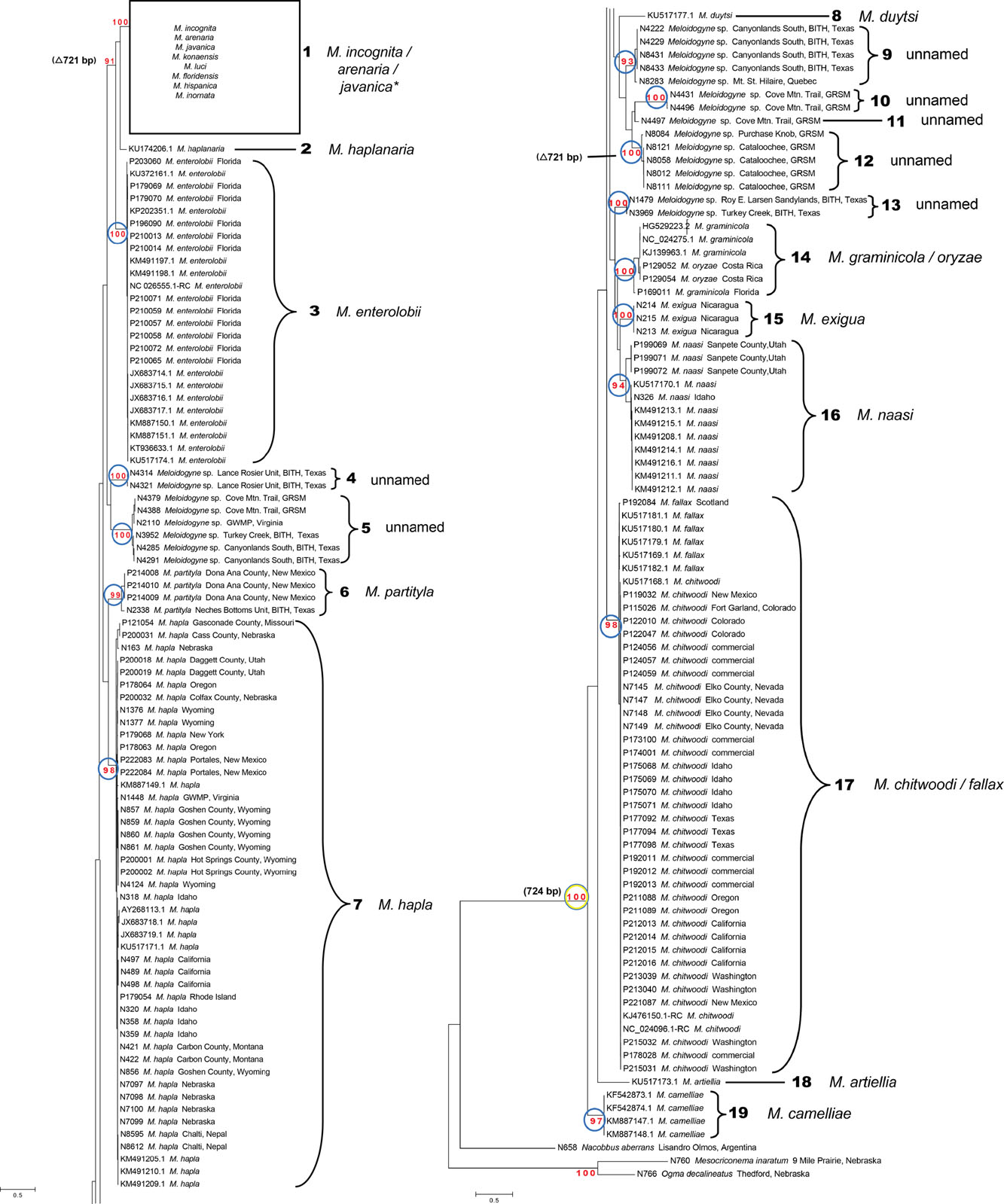
Fig. 1
Maximum likelihood tree of 322 Meloidogyne COI sequences created in MEGA 6.06 using GTR+G substitution model, with 200 bootstraps and a gap treatment of use all sites. Support values that designate clades and haplotype groups are circled. Clades that correspond to named and unnamed species or haplotype groups are numbered. Clades that include specimens with a single amino acid deletion are denoted by (Δ721 bp). Group 1 has been reduced to a box of species names. Sequences within Group 1 are presented in Table 2. A list of GenBank accession numbers for specimens included in Group 1 are found in supplementary Table 1.
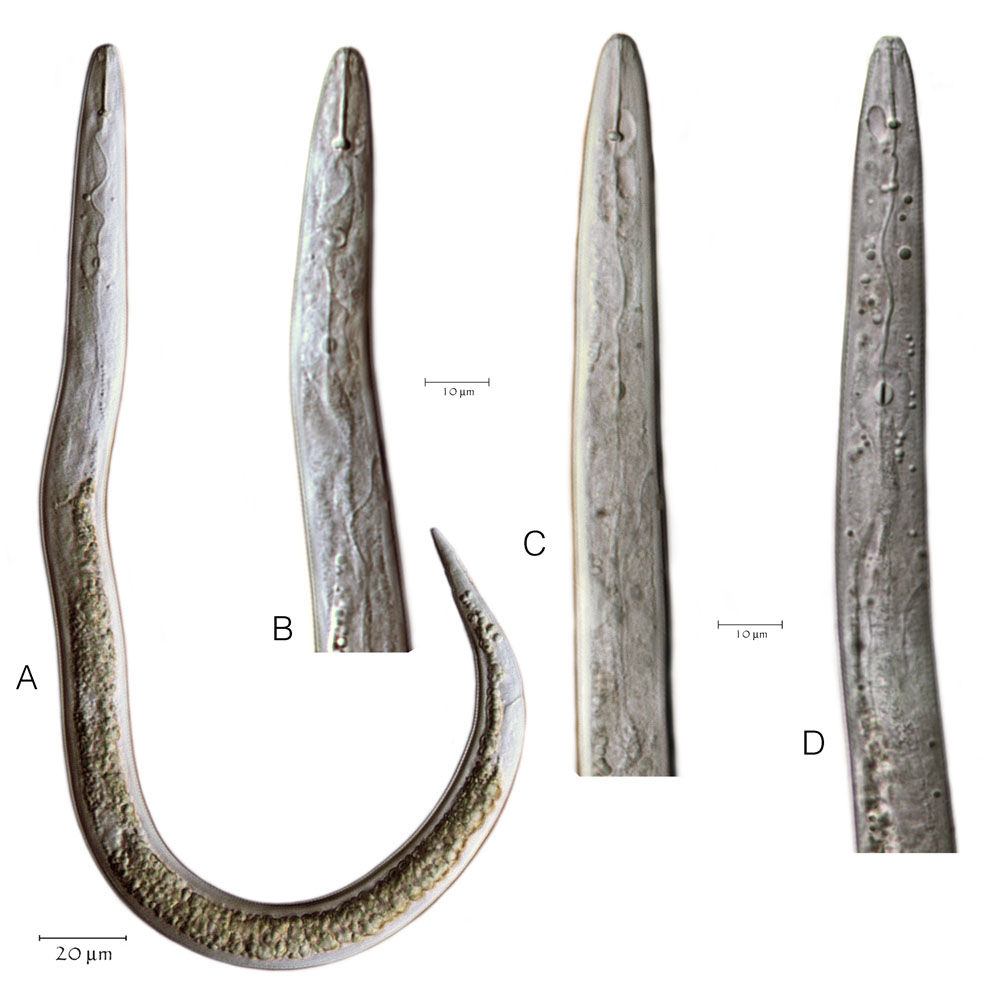
Fig. 2
Selected Meloidogyne juveniles from unnamed groups. A, Entire body of NID 8084 in Group 12, from chestnut in Great Smoky Mountains National Park (GRSM); B, Anterior region of NID 8012 in Group 12 from chestnut in GRSM; C, Anterior region of NID 8283 from Group 9 from Mt. St. Hilaire, Quebec; D, Anterior region of NID 4379 in Group 5 from chestnut in GRSM.
Discussion
The COI gene region used as a diagnostic marker in this study appears to discriminate many of the described species of Meloidogyne. It does not separate the apomictic “major species” and their close relatives, except possibly M. konaensis and M. incognita grahami. Other mitochondrial genes such as NAD 5 may help resolve some of those species boundaries (Janssen et al., 2016). Aside from an inability to discriminate among the tropical clade 1 species, there are advantages to using COI as a DNA barcode. As a protein coding gene, nucleotide alignment is easier compared with non-protein coding genes. Taxonomic resolution is at the population and species level, although for many genera, mutational saturation, lineage extinctions, or inadequate sampling may obscure deeper relationships that aid in the recognition of species groupings. Nonetheless, COI barcodes in combination with an adequately curated sequence database, provide a powerful tool for identification and discovery. The limitation of DNA barcoding without a corresponding database is illustrated by the unnamed groups in the Meloidogyne dataset. For example, there was an expectation that focal samples from soil around individual chestnut and oak trees in GRSM might yield Meloidogyne querciana Golden, 1979 which was described from northern red oak (Quercus rubra L.) and chestnut hosts within the same ecoregion. Indeed Meloidogyne specimens were found in these samples, however, the barcode data demonstrate that multiple COI lineages were associated with chestnut and oaks in the park. Similarly, unnamed lineages were also discovered associated with American beech and baygall plant communities in Big Thicket National Preserve, Texas (www.nps.gov/bith/plant-communities.htm). These results indicate that considerable Meloidogyne diversity exists in the primary and secondary forests of eastern and southern United States. Characterization of this diversity by COI barcoding allows us to rule out described species with representation in the COI database, yet neither COI barcode nor morphometrics of juvenile specimens permits unequivocal assignment of a species name to these specimens. For these unknown specimens a more complete taxonomic analysis that includes obtaining adult stages will be required before a barcode sequence can be linked to a formal Latin binomial.
Acknowledgements
Thanks to the sponsors of nematode surveys, Department of Interior-National Park Service, Discover Life in America, NSF project DEB-1145440, Nebraska Department of Agriculture, Thicket of Diversity, USDA Multistate Project 3186, and University of Nebraska-Lincoln Agricultural Research Division IC-282. Most of all we thank the numerous collaborators and colleagues who have contributed nematode specimens for identification.
Appendices
Appendix
Supplementary Table S1.
Accession numbers of specimens from Group 1 acquired from GenBank.
| GenBank accession # | Species |
|---|---|
| KU372176.1 | Meloidogyne sp. |
| KM491194.1 | Meloidogyne incognita |
| KU372162.1 | Meloidogyne ethiopica |
| KU360142.1 | M. incognita |
| KM491204.1 | Meloidogyne arenaria |
| KU372172.1 | Meloidogyne luci |
| KU372173.1 | M. luci |
| KM491195.1 | M. incognita |
| KM491192.1 | M. incognita |
| KM491191.1 | M. incognita |
| KM491196.1 | M. incognita |
| KM491188.1 | M. incognita |
| KM491203.1 | M. arenaria |
| KM491201.1 | M. arenaria |
| KM491207.1 | M. incognita |
| KM491199.1 | M. arenaria |
| KM491202.1 | M. arenaria |
| KM491200.1 | M. arenaria |
| KM491190.1 | M. incognita |
| KM491189.1 | M. incognita |
| NC_026556.1 | Meloidogyne javanica |
| NC_026554.1 | M. arenaria |
| KP202352.1 | M. javanica |
| KP202350.1 | M. arenaria |
| NC_024097.1 | M. incognita |
| KJ476151.1 | M. incognita |
| KU372158.1 | M. arenaria |
| KU372165.1 | M. incognita |
| KU372167.1 | Meloidogyne inornata |
| KU372159.1 | M. arenaria |
| KU372166.1 | M. incognita |
| KU372169.1 | M. javanica |
| KU372170.1 | M. javanica |
| KU372171.1 | M. luci |
| KU372174.1 | Meloidogyne sp. |
| KU372168.1 | M. inornata |
| KU372175.1 | Meloidogyne sp. |
| KU372164.1 | M. incognita |
| KU372163.1 | M. incognita |
| KU517167.1 | M. incognita |
| KU360143.1 | M. arenaria |
| JX683704.1 | M. arenaria |
| KU360144.1 | M. javanica |
| JX683696.1 | M. incognita |
| JX683698.1 | M. incognita |
| JX683699.1 | M. incognita |
| JX683700.1 | M. incognita |
| JX683706.1 | M. javanica |
| JX683701.1 | M. arenaria |
| JX683702.1 | M. arenaria |
| JX683703.1 | M. arenaria |
| JX683705.1 | M. arenaria |
| JX683707.1 | M. javanica |
| JX683708.1 | M. javanica |
| JX683709.1 | M. javanica |
| JX683711.1 | M. javanica |
| JX683710.1 | M. javanica |
| JX683712.1 | Meloidogyne hispanica |
| JX683713.1 | M. hispanica |
| KM887153.1 | M. arenaria |
| KM887152.1 | M. incognita |
| KM887155.1 | M. arenaria |
| KM887154.1 | M. incognita |
| JX683697.1 | M. incognita |
| KM887156.1 | M. javanica |
| KU517172.1 | M. javanica |
| KU517176.1 | M. arenaria |
| KU372160.1 | M. arenaria |
| KM491193.1 | M. incognita |
| KM491206.1 | M. incognita |