
Table 1
Nematoda species used in the phylogenetic analysis of Aspiculuris tetraptera in the present study.
| Parasite species | Order/family | Host species | Source | Accession no. | Sequence length (bp) | Divergence | Percent identity (%) |
|---|---|---|---|---|---|---|---|
| Cosmocerca japonica | Ascaridida/Cosmocercidae | Rana ornativentris | GenBank | LC052782 | 749 | 5.2 | 89.0% |
| Parascaris equorum | Ascaridida/Ascarididae | Africa lion and wolf | GenBank | JN617987 | 814 | 5.2 | 89.0% |
| Cucullanus extraneus | Rhabditida/Cucullanidae | Pomacanthus maculosus | GenBank | KT192060 | 1,150 | 4.9 | 90.0% |
| Pseudanisakis rajae | Rhabditida/Acanthocheilidae | Elasmobranchs | GenBank | JN392470 | 903 | 4.9 | 90.0% |
| Enterobius vermicularis | Oxyurida/Oxyuroidae | Human children | GenBank | HQ646164 | 2,867 | 5.2 | 91.0% |
| Skrjabinema kamosika | Oxyurida/Oxyuroidae | Capricornis crispus | GenBank | AB699691 | 898 | 4.9 | 91.0% |
| Aspiculuris tianjinensis | Oxyurida/Heteroxynematidae | Mus musculus domesticus | GenBank | KT175733 | 967 | 3.2 | 92.0% |
| Aspiculuris tetraptera | Oxyurida/Heteroxynematidae | M. musculus domesticus | GenBank | KT175725 | 936 | 1.4 | 97.0% |
| Aspiculuris dinniki | Oxyurida/Heteroxynematidae | Myodes glareolus | GenBank | KT175736 | 995 | 0.6 | 98.0% |
| A. tetraptera | Oxyurida/Heteroxynematidae | M. glareolus | GenBank | KT175728 | 954 | 0.6 | 98.0% |
| A. tetraptera | Oxyurida/Heteroxynematidae | M. glareolus | GenBank | KT175729 | 964 | 0.6 | 98.0% |
| A. tetraptera | Oxyurida/Heteroxynematidae | M. musculus musculus | GenBank | KJ143615 | 419 | 0.1 | 99.0% |
| A. tetraptera | Oxyurida/Heteroxynematidae | M. musculus musculus | GenBank | KJ143618 | 419 | 0.1 | 99.0% |
| A. tetraptera | Oxyurida/Heteroxynematidae | M. musculus musculus | GenBank | KJ143617 | 419 | 0.1 | 99.0% |
| A. tetraptera | Oxyurida/Heteroxynematidae | M. musculus musculus | GenBank | KJ143616 | 419 | 0.1 | 99.0% |
| A. tetraptera | Oxyurida/Heteroxynematidae | M. musculus musculus | GenBank | EF464551 | 3,676 | 0.1 | 99.0% |
| A. tetraptera | Oxyurida/Heteroxynematidae | M. musculus musculus | GenBank | EU263107 | 1,032 | 0.1 | 99.0% |
Table 2
Main morphological features and measurements of male Aspiculuris tetraptera compared with previous studies.
| Related species | Aspiculuris ackerti | Aspiculuris artigasi | Aspiculuris versterae | Aspiculuris tetraptera | A. ackerti | A. tetraptera | A. tetraptera | A. tetraptera | Aspiculuris huascaensis | Aspiculuris tianjinensis | A. tetraptera | A. tetraptera | A. tetraptera |
|---|---|---|---|---|---|---|---|---|---|---|---|---|---|
| Parameters | Kruidenier and Mehra (1959) | Araujo (1965) | Hugot (1980) | Hugot (1980) | Miller and Schmidt (1982) | Kohn and Macedo (1984) | Pinto et al. (1994) | Landaeta-Aqueveque et al. (2007) | Falcón-Ordaz et al. (2010) | Liu et al. (2012) | Khalil et al. (2014) | Abdel-Gaber and Fol (2015) | (Present study) |
| Host species | Neotoma albigtda | M. musculus | Mastomys natalensis | Mastomys natalensis | Neotoma cinerea | Haemulon sciurus | M. musculus | M. musculus | M. musculus | Clethrionomys rufocanus | M. musculus | M. musculus | M. musculus |
| Host locality | Coconimo, Arizona | Sao Paulo, Brazil | Onderstepoort, South Africa | Maracay, Venezuela | Colorado, Idaho, USA | Rio de Janeiro, Brazil | Río de Janeiro, Brazil | Santiago, Chile | Hidalgo, Mexico | Tianjin, China | Cairo, Egypt | Cairo, Egypt | Cairo, Egypt |
| Site of infection | Intestine | Intestine | Caecum | Caecum | Caecum | Intestine | Intestine | Caecum and upper colon | Intestine | Intestine | Caecum | Caecum | Caecum and upper colon |
| Body length | 4.41–4.87 (4.64) | 2.945–3.472 | 1.59 | 2.7 | 3.01–6.35 (5.03) | 2.90–3.60 (3.22) | 2.4–3.1 | 2.65–3.95 (3.393 ± 0.427) | 2.16–2.69 (2.48 ± 0.172) | 3.69– 5.12 (4.69) | 2.55–2.57 (2.56 ± 0.014) | 2.73–3.87 (3.21 ± 0.1) | 2.23–3.29 (2.79 ± 0.1) |
| Body width | 0.162–0.174 (0.168) | 0.156–0.180 | 0.10 | 0.11 | 0.137–0.293 (0.236) | 0.15–0.20 (0.17) | 0.17–0.21 | 0.17–0.25 (0.202 ± 0.2) | 0.078–0.114 (0.096 ± 0.01) | 0.204–0.388 (0.307) | 0.088 (0.088 ± 0) | 0.18–0.23 (0.20 ± 0.1) | 0.16–0.20 (0.18 ± 0.1) |
| Esophageal length | 0.264–0.271 (0.267) | 0.213–0.243 | 0.310 | 0.38 | 0.260–0.480 (0.343) | 0.18–0.27 (0.23) | 0.288–0.360 | 0.320–0.390 (0.375 ± 0.02) | 0.291–0.294 (0.272 ± 0.013) | 0.343–0.397 (0.384) | 0.439–0.450 (0.44 ± 0.007) | 0.38–0.45 (0.41 ± 0.1) | 0.32–0.40 (0.39 ± 0.1) |
| Esophageal width | 0.039–0.040 (0.039) | 0.036–0.054 | – | – | 0.033–0.060 (0.051) | – | – | – | – | – | – | 0.06–0.11 (0.08 ± 0.01) | 0.05–0.09 (0.07 ± 0.01) |
| Esophageal bulb length | 0.145–0.155 (0.150) | 0.105–0.135 | 0.10 | 0.14 | 0.113–0.183 (0.157) | 0.10-0.12 (0.11) | – | 0.110–0.140 (0.133 ± 0.01) | 0.090–0.110 (0.097 ± 0.006) | 0.074–0.142 (0.122) | 0.244 (0.24 ± 0) | 0.14–0.19 (0.16 ± 0.1) | 0.13–0.17 (0.15 ± 0.1) |
| Esophageal bulb width | 0.071–0.079 (0.075) | 0.075–0.096 | 0.08 | 0.09 | 0.065–0.120 (0.090) | 0.06–0.08 (0.07) | – | – | 0.040–0.063 (0.051 ± 0.006) | 0.059–0.123 (0.098) | 0.077–0.088 (0.08 ± 0.007) | 0.07–0.09 (0.08 ± 0.01) | 0.04–0.07 (0.05 ± 0.01) |
| Distance from anterior extremity Nerve ring | 0.158 | 0.108–0.144 | 0.09 | 0.10 | 0.150–0.213 (0.186) | 0.11–0.13 (0.12) | 0.115–0.140 | 0.115–0.145 (0.129 ± 0.013) | 0.072–0.093 (0.080 ± 0.008) | 0.116–0.133 (0.123) | 0.088 (0.088 ± 0) | – | 0.065–0.082 (0.078 ± 0.001) |
| Excretory pore | – | 0.600–0.876 | 0.325 | 0.78 | 0.69–1.21 (0.96) | 0.69–0.78 (0.73) | 0.619 | 0.750 –0.910 (0.854 ± 0.056) | 0.495–0.579 (0.545 ± 0.035) | 0.93–1.03 (1.01) | 0.144–0.147 (0.145 ± 0.002) | – | 0.392–0.547 (0.491 ± 0.03) |
| No. of Caudal papillae | 11 | 5 | 5 | 5 | 10 | 12 | 12 | 12 | 12 | 12 | 12 | 12 | 12 |
| Tail length | 0.238–0.280 (0.259) | 0.147–0.183 | 0.12 | 0.17 | 0.049–0.117 (0.092) | 0.10-0.12 (0.11) | 0.144–0.172 | 0.162–0.187 (0.178 ± 0.009) | 0.075–0.114 (0.102 ± 0.013) | 0.181–0.245 (0.220) | 0.12–0.144 (0.132 ± 0.01) | 0.13–0.15 (0.14 ± 0.1) | 0.11–0.14 (0.12 ± 0.1) |
Table 3
Main morphological features and measurements of female Aspiculuris tetraptera compared with previous studies.
| Related species | Aspiculuris ackerti | Aspiculuris artigasi | Aspiculuris versterae | Aspiculuris tetraptera | Aspiculuris ackerti | A. tetraptera | A. tetraptera | A. tetraptera | Aspiculuris huascaensis | Aspiculuris tianjinensis | A. tetraptera | A. tetraptera | A. tetraptera |
|---|---|---|---|---|---|---|---|---|---|---|---|---|---|
| Parameters | Kruidenier and Mehra (1959) | Araujo (1965) | Hugot (1980) | Hugot (1980) | Miller and Schmidt (1982) | Kohn and Macedo (1984) | Pinto et al. (1994) | Landaeta-Aqueveque et al. (2007) | Falcón-Ordaz et al. (2010) | Liu et al. (2012) | Khalil et al. (2014) | Abdel-Gaber and Fol (2015) | (Present study) |
| Host species | Neotoma albigtda | Mus musculus | Mastomys natalensis | M. natalensis | Neotoma cinerea | Haemulon sciurus | M. musculus | M. musculus | M. musculus | Clethrionomys rufocanus | M. musculus | M. musculus | M. musculus |
| Host locality | Coconimo, Arizona | Sao Paulo, Brazil | Onderstepoort, South Africa | Maracay, Venezuela | Colorado, Idaho, USA | Rio de Janeiro, Brazil | Río de Janeiro, Brazil | Santiago, Chile | Hidalgo, Mexico | Tianjin, China | Cairo, Egypt | Cairo, Egypt | Cairo, Egypt |
| Site of infection | Intestine | Intestine | Caecum | Caecum | Caecum | Intestine | Intestine | Caecum and upper colon | Intestine | Intestine | Caecum | Caecum | Caecum and upper colon |
| Body length | 5.5–6.8 (6.2) | 3.534–5.394 | 1.95 | 1.2 | 5.46–8.97 (7.41) | 3.60–4.61 (4.18) | 3.1–3.6 | 3.53–4.51 (3.53–4.51) | 3.024–3.528 (3.219 ± 0.150) | 5.38–7.00 (6.46) | 3.55–4.12 (3.83 ± 0.403) | 3.2–3.6 (3.5 ± 0.1) | 2.9–3.4 (3.1 ± 0.1) |
| Body width | 0.197–0.232 (0.210) | 0.153–0.234 | 0.15 | 0.08 | 0.225–0.391 (0.330) | 0.20–0.30 (0.27) | 0.175–0.245 | 0.230–0.270 (0.260 ± 0.01) | 0.099–0.153 (0.120 ± 0.016) | 0.282–0.447 (0.352) | 0.199–0.288 (0.244 ± 0.062) | 0.21–0.26 (0.24 ± 0.01) | 0.19–0.23 (0.20 ± 0.01) |
| Esophageal length | 0.290–0.348 (0.317) | 0.252–0.336 | 0.49 | 0.43 | 0.305–0.465 (0.387) | 0.25–0.29 (0.27) | 0.331–0.433 | 0.400–0.450 (0.425 ± 0.01) | 0.312–0.351 (0.322 ± 0.012) | 0.417–0.480 (0.461) | 0.328–0.382 (0.35 ± 0.038) | 0.33–0.39 (0.27 ± 0.01) | 0.30–0.34 (0.32 ± 0.01) |
| Esophageal width | 0.042–0.052 (0.044) | 0.048–0.057 | – | – | 0.045–0.080 (0.061) | – | – | – | – | – | – | 0.17–0.19 (0.18 ± 0.01) | 0.14–0.16 (0.15 ± 0.01) |
| Esophageal bulb length | 0.145–0.171 (0.158) | 0.129–0.159 | 0.14 | 0.16 | 0.150–0.225 (0.177) | 0.12–0.15 (0.13) | – | 0.140–0.160 (0.152 ± 0.006) | 0.090–0.111 (0.103 ± 0.005) | 0.123–0.167 (0.152) | 0.108 (0.108 ± 0) | 0.12–0.15 (0.140 ± 0.01) | 0.10–0.13 (0.11 ± 0.01) |
| Esophageal bulb width | 0.068–0–0.087 (0.080) | 0.087–0.111 | 0.095 | 0.13 | 0.080–0.150 (0.107) | 0.08–0.12 (0.10) | – | – | 0.054–0.087 (0.063 ± 0.008) | 0.088–0.137 (0.118) | 0.081 (0.081 ± 0) | 0.07–0.11 (0.09 ± 0.01) | 0.05–0.09 (0.07 ± 0.01) |
| Distance from anterior extremity Nerve ring | 0.155–0.185 (0.168) | 0.120–0.168 | 0.14 | 0.13 | 0.162–0.238 (0.202) | 0.15 | 0.158–0.216 | 0.12–0.162 (0.140 ± 0.013) | 0.081–0.0105 (0.093 ± 0.007) | 0.121–0.157 (0.134) | 0.144–0.147 (0.145 ± 0.002) | – | 0.078–0.090 (0.085 ± 0.002) |
| Excretory pore | – | 0.756–1.056 | 0.53 | 0.9 | 0.82–1.67 (1.10) | 0.81–0.89 (0.86) | 0.734–0.936 | 0.860–0.950 (0.888 ± 0.032) | 0.555–0.675 (0.590 ± 0.038) | 1.09–1.23 (1.17) | – | – | 0.564–0.780 (0.680 ± 0.02) |
| Vulval opening | 2.1–2.5 (2.3) | 1.457–2.015 | 0.85 | 1.65 | 1.52–2.89 (2.49) | 1.54–2.36 (1.76) | 1.1–1.4 | 1.61 ± 0.038 (1.55–1.67) | 1.204–1.428 (1.269 ± 0.066) | 2.07–2.43 (2.27) | 1.56–1.86 (1.71 ± 0.21) | – | 1.112–1.630 (1.406 ± 0.03) |
| Tail length | 0.232–0.690 (0.445) | 0.444–0.660 | 0.435 | 0.55 | 0.088–0.110 (0.101) | 0.36–0.40 (0.39) | 0.360–0.486 | 0.347–0.537 (0.477 ± 0.06) | 0.330–0.372 (0.358 ± 0.016) | 0.92–1.14 (1.05) | 0.382–0.405(0.393 ± 0.016) | 0.34–0.48 (0.42 ± 0.01) | 0.30–0.42 (0.39 ± 0.01) |
| Eggs length | 0.097–0.106 (0.101) | 0.084–0.090 | 0.09 | 0.095 | 0.093–0.110 (0.102) | 0.075–0.090 (0.084) | 0.72–0.90 | 0.084–0.092 (0.087 ± 0.005) | 0.054–0.069 (0.061 ± 0.003) | 0.092–0.096 (0.094) | 0.115–0.129 (0.122 ± 0.008) | 0.05–0.07 (0.06 ± 0.01) | 0.04–0.06 (0.05 ± 0.01) |
| Eggs width | 0.0390.047 (0.044) | 0.036–0.039 | 0.04 | 0.045 | 0.038–0.055 (0.045) | 0.038–0.051 (0.045) | 0.036 –0.053 | 0.043–0.052 (0.046 ± 0.005) | 0.018–0.030 (0.022 ± 0.003) | 0.051–0.058 (0.054) | 0.054–0.072 (0.06 ± 0.008) | 0.03–0.05 (0.04 ± 0.01) | 0.02–0.04 (0.03 ± 0.01) |
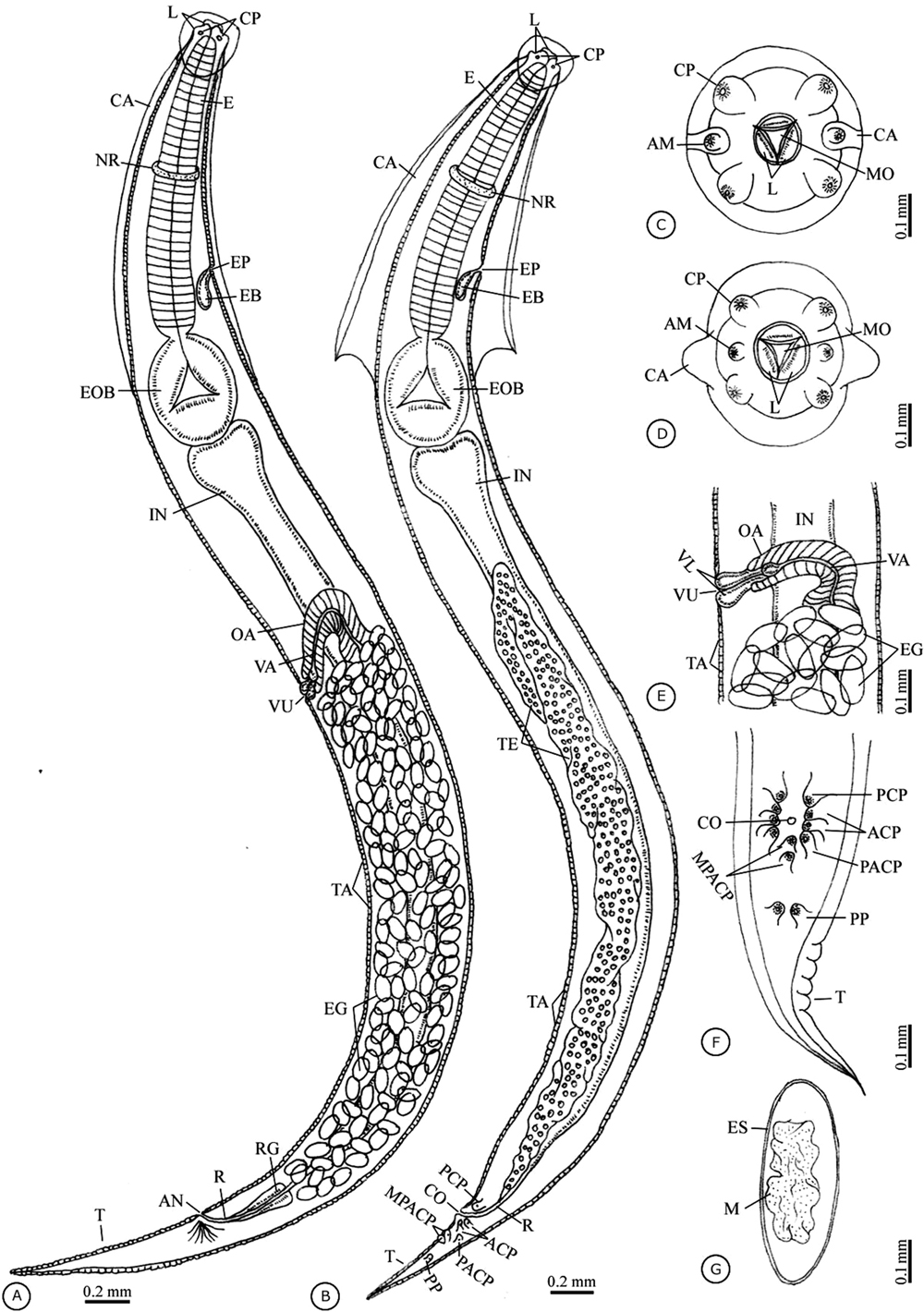
Fig. 1
A–G, Line drawings of different body parts of Aspiculuris tetraptera. A, Lateral view of female worm with mouth opening surrounded by three lips with cephalic papillae (CP) and amphids (AM), muscular esophagus (E), esophageal bulb region (EOB), intestine (IN), rectum (R) with rectal gland (RG), anal opening (AN) and ending with a long tapered tail (T). Note, transverse annulated (TA) cuticle, and the genital system characterized with a uterus filled with numerous eggs (EG), ovijector apparatus (OA), vagina (VA) and vulval opening (VU) surrounded by two fleshy vulval lips (VL). B, Lateral view of male worm with mouth opening surrounded by three lips with cephalic papillae (CP) and amphids (AM), followed by muscular esophagus (E), esophageal bulb region (EOB), intestine (IN), rectum (R) with rectal gland (RG), anal opening (AN), and ending with a long tapered tail (T). Note, transverse annulated (TA) cuticle, and the genital system with testes (TE), cloacal opening (CO) surrounded by precloacal papillae (PCP), adcloacal papillae (ACP), postadcloacal papillae (PACP), median postadcloacal papillae (MPACP), and posterior papillae (PP). C–G, High magnifications of: C, Face view of anterior extremity of female worm mouth opening (MO) surrounded by three lips (L) with cephalic papillae (CP) and amphids (AM) with cervical alae (CA). D, Face view of anterior extremity of male worm mouth opening (MO) surrounded by three lips (L) with cephalic papillae (CP) and amphids (AM) with cervical alae (CA). E, Ovejector region (OA) of female showing vulva opening (VU), two fleshy vulval lips (VL), muscular vagina (VA), and eggs collected (EG) from uterus. F, Posterior end of male worm showing the cloacal opening (CO) with caudal papillae of precloacal papillae (PCP), adcloacal papillae (ACP), postadcloacal papillae (PACP), median postadcloacal papillae (MPACP), and posterior papillae (PP). G, Morula (M) surrounded by egg shell (ES).
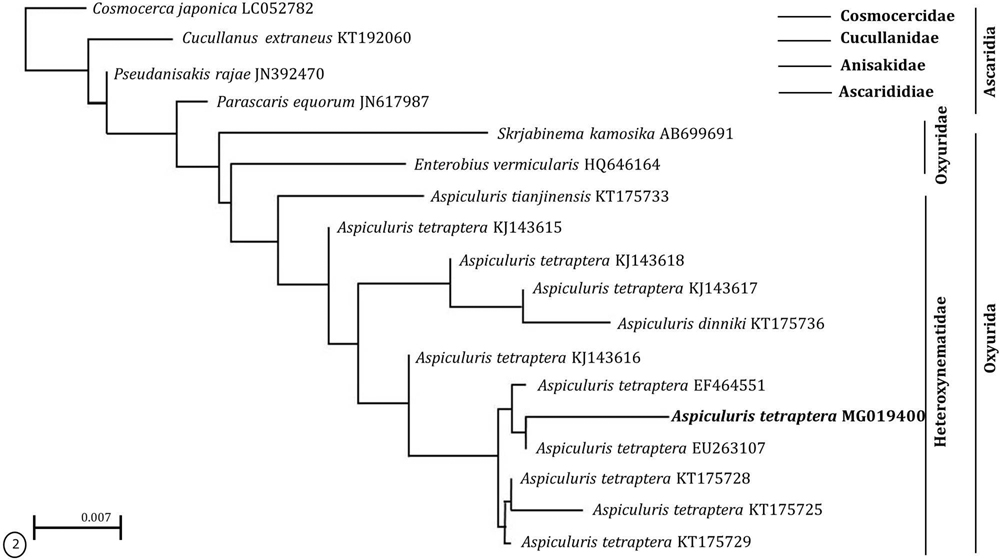
Fig. 2
Phylogenetic tree generated by neighbor-joining analyses of the partial SSU rDNA sequence of Aspiculuris tetraptera and oxyurid species with the strongest BLAST matches and in part with some ascarid species. GenBank accession numbers are given after the species names. The tree is drawn to scale, with branch lengths measured in the number of substitutions per site. Oxyurid parasite examined in the present study is bolded.