
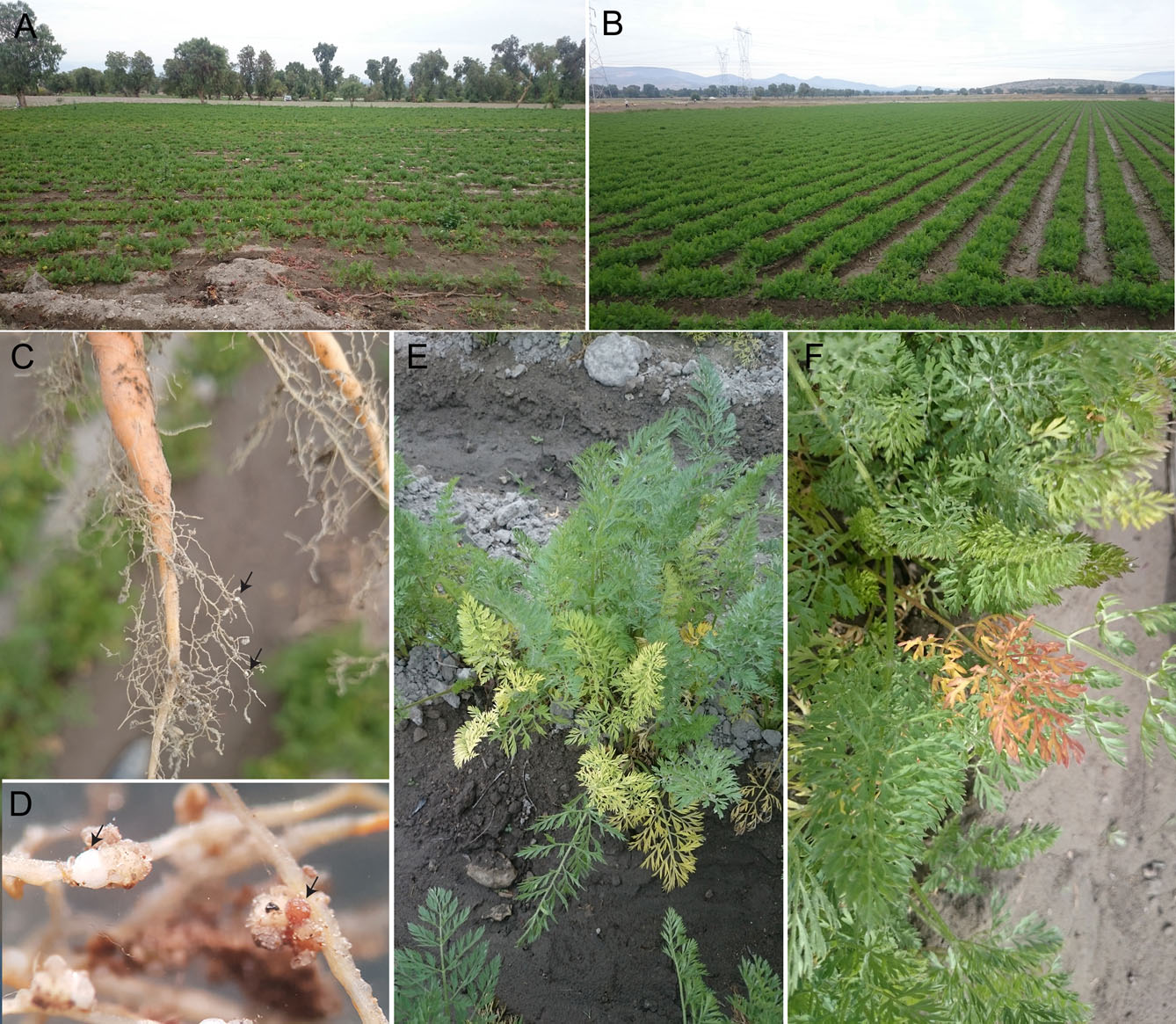
Fig. 1
A, Carrot field infected with Heterodera carotae; B, Healthy carrot field; C and D, Carrot secondary roots with white females and cysts (indicated by arrows); E and F, Symptoms of an infected carrot. Chlorosis and reddish foliage.
Table 1.
Morphometrics of J2, males, females, and cysts from Heterodera carotae and H. cruciferae from different populations. All measurements are in micrometer.
| Species | Heterodera carotae | Heterodera cruciferae | |||||
| Population Characters | Mexico (original) | Isle of Ely, UK (Jones, 1950b) | Ireland, England and Italy (Mathews, 1975) | UK, (Stone and Rowe, 1976) | Moscow region, Russia (Chizhov et al., 2009) | Tabriz, Iran (Jabbari and Niknam, 2008) | Spain (Bello et al., 1999) |
| J2 | n = 30 | – | n = 100 | n = 25 | n = 28 | – | n = 30 |
| Length | 394 (360–443) | 453.8 ± 1.38 | 422 (375–452) | 431 ± 19 | 426 ± 31.8 (377–504) | 351 ± 15 (333–381) | 438 (407–479) |
| a | 18.9 (18.8–20.14) | – | 21.4 (18.2–22.7) | 20.7 ± 1.1 | 20.5 ± 2.7 (14.5–31.8) | 20 ± 1.5 (17.5–24) | 22.4 (20–25.2) |
| b | 3 (2.99–3.46) | – | – | – | 4.5 ± 0.2 (4.1–5.1) | 4 ± 0.4 | 3.4 (2.7–7.4) |
| b′ | 2.52 (2.5–2.81) | – | – | – | 2.4 ± 0.2 (2.1–3.1) | 2.4 ± 0.4 (2.06–2.7) | – |
| c | 8.2 (8.18–8.52) | – | – | – | 9.1 ± 0.5 (8.2–10) | 8.4 ± 0.7 (7.5–10) | 9 (7.9–12.5) |
| c′ | 3.7 (3.7–4) | – | – | – | 3.7 ± 0.3 (3.2–4.4) | 4 ± 0.3 (3.5–4.4) | – |
| Stylet length | 25 (24–26) | – | 24 (22–25) | 24.1 ± 1.6 | 23 ± 0.9 (21–25) | 21 ± 0.8 (20–22.4) | 23.5 (21.9–25.4) |
| Labial region height | 5 (4–6) | – | 5 (4–6) | 4.1 ± 0.7 | – | 3–4 | – |
| Labial region diameter | 9 (8–10) | – | 10 (9–10) | – | – | – | – |
| DGO | 5 (4–6) | – | 5–6 | 5.5 ± 0.7 | 3–4 | 5–6 | 5.2 |
| Anterior end to valve of median bulb | 61 (52–73) | – | 66 (61–72) | 68.3 ± 3.1 | 70 ± 4.1 (62–81) | – | – |
| Anterior end to excretory pore | 87 (78–98) | – | 99 | 101.6 ± 4.8 | 103 ± 6.2 (91–117) | 95–110 | – |
| Oesophageal length | 131 (104–148) | – | – | – | 95 ± 5.9 (85–106) | – | – |
| Body diameter at mid-body | 21 (19–22) | – | 20 (19–21) | 20.8 ± 1.5 | 21 ± 2.2 (12–27) | – | – |
| Body diameter at anus | 13 (11–14) | – | 12.4 (11.1–13.4) | 13.6 ± 0.7 | 13 ± 0.8 (11–14) | – | – |
| Body diameter at hyaline region | 8 (7–9) | – | 7.1 (5.9–8.3) | – | – | – | – |
| Tail length | 48 (44–52) | – | 51.8 (43.5–58.6) | 50 ± 2.7 | 47 ± 4 (38–54) | 41 ± 5 (26.2–47) | 49.2 (34.1–58.9) |
| Hyaline region length | 26 (21–31) | – | 28.3 (20.3–31.8) | 25.2 ± 2.7 | 24 ± 3.3 (17–30) | 21.3 ± 1.9 (16–23.4) | 27.3 (20.7–33.9)0.5 |
| Males | n = 30 | – | n = 40 | n = 25 | n = 24 | – | n = 11 |
| Length | 1180 (1114–1219) | 1119 ± 14 | 1154 (1090–1220) | 1170 ± 79 | 1156 ± 132.1 (718–1343) | 961 ± 83 (828.6–1028.6) | 1149 (1081–1283) |
| a | 37 (33.9–42.8) | – | – | 40.8 ± 5.8 | 35.3 ± 5.8 (18.9–47.2) | 38.2 ± 2.5 (34.1–41.2) | 44.5 (34.3 –43.8) |
| b | 6.7 (4.7–7.7) | – | – | – | 8.2 ± 0.9 (5.2–9.5) | 8.3 ± 0.9 (8.1–10) | – |
| b′ | 5.8 (4.6–6.5) | – | – | – | 6.1 ± 0.4 (5.2–6.8) | 5.3 ± 0.6 (5–6) | – |
| Stylet length | 32 (29–36) | 28.8 ± 0.36 | 35 (31–38) | 24.9 ± 1.1 | 25 ± 1.7 (22–28) | 23 ± 1.6 (20–24.3) | 27.1 (25–28) |
| Labial region height | 5 (4–6) | – | 7 | – | 6–8 | – | – |
| Labial region diameter | 11 (9–13) | – | 11 | – | 10–12 | – | – |
| DGO | 5 (4–6) | – | 5–7 | 7.2 ± 0.8 | 4–6 | 6–7 | – |
| Anterior end to valve of median bulb | 103 (101–106) | – | 90 (85–105) | 97.8 ± 4.9 | 96 ± 8.7 (68–107) | – | – |
| Anterior end to excretory pore | 157 (146–169) | – | 153 (148–161) | 154.4 ± 12.3 | 159 ± 10.8 (140–182) | – | – |
| Body diameter at mid-body | 32 (26–36) | 31.4 ± 0.6 | 30 (27–33) | 29.1 ± 1.38 | 33 ± 5.4 (23–43) | – | – |
| Oesophageal length | 175 (144–238) | – | – | – | 144 ± 14.3 (119–168) | – | – |
| Anterior end to oesophageal gland base | 203 (172–267) | – | – | – | 192 ± 14.8 (163–208) | – | – |
| Spicules | 36 (32–39) | – | 34 (31–36) | 34.5 ± 2.4 | 34 ± 2.4 (29–38) | 21 ± 4.4 (16–26.2) | 32.2 (25.4–32.3) |
| T(%) | 48 (39–57) | – | 59 | 50 | – | 48 ± 14.1 (13.5–68) | – |
| Females | n = 30 | – | n = 10 | n = 20 | – | – | – |
| Length | 474 (388–686) | – | 451 (375–513) | – | – | 365.6 ± 28.15 | – |
| Width | 295 (229–430) | – | 203 (168–238) | – | – | 172.9 ± 18 | – |
| a | 1.6 (1.6–1.7) | – | 2.3 (1.9–2.8) | – | – | – | – |
| Stylet length | 27 (23–32) | – | 27 (25–31) | 26.5 ± 1.5 | – | 20.1 ± 4 (15.6–25) | – |
| Anterior end to excretory pore | 94 (80–116) | – | 81–119 | 93 ± 20 | – | 112.5–143.7 | – |
| Cysts | n = 30 | – | n = 150 | n = 25 | n = 25 | – | n = 30 |
| Length (excluding neck) | 423 (286–575) | 210–680 | 408 (218–625) | 429 ± 67 | 557 ± 71.6 (355–690) | 505.4 ± 58.5 (400–609.5) | 555 (427–624) |
| Width | 331 (217–472) | 150–530 | 309 (165–500) | 333 ± 56 | 398 ± 72.3 (300–460) | 398 ± 63.2(305–571.4) | 399 (326–464) |
| L/W ratio | 1.28 (1.22–1.31) | – | – | – | 1.4 ± 0.3 (0.6–1.8) | 1.3 ± 0.1 (1.1–1.5) | – |
| Neck length | 80 (63–120) | – | – | 76 ± 18 | 66 ± 17.4 (40–90) | 66.5 ± 15 (50–84.2) | – |
| Fenestral lenth | 44 (32–58) | – | 31 (27–36) | 34.5 ± 5.9 | 41 ± 5.5 (27–53) | – | 38.9 (22–58.8) |
| Fenestral width | 50 (38–67) | – | 39 (35–42) | – | – | 36.6 ± 5 (31.2–44) | 38.4 (30–50) |
| Vulval slit length | 48 (39–56) | – | 47 (43–51) | 45.5 ± 5.5 | 46 ± 6.3 (32–55) | 42.3 ± 5 (30.2–50) | 36.9 (28.8–47.7) |
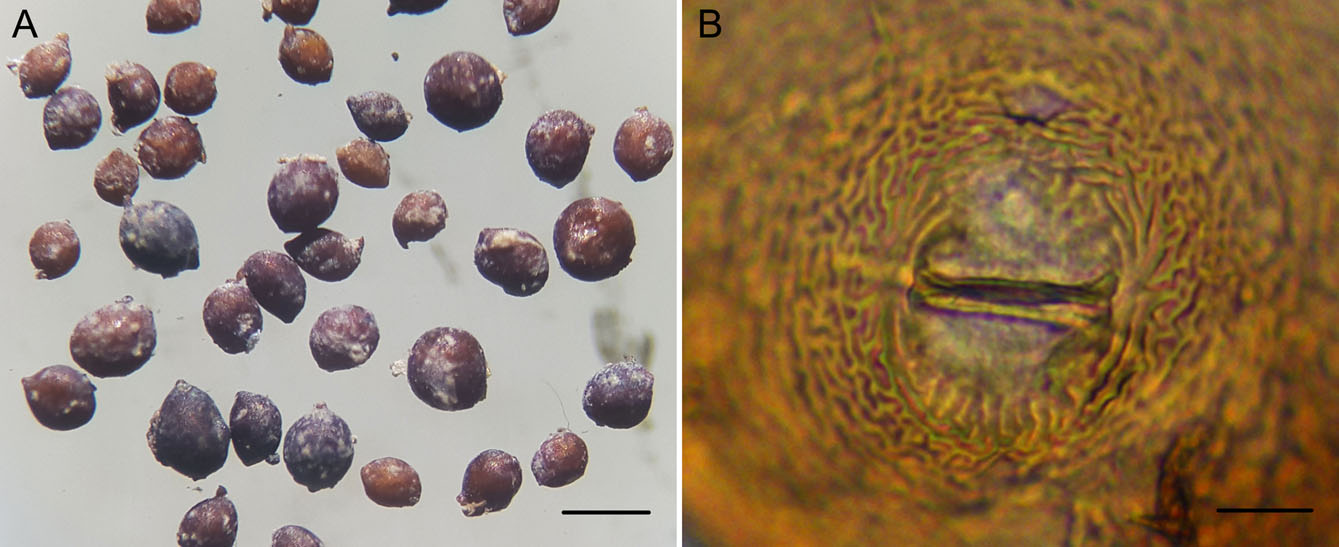
Fig. 2
Light microscopic photos. A, Cysts; B, Vulval cone. Scale bar: A, 0.5 mm; B, 20 μm.
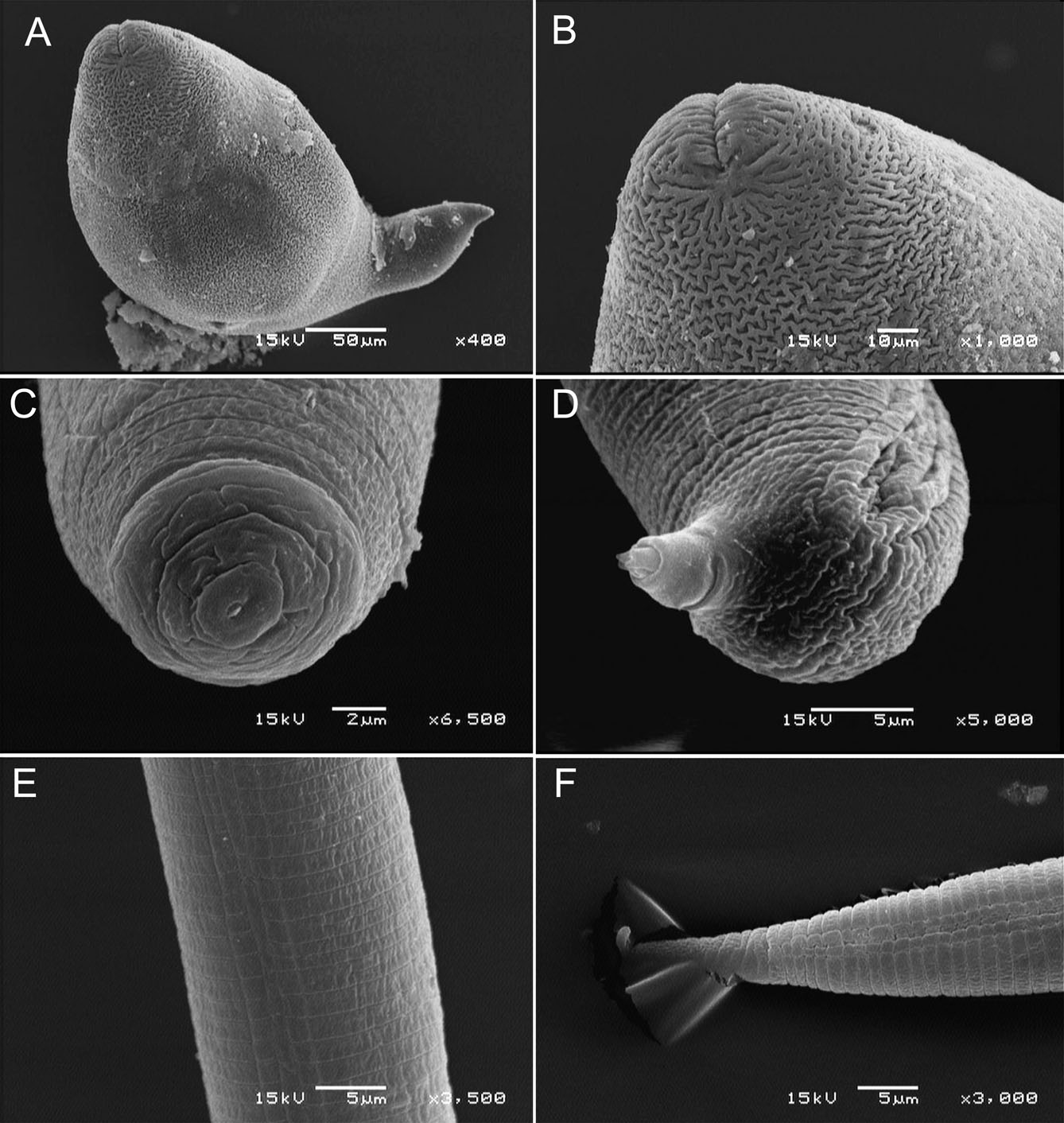
Fig. 3
Scanning electron microscopic photos. A, Entire body of female; B, Vulval cone; C, En face view of male; D, Posterior region of male with bidentate spicules; E, Midbody of J2 with lateral field; F, Tail of J2.
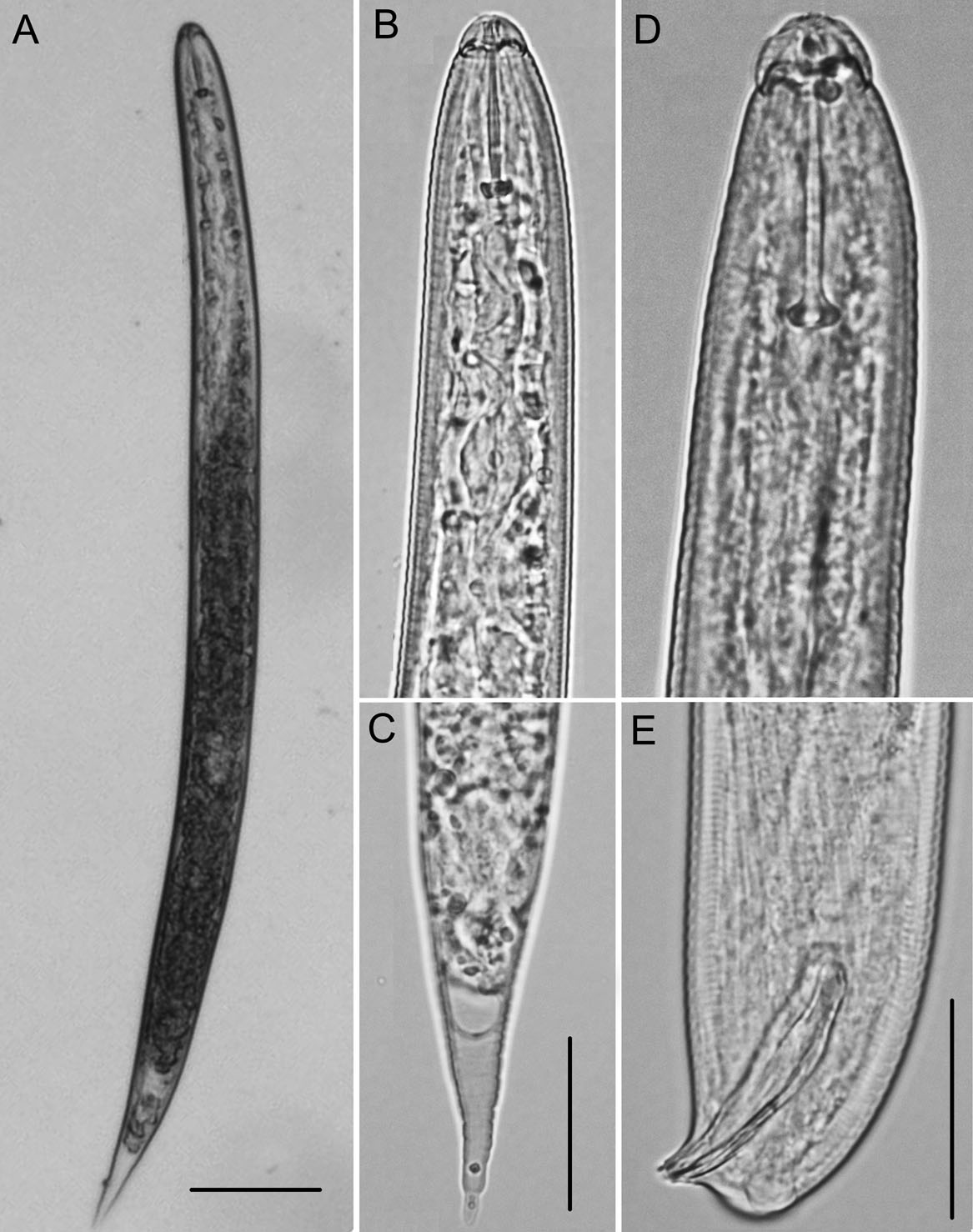
Fig. 4
Light microscopic photos. A, Entire body of second stage juvenile (J2); B, Head of J2; C, Tail of J2; D, Head of male; E, Tail with spiclules of male. Scale bar: A, 45 μm; B and C, 25 μm; D and E, 35 μm.
Table 2
Host range test results of Heterodera carotae from the Tepeaca Valley, Puebla, Mexico.
| Latin name | Commun name | Nematodes |
|---|---|---|
| Apiaceae | ||
| Daucus carota L. | Carrot | + |
| Asteraceae | ||
| Lactuca sativa L. | Lettuce | – |
| Brassicaceae | ||
| Brassica oleracea var botrytis L. | Cauliflower | – |
| Brassica oleracea var capitata L. | Cabbage | – |
| Brassica oleracea var gemmifera L. | Brussels sprouts | – |
| Brassica oleracea var italica L. | Broccoli | – |
| Raphanus sativus L. | Radish | – |
| Chenopodiaceae | ||
| Beta vulgaris L. | Beetroot | – |
| Poaceae | ||
| Triticum aestivum L. | Wheat | – |
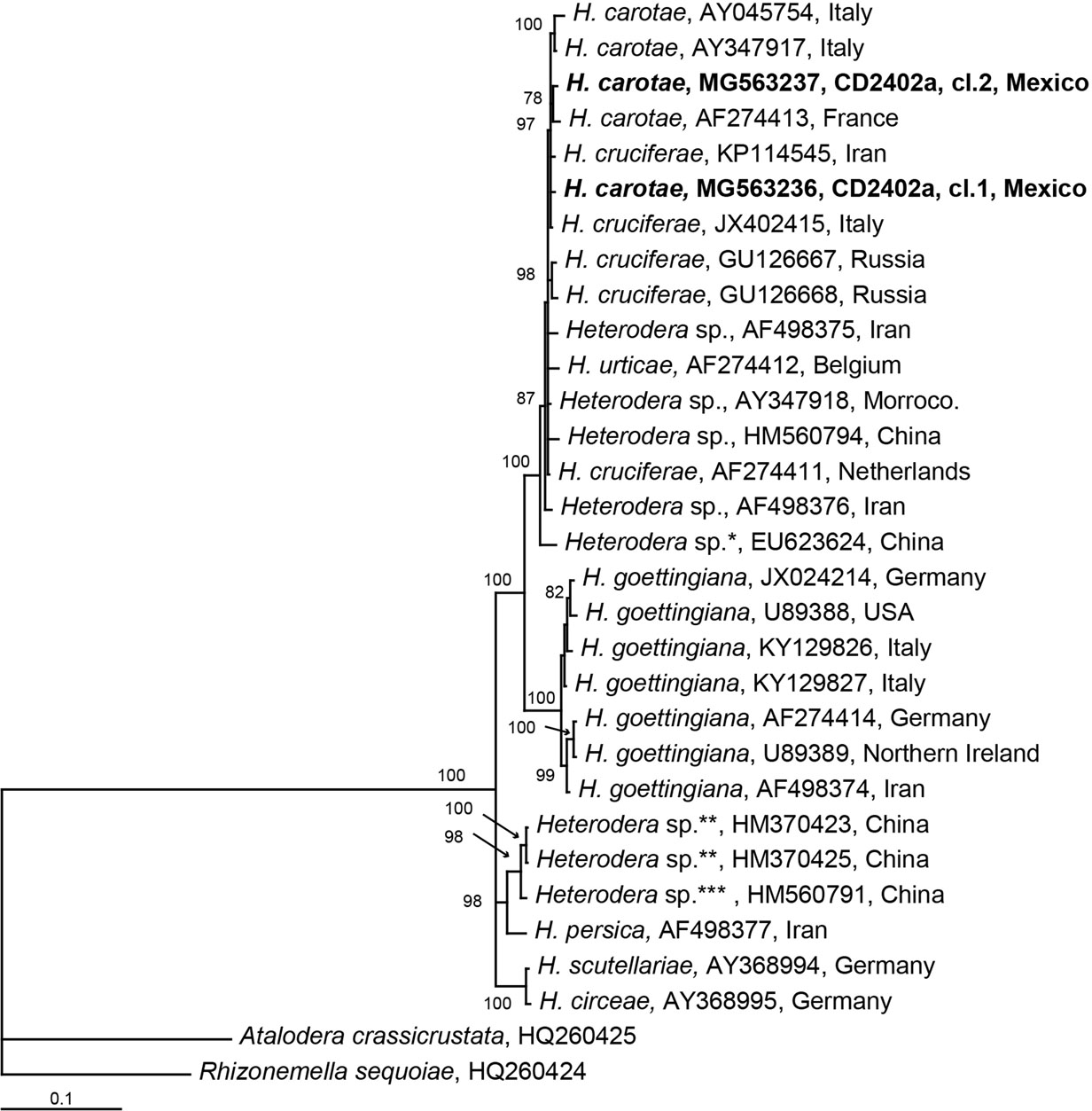
Fig. 5
Phylogenetic relationships within populations and species of the Goettingiana group of the genus Heterodera as inferred from Bayesian analysis using the ITS rRNA gene sequence dataset. Posterior probability more than 70% is given for appropriate clades. Newly obtained sequences are indicated in bold. *Identified as Heterodera goettingiana by Ou et al. (unpublished); **Identified as H. goettingiana by Huang et al. (unpublished); ***Identified as Heterodera sp. by Peng et al. (unpublished) in the GenBank.
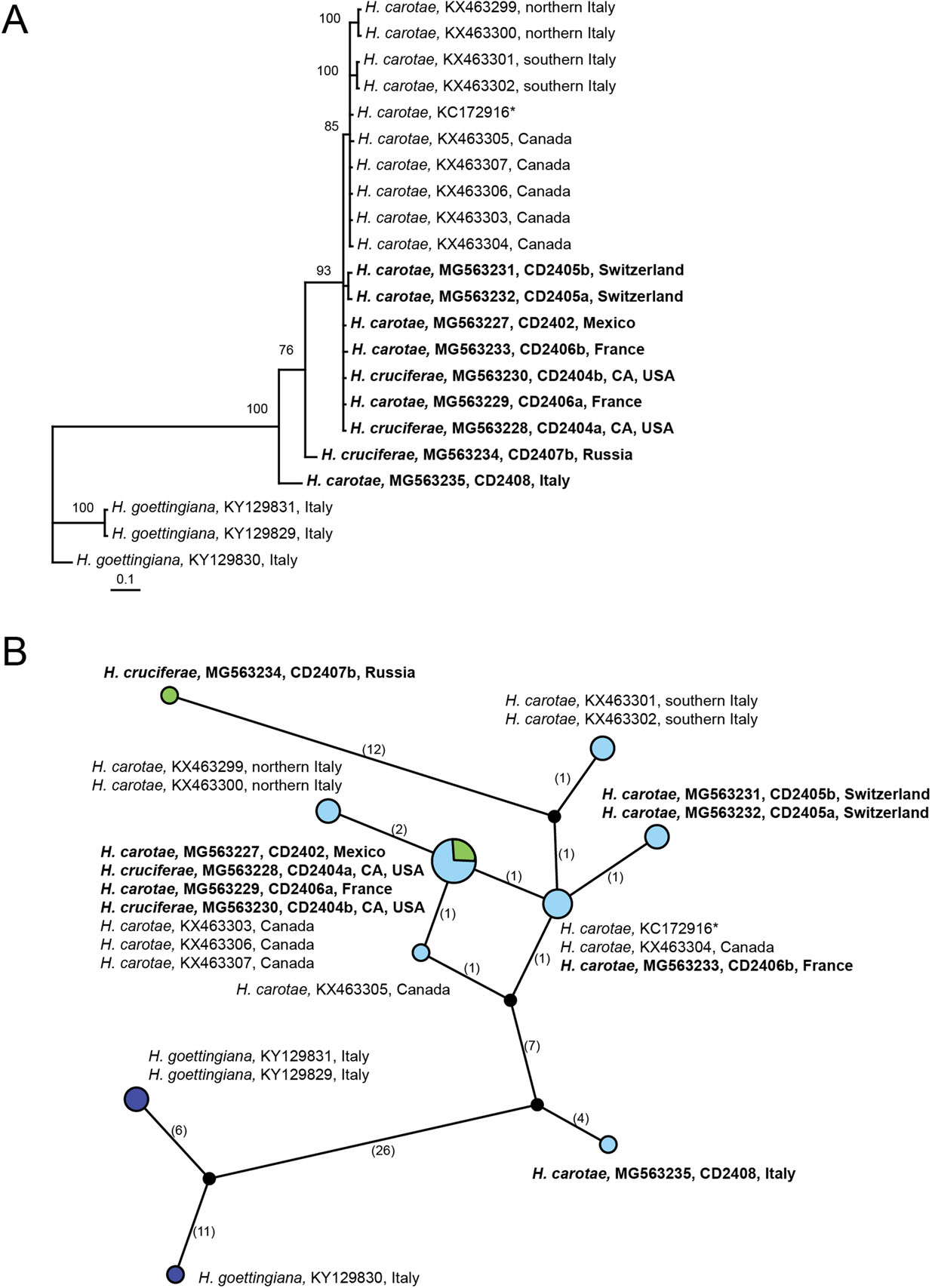
Fig. 6
A, Phylogenetic relationships within populations and species of the Goettingiana group of the genus Heterodera as inferred from Bayesian analysis using the COI gene sequence dataset. Posterior probability more than 70% is given for appropriate clades. B, Statistical parsimony network showing the phylogenetic relationships between haplotypes of species of the Goettingiana group. Small black cycles represent missing haplotypes. Pie chart sizes are proportional to the number of samples with a particular haplotype. Newly obtained sequences are indicated in bold. *Originally identified as Heterodera pratensis by Toumi et al. (2013) and later corrected to Heterodera carotae by Madani et al. (2018).