
Table 1
Morpometrics of Pristionchus sikae sp. n. and Pristionchus kurosawai sp. n.
| Character | P. kurosawai RS5914 stenostomatous male | stenostomatous female | P. sikae RS5901 stenostomatous male | stenostomatous female |
|---|---|---|---|---|
| n | 10 | 10 | 10 | 10 |
| L | 998 ± 133 (828–1285) | 1460 ± 234 (1097–1831) | 619 ± 81.9 (533–813) | 1003 ± 70.6 (867–1121) |
| L′ | 861 ± 127 (710–1128) | 1186 ± 175.2 (915–1454) | 514 ± 75.7 (434–708) | 809 ± 50.8 (699–895) |
| A | 15 ± 1.8 (12–17) | 14 ± 1.7 (12–17) | 13 ± 1.9 (10–15) | 12 ± 1 (11–14) |
| B | 6.3 ± 0.6 (5.1–7.0) | 9 ± 1.4 (7.5–11.7) | 4.6 ± 0.5 (3.8–5.4) | 6 ± 0.5 (5.2–6.6) |
| C | 7.4 ± 1.2 (4.9–8.9) | 5.6 ± 1.0 (3.5–7.1) | 6.1 ± 1 (4.6–7.7) | 5.2 ± 0.6 (4.4–6.2) |
| c′ | 3.4 ± 0.9 (2.2–5.0) | 6.1 ± 2.3 (3.9–11.4) | 3.7 ± 0.5 (2.4–4.4) | 6 ± 0.7 (4.7–7.2) |
| T or V | 60 ± 5.2 (51–68) | 46 ± 3 (41–50) | 51 ± 5 (45–60) | 46 ± 2.6 (42–50) |
| Maximum body diam. | 69 ± 8.1 (54–79) | 105 ± 20.6 (76–134) | 50 ± 8.1 (40–64) | 82 ± 6.7 (72–93) |
| Stoma length | 9.5 ± 1.2 (8.1–12.1) | 11.3 ± 1.4 (9.8–13.6) | 10 ± 0.8 (9.1–11.6) | 11.3 ± 0.9 (10.3–13.1) |
| Stoma diam. | 5.9 ± 0.6 (5.3–7.0) | 7.2 ± 0.7 (6.0–8.6) | 5.4 ± 0.8 (4.5–6.8) | 7.3 ± 0.7 (6.3–8.2) |
| Pharynx length (head to base of pharynx) | 149 ± 12.4 (130–174) | 154 ± 14.1 (134–176) | 126 ± 10.6 (111–139) | 157 ± 7.8 (145–169) |
| Anterior pharynx (pro- + metacorpus) | 88 ± 7.2 (75–100) | 92 ± 9.4 (83–108) | 78 ± 6.4 (66–85) | 98 ± 5.6 (89–107) |
| Posterior pharynx (isthmus + basal bulb) | 62 ± 5.7 (55–74) | 62 ± 6.6 (47–68) | 48 ± 5.7 (37–56) | 60 ± 5.1 (55–70) |
| Ant/total pharynx % | 59 ± 1.2 (57–61) | 60 ± 2.5 (56–65) | 62 ± 2.5 (58–67) | 62 ± 2.3 (59–65) |
| Median bulb diam. | 24 ± 2.1 (21–28) | 29 ± 3.7 (24–35) | 21 ± 3.4 (17–26) | 31 ± 2.3 (28–35) |
| Terminal bulb diam. | 26 ± 3.5 (21–33) | 29 ± 3.9 (24–36) | 21 ± 3.4 (18–26) | 30 ± 2.2 (25–32) |
| Testis length | 601 ± 115.3 (450–799) | – | 317 ± 65.3 (250–485) | – |
| Ant. end to vulva | – | 666 ± 122 (542–795) | – | 460 ± 41.1 (372–510) |
| Vulva to anus distance | – | 548 ± 74.6 (433–683) | – | 340 ± 22.9 (309–372) |
| Cloacal or anal body diam. | 42 ± 10.9 (28–70) | 46 ± 8.9 (29–59) | 29 ± 4.6 (21–38) | 32 ± 2.4 (28–36) |
| Tail length | 136 ± 24.5 (111–186) | 274 ± 97.2 (182–525) | 104 ± 20.2 (78–142) | 194 ± 30.3 (155–237) |
| Spicule length (curve) | 44 ± 2.7 (40–49) | – | 40 ± 3.8 (33–44) | – |
| Spicule length (chord) | 36 ± 2.1 (33–39) | – | 32 ± 3.3 (27–37) | – |
| Gubernaculum length | 16 ± 1.6 (14–18) | – | 13 ± 1 (12–15) | – |
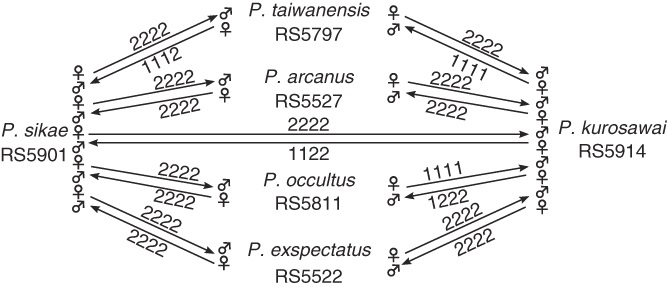
Fig. 1
Results of reciprocal mating experiments between gonochoristic species of the pacificus species-complex sensu stricto. Numbers indicate the results of four replications of mating experiments. Production of no F1 progeny is indicated as ‘1’, whereas formation of viable sterile F1 progeny is indicated as ‘2’.
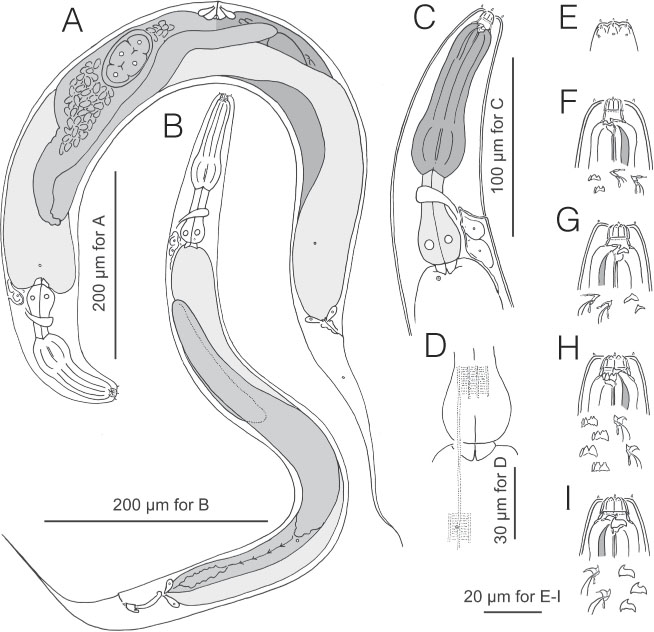
Fig. 2
Pristionchus sikae sp. n. Drawings are of live specimens (non-types) from temporary mounts. A, Stenostomatous female in right lateral view. B, Stenostomatous male in left lateral view. C, Anterior region of stenostomatous female in left lateral view. D, Body surface showing longitudial striations, annulations and relative position of deirid and lateral glands. E, Anterior end of stenostomatous male in left lateral view. F, Stomatal region of stenostomatous male in left lateral view; below (from left to right) are left subventral ridge and dorsal tooth. G, Stomatal region of stenostomatous female in right lateral view; below are dorsal tooth and right subventral denticle. H, Stomatal region of eurystomatous female in left lateral view; below are left subventral ridge and dorsal tooth. I, Stomatal region of eurystomatous female in right lateral view; below are dorsal tooth and right subventral tooth.
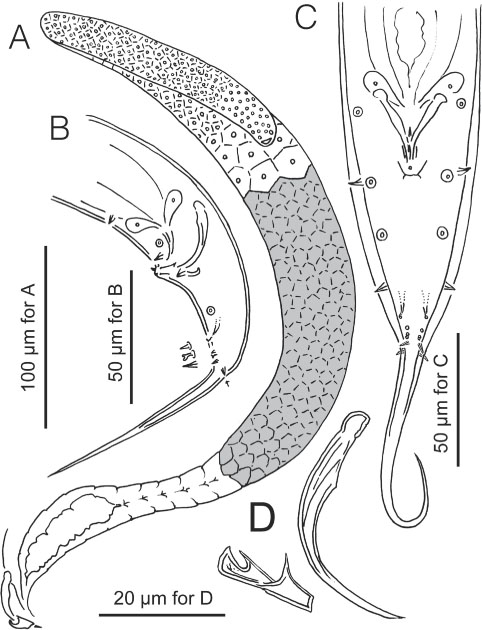
Fig. 3
Adult male of Pristionchus sikae sp. n. Drawings are of live specimens (non-types) from temporary mounts. A, Gonadal system in right lateral view. B, Tail region in left lateral view with schematic drawings of distal ventral triplet papillae. C, Tail region in ventral view. D, Spicule and gubernaculum in right lateral view.
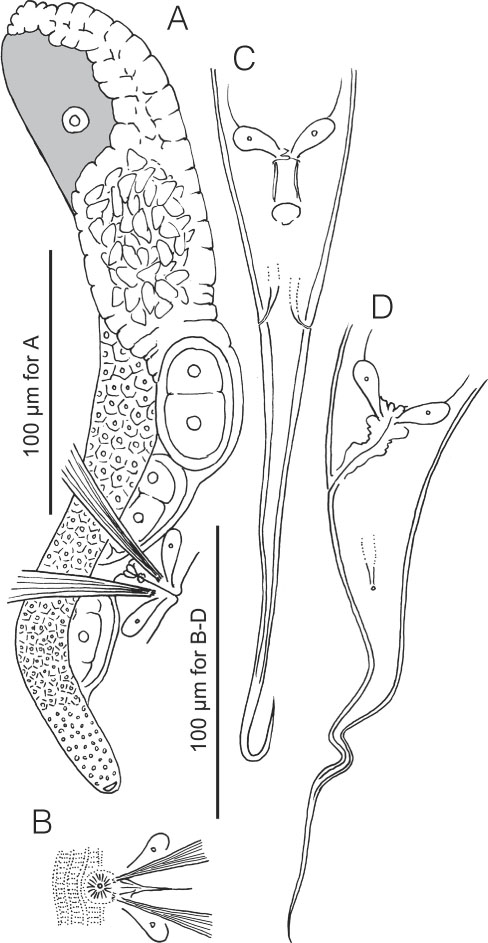
Fig. 4
Adult female of Pristionchus sikae sp. n. Drawings are of live specimens (non-types) from temporary mounts. A, Gonadal system in right lateral view. B, Vulval region in ventral view. C, Tail region in ventral view. D, Tail region in left lateral view.
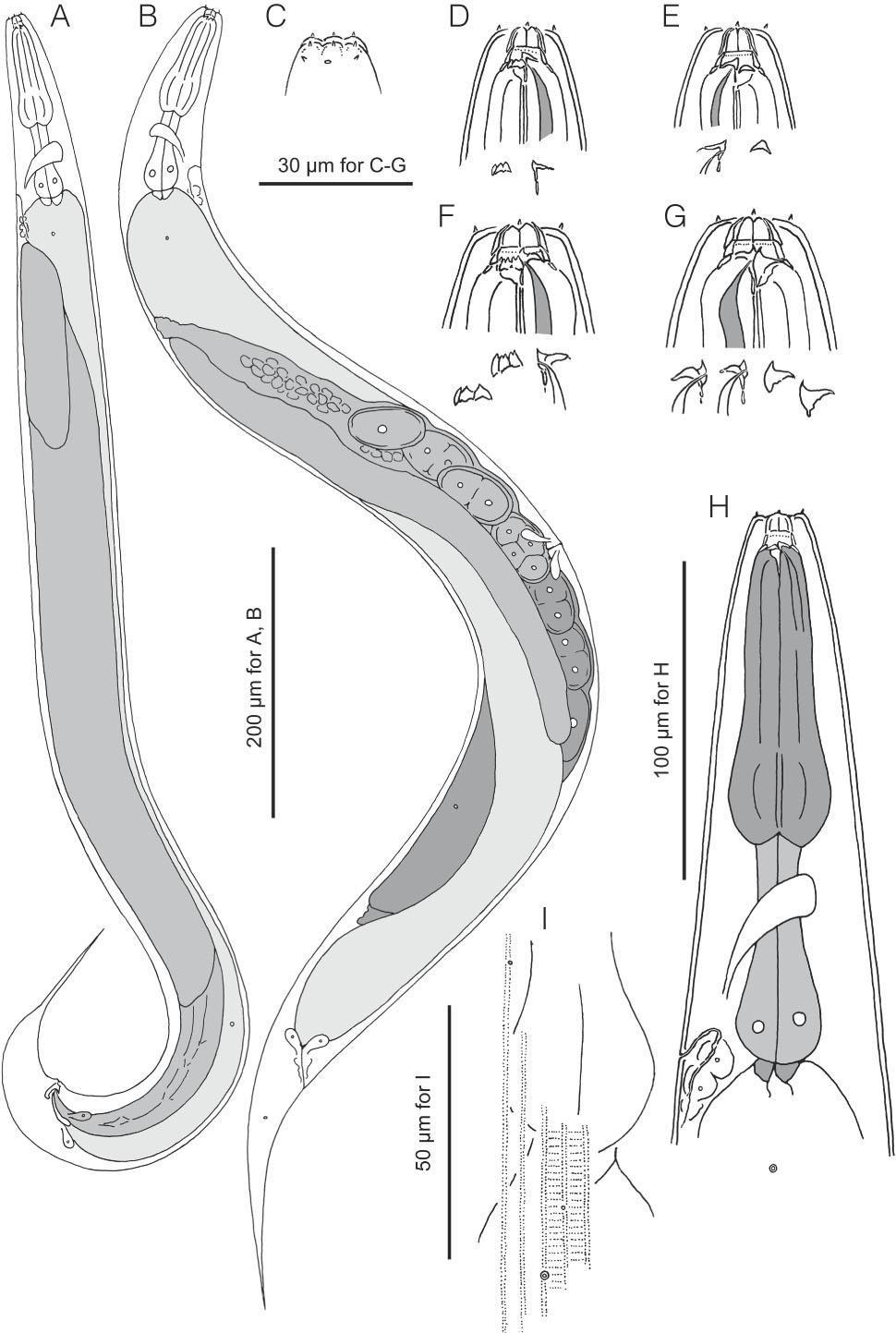
Fig. 5
Male Pristionchus kurosawai sp. n. Drawings are of live specimens (non-types) from temporary mounts. A, Stenostomatous male in left lateral view. B, Stenostomatous female in right lateral view. C, Anterior end of stenostomatous male in left lateral view. D, Stomatal region of stenostomatous male in left lateral view; below (from left to right) are left subventral ridge and dorsal tooth. E, Stomatal region of stenostomatous male in right lateral view; below are dorsal tooth and right subventral denticle. F, Stomatal region of eurystomatous female in left lateral view; below are left subventral ridge and dorsal tooth. G, Stomatal region of eurystomatous female in right lateral view; below are dorsal tooth and right subventral tooth. H, Anterior region of stenostomatous female in left lateral view. I, Body surface showing longitudial striations, annulations and relative position of deirid and lateral glands.
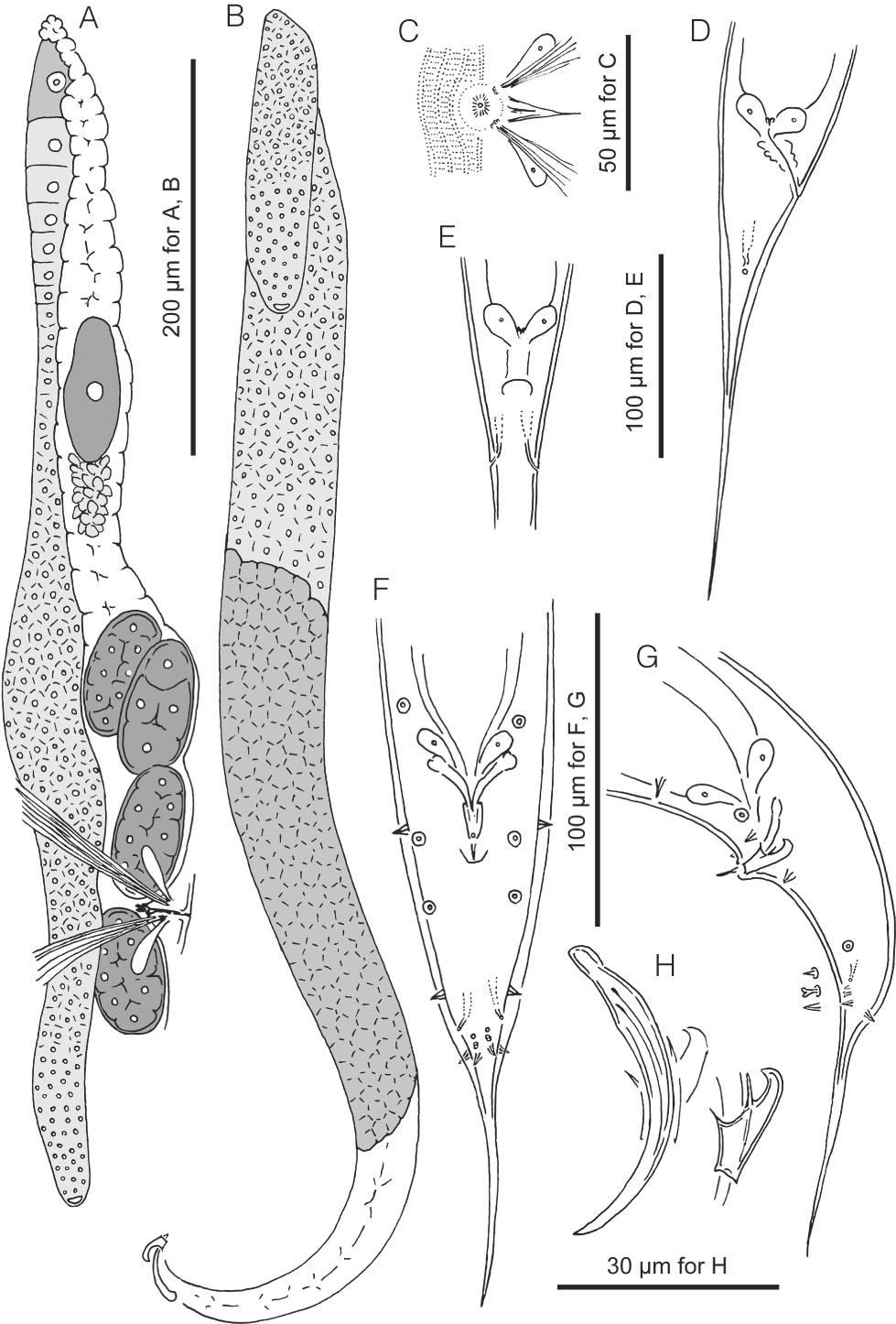
Fig. 6
Female Pristionchus kurosawai sp. n. Drawings are of live specimens (non-types) from temporary mounts. A, Female gonadal system in right lateral view. B, Male gonadal system in left lateral view. C, Vulval region in ventral view. D, female tail region in left lateral view. E, Female tail region in ventral view. F, Male tail region in ventral view. G, Male tail region in left lateral view with schematic drawings of distal ventral triplet papillae. H, Spicule and gubernaculum in left lateral view.
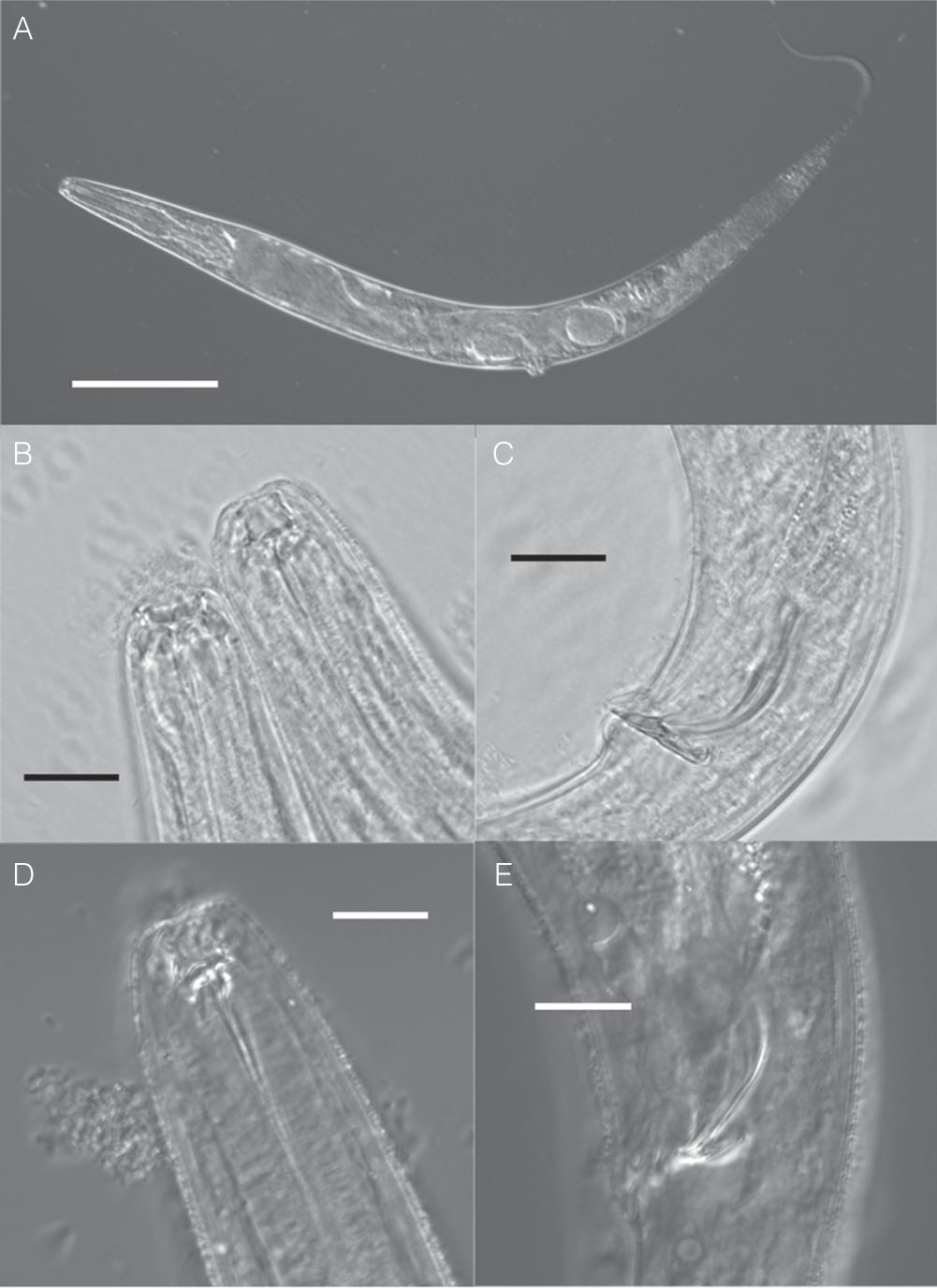
Fig. 7
Nomarski Light Microscopy pictures of alive nematodes. A, Female Pristionchus sikae sp. n., total; B, Eurystomatous morph female, left & stenostomatous morph male, right, mouth region and C, male tail; D, Pristionchus kurosawai sp. n. mouth region, stenostomatous morph and E, male tail. Scale = 100 µm in A, 10 µm in B–E.
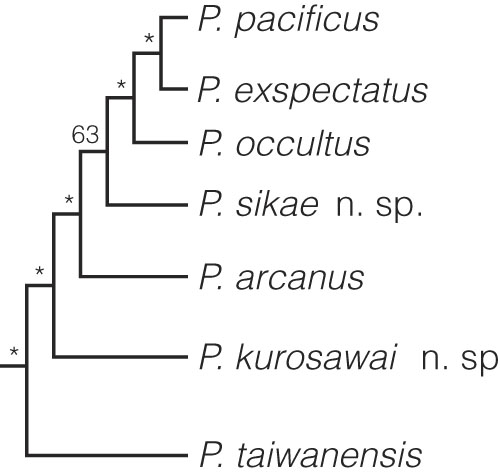
Fig. 8
Phylogenetic relationship of the seven species of the ‘pacificus species-complex sensu stricto’. The schematic phylogeny shows a subtree of a phylogeny that was generated from transcriptome data of all cultivable Pristionchus species (Rödelsperger et al., 2018). Inner nodes are labeled with bootstrap support values and stars indicate full bootstrap support (100 replicates).