
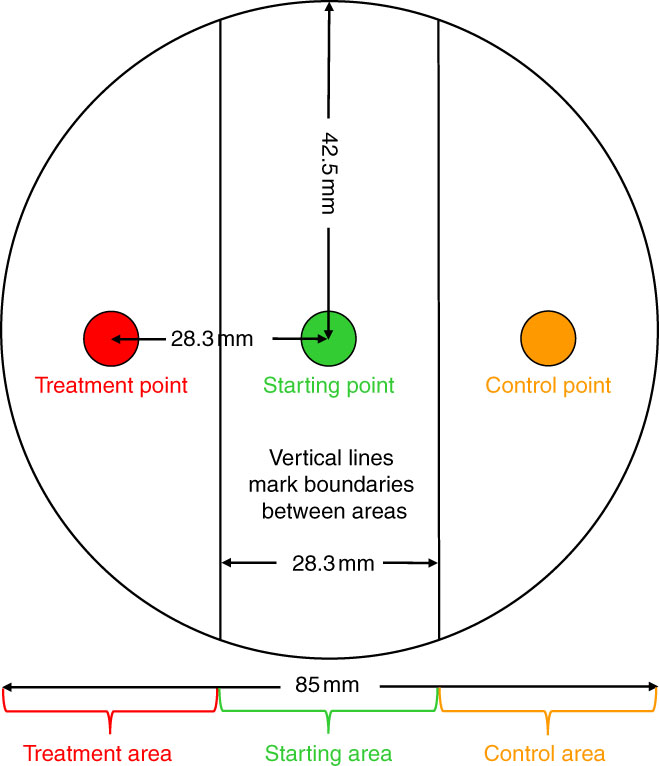
Figure 1
Diagram of a chemotaxis assay. Each plastic plate was divided into three areas: the treatment area (consisting of the treatment point and the surrounding area), the starting area (consisting of the starting point and the surrounding area), and the control area (consisting of the control point and the surrounding area). J2 were placed on the agar at the starting point, treatments were applied to the agar at the treatment point, and sterile distilled water was applied to the agar at the control point. Measurements are given for a plate with an 85-mm-diam. cup (100-mm-diam. lid).
Table 1
Percentage inactive or dead Meloidogyne incognita second-stage juveniles (J2) in Vetiveria zizanioides (vetiver) shoot aqueous (VSA) extracts and vetiver root aqueous (VRA) extracts.
| Percentage inactive J2 | Percentage dead J2 | ||
|---|---|---|---|
| Treatmenta | Day 1 | Day 2 | Day 3 rinsed |
| VSA 94% | 53.4 bAb | 70.4 abA | 68.2 aA |
| VRA 94% | 79.6 aAB | 86.7 aA | 71.9 aA |
| VSA 71% | 46.2 bB | 63.5 bcA | 71.1 aA |
| VRA 71% | 74.4 aA | 72.1 abA | 68.0 aA |
| VSA 47% | 39.8 bcB | 49.3 cdB | 67.6 aA |
| VRA 47% | 50.3 bA | 49.8 cdA | 53.4 abA |
| VSA 24% | 23.7 cdB | 38.3 dAB | 56.3 abA |
| VRA 24% | 16.6 deB | 34.3 deA | 43.6 bA |
| 0.48 mg/ml streptomycin sulfate | 14.7 deA | 18.7 efA | 22.3 cA |
| Water | 6.7 eB | 9.8 fAB | 17.5 cA |
[i] aAll extracts were from shoots or roots of greenhouse-grown, 2-mon-old vetiver cv. Sierra. Treatments were prepared from 100% extracts (undiluted extracts) containing streptomycin sulfate, diluted to 75%, 50%, and 25% with water, and then added to J2 suspensions in the wells. Final extract dilutions in the wells are presented in the table.
[ii] bValues are means of eight replications in each of the two trials, for a total of N = 16. Differences among treatments were determined by analysis of variance (ANOVA) and means were compared using Tukey-Kramer’s adjustment for multiple comparisons (P ⩽ 0.05). Similar lower case letters indicate that means are not significantly different within a column; similar upper case letters indicate that means are not significantly different within a row.
Table 2
Percentage inactive or dead Meloidogyne incognita second-stage juveniles (J2) in Vetiveria zizanioides (vetiver) root ethanol (VRE) extracts, Tagetes patula (French marigold cv. Durango Mix) root ethanol (FMRE) extract, and in vetiver oil (VO). Extracts were prepared from greenhouse-grown, 2-mon-old and 4-yr-old vetiver cv. Sierra, and from field-grown, 1-yr-old cv. Songkha 3.
| Percentage inactive J2 | Percentage dead J2 | ||
|---|---|---|---|
| Treatmenta | Day 1 | Day 2 | Day 3 rinsed |
| FMRE 0.95 mg/ml | 34.9 aBb | 30.7 aB | 69.1 aA |
| 2-mon VRE 0.95 mg/ml | 24.9 abcB | 28.0 abB | 38.3 bcA |
| 1-yr VRE 0.95 mg/ml | 27.6 abB | 26.5 abB | 42.4 bA |
| 4-yr VRE 0.95 mg/ml | 29.7 abB | 30.0 aB | 41.9 bA |
| VO 0.95 mg/ml | 20.3 bcdA | 12.6 cdA | 17.1 deA |
| 0.95% CTD | 12.9 dA | 8.0 dA | 11.3 eA |
| FMRE 0.095 mg/ml | 13.7 cdB | 17.0 bcdB | 35.0 bcA |
| 2-mon VRE 0.095 mg/ml | 16.2 cdA | 20.2 abcA | 24.0 cdeA |
| 1-yr VRE 0.095 mg/ml | 16.2 cdB | 13.9 cdB | 30.5 bcdA |
| 4-yr VRE 0.095 mg/ml | 14.2 cdB | 11.0 cdB | 27.8 bcdA |
| VO 0.095 mg/ml | 9.7 dA | 8.6 cdA | 9.8 eA |
| 0.095% CTD | 12.8 dA | 8.0 dA | 11.8 eA |
| Sterile distilled water | 11.8 dA | 12.4 cdA | 15.2 deA |
[i] a2-mon VRE = vetiver root ethanol extracts from greenhouse-grown, 2-mon-old cv. Sierra; 1-yr VRE = vetiver root ethanol extracts from field-grown, 1-year-old cv. Songkha 3; 4-yr VRE = vetiver root ethanol extracts from greenhouse-grown, 4-yr-old cv. Sierra; VO = commercial vetiver oil. Treatments were prepared from 1.0 mg/ml and 0.1 mg/ml extracts that were dissolved in a solvent of equal parts castor oil, Tween 80, and dimethyl sulfoxide (CTD) and then added to J2 suspensions in the wells. Final extract dilutions in the wells are presented in the table.
[ii] bValues are means of eight replications in each of the two trials, for a total of N = 16. Differences among treatments were determined by analysis of variance (ANOVA) and means were compared using Tukey-Kramer’s adjustment for multiple comparisons (P ⩽ 0.05). Similar lower case letters indicate that the means are not significantly different within a column; similar upper case letters indicate that the means are not significantly different within a row.
Table 3
Repellent activity of aqueous Vetiveria zizanioides (vetiver) extracts on Meloidogyne incognita second-stage juveniles. The chemotaxis index (CI) was recorded after 24 hr.
| Treatmenta | CIb |
|---|---|
| 2-mon VRA 0.1 g/ml | −0.5 bc |
| 2-mon VSA 0.1 g/ml | −0.6 b |
| Control sterile distilled water | 0.0 a |
[i] aVRA = vetiver root aqueous extracts from greenhouse-grown, 2-mon-old cv. Sierra; VSA = vetiver shoot aqueous extracts from greenhouse-grown, 2-mon-old cv. Sierra.
[ii] bChemotaxis index (CI): ⩾0.2 indicated an attractant; between 0.2 and 0.1, a weak attractant; 0.1 to −0.1, without effect; between −0.1 and −0.2, a weak repellent; and ⩽−0.2, a repellent.
[iii] cValues are means of five replications in each of the two trials, for a total of N = 10. Differences among treatments were determined by analysis of variance (ANOVA) and means were compared using Tukey-Kramer’s adjustment for multiple comparisons (P ⩽ 0.05). Similar lower case letters indicate that means are not significantly different.
Table 4
Repellent activity of Vetiveria zizanioides (vetiver) oil, vetiver root ethanol extracts, and Tagetes patula (French marigold cv. Durango Mix) root ethanol extracts on Meloidogyne incognita second-stage juveniles. The chemotaxis index (CI) was recorded after 24 hr.
| Treatmenta | CIb |
|---|---|
| FMRE 0.1 g/ml | −0.4 dec |
| 2-mon VRE 0.1 g/ml | −0.6 e |
| 1-yr VRE 0.1 g/ml | −0.3 bcd |
| 4-yr VRE 0.1 g/ml | −0.3 cde |
| VO 0.1 g/ml | −0.1 abc |
| Ethanol | 0.1 a |
| Sterile distilled water | 0.0 ab |
[i] a2-mon VRE = vetiver root ethanol extracts from greenhouse-grown, 2-mon-old cv. Sierra; 1-yr VRE = vetiver root ethanol extracts from field-grown, 1-yr-old cv. Songkha 3; 4-yr VRE = vetiver root ethanol extracts from greenhouse-grown, 4-yr-old cv. Sierra; VO = commercial vetiver oil.
[ii] bChemotaxis Index (CI): ≥0.2 indicated an attractant; between 0.2 and 0.1, a weak attractant; 0.1 to −0.1, without effect; between −0.1 and −0.2, a weak repellent; and ⩽−0.2, a repellent.
[iii] cValues are means of five replications in each of the two trials, for a total of N = 10. Differences among treatments were determined by analysis of variance (ANOVA) and means were compared using Tukey–Kramer’s adjustment for multiple comparisons (P ⩽ 0.05). Similar lower case letters indicate that the means are not significantly different.
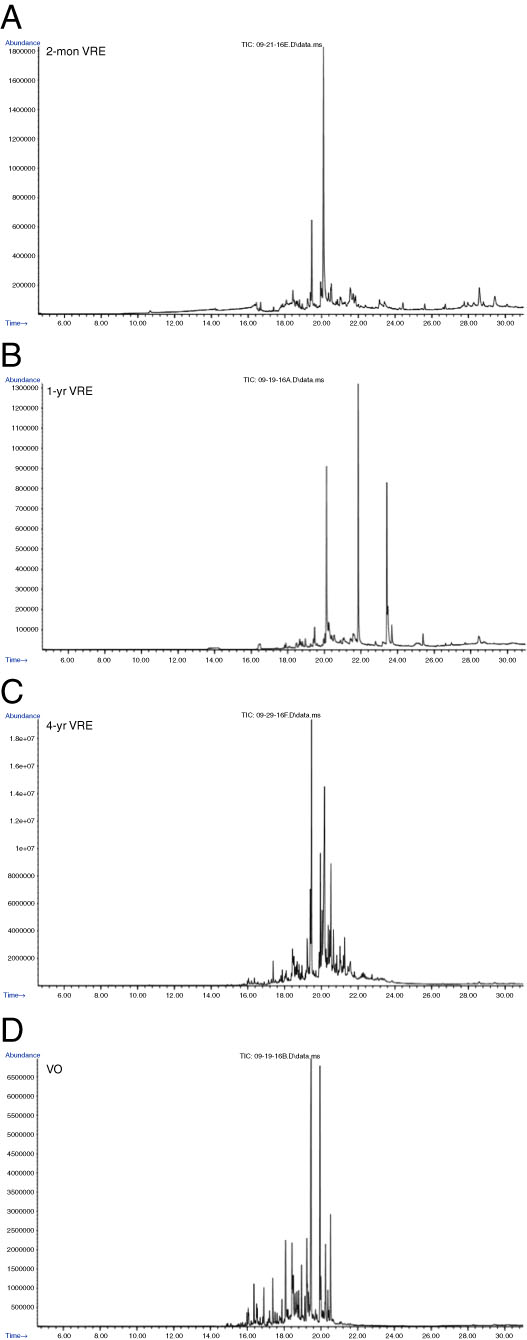
Figure 2
GC-MS spectra of crude Vetiveria zizanioides (vetiver) root ethanol (VRE) extracts and commercial vetiver oil (VO). (A) VRE from greenhouse-grown, 2-mon-old cv. Sierra; (B) VRE from field-grown, 1-yr-old cv. Songkha 3; (C) VRE from greenhouse-grown, 4-yr-old cv. Sierra; (D) commercial VO from Haiti.
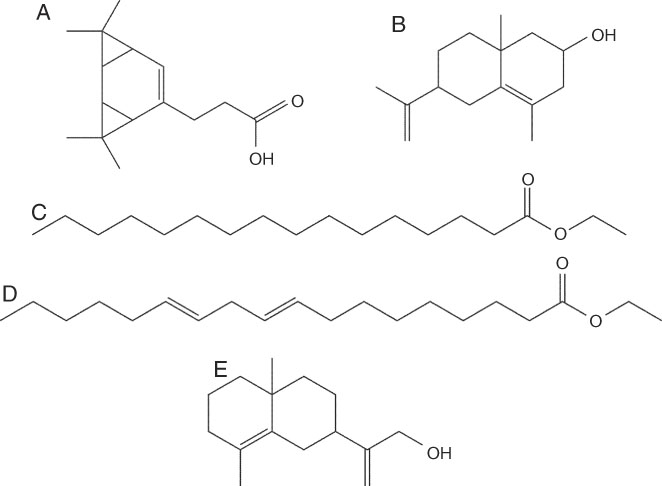
Figure 3
Chemical structures of the major constituents in vetiver root crude extracts and commercial vetiver oil from Vetiveria zizanioides, determined by GC/MS analysis: (A) 3,3,8,8-tetramethyltricyclo[5.1.0.0(2,4)]oct-5-ene-5-propanoic acid; (B) 6-isopropenyl-4,8a-dimethyl-1,2,3,5,6,7,8,8a-octahydronaphthalen-2-ol; (C) ethyl hexadecanoate; (D) ethyl 9,12-octadecadienoate; (E) 2-(4a,8-dimethyl-1,2,3,4,4a,5,6,7-octahydro-naphthalen-2-yl)-prop-2-en-1-ol.
Table 5
Chemical composition of major constituents in three Vetiveria zizanioides (vetiver) root crude extracts and a commercial vetiver oil, determined by GC/MS analysis.
| Sourcea | Compound nameb | Retention time | Component percentage under peakc | Molecular formula | Molecular weight |
|---|---|---|---|---|---|
| 2-mon VRE | 3,3,8,8-Tetramethyltricyclo[5.1.0.0(2,4)]oct-5-ene-5-propanoic acid (a sesquiterpene acid) | 20.11 | 42.8 | C15H22O2 | 234 |
| 6-Isopropenyl-4,8a-dimethyl-1,2,3,5,6,7,8,8a-octahydronaphthalen-2-ol (a sesquiterpene alcohol) | 19.46 | 11.2 | C15H24O | 220 | |
| 1-yr VRE | 3,3,8,8-Tetramethyltricyclo[5.1.0.0(2,4)]oct-5-ene-5-propanoic acid | 20.12 | 26.1 | C15H22O2 | 234 |
| 6-Isopropenyl-4,8a-dimethyl-1,2,3,5,6,7,8,8a-octahydronaphthalen-2-ol | 19.47 | 3.0 | C15H24O | 220 | |
| Ethyl hexadecanoate (ethyl palmitate) | 21.86 | 32.3 | C18H36O2 | 284 | |
| Ethyl 9,12-Octadecadienoate (ethyl linoleate) | 23.42 | 18.9 | C20H36O2 | 308 | |
| 4-yr VRE | 3,3,8,8-Tetramethyltricyclo[5.1.0.0(2,4)]oct-5-ene-5-propanoic acid | 20.17 | 14.1 | C15H22O2 | 234 |
| 6-Isopropenyl-4,8a-dimethyl-1,2,3,5,6,7,8,8a-octahydronaphthalen-2-ol | 19.46 | 9.9 | C15H24O | 220 | |
| VO | 3,3,8,8-Tetramethyltricyclo[5.1.0.0(2,4)]oct-5-ene-5-propanoic acid | 20.15 | 0.7 | C15H22O2 | 234 |
| 6-Isopropenyl-4,8a-dimethyl-1,2,3,5,6,7,8,8a-octahydronaphthalen-2-ol | 19.47 | 17.1 | C15H24O | 220 | |
| 2-(4a,8-Dimethyl-1,2,3,4,4a,5,6,7-octahydro-naphthalen-2-yl)-prop-2-en-1-ol(the sesquiterpene alcohol γ-costol) | 19.95 | 10.5 | C15H24O | 220 |