
Table 1
Numerical properties of the viruses in the Soybean Cyst Nematode Simulation Framework SCNSim.
| Definition | ||||
|---|---|---|---|---|
| Property | Symbol | Range | in vivo | in silico |
| Viral Load | L | 0 1 | Amount of viral particles per host | Scalar multiplier to nematode health decrement |
| Virulence | V 0, v | R > 0 | Pathogen damage inflicted on host | Multiplier to Viral Load |
| Transmissibility | b 0, b | 0 1 | Rate of infection of suscep-tible population | Proportion of viral load sexu-ally transmitted from infected male to a recipient female or from female to egg |
| Prevalence | i 0, i | 0 1 | Disease prevalence in a population | Fraction of initial population infected |
| Durability | D | 0 1 | Longevity of virus parti-cles. | The complement is an ampli-fying constant on increasing viral load. |
| Mutation Rate | M | 0 1 | Proportion of progeny gen-eration with significant ge-netic variation | Probability of virus proper-ties undergoing mutation |
Table 2
Environmental set points and nematode stages modeled in the Soybean Cyst Nematode Simulation Framework (SCNSim) based on figures in Schmitt et al. (2004).
| Model compartment | Parameter description | Value |
|---|---|---|
| SCN life cycle laws | SCN eggs per cyst | 300-500a |
| Minimum hatching temperature | 16° C | |
| Maximum hatching temperature | 36° C | |
| Cyst dormancy initialize temperature | < 20° C | |
| Probability of hatching from egg sac | 0.2b | |
| Probability of hatching from cyst | 0.002b | |
| SCN life stages | Egg state | 1-5 d |
| J1 state | 1-2 d | |
| Unhatched J2 | 1-3000 d | |
| Hatched J2 | 1-4 d | |
| J3 | 3-4 d | |
| J4 male | 5-6 d | |
| J4 female | 3-4 d | |
| Adult male | 1-21 d | |
| Adult female | 2-60 d | |
| Range of mating | 1-21 d | |
| Gestation period | 3-5 d | |
| Egg Sac | 1-3000 d | |
| Cyst | 1-3000 d | |
| Soybean growth | Minimum germinate temperature | 13 ° C |
| Soybean germinate date | 115 days (about April 25) | |
| Soybean harvest date | 240 days (about August 28) | |
| Optimal soybean growth temperature | 27° C | |
| SCN Parasitism | Minimum soybean age for parasitism | 20 days post germinationc |
| Maximum soybean age for parasitism | 100 days post germinationc | |
| Feed rate | 5% |
a According to Biology and Management of Soybean Cyst Nematode 2nd ed., a female cyst growing in optimal conditions may produce up to 600 eggs. However, the averages found in fields has been reported to be much lower, ranging between 60 and 200, depending on the location (Koenning, 2004).
Table 3
Simulation parameters used in producing data on the Soybean Cyst Nematode Simulation SCNSim framework.
| Simulation configuration | Sampling frequency | 4 days |
| Iterations | 10 | |
| Simulation duration | 5 years | |
| Virus properties | Mutation rates (m) | 0, 0.1, 0.2, 0.4, 0.6, 0.8 |
| Virulence (V 0) | 0.1, 0.5, 1, 1.5, 2, 2.5, 4 | |
| Transmissibility (b 0) | 0.5 | |
| Infection rate (i 0) | 0.2, 0.8 | |
| Durability (D) | 0.5 | |
| Viral load (L) | 0.5 |
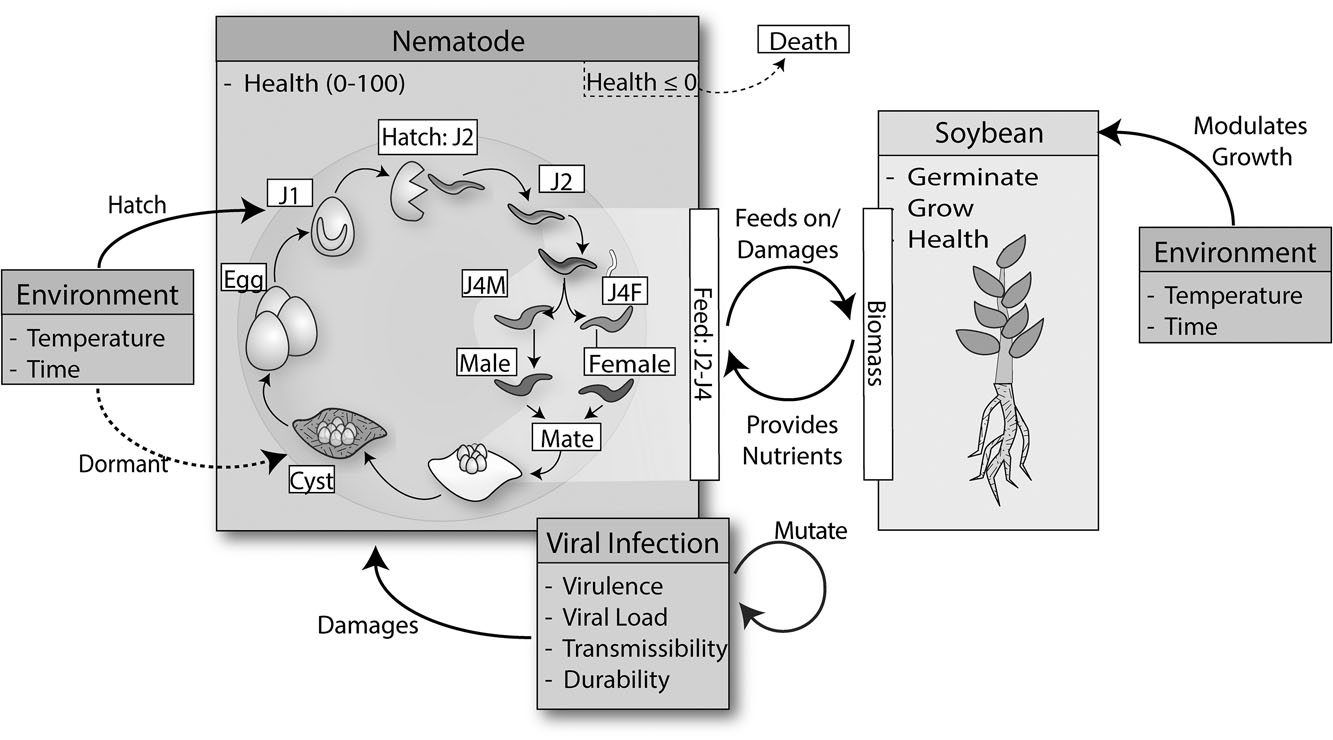
Figure 1:
The Soybean Cyst Nematode Simulation (SCNSim) framework. Envi-ronment, Nematode, Viral Infection and Soybean boxes represent classes in an object-oriented framework, with their respective properties listed within the boxes, and interactions between each other shown by solid arrows. The Nematode class is a simplified model of the life cycle of the nematode Heterodera glycines. SCNSim stochastically simulates a population of nematode agents governed by a dynamic environment, health of the host soybean crops, and the nature of the viral infec- tion. Nematode transition between life stages. Stages J2-J4 feed on the soybean plant diminishing the plant health. The environment modulates the growth of the soybean plant as well as the hatching and transition to the cyst stage in the nematode. The viral parameters are a property of the nematode objects that reduce their health. Viruses transmit horizontally and vertically. Nematodes are removed from simulation when their Health parameter drops below zero.
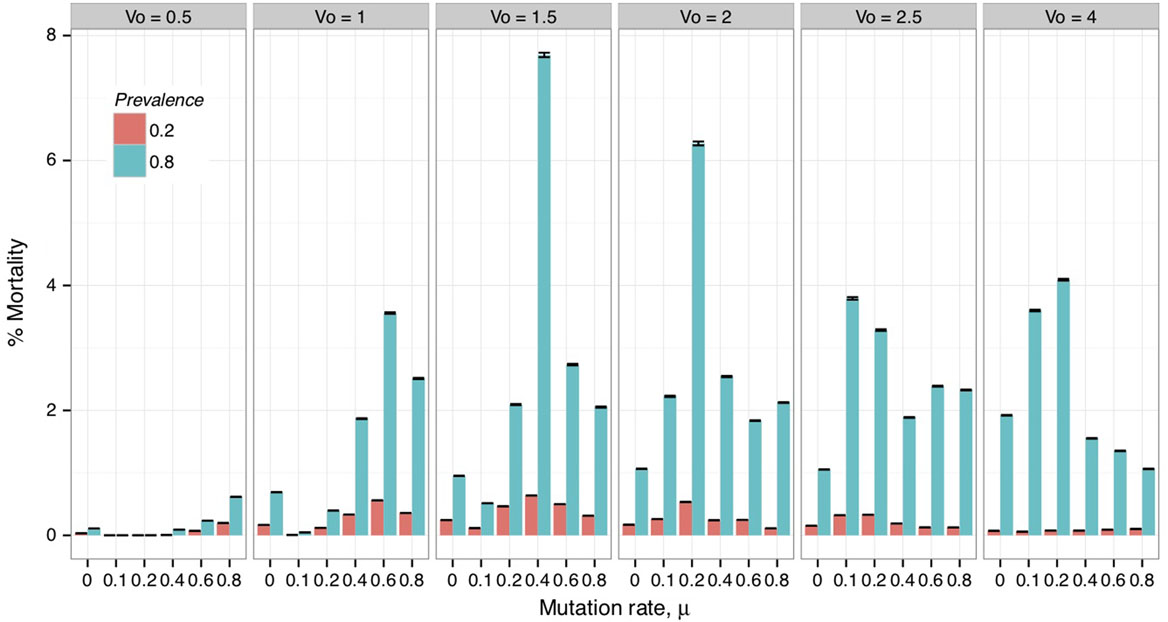
Figure 2:
Soybean cyst nematode mortality across viral pathotypes. Each panel describes the mortality in the nematode population as a function of the mutation rate for a given initial virulence V0. Greater prevalence of the infection resulted in higher mortalities than the low release treatments.
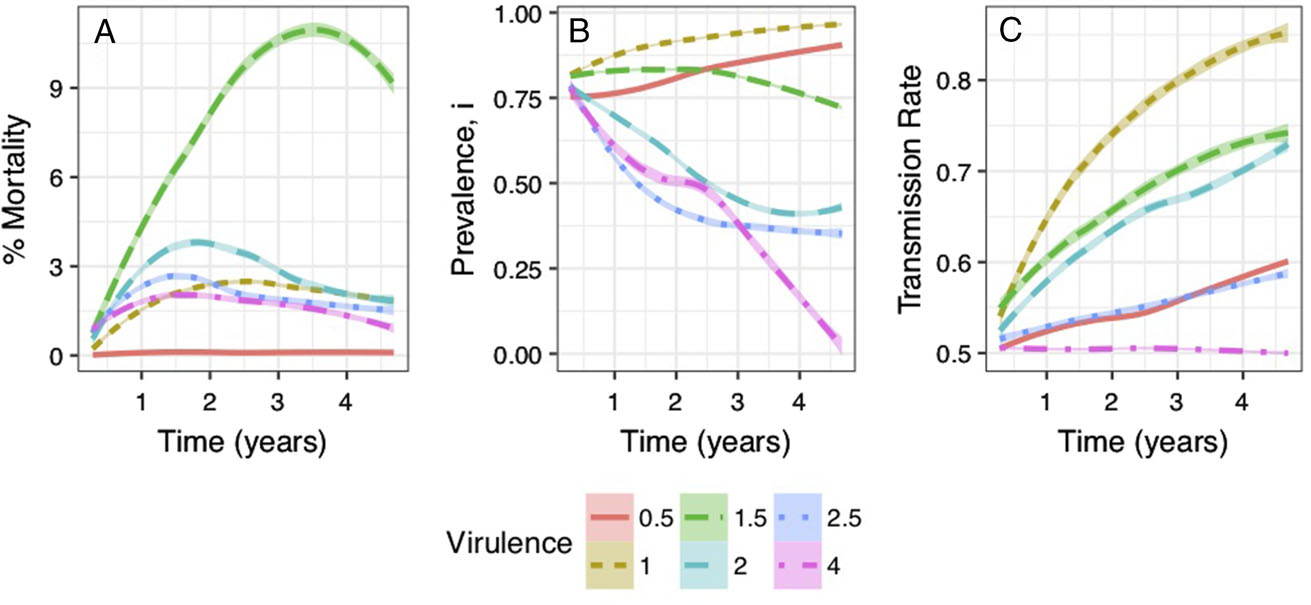
Figure 3:
SCN suppression over time at mutation rate of 0.4 across initial virulence V 0: (A) virus mortality rate changes over time; (B) virus prevalence changes over time; and (C) virus transmission rate changes over time for different virus initial virulence (V 0) rate.
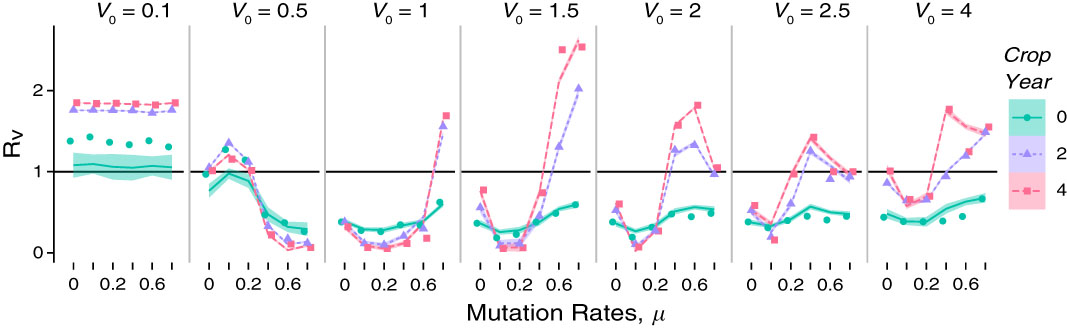
Figure 4:
Replication ratio (R v) with respect to mutation rate of viruses with respect to mutation rate at five different initial virulence rate (V 0) over 4 crop years. Median R v values are accompanied by smoothing (loess) curves with 95% confidence bands.
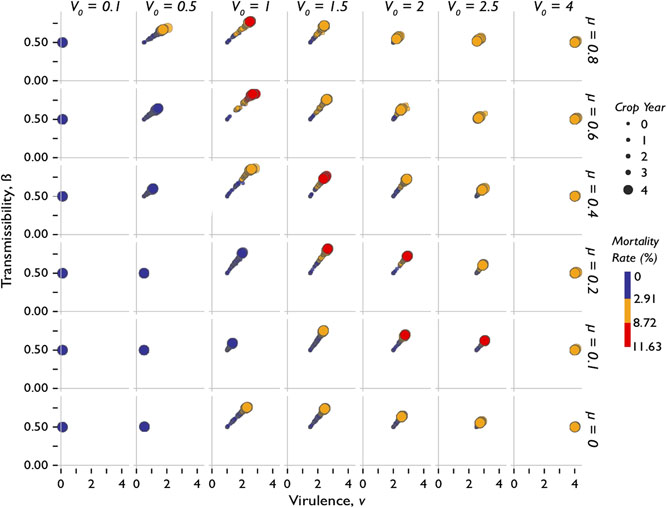
Figure 5:
Four-dimensional scatter plot showing virus-caused nematode mortali- ties over time across treatments by mutation rates and virulences. Each panel in the grid layout denotes the evolution of transmissibility b and virulence v over time for a specific mutation rate and initial virulence.
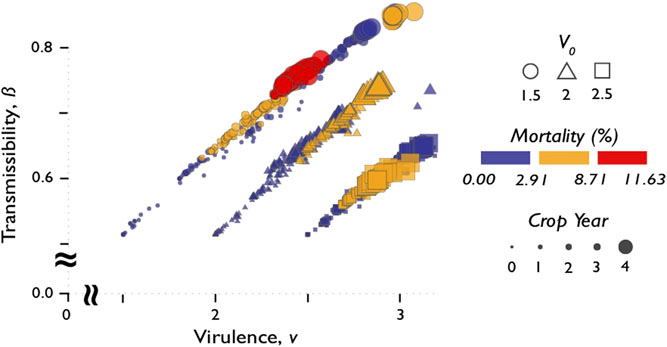
Figure 6:
Relationship between transmissibility and virulence across three distinct initial virulence values (V 0 = 1.5, 2.0, and 2), with a single mutation rate, m = 0.4 over 4 years. Mortality rate of soybean cyst nematodes are shown in different colors.