
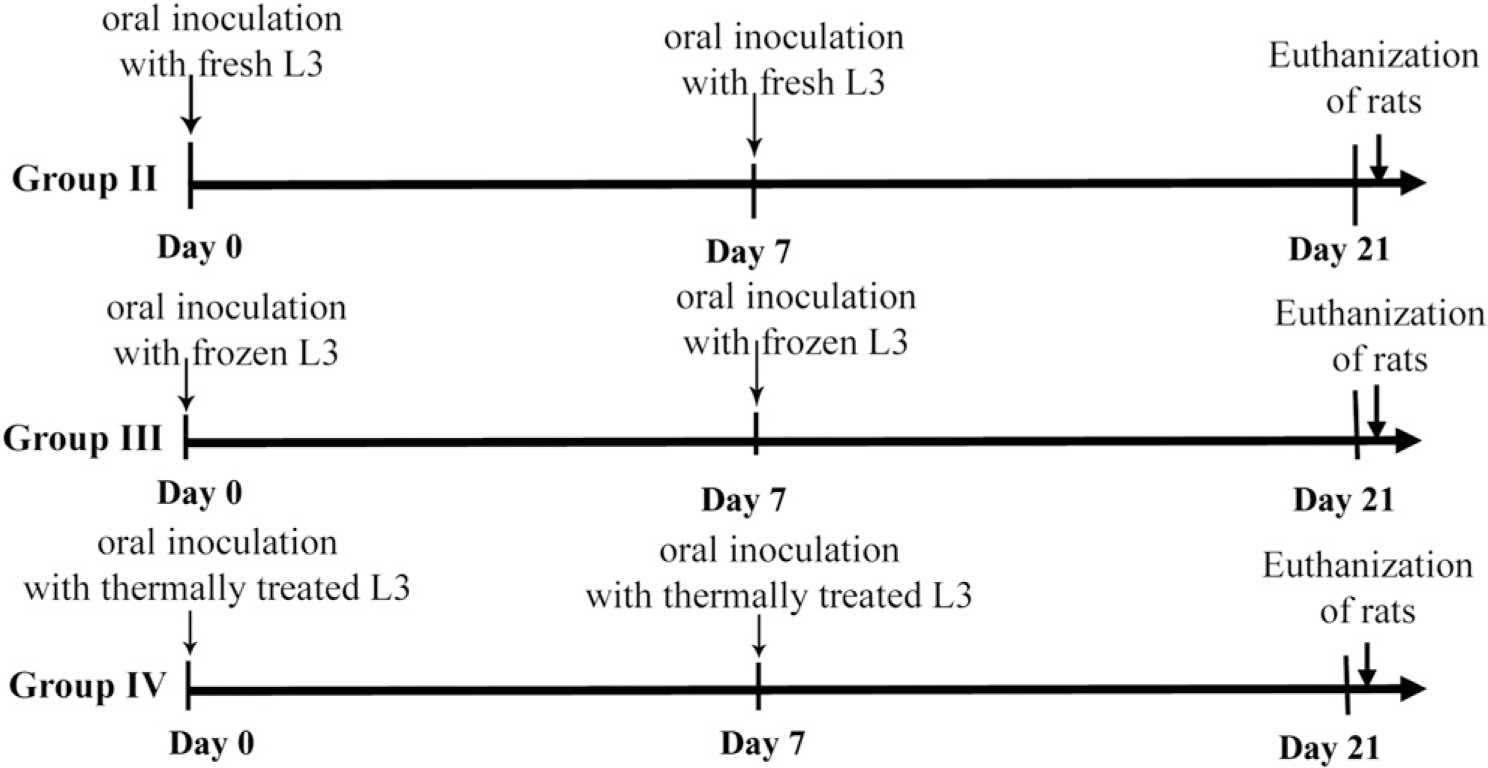
FIG. 1.
Timeline of the experiment showing inoculation and euthanization days.
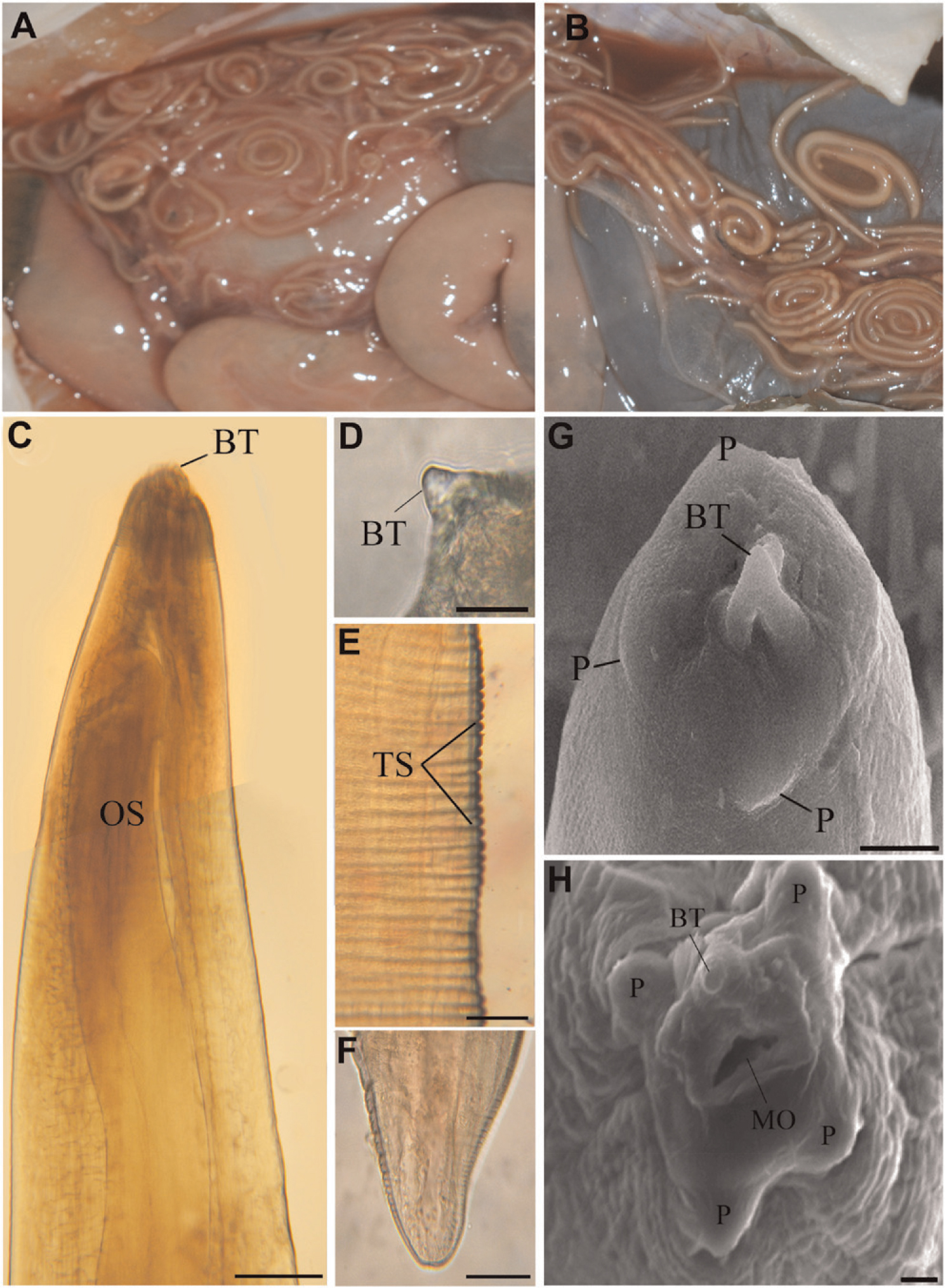
FIG. 2.
A, B. Photographs of Dicentrarchus labrax showing the heavy infestation with Anisakis spp. Type II (L3) in the peritoneum and visceral organs of infected fish. C–F. Photomicrographs showing high magnifications of the worm L3: C. The anterior part with a boring tooth (BT) and esophagus (OS). D. The boring tooth (BT). E. Transverse striations (TS) of the cuticle. F. The posterior part of the worm. G, H. Scanning electron micrographs of Anisakis spp. Type II (L3) showing the anterior part of the worm body, with a boring tooth (BT) and four papillae (P) surrounding the triangular mouth (MO), 10 μm. (Scale bars: C = 100 μm; D–H = 10 μm).
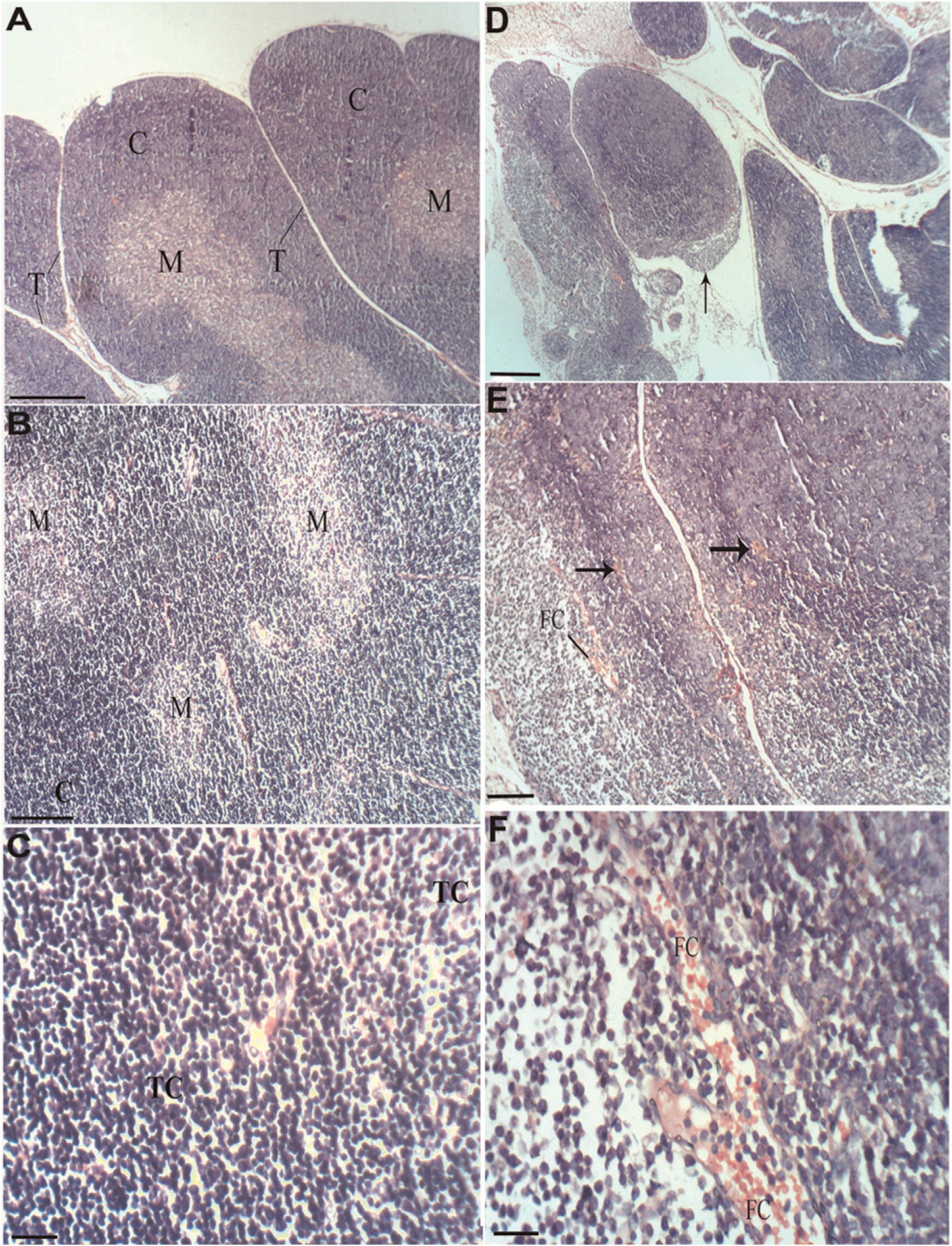
FIG. 3.
A–C. Photomicrographs of sections in thymus (H&E) from control rats (saline treated) showing A. the normal architecture of thymus lobules, separated by trabeculae (T), with outer cortex (C) and inner medulla (M). B, C. High magnifications with rare tinctorial change. D–F. Photomicrographs of sections in thymus (H&E) from rats orally inoculated with freshly isolated L3 of Anisakis simplex showing D. atrophy of the thymus (arrow) and striking tinctorial change in the cortical region because of marked apoptosis of the lymphocytes. E,F. lymphocytic necrosis, depletion (arrows), and focal hemorrhage (FC). (Scale bars: A, D = 500 μm; B, E = 200 μm; C, F = 50 μm).
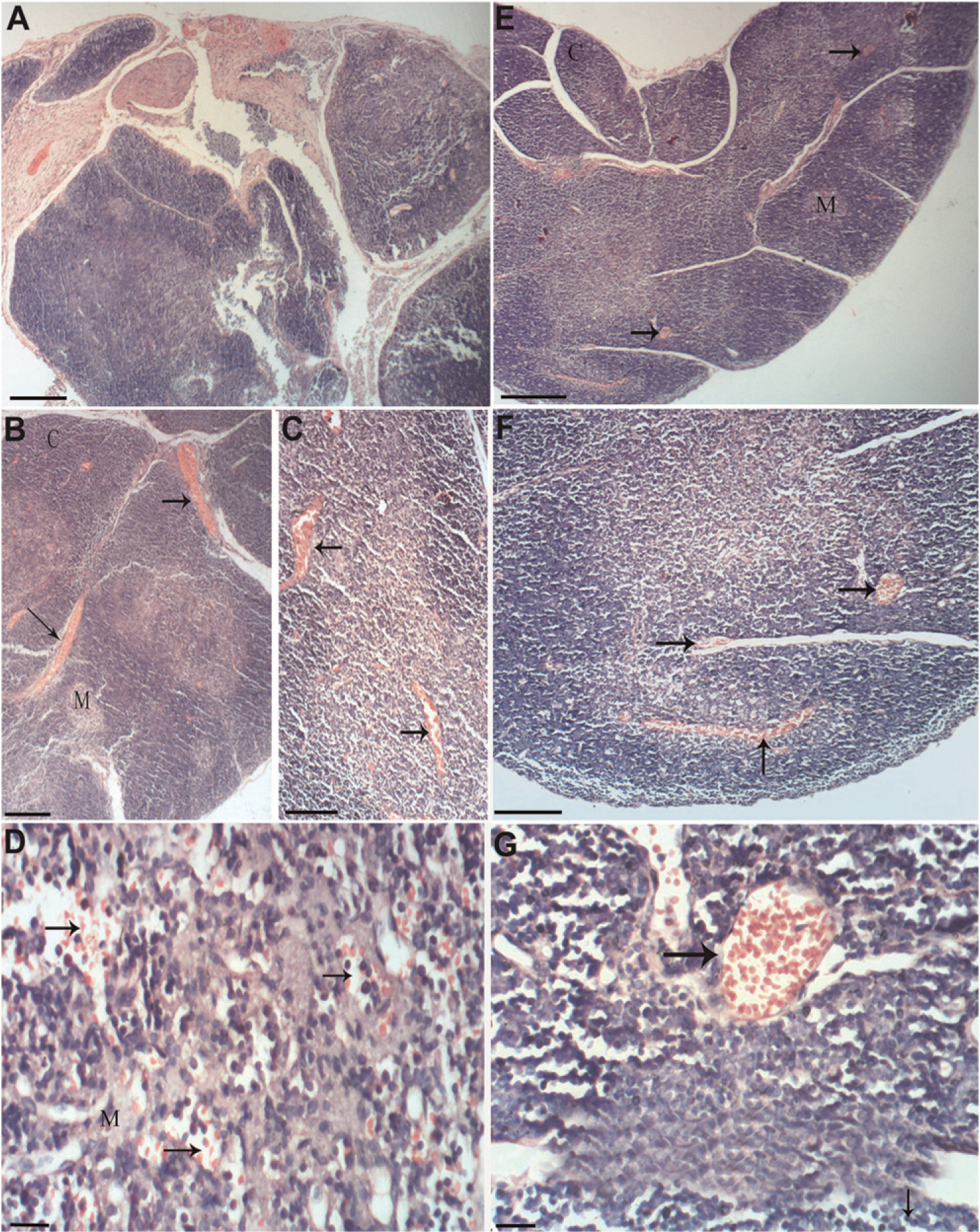
FIG. 4.
A–D. Photomicrographs of sections in thymus (H&E) from rats orally inoculated with frozen Anisakis spp. Type II (L3) showing: A–C. Necrosis and inflammation of the cortical tissue and congested blood vessels (arrow). D. Lymphocytic depletion (arrows). E–G. Photomicrographs of section in thymus (H&E) from rat orally inoculated with thermally treated L3 showing: E. Decreased cellularity in the medulla region leading to the difficulty of determining the ratio between cortex and medulla and congested blood vessels (arrow). F, G. congested blood vessels (arrow). (Scale bars: A, E = 500 μm; B, C, F = 200 μm; D, G = 50 μm).
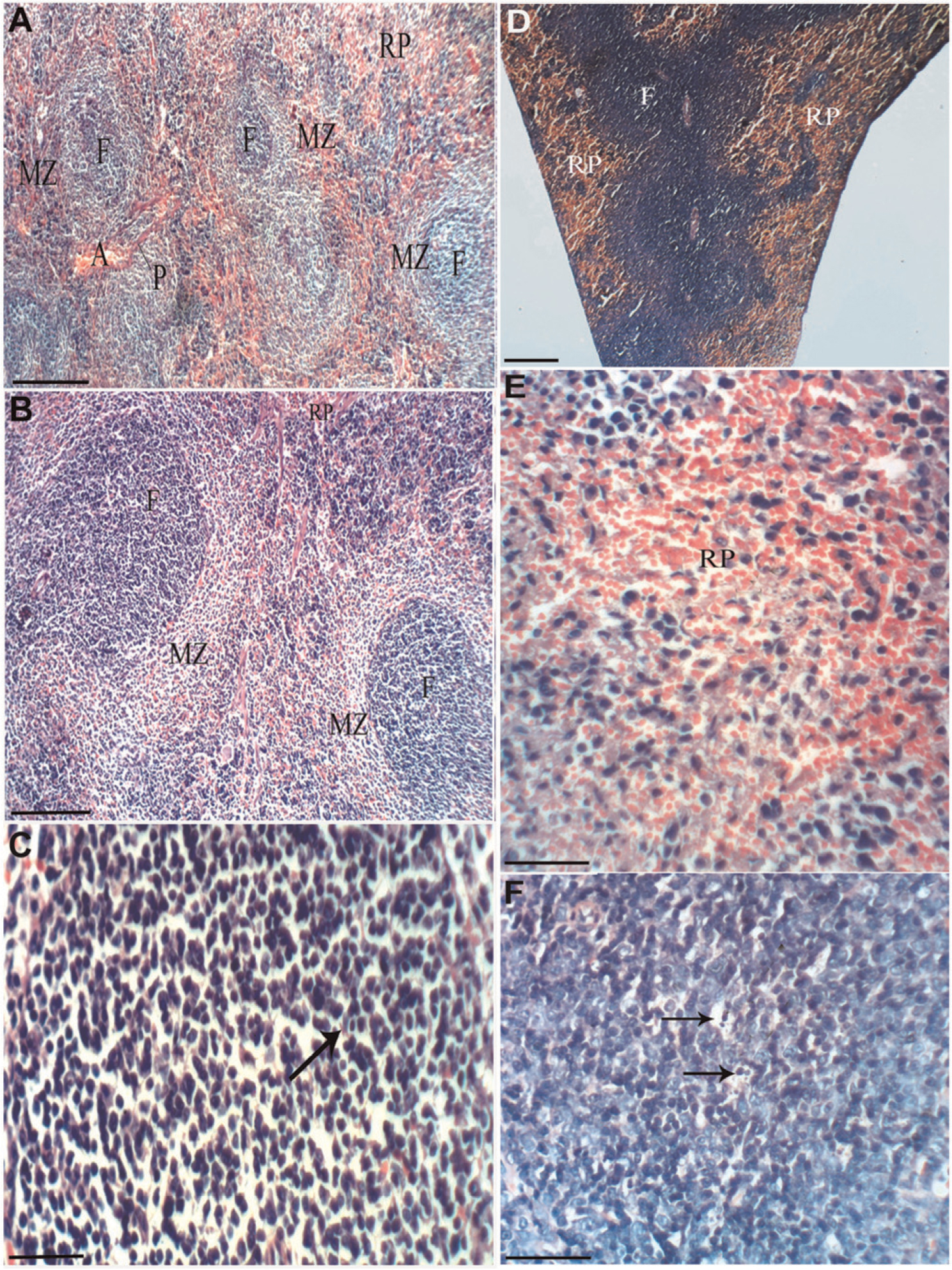
FIG. 5.
A–C. Photomicrographs of the spleen sections (H&E) from control rats (saline treated) showing A, B. the normal architecture of the spleen tissue with red (RP) and white pulps; the white pulp is composed of PALS area (P) surrounding central artery, the lymphoid follicle (F), and the marginal zone (MZ) surrounding the follicle. C. A high magnification, apoptotic bodies were observed (arrow). D–F. Photomicrographs of the spleen section (H&E) from rats orally inoculated with freshly isolated L3 showing D, E. congestion of red pulp (RP). F. Lymphocytic necrosis and depletion (arrow). (Scale bars: A = 300 μm; B = 200 μm; D = 500 μm; C–F = 50 μm).
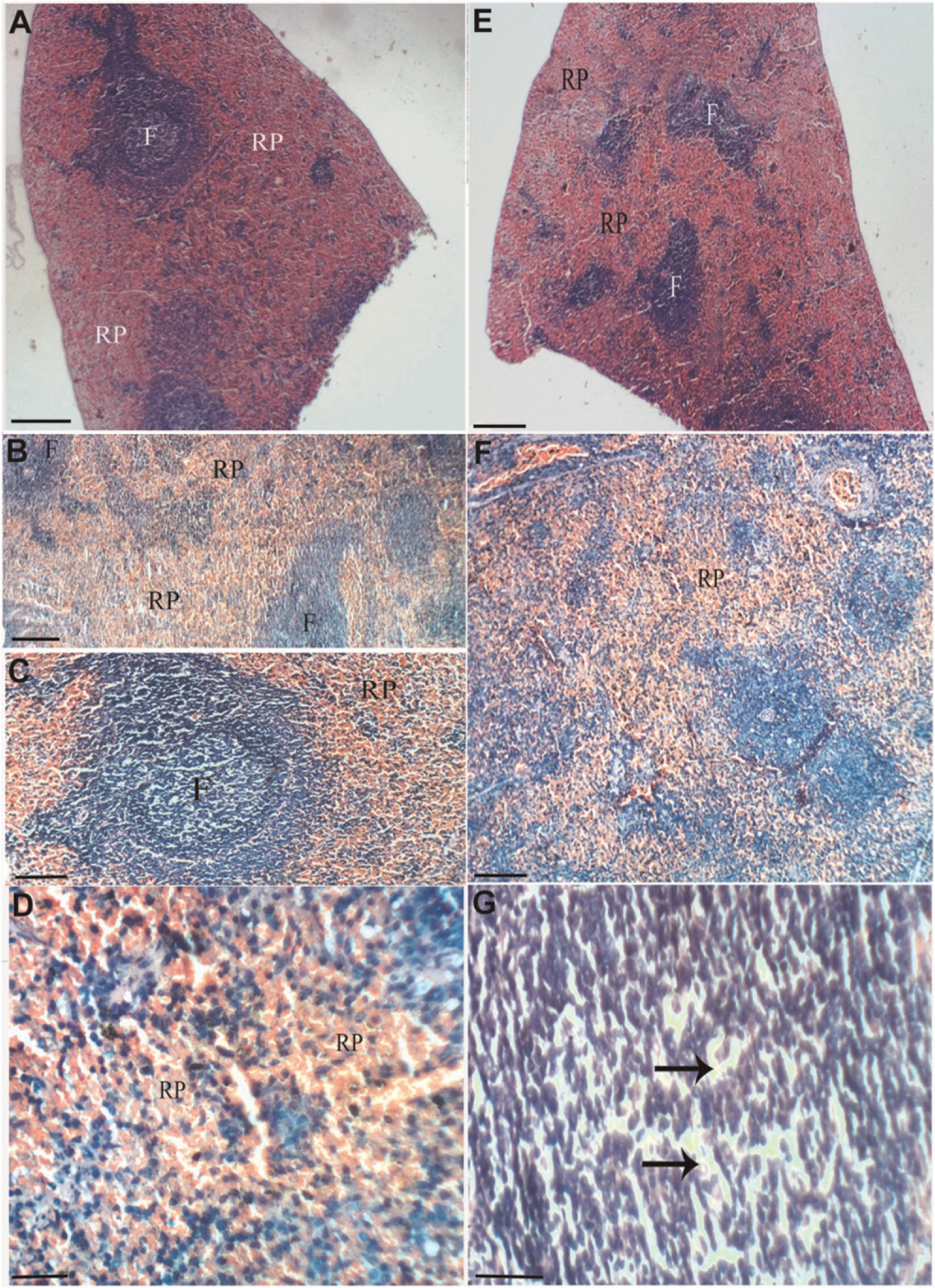
FIG. 6.
A–D. Photomicrographs of the spleen sections (H&E) from rats orally inoculated with frozen L3 showing A–C. severe congestion of red pulp (RP) indicating a difficulty to determine the area percentage between the spleen pulps. E–F. Photomicrographs of the spleen sections (H&E) from rats orally inoculated with thermally treated L3 showing: E, F. Severe congestion of red pulp (RP). D, G. Lymphocytic necrosis and depletion in white pulp (arrows). (Scale bars: A, E = 300 μm; B, C, F = 200 μm; D, G = 50 μm).
TABLE 1.
Kruskal–Wallis analysis for different parameters of the thymus and spleen from control as well as experimental rat groups inoculated (oral) with Anisakis Type II (L3).
| Experimental rat groups | Organ | |||||||||
|---|---|---|---|---|---|---|---|---|---|---|
| Thymus | ||||||||||
| Cortex | Medulla | Spleen (white pulp) | ||||||||
| Area | Area fraction | Area% | Lymphocyte count | Area | Area fraction | Area% | Follicle area | Follicular perimeter | Lymphocyte count | |
| Control | 4781.85 ± 1302 | 0.402 ± 0.11 | 40.25 ± 10.96 | 181.6 ± 4.37 | 5748.88 ± 1254.73 | 0.484 ± 0.10 | 48.39 ± 10.59 | 4335.09 ± 206.71 | 257.22 ± 9.98 | 148.40 ± 8.30 |
| Per oral inoculation with fresh L3 | 2777.56 ± 2000.10 | 0.234 ± 0.01 | 23.38 ± 1.68 | 130 ± 4.60 ** | 3811.41 ± 633.14 | 0.320 ± 0.05 | 32.08 ± 5.32 | 6056.71 ± 1833.78 | 300.24 ± 59.83 | 190.80 ± 8.30 ** |
| Per oral inoculation with frozen | 4325.49 ± 836.97 | 0.364 ± 0.07 | 36.41 ± 7.04 | 200.60 ± 2.52 * | 5562.02 ± 739.48 | 0.468 ± 0.06 | 46.82 ± 6.22 | 5272.61 ± 905.76 | 272.25 ± 25.85 | 140.00 ± 12.96 |
| Per oral inoculation with thermally treated L3 | 3657.39 ± 724.36 | 0.308 ± 0.06 | 30.78 ± 6.09 | 208.60 ± 6.55 ** | 5040.2 ± 1050.13 | 0.424 ± 0.08 | 42.42 ± 8.83 | 4322.01 ± 583.52 | 248.06 ± 18.38 | 201.60 ± 6.04 ** |