
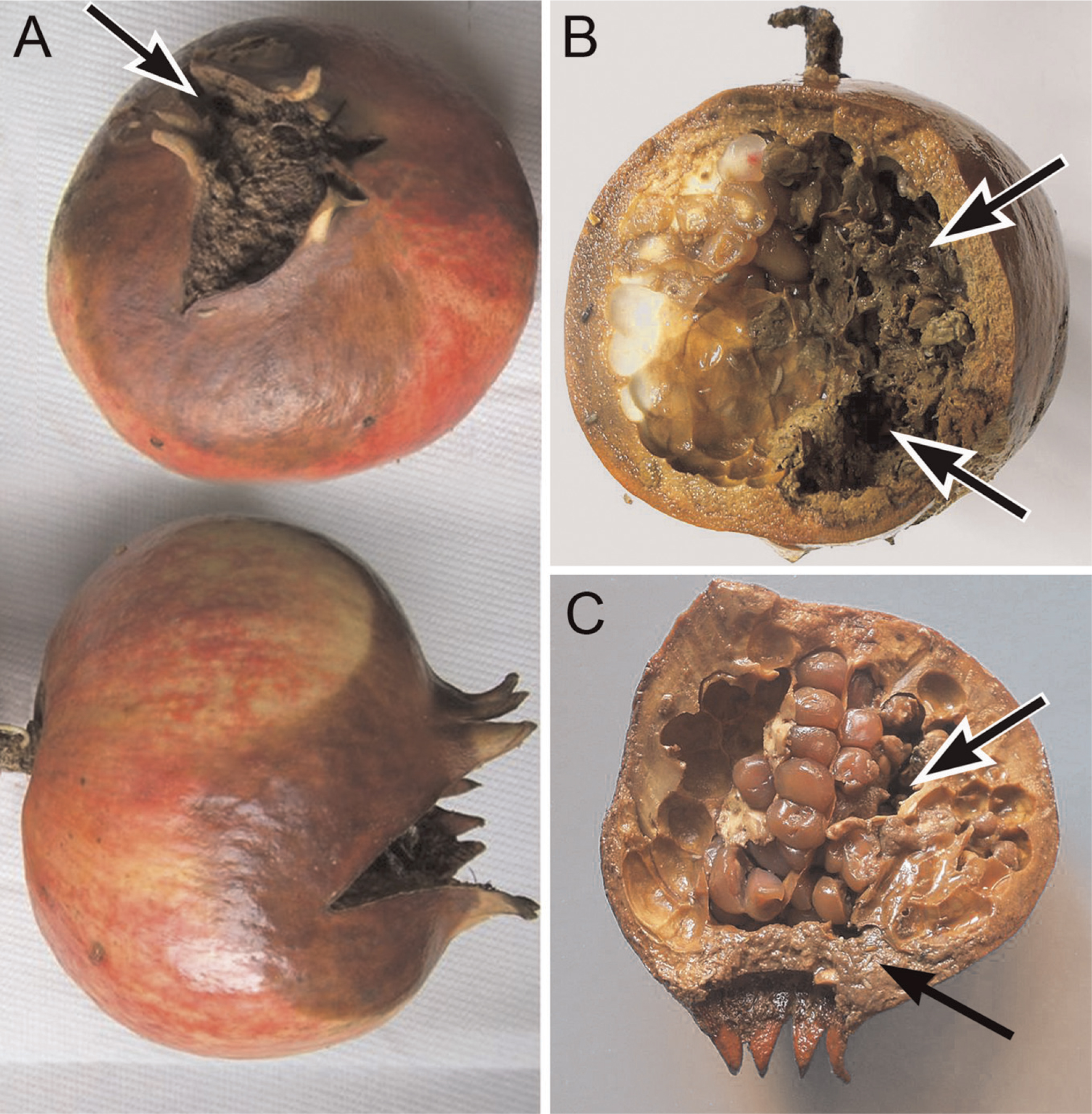
FIG. 1.
Pomegranate decaying fruit hosting fungi, the nematode mycetophagus (Sheraphelenchus sucus), and bacteriophagus (Panagrolaimus sp.) populations. A. Top (top) and lateral (bottom) view of the entire decaying fruit; B, C. Cross-section of an affected pomegranate showing more or less extensive rotting tissue portions.
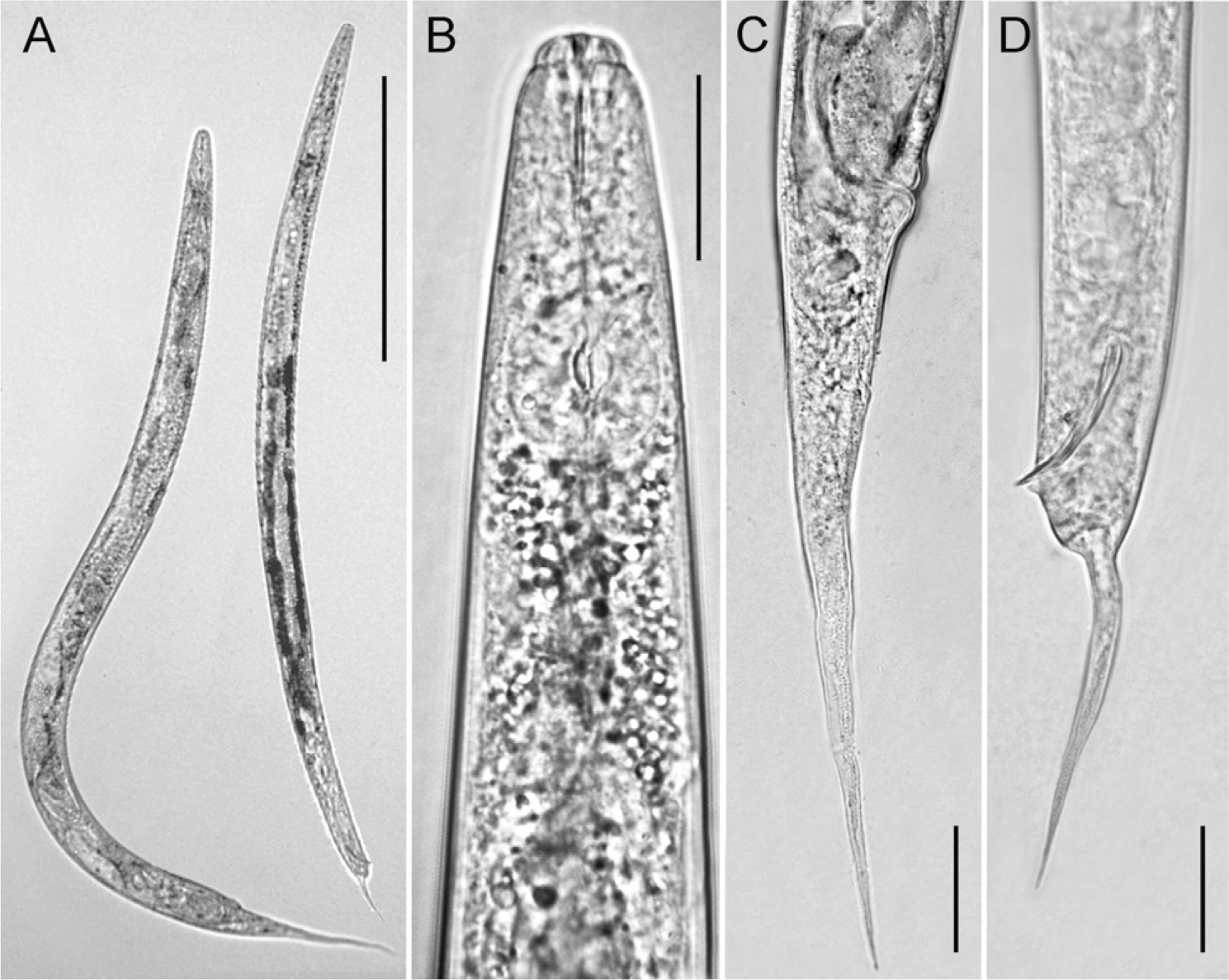
FIG. 2.
Light microscopy micrographs illustrating morphodiagnostic characters of freshly mounted specimens of the Italian bisexual population of Sheraphelenchus sucus. A. Female (left) and male (right) entire body; B. Female anterior end; C. Female tail; D. Male tail with spicules (Scale bars: A = 250 μm; B–D = 20 μm).
TABLE 1.
Morphometric comparison of the Italian populations of Sheraphelenchus sucus with populations of S. entomophagus and S. sucus from the literature. All measurements are in micrometers and in the form: mean ± s.d. (range).
| S. sucus | S. sucus | S. entomophagus | S. entomophagus | S. sucus | S. sucus type isolate | |||||||
|---|---|---|---|---|---|---|---|---|---|---|---|---|
| Metaponto (MT) population | Fasano (BR) population | (Moosavi et al., 2014) | (Nickle, 1970) | (Fang et al., 2015) | (Kanzaki and Tanaka, 2013) | |||||||
| Male | Female | Male | Female | Male | Female | Male | Female | Male | Female | Male | Female | |
| n | 4 | 11 | 12 | 12 | 10 | 10 | 12 | 12 | 20 | 20 | 15 | 16 |
| L | 770 ± 50.7 | 690 ± 98.3 | 678 ± 78 | 690 ± 59 | 559.6 ± 58.5 | 626.3 ± 68.7 | 682.0 | 697.0 | 575 ± 70 | 597 ± 83 | 527 ± 41 | 623 ± 82 |
| (714–817) | (560–868) | (612–744) | (748–866) | (431–630) | (550–782) | (478–1,186) | (532–975) | (494–751) | (500–876) | (483–601) | (451–719) | |
| a | 23.4 ± 0.8 | 22.8 ± 0.8 | 24 ± 1.8 | 27 ± 0.8 | 20.4 ± 2.6 | 21.2 ± 2.7 | 24.1 | 23.3 | 25.4 ± 1.9 | 24.2 ± 2.0 | 23.2 ± 2.5 | 22.8 ± 1.7 |
| (22.9–24.7) | (22.0–24.6) | (22–26) | (23–31) | (16.5–25.4) | (18.2–27.4) | (20.5–27.3) | (19.7–26.3) | (22.6–30.4) | (20.7–27.4) | (19.4–27.8) | (20.2–26.3) | |
| c | 12.9 ± 0.4 | 7.7 ± 0.5 | 11 ± 0.4 | 8 ± 0.5 | 9.9 ± 0.7 | 6.8 ± 0.9 | 14.4 | 8.7 | 10.8 ± 1.0 | 7.5 ± 0.7 | 10.8 ± 1.4 | 7.6 ± 0.7 |
| (12.5–13.3) | (6.8–8.3) | (8–14) | (7–9) | (8.7–11.0) | (5.5–8.3) | (10.7–22.6) | (7.5–10.2) | (9.3–12.8) | (6.5–9.3) | (8.5–13.8) | (6.6–9.4) | |
| c′ | 3.6 ± 0.2 | 7.2 ± 0.8 | 4.6 ± 0.5 | 7.2 ± 0.8 | 3.9 ± 0.7 | 7.3 ± 0.9 | 4.1 ± 0.2 | 7.2 ± 0.7 | 3.9 ± 0.4 | 6.9 ± 0.7 | ||
| (3.4–3.8) | (6.2–8.3) | (3.9–5.8) | (6.4–9.4) | (3.2–4.6) | (6.7–8.4) | (3.8–4.6) | (5.9–8.8) | (2.9–4.6) | (5.8–8.3) | |||
| T or V | 68.2 ± 3.7 | 82.6 ± 0.9 | 57 ± 1.7 | 78.5 ± 0.9 | 60.5 ± 4.3 | 79.3 ± 1.5 | 59.9 ± 5.0 | 80.9 ± 0.9 | 56.6 ± 7.8 | 82.3 ± 1.2 | ||
| (66.0–72.4) | (81.1–84.2) | (46–68) | (75–82) | (57.5–67.0) | (76.5–81.0) | (45.3–66.6) | (79.0–82.8) | (41.5–70.0) | (80.3–85.1) | |||
| Max. body diam. | 32.9 ± 2.8 | 30.2 ± 4.3 | 18.5 ± 0.8 | 25 ± 3.1 | 17.8 ± 3.5 | 26.2 ± 3.2 | 28.4 | 29.9 | 22.7 ± 2.5 | 24.7 ± 2.6 | 23.0 ± 3.4 | 27.5 ± 4.6 |
| (30.0–35.6) | (25.0–38.7) | (18–19) | (20–30) | (14.5–23.5) | (20.0–30.0) | (21.4–53.3) | (22.8–45.4) | (19.7–28.8) | (20.6–33.2) | (19.5–31.0) | (17.5–33.0) | |
| Lip diam. | 9.5 ± 0.3 | 9.3 ± 0.5 | 8.5 ± 0.5 | 9.5 ± 0.6 | 7.4 ± 0.3 | 8.0 ± 0.4 | 7.9 ± 0.5 | 8.1 ± 0.7 | 8.0 ± 0.5 | 8.5 ± 0.5 | ||
| (9.2–9.8) | (8.5–10.2) | (8–9) | (9–10.5) | (7.0–7.5) | (7.6–8.2) | (6.9–8.8) | (7.0–9.6) | (7.5–9.0) | (7.0–9.0) | |||
| Lip height | 3.7 ± 0.3 | 3.6 ± 0.3 | 2 ± 0.3 | 3 ± 0.3 | 2.5 ± 0.4 | 3.0 ± 0.5 | 3.1 ± 0.3 | 3.2 ± 0.3 | 3.5 ± 0.3 | 3.5 ± 0.3 | ||
| (3.4–4.1) | (3.1–4.0) | (3.4–4.1) | (2.6–3.5) | (2.0–3.0) | (2.5–3.5) | (2.7–3.6) | (2.8–4.0) | (2.5–4.0) | (3.0–4.5) | |||
| Stylet length | 13.4 ± 0.4 | 13.4 ± 0.6 | 13.5 ± 0.8 | 13.5 ± 0.6 | 12.0 ± 1.3 | 11.5 ± 1.2 | 12.3 | 12.0 | 13.5 ± 0.3 | 13.2 ± 0.4 | 14.9 ± 0.8 | 15.2 ± 1.1 |
| (12.9–13.7) | (12.6–14.0) | (12.8–14.2) | (13–14) | (9.5–14.0) | (10.0–15.0) | (11.3–13) | (11.3–13.0) | (12.8–14.0) | (12.3–13.9) | (13.7–16.2) | (14.1–17.3) | |
| Median bulb diam. | 13.9 ± 0.8 | 13.2 ± 1.3 | 14.5 ± 0.8 | 15 ± 1 | 11.5 ± 0.8 | 13.0 ± 0.6 | 11.8 ± 0.8 | 12.3 ± 1.0 | 12.0 ± 0.7 | 12.5 ± 1.3 | ||
| (13.1–14.9) | (11.1–15.5) | (13–16) | (14–16) | (10.5–12.0) | (12.3–13.6) | (10.3–13.3) | (10.7–13.8) | (10.5–13.5) | (10.5–14.5) | |||
| Median bulb length | 16.9 ± 0.2 | 17.2±0.7 | 17.5 ± 0.3 | 18 ± 1.2 | 15.7± 2.6 | 18.0 ± 0.5 | 16.0 ± 0.7 | 17.0 ± 1.0 | 15.5 ± 0.7 | 16.5 ± 1.1 | ||
| (16.6–17.2) | (15.6–18.3) | (17–18) | (16–19) | (12.5–18.5) | (17.6–18.5) | (14.7–17.4) | (14.9–20.0) | (14.0–17.0) | (15.5–18.5) | |||
| Spicule (dorsal limb) | 27.6 ± 2.0 | – | 26 ± 1.8 | – | 24.5 ± 0.5 | – | 21.9 | 22.1 ± 1.5 | – | – | – | |
| (25.0–30.0) | (25–30) | (21.0–30.0) | (18.9–25.2) | – | (19.0–24.9) | |||||||
| Tail length | 59.5 ± 3.2 | 90.3 ± 10.9 | 52.5 ± 5.2 | 8.9 ± 13 | 52.0 ± 9.0 | 87.0 ± 9.0 | 53 ± 3.5 | 80 ± 11.0 | 49 ± 6.1 | 82 ± 9.5 | ||
| (55.0–62.8) | (77.2–106.9) | (40–65) | (52–118) | (42.5–60.0) | (79.0–97.0) | (48–59) | (57–116) | (41–63) | (63–93) | |||
| Anal body diam. | 16.5 ± 0.8 | 12.4 ± 1.0 | 10 ± 0.8 | 16.4 ± 1.0 | 13.5 ± 0.5 | 12.0 ± 0.6 | 12.9 ± 0.8 | 11.1 ± 1.0 | 12.5 ± 0.8 | 12.0 ± 1.1 | ||
| (15.9–17.7) | (11.0–14.6) | (9–12) | (16–17) | (13.0–14.0) | (11.5–12.5) | (11.8–14.5) | (9.0–13.2) | (12.0–14.5) | (9.5–13.5) | |||
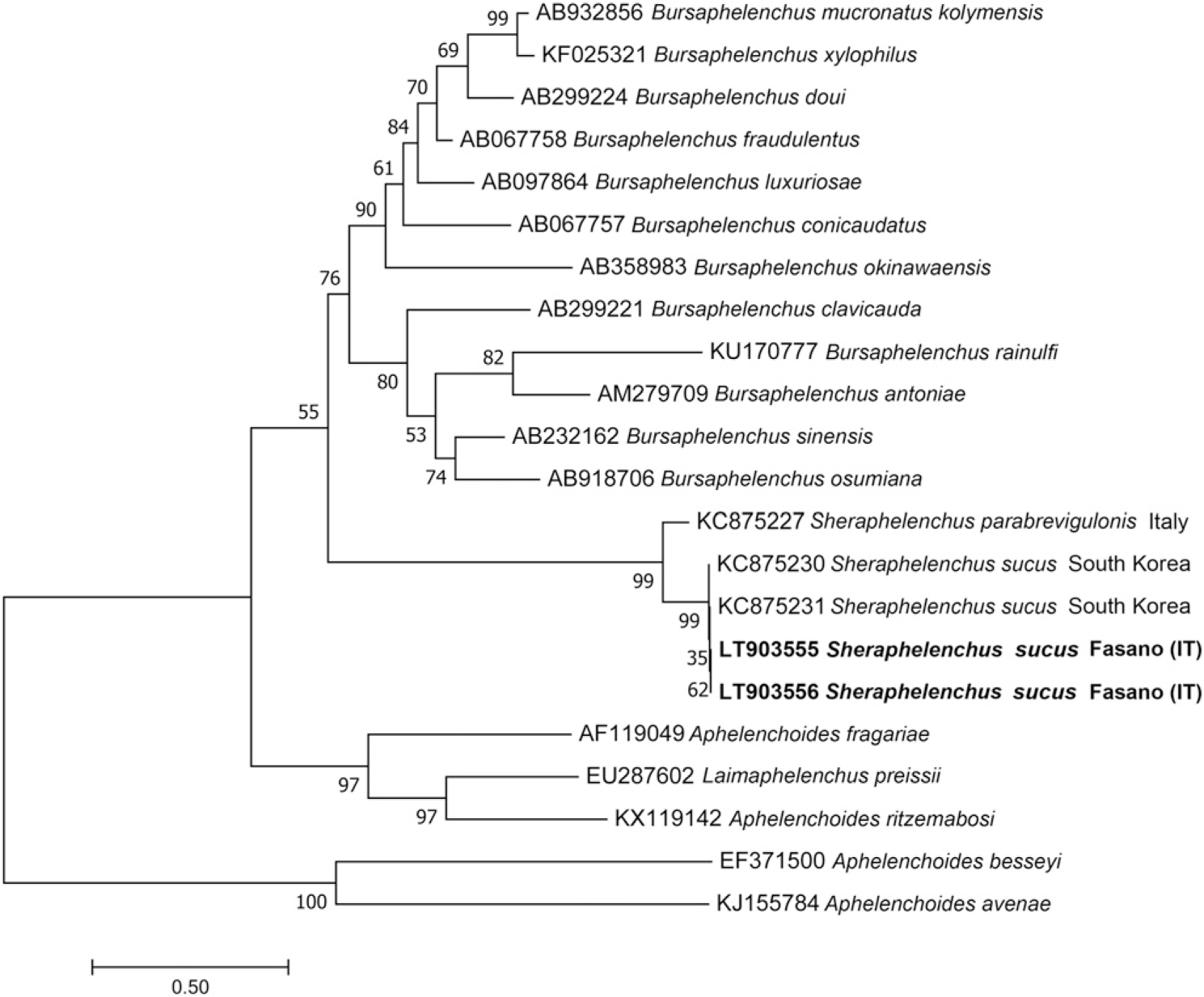
FIG. 3.
Phylogenetic tree based on ITS sequences describing the evolutionary relationships among different Sheraphelenchus and Bursaphelenchus species using the Maximum Likely (ML) method. Branch lengths are proportional to the distances as derived from the distance matrix obtained using the General Time Reversible (GTR) method with the invariant site plus gamma options. Numbers at nodes indicate bootstrap values.
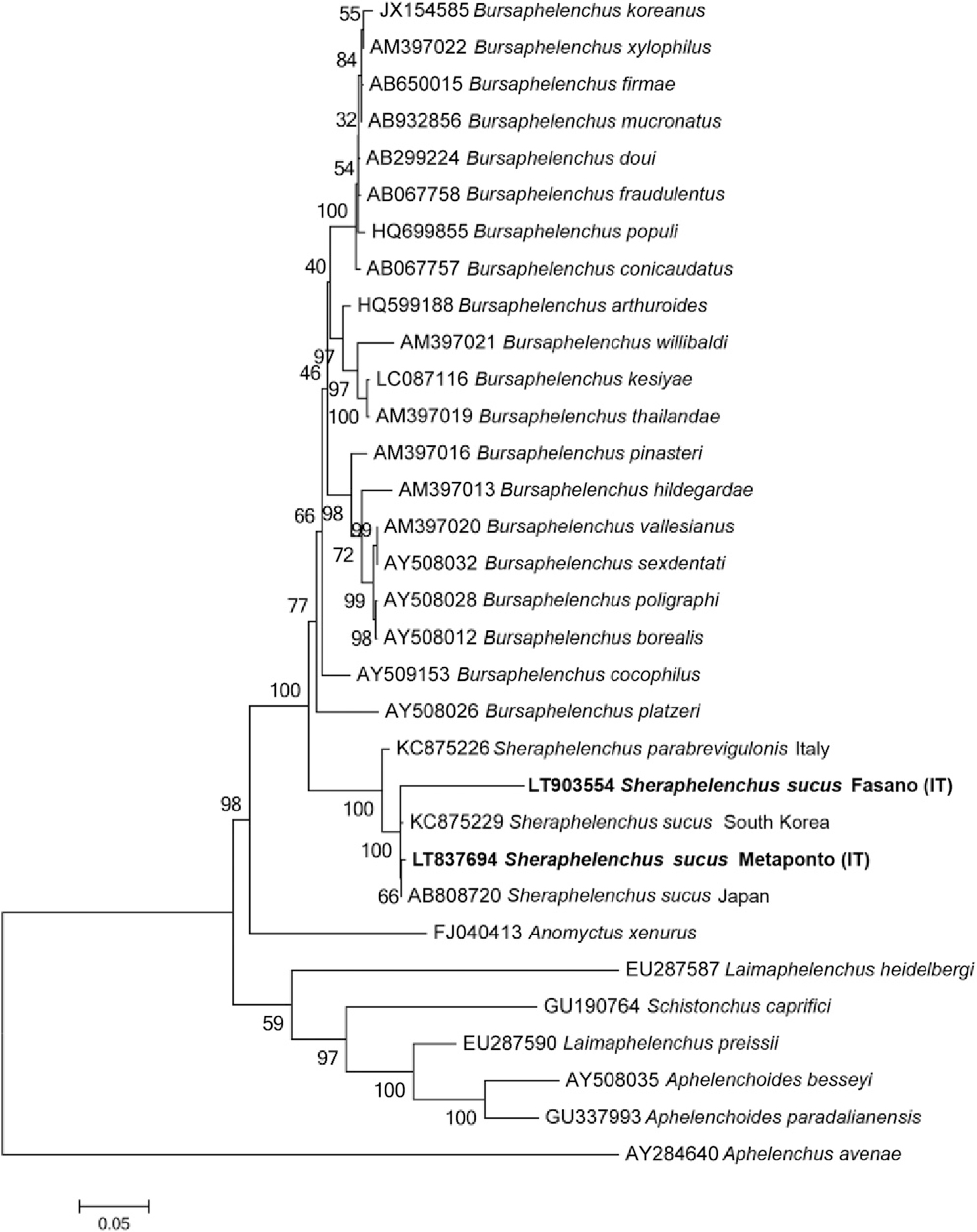
FIG. 4.
Phylogenetic tree based on 18S rRNA gene describing the evolutionary relationships among different Sheraphelenchus and Bursaphelenchus species using the Maximum Likely (ML) method. Branch lengths are proportional to the distances as derived from the distance matrix obtained using the General Time Reversible (GTR) method with the invariant site plus gamma options. Numbers at nodes indicate bootstrap values.
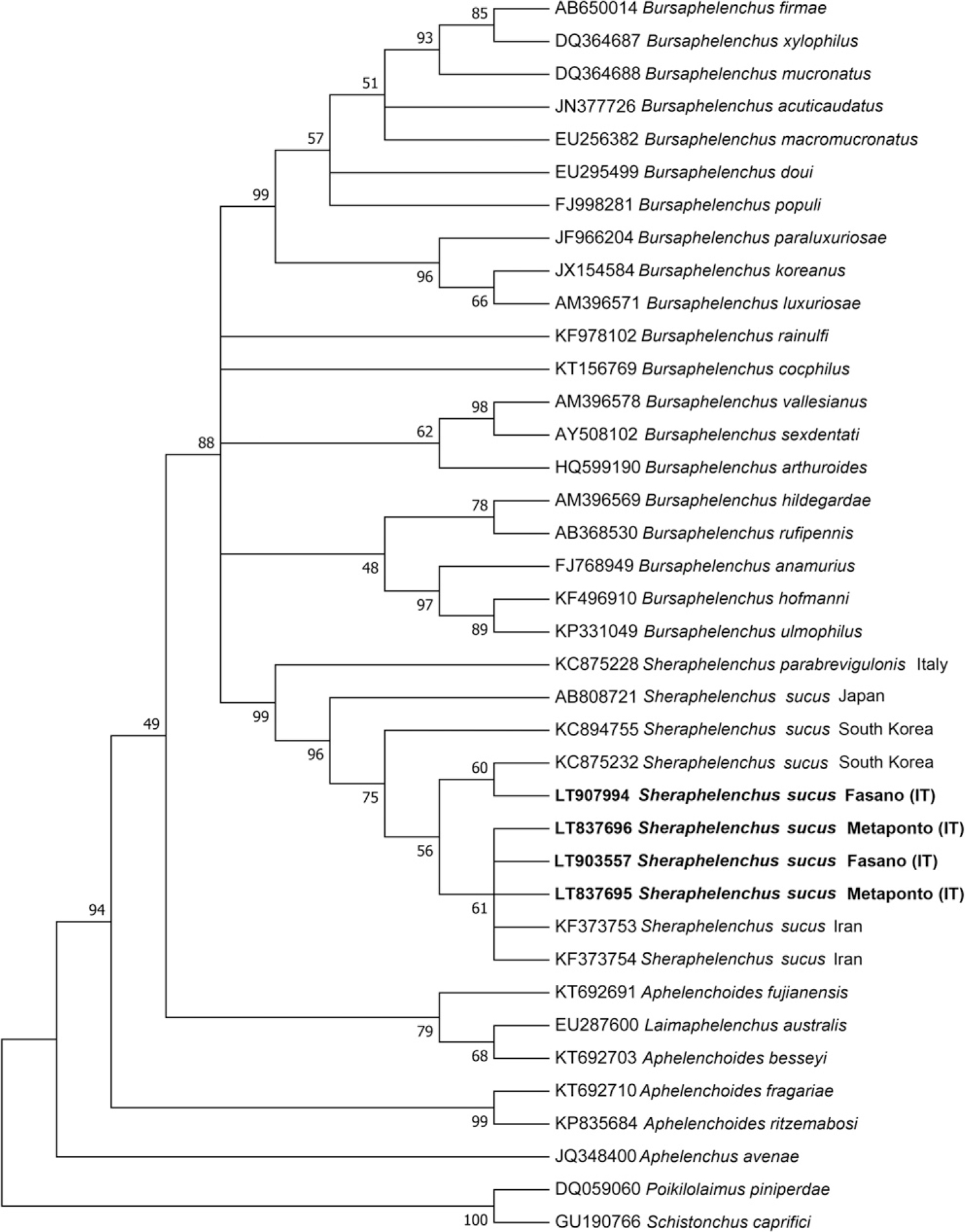
FIG. 5.
Phylogenetic tree based on D2–D3 expansion domains of 28S rRNA gene describing the evolutionary relationships among different Sheraphelenchus and Bursaphelenchus species using the Maximum Likely (ML) method. Branch lengths are proportional to the distances as derived from the distance matrix obtained using the General Time Reversible (GTR) method with the invariant site plus gamma options. Numbers at nodes indicate bootstrap values.
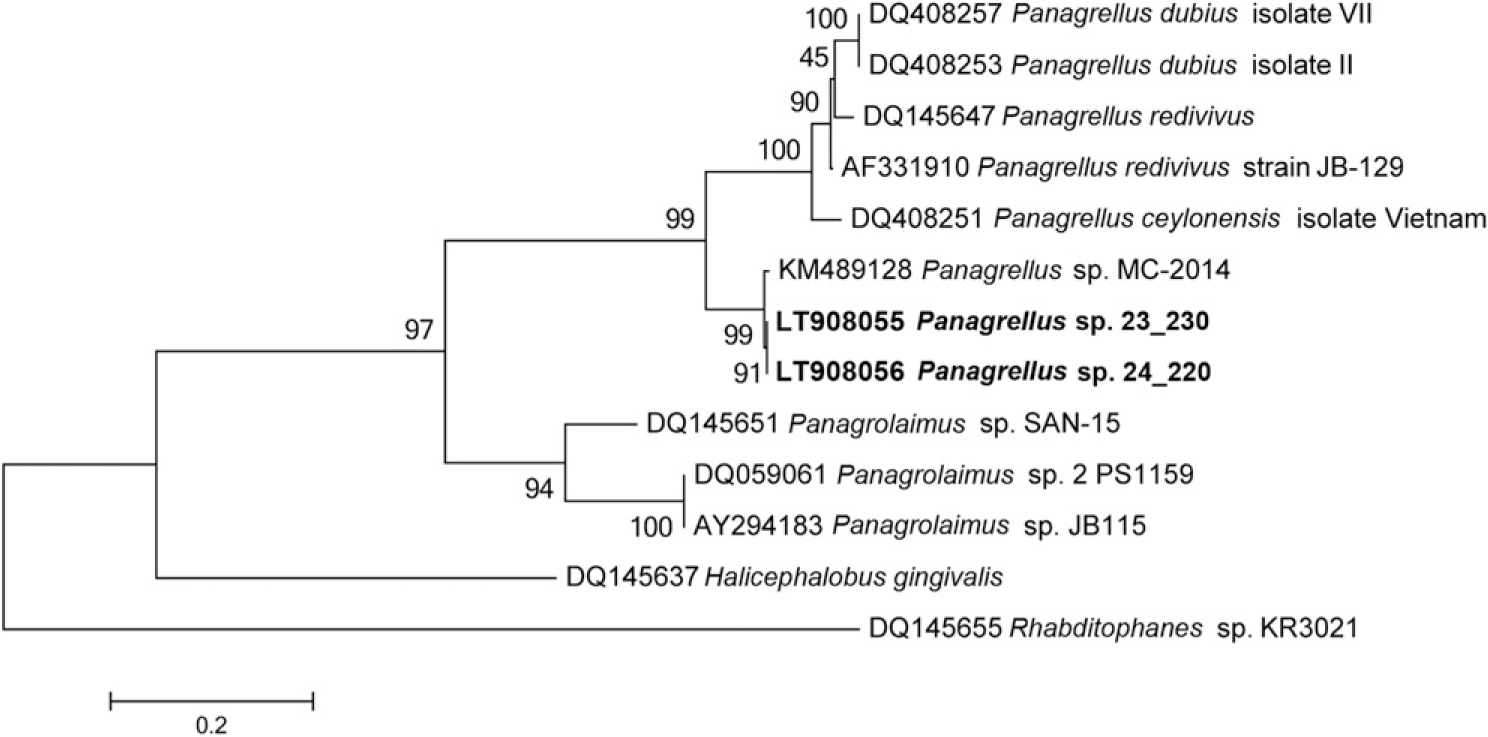
FIG. 6.
Phylogenetic tree based on D2–D3 expansion domains of 28S rRNA gene describing the evolutionary relationships among different Panagrellus species using the Maximum Likely (ML) method. Branch lengths are proportional to the distances as derived from the distance matrix obtained using the General Time Reversible (GTR) method with the invariant site plus gamma options. Numbers at nodes indicate bootstrap values.