
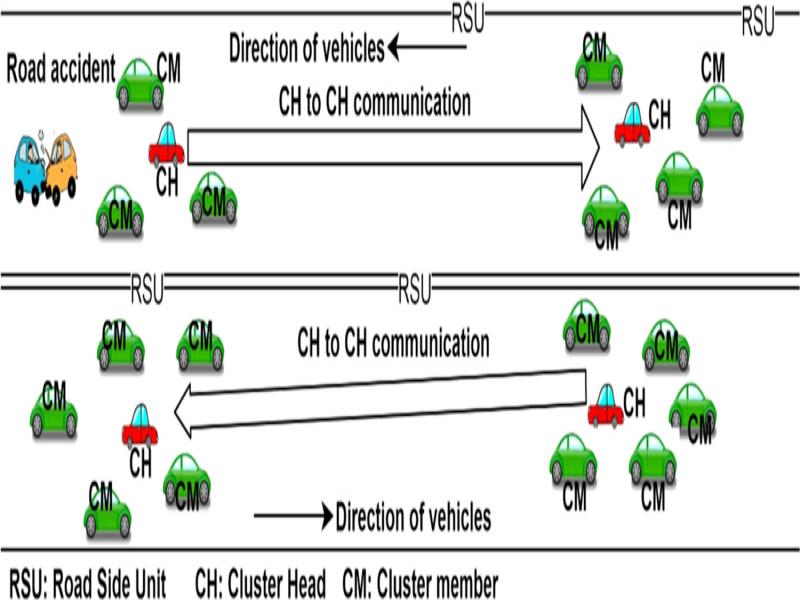
Figure 1:
Basic clustering communication model in VANET.
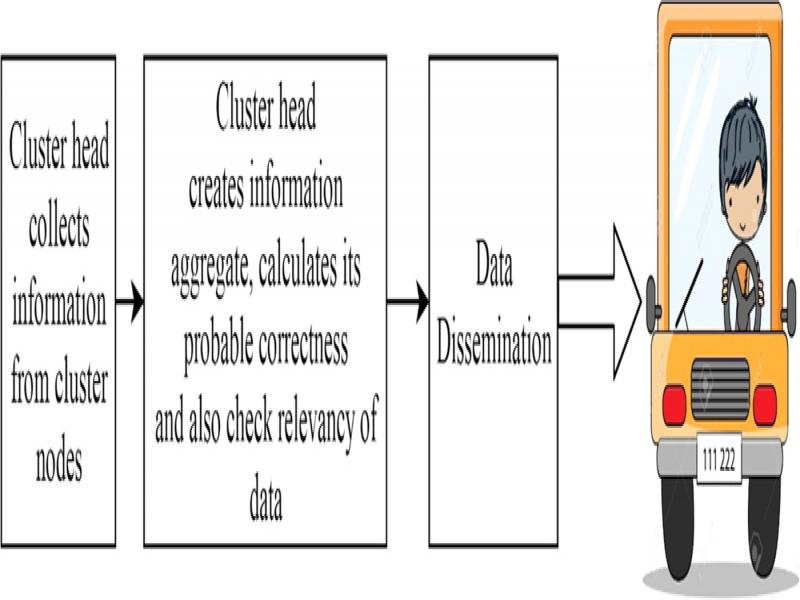
Figure 2:
Basic model for information flow.
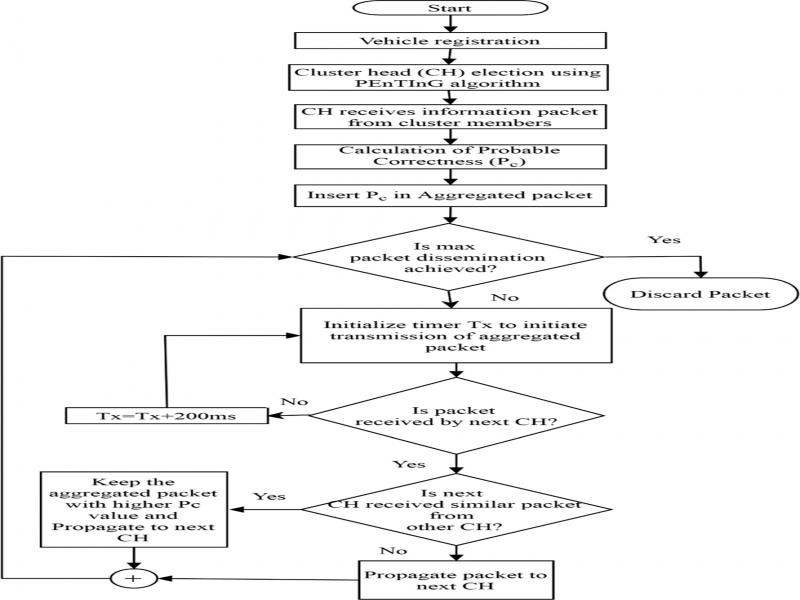
Figure 3:
Data aggregation and dissemination process.
Table 1.
Simulation parameters.
| Parameter | Value or type |
|---|---|
| Simulation area | 2500 m × 2500 m |
| Simulation time | 600s |
| Radio model | Two-ray ground |
| MAC layer | IEEE802.11 |
| Number of vehicles | 50–400 |
| Vehicle speed | 40–120 km/h |
| Constant bit rate (CBR rate) | 1–4 packet/s |
| Vehicle communication range | 500 m |
| Bandwidth | 20Mbps |
| Data packet size | 500–2,500 byte |
| Cache replacement policy | FIFO |
| Mobility model | Manhattan |
| Traffic environment | Urban |
| Number of lanes | 4–8 |
| Traffic type | Multimodal |
| Routing protocol | AODV |
| Number of simulation runs | 10 |
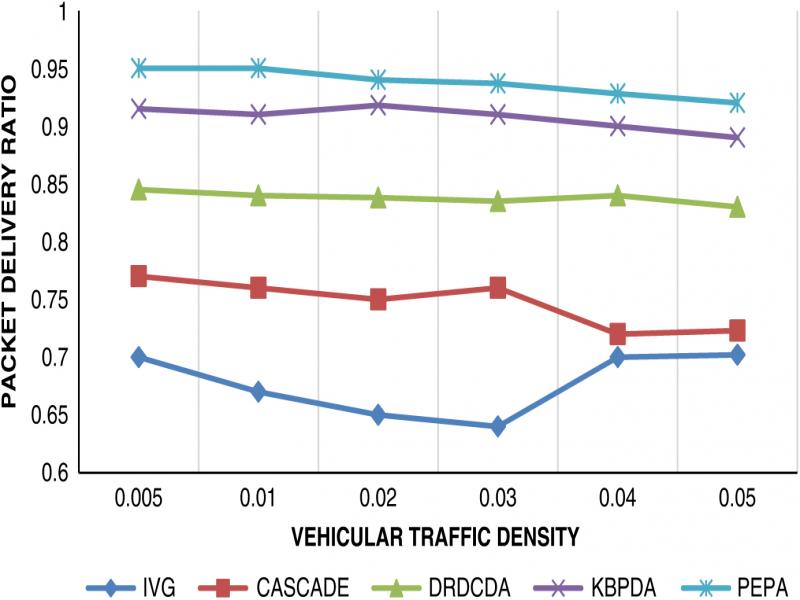
Figure 4:
Packet delivery ratio of PEPA, KBPDA, DRDCA, CASCADE, and IVG under different densities of vehicles.
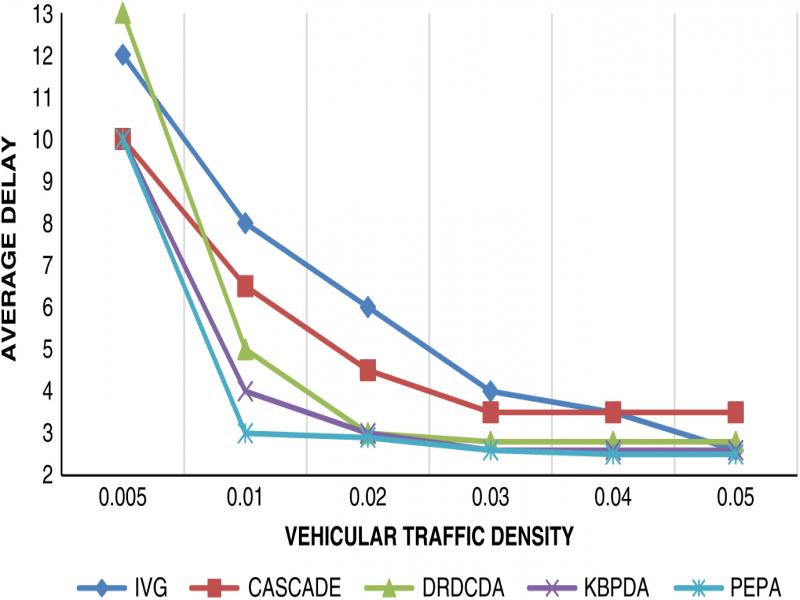
Figure 5:
Average delay of PEPA, KBPDA, DRDCA, CASCADE, and IVG under different densities of vehicles.
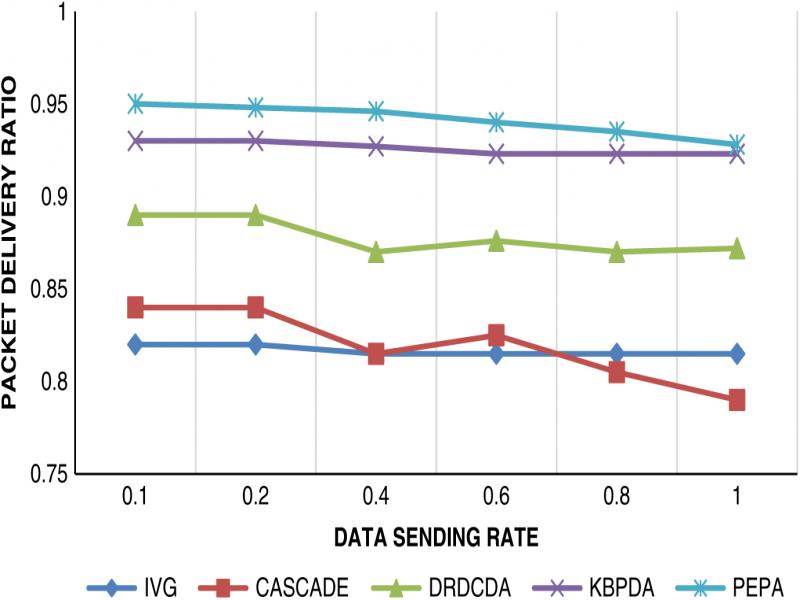
Figure 6:
Packet delivery ratio of PEPA, KBPDA, DRDCDA, CASCADE, and IVG under varying data-sending rates.
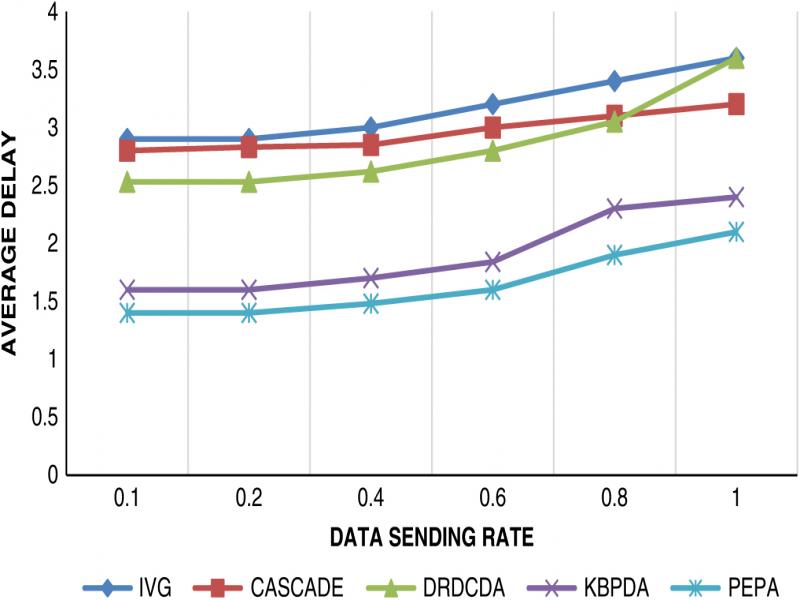
Figure 7:
Average delay of PEPA, KBPDA, DRDCDA, CASCADE, and IVG under varying data-sending rates.
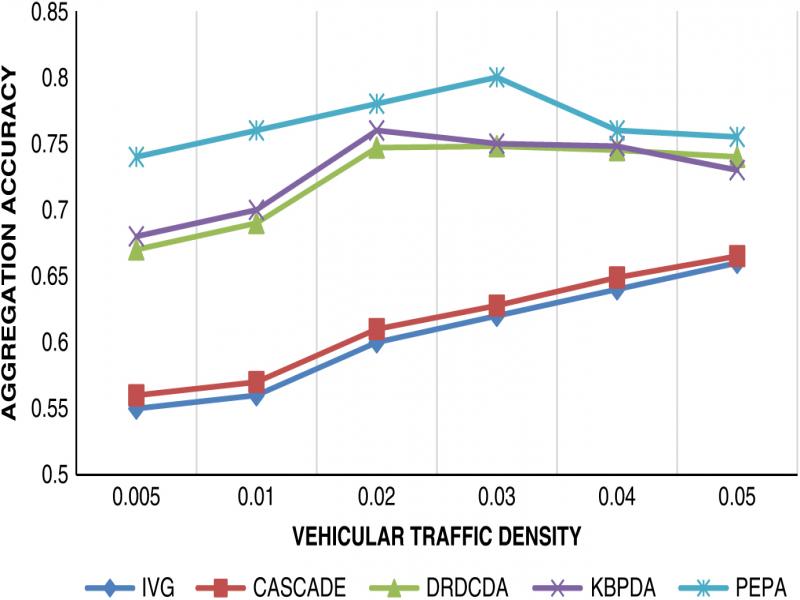
Figure 8:
Aggregation accuracy of PEPA, KBPDA, DRDCDA, CASCADE, and IVG under varying vehicular traffic densities.