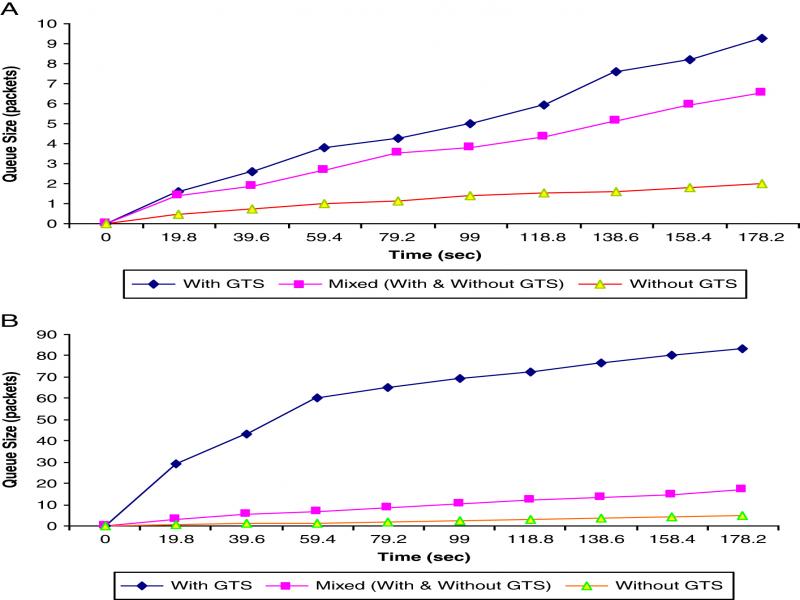
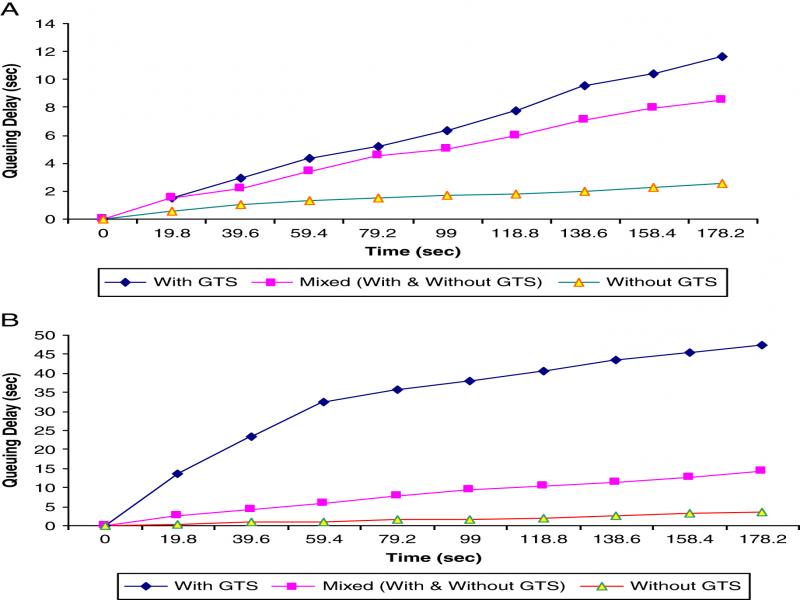
IEEE standard 802.15.4 due to its flexible features such as low data rate, low power consumption, and low cost makes it most suitable for WSNs (Koubaa et al., 2007). Furthermore, ZigBee protocol (ZigBee Specifications ◾) based upon the physical and MAC layers of IEEE standard 802.15.4 completes the protocol stack for building low rate-wireless personal area networks (LR-WPANS). Physical layer of IEEE standard 802.15.4 because of its low data rate, low power consumption, and robustness is suitable for most of the WSN applications. Additionally, the MAC layer with its feature of Superframe makes 802.15.4 even more suited for WSN applications. The Superframe structure is possible only with the use/implementation of beacons as it is the time interval between two successive beacons. If the beacons are not used in WPAN, then GTSs cannot be implemented and guarantee of service (GoS) cannot be provided to the real-time data. The mechanism of allocating the time slots in advance from the superframe to the real-time data sensed by the sensor nodes (SNs) is called GTS mechanism.
The IEEE 802.15.4 protocol because of its suitability to WSNs has made several researchers to work on this protocol (Jurcik et al., 2007; Koubaa et al., 2005a, 2005b, 2006a, 2006b, 2006c, 2006d; Koubaa, Alves, Attia and Nieuwenhuyse, 2006; Koubaa, Alves, Nefzi and Song, 2006, 2007; ZigBee Specifications ◾; IEEE 802.15.4 OPNET Simulation Model ◾; Cunha et al., 2007; Huang et al., 2006; Chen et al., 2008; Li et al., 2008; Hameed et al., 2008; Lee, 2006; Zhang et al., 2008; Tao et al., 2006; Zen et al., 2008; Lee, 2005; Jurick and Koubaa, 2007; Gholamzadeh and Nabovati, 2008). Most of these research works are on evaluation or performance improvement of one or other characteristic of 802.15.4 standard. Jurcik et al. (2007) have evaluated the performance of IEEE standard 802.15.4 for GTS feature and have also highlighted its applicability. Koubaa et al. (2007) have explained the suitability of 802.15.4 in terms of power efficiency, GTSs, and scalability for WSNs. Koubaa et al. (2006c) have evaluated the performance of 802.15.4 for real-time applications using GTSs. Koubaa, Alves, Attia and Nieuwenhuyse (2006) have synchronized ZigBee cluster-tree network by proposing collision-free beacon frame scheduling algorithms. Koubaa et al. (2006a) evaluated the performance of slotted CSMA/CA in the case of broadcast transmissions. Koubaa et al. (2006b) have proposed alternates for GTS as a function of delays. Chen et al. (2008) have developed an accurate analytical model using the Markov chain model for evaluating CSMA/CA in IEEE 802.15.4. Li et al. (2008) have enhanced reliability of 802.15.4 by reducing the packets dropped. Hameed et al. (2008), Lee (2005, 2006), Zhang et al. (2008), Tao et al. (2006), Zen et al. (2008) have researched on analysis, investigations, and performance evaluation of 802.15.4. Koubaa, Alves, Nefzi and Song (2006) have evaluated different parameters of 802.15.4 on the basis of queuing strategies: FIFO and priority queuing. Koubaa et al. (2006d) have modeled a cluster-shaped WSN to guarantee minimum service to each and every node in the network. Koubaa et al. (2005a) have characterized IEEE 802.15.4 standard with respect to its suitability for WSNs. Gholamzadeh and Nabovati (2008) have proposed techniques that reduces the power consumption by WSNs.
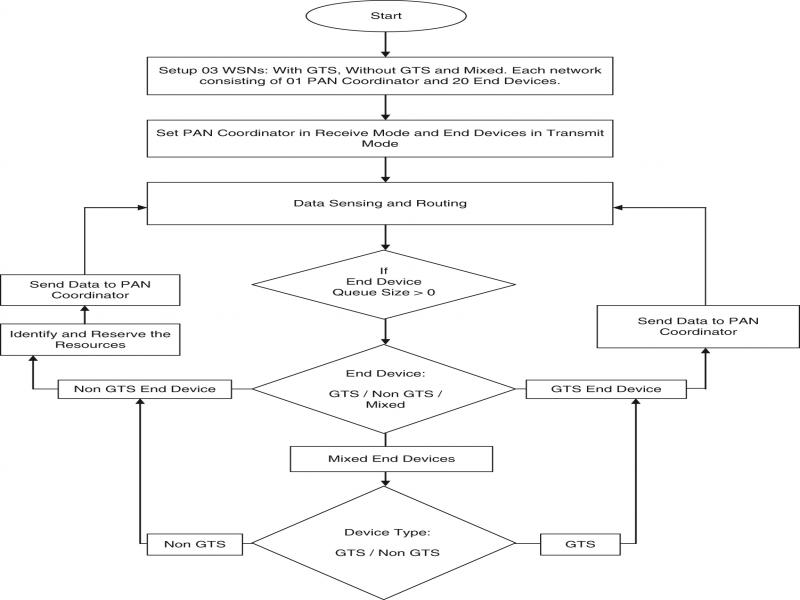
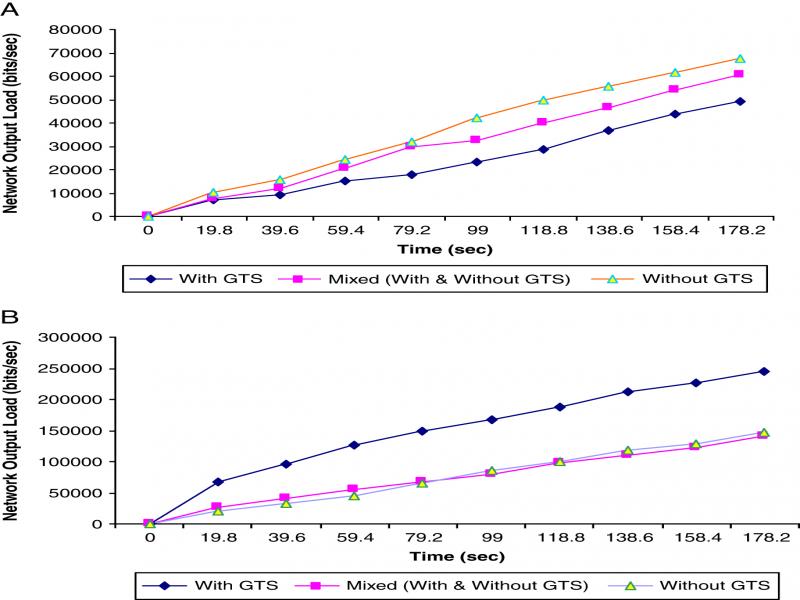
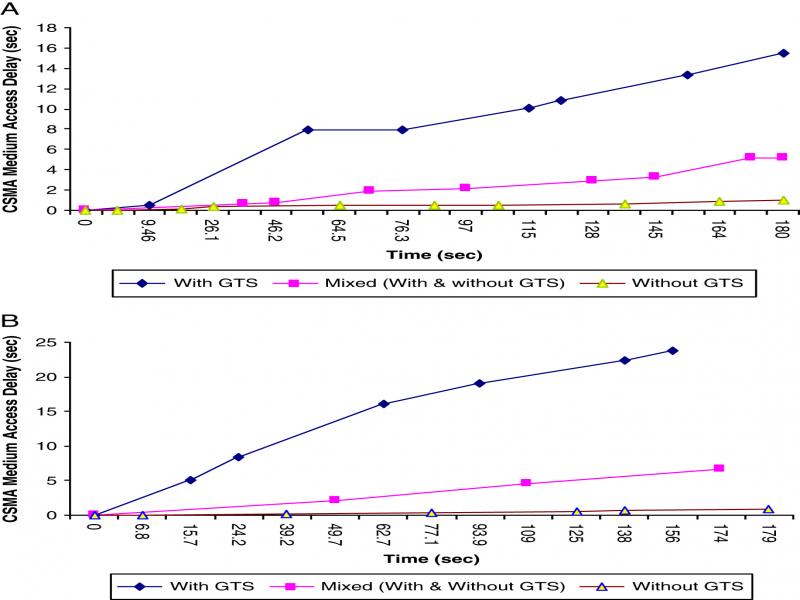
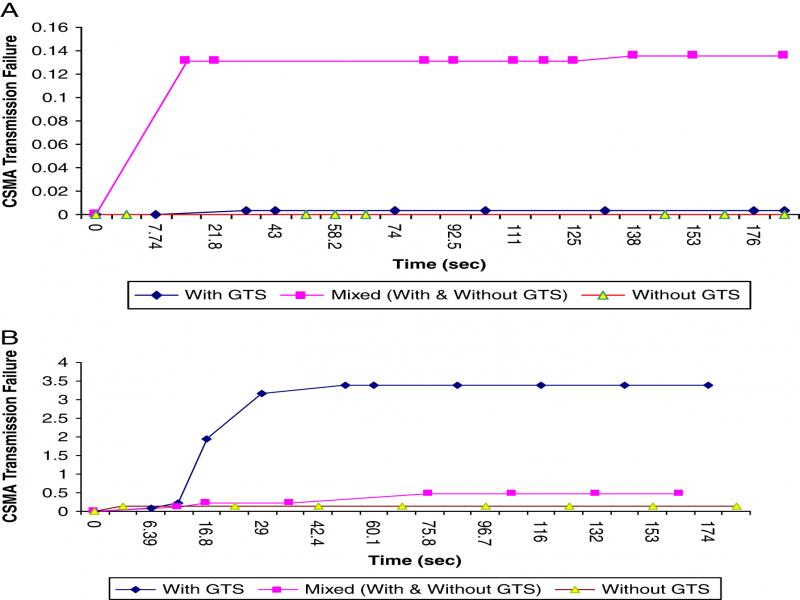
This paper has analyzed the GTS mechanism in 802.15.4 standard for conversion into WSN from WPAN. For this, three different networks with the same configurations are developed: a network in which all the nodes have the GTS feature, the network in which none of the nodes have the GTS feature, and finally, a network in which half of the nodes have the GTS feature and remaining half do not have this feature. Finally, the performance of these networks is analyzed at PAN coordinator – fully functional device (FFD), and end device – reduced functional device (RFD).
In this paper, the first section surveys and details the prominent research works on 802.15.4 standard. The second section describes the system setup. The third section compares and analyzes the performance metrics at FFD and RFD in three different networks with the same configurations. Finally, the fourth section gives the conclusions on this paper.
System setup
Three different networks of standard – IEEE 802.15.4 are developed, i.e. With GTS – in which all the nodes have the GTS feature, without GTS – in which none of the nodes have the GTS feature and can handle non-GTS traffic only, and mixed – in which half of the nodes have GTS feature and remaining half are without GTS feature as shown below in Figure 1. Each network has one FFD (PAN coordinator), one analyzer, and 20 RFDs (end devices). These networks except the GTS feature are the same in all respects. IEEE 802.15.4 provides the GTS feature on the basis of superframe as explained below.
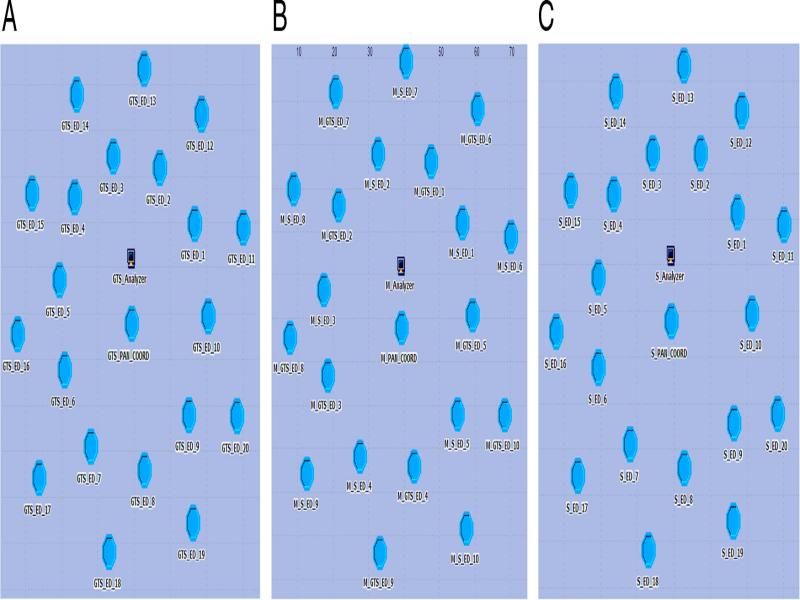
Figure 1:
Networks – (A) With GTS, (B) mixed, (C) without GTS.
Structure – superframe
Superframe is the calculation of time interval between the two successive beacon frames, in which one indicates the beginning and the other marks the end of the superframe. Beacon frames are generated by the PAN coordinator after fixed intervals of time to advertise its personal area network and to synchronize all the nodes attached to it. Now, the time interval between two successive beacon frames constitutes Beacon interval (BI) which comprises of an active period and, optional, inactive period as depicted in Figure 2.
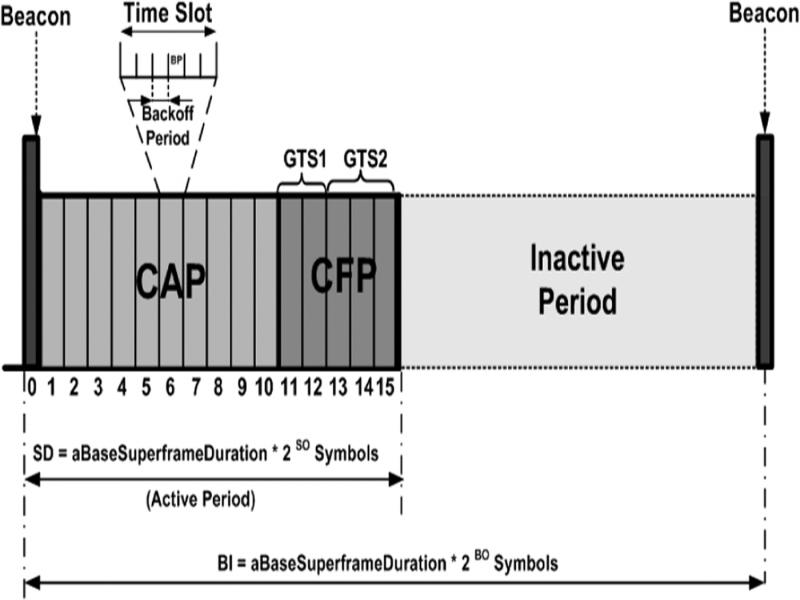
Figure 2:
Superframe structure (Koubaa et al., 2007).
From the working of superframe, it can be concluded that if the GTS-enabled data are to be trafficked along with the non-GTS data, then the contention-free period (CFP) occupies at least one time slot (channel) and maximum of seven time slots in the CFP portion as follows:
If only non-GTS data are to be trafficked, then:
From (1), it is concluded that whenever GTS data are to be trafficked, specific numbers of time slots (sub-channels/bandwidth) are reserved for a specific period of time. During this time period, these time slots can only be used by the specific GTS data for which these are reserved or will remain idle if that data have finished being trafficked or is not being trafficked for one or the other reason. These time slots are released only after that specific data trafficking has finished. Therefore, no access mechanism works during this period, but only guarantee of service is provided at the cost of major resource bandwidth and the performance parameters like throughput, utilization, channel business, etc.
From (2), it can be concluded that if all 14 time slots (sub-channels) of superframe are accessed using CSMA/CA, i.e. without the use of GTS feature, then none of the time slots (sub-channel) will remains idle. Once it has finished trafficking data from one RFD, it can be immediately accessed by some other RFD using CSMA/CA mechanism.
From (1) and (2), we conclude that in 802.15.4, channel(s) can be reserved forehand to guarantee services to a particular application which constitutes GTS mechanism and is the core of WSNs but only by compromising its performance in terms of throughput, utilization, etc. As the slots are reserved in advance for the data fetched from the surroundings to be transmitted, this leads to the wastage of overall resources by reserving them in advance and then keeping them idle till the data arrives, just to provide the GoS to the data to be trafficked. Whole of this process reduces the overall throughput, utilization, etc., as the resources like channel are kept idle for long durations till the data arrives. On the contrary, channel could have been used for the ordinary data, had it been not reserved for the GTS data. According to (1), maximum of 07 slots are reserved for the GTS utilization i.e. 07 slots can be idle at a time just to provide the GTS to the data to be trafficked by the sensor node. According to (2), all the 14 data carrying slots are free to transmit the data any time, received from the surrounding which in turn increases the utilization of the resources like channel utilization. Simulation setup along with its parametric values for the GTS slot utilization in three different networks, i.e. with GTS, mixed and without GTS, is given below in Table 1.
Table 1.
Parametric values for PAN coordinator and end devices in three different networks.
| PAN coordinator | End device | |||||||
|---|---|---|---|---|---|---|---|---|
| Device type | Mixed | Mixed | ||||||
| Parameter/network | With GTS | With GTS | Without GTS | Without GTS | With GTS | With GTS | Without GTS | Without GTS |
| Acknowledged traffic parameters | ||||||||
| MSDU interarrival time (sec) | Exponential (2) | |||||||
| MSDU size (bits) | Exponential (912) | |||||||
| Start time (sec) | 0.1 | |||||||
| Stop time (sec) | 180 | |||||||
| Destination MAC address | Broadcast | PAN coordinator | ||||||
| Unacknowledged traffic parameters | ||||||||
| MSDU interarrival time (sec) | Exponential (2) | |||||||
| MSDU size (bits) | Exponential (912) | |||||||
| Start time (sec) | 0.1 | |||||||
| Stop time (sec) | 180 | |||||||
| CSMA parameters | ||||||||
| Maximum backoff number | 4 | |||||||
| Minimum backoff exponent | 3 | |||||||
| IEEE 802.15.4 | ||||||||
| Device mode | PAN coordinator | End device | ||||||
| MAC address | Auto assigned | |||||||
| WPAN settings | ||||||||
| Beacon order | 3 | |||||||
| Superframe order | 2 | |||||||
| PAN ID | 0 | |||||||
| Logging | ||||||||
| Enable logging | Enabled | |||||||
| GTS settings | ||||||||
| GTS permit | Enabled | Disabled | Enabled | Disabled | ||||
| Start time (sec) | 0.1 | Infinity | 0.1 | Infinity | ||||
| Stop time (sec) | 180 | Infinity | 180 | Infinity | ||||
| Length (slots) | 2 | 0 | 2 | 0 | ||||
| Direction | Receive | Transmit | Transmit | Transmit | ||||
| Buffer capacity (bits) | 10,000 | 1000 | 1000 | 1000 | ||||
| GTS traffic parameters | ||||||||
| MSDU interarrival time (sec) | Exponential (2) | Constant (1.0) | Exponential (2) | Constant (1.0) | ||||
| MSDU size (bits) | Exponential (912) | Constant (0.0) | Exponential (912) | Constant (0.0) | ||||
| Acknowledgment | Enabled | Disabled | Enabled | Disabled | ||||