A smart grid is a network that incorporates information and communication techniques with an electric power grid structure to improve the robustness and performance of the power distribution system (Ullah et al., 2017). The Advanced Metering Infrastructure (AMI) is an essential element of the smart grid, and smart meters are basic components of the AMI networks. In the conventional electric grid, recurrent transmission failures, congestion, and electricity theft are few elements that make the electricity grid ineffective in terms of electricity management. These pitfalls are due to unidirectional communication from the power generation to the consumer, whereas in the smart grid the communication is bidirectional (Ghosaland and Conti, 2019). WSN’s can be employed in the AMI networks of the smart grid to monitor, examine, and manage the various operations of the grid. The sensor nodes are restrained in-terms of processing functionality, energy, and memory (Yu et al., 2012). Data collection and aggregation from nodes are to be done timely as it is required to activate load shutdown under maximum usage, demand side management, emergency alerts, etc. Most of the data collection protocols assure the key application requirements such as delay reduction and trust along with energy efficiency. Packet dropping is one of the most important concerns in WSN’s due to the deployment of nodes in harsh environment. Apart from this poor link quality, non-availability of queue at intermediate nodes, improper selection of forwarder node for next hop may be major reasons for packet dropping (Mothku and Rout, 2019). For effective data communication, it is required to select a forwarder node which has a good link quality, high queue size, and good amount of residual energy (Mahmood et al., 2015; Lai et al., 2017). Due to the random deployment of sensor nodes, the routing mechanism ends in hot spot issues and also leads to exclusive density of nodes inside the monitoring area (Zaheeruddin et al., 2017). To cope with these issues and to obtain better performance of the network, researchers have proposed a work sleep cycle scheme for sensor nodes (Alfayez et al., 2015). The work sleep scheme results in opportunistic routing (OR), which facilitates to improve the overall performance of the network. OR allows the nodes within the network to overhear the transmission of the adjacent nodes for data forwarding. The primary characteristic of OR is its potential to transmit the data packet and to synchronize among the relaying nodes (Boukerche and Darehshoorzadeh, 2015). The performance of OR depends on the OR metric, algorithm involved in selection of nodes, and the coordination method used in coordinating the nodes (Biswas and Morris, 2005). The sensor data produced via deploying WSN in AMI networks may additionally have attributes like delay tolerance and sensitivity issues. In smart grids, the monitoring data (e.g. too many Ev’s charging) are delay sensitive as the data have to be communicated with the meter management system in specified time, while the control data (load shut down) may be considered as delay tolerant with the system requirements of smart grids. Designing an energy proficient routing scheme for the deployed WSN’s in AMI networks faces difficulties like data reliability, definite delay, node fault, packet drop, delay tolerance, sensitivity issues, etc. (Mahmood et al., 2015; Anees et al., 2019). In conventional routing, the time period for hello messages is fixed which leads to high energy consumption when the hello messages are frequently communicated. A probe message forwarding mechanism is also proposed here for communicating the source information. In this work, the data collection can be initiated by the sink whenever required. Inspired by the work of Yang et al. (2018), the probe message transmitting method is adopted here in the routing process. Once the subsequent forwarder node is selected via fuzzy logic and the source information is analyzed from the probe message, the link connectivity between the adjacent nodes is calculated, which results in the identification of opportunistic nodes for connection; hence, a spanning tree can be constructed with the sink node as root and optimal paths can be identified for data transmission. The following are the contributions in this paper:
An energy-efficient routing scheme is proposed which can be used in AMI networks of smart grids.
Using the probe message and work sleep scheme opportunistic node, connections are obtained.
Considering residual energy, link quality, queue size, and closeness of node to sink a routing parameter has been computed.
The performance of the proposed scheme is evaluated through simulation and the results are presented.
Related work
There exists a wide variety of routing protocols in the literature. Here, we surveyed suitable papers that are related to proposed work. To make the electric grid more efficient, NIST proposed a conceptual framework in Smart Grids. According to the framework both intra-domain and inter-domain communication must take place between all the building blocks in Smart Grids. It also suggests that both information and electrical flow should be supported in Smart Grids between all the building blocks of the Smart Grids. Data collection, data processing, and data aggregation among energy subsystems constitute information flow and electrical flow within the electrical energy distribution, transmission and generation (Fang et al., 2011; NIST, 2013). The purpose of information flow is to regulate the power distribution and the electrical flow takes care of power delivery, demand response, and so on. For effective information exchange within the Smart Grids domains, a highly intellectual communication infra-structure is required. WSN’s can also be used to prevent power theft, handle demand response seamlessly, and make real-time decisions at the prosumer end. Ma et al. (2013) have presented the communication architecture of Smart Grids. Fadel et al. (2015) demonstrated that WSN’s can be utilized effectively in Smart Grids entities. LEACH (Heinzelman et al., 2000) is one of the vital and broadly used protocols for routing in WSN’s. The routing is accomplished through cluster heads that are elected periodically based on a predefined probability value. LEACH gives identical possibility for every sensor node to emerge as cluster head. However, routing through LEACH does not take into account few parameters like energy consumed by each node, geographical positioning of the nodes in the case of asymmetrical clusters. HEED was proposed by authors (Younis and Fahmy, 2004) which rectifies the shortcomings of LEACH in terms of uneven formation of clusters. It also rotates the cluster heads uniformly across the sensor network in multiple rounds of communication based on rotation policy. PEGASIS (Aliouat and Aliouat, 2012) was the upgradation of LEACH. A series of sensor nodes is created for transmitting and receiving the collected data from sensors. But this technique is not appropriate for huge networks because it wastes energy in forming the cluster and electing the cluster heads. In EADEEG (Priya et al., 2017), the cluster heads are elected based on a metric. The metric is the energy of adjacent nodes to the energy of the self-node itself ratio. In EADEEG, nodes close to centroid are summarized and few nodes that are close but not close to centroid are not assigned to any cluster resulting in isolated points. FEAR was proposed by authors (AbdulAlim et al., 2013) which used a ranking scheme to rank the neighboring nodes. A tree is constructed for each transmission based on energy. In this method, however, clusters are not formed; instead, a tree is constructed to enhance the network life time. Although communication via clustering of sensor nodes is highly energy efficient, it yet ends with certain issues in the network. As the cluster heads are chosen primarily based on a preset probability value, real-time load balancing can’t be accomplished. Also, multiple route request packets and control messages for cluster formation cause overhead problem. Most of the clustering protocols don’t consider the location of the base station for routing which is one of the main reasons for hot spot problem in multi-hop communication networks. To overcome this, some unequal clustering strategies are available in the literature like EAFA, EDUC, and UHEED (Yu et al., 2011; Ever et al., 2012; Bagci and Yazici, 2013). Mhemed et al. (2012) proposed a cluster formation protocol to identify the next possible head in the cluster through fuzzy logic by considering distance as a main parameter to enhance the network lifetime. A super-cluster head approach was presented by authors (Selvi et al., 2016), in which the base station receives the sensed data from the super-cluster head rather than from cluster heads. The super-cluster head aggregates the data collected by the normal cluster heads. The routing is decided by fuzzy logic to improve the performance of the network. Most of the fuzzy-based routing protocols discussed in the literature are not able to tune the membership function as input–output pairs change with environment. A genetic-based virtualisation approach was used by authors (Kaiwartya et al., 2017) to handle torrent delay and energy consumption in IoT networks. WCA (Jian-wu et al., 2008) was proposed by authors in which weights of nodes are calculated before creating the node information table. Due to excessive computation, high energy is consumed by the nodes in WCA, making the network unstable. FLEOR was proposed by authors (Julie and Selvi, 2016) which calculates the shortest path for each round of communication. In this method, the network life time is improved; however, it doesn’t take care into account the packet loss rate and also it is not fault tolerant. Path cost was computed using the link quality by authors in (Anees et al., 2019). The fundamental blocks for OR were presented in by the authors (Zeng et al., 2013). ExOR was proposed by authors (Biswas and Morris, 2005) that is considered as the basic protocol implemented using opportunistic routing which sends packets in batches and the nodes overhear their adjacent nodes to participate in data forwarding. A reinforcement learning-based adaptive OR was suggested by authors (Zhang and Huang, 2006) for ad hoc networks to estimate the optimal hop count. With the aid of work sleep cycle scheme, the various nodes deployed in WSN’s can implement the OR logic for data transmission. Authors (Guntupalli et al., 2018) with the help of work sleep cycle achieved life-time improvement. Authors (Ng et al., 2017) proposed energy efficient routing algorithm based on synchronisation of wake up, traffic and sleep cycle. In smart grids two types of traffic data are routed (delay sensitive and delay tolerant) so it is required to minimize the energy consumption to enhance the network life span. DCBONC was proposed by authors (Yang et al., 2018) for data collection in sensor networks using opportunistic node connections. Here, a random graph is constructed considering the sink as a root node, and then, optimal path is calculated for data communication within the radio range. Certain ideas and concepts from the literature are utilized to propose a solution to enhance the network lifetime using the MDRP routing protocol.
System model
The network and energy model used for routing is discussed in this section. It is assumed the sensor nodes in the AMI network are deployed in random fashion. The nodes are independent, and the AMI gateway is the sink for data collection and monitoring. All the sensor nodes utilizes the work sleep approach to sense and communicate with sink. The nodes can communicate with each other throughout the working mode. Multiple sink strategy is also supported by the network for data collection. A specific id is allocated to each sink node (Sid). With the help of Sid, multiple sink nodes can be differentiated. Figure 1 describes the work sleep scheme of the sensor nodes deployed in the AMI network. ni, nj, nk are the sensor within their radio range rr, and they operate in asynchronous fashion. Wt indicates the working time, and St indicates the sleeping time. The nodes transmit their data to the adjacent nodes during work mode, i.e. [t1, t2] or [t3, t4]. During work mode, the energy of the nodes starts to dissipate and follows the energy slope progressively. At start, the residual energy is high, and it gradually decreases so it is required to find the opportunistic nodes for communication at this stage to gain a better connectivity link. To transmit ‘b’ bits from node ni to nj to a distance ‘d’, the energy required is:
(1)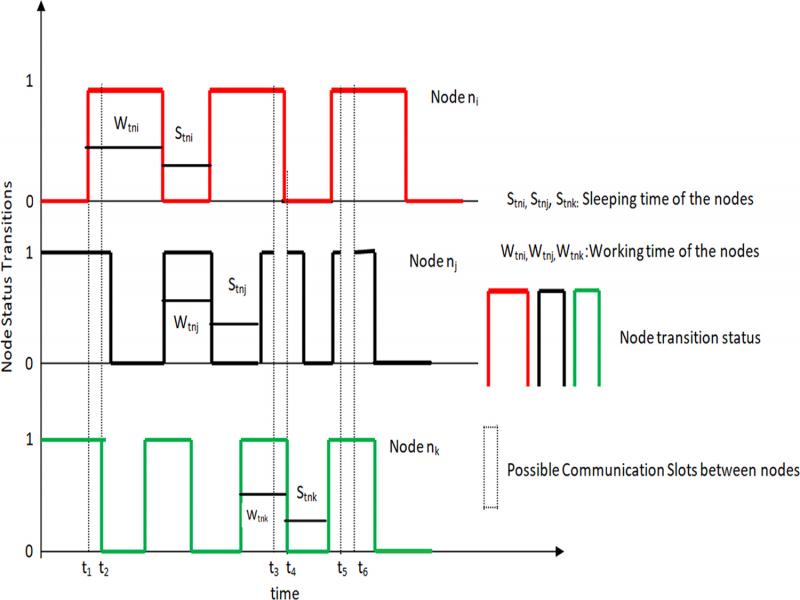
Figure 1:
Asynchronous work-sleep cycle approach for nodes in the network.
To receive ‘b’ bits by node nj, the energy required is:
(2)where E is per bit energy consumption, and Emp is the energy consumed by the transmission amplifier.MDRP protocol for WSN’s in AMI networks
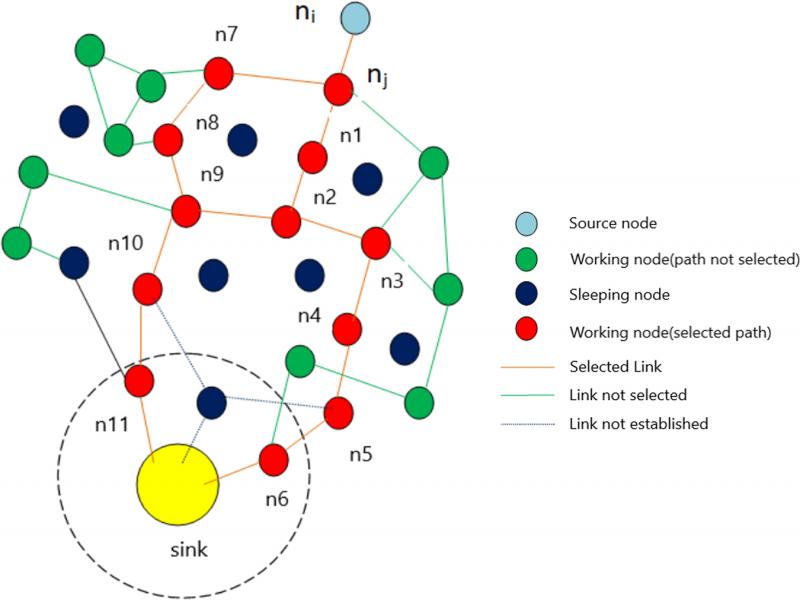
In this section, the energy proficient routing approach is presented. In the proposed data collection scheme, the sink node is stationary and can initiate data collection whenever required. The data collection process includes the following five phases:
Initialization phase.
Probe message transmission phase.
Subsequent node selection phase.
Path estimation phase.
Routing phase.
Initialization phase
Data collection process can be initiated by the sink node randomly whenever required by transmitting a tag message. The tag message includes data collection period and the specific Sid. Upon receiving the tag message the sensor nodes in the radio range calculate their working time based on their work-sleep schedule. For the network graph creation it is considered that the sink node is always in working mode and any sensor falling within the short radio range can establish communication with the sink at any time and the nodes have the ability to collect the information about their adjacent nodes, status transition between working mode and sleep mode. The distance between the sensor nodes and sink node is computed by the relative signal strength. To reduce the energy consumption EOH metric is used. Expected optimal hops (EOH) is the total number of hops required to transmit the probe message to the sensor nodes. EOH can be computed as:
(3)For the network graph creation, it is considered that sink node remains in a working mode all the time and any sensor node in the network falling within the short radio range can establish communication with the sink at any time and the nodes have the ability to collect the information about their adjacent nodes.
Probe message transmission phase
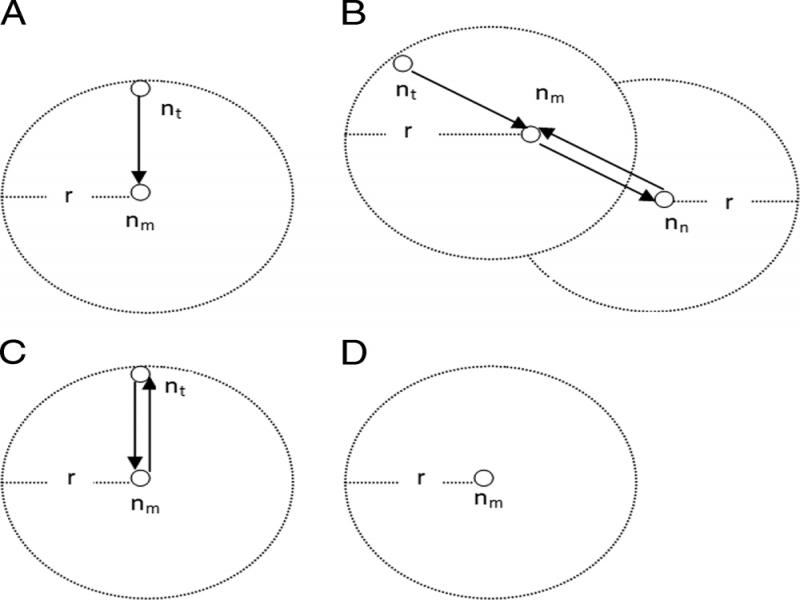
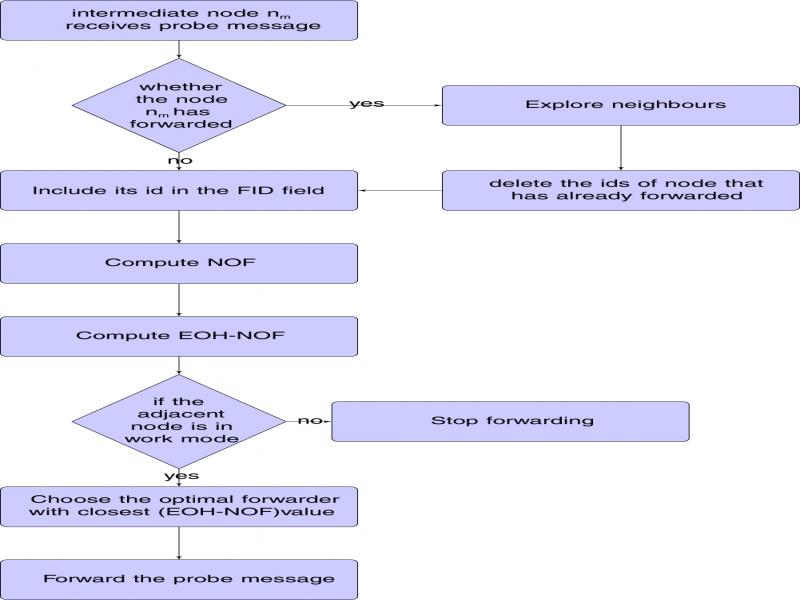
When the tag message is received by the sensor nodes from the sink node, the sensor nodes transmit their information to their sink node (i.e. its working time, status transition, source ID, work sleep scheme and their adjacent node id). The format of probe message which is transmitted to sink is shown in Table 1. Sid field represents the specific id of the node that communicates with the sink node. The work sleep scheme represents the period of working and sleeping duration of the respective node. STF is the status transitions of the sensor node, adjacent node id is the available adjacent nodes to the source node. If there is no active adjacent node (node in work mode) or no node is available, the field remains empty. Sink id is the identification of the sink node that send the tag message, Fid is the ids of the nodes that have already transmitted their probe message to sink. EOH stores the expected hop count required to reach the sink. Tag message is received by all nodes within the radio range and all the nodes can generate probe message. Due to different work sleep scheme and STF of sensor node the efficiency of probe message transmission may decrease. So it is necessary to design a mechanism for forwarding the probe message to avoid unnecessary opportunistic connections and to balance the energy consumption. The process is demonstrated in Figure 2, nr, nm, nt are the nodes that are involved in data transmission. When an intermediate sensor node nm receives a probe message from its adjacent node, it will check the Fid field in the table to know the status of the transmitter node, nm. Here, if the node nm has not forwarded the probe message, as indicated in Figure 2A, it updates its own id in the Fid field. Based on this, it computes the number of forwarders (NOF) by obtaining EOH value. Then, it computes (EOH–NOF) to find an adjacent node with the closest EOH value as optimal forwarder. Unlike if the probe message is forwarded by nm as indicated in Figure 2B, it explores the status of adjacent nodes by checking the Fid field. For sake of exposition, if the ids in the Fid fields are specified as nn, np, …, nm, nr, ns. The node nm explores table to learn about the nodes that have already transmitted the probe message. In this case, the node updates the Fid by deleting the ids of nm, nr and includes its specific id, followed by the calculation of NOF (EOH–NOF) and finds the optimal forwarder. Here, the nodes follow asynchronous work sleep scheme, node nt can transmit the probe message to nm only if nt is in work mode as indicated in Figure 2C. If the node is in sleep mode as indicated in Figure 2D, the node stops transmitting. Figure 3 describes the mechanism of probe message transmission.
Table 1.
The design of the probe message.
| Field | Sid | Work sleep cycle | STF | Adjacent node id | Sink id | Fid | EOH |
| I/O variables | Linguistic variables | |||
|---|---|---|---|---|
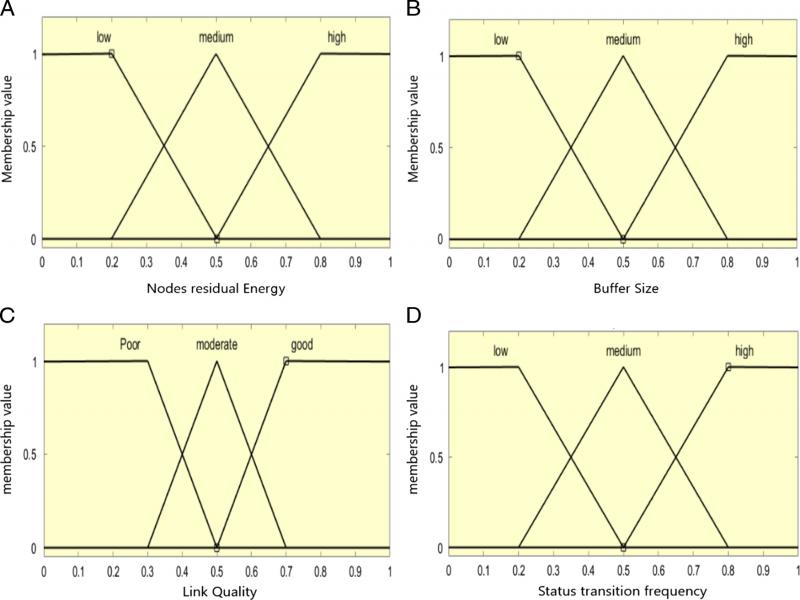
| Residual energy of node (NRE) | Low, Medium, High | |||
| Queue size (QS) | Low, Medium, High | |||
| Status transition frequency (STF) | Low, Medium, High | |||
| Link quality (LQ) | Poor, Moderate, Good | |||
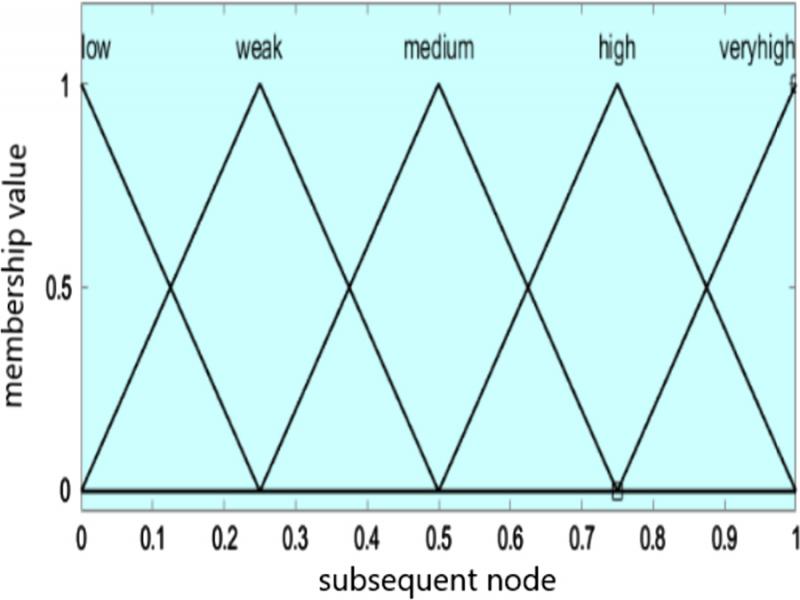
| Possibility of turning into subsequent node for hopping | Low, Weak, Medium, High, Very high |
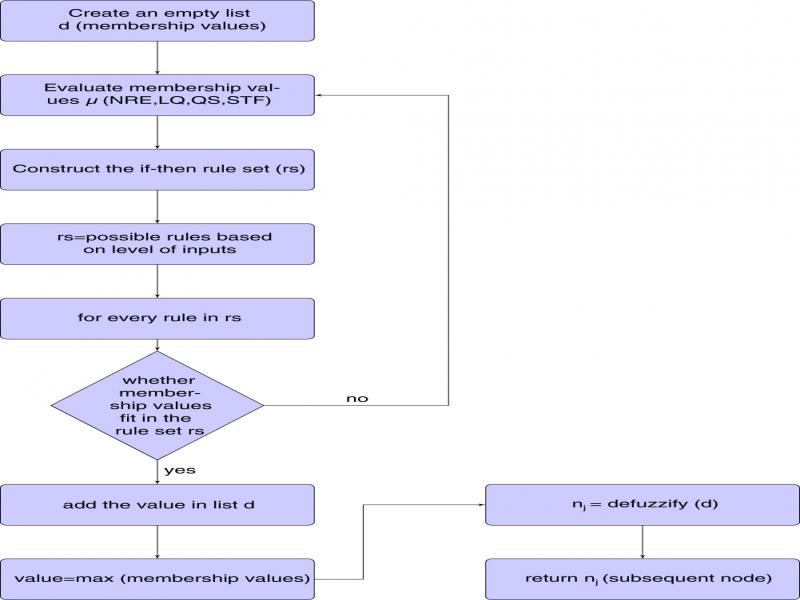
| Residual energy | Queue size | STF | Link quality | Chance of becoming subsequent node |
|---|---|---|---|---|
| Low | Low | Low | Poor | Low |
| Low | Low | Low | Moderate | Low |
| Low | Low | Low | Good | Weak |
| Low | Low | Medium | Poor | Low |
| Low | Low | Medium | Moderate | Medium |
| Low | Low | Medium | Good | Medium |
| Low | Low | High | Poor | Weak |
| Low | Low | High | Moderate | Weak |
| Low | Low | High | Good | Medium |
| Low | Medium | Low | Poor | Low |
| Low | Medium | Low | Moderate | Low |
| Low | Medium | Low | Good | Low |
| Low | Medium | Medium | Poor | Low |
| Low | Medium | Medium | Moderate | Weak |
| Low | Medium | Medium | Good | Medium |
| Low | Medium | High | Poor | Low |
| Low | Medium | High | Moderate | Weak |
| Low | Medium | High | Good | Medium |
| Low | High | Low | Poor | Low |
| Low | High | Low | Moderate | Low |
| Low | High | Low | Good | Low |
| Low | High | Medium | Poor | Low |
| Low | High | Medium | Moderate | Weak |
| Low | High | Medium | Good | Medium |
| Low | High | High | Poor | Weak |
| Low | High | High | Moderate | Medium |
| Low | High | High | Good | High |
| Medium | Low | High | Poor | Low |
| Medium | Low | High | Moderate | Low |
| High | Low | Low | Poor | Low |
| High | Low | Low | Moderate | Low |
| High | Low | Low | Good | Weak |
| High | Low | Medium | Poor | Low |
| High | Low | Medium | Moderate | Weak |
| High | Low | Medium | Good | Medium |
| High | Low | High | Poor | Low |
| High | Low | High | Moderate | Weak |
| High | Low | High | Good | Medium |
| High | Medium | Low | Poor | Weak |
| High | Medium | Low | Moderate | Medium |
| High | Medium | Low | Good | High |
| High | Medium | Medium | Poor | Medium |
| High | Medium | Medium | Moderate | High |
| High | Medium | Medium | Good | Very High |
| High | Medium | High | Poor | Medium |
| High | Medium | High | Moderate | High |
| High | Medium | High | Good | Very High |
| High | High | Low | Poor | Weak |
| High | High | Low | Moderate | Medium |
| Parameters | Values |
|---|---|
| Size of the network | (500 × 500) m2 |
| No of mobile sink | 1 |
| No of nodes in the network | 500 |
| Mobility pattern | random |
| Time duration for data collection | 600 s |
| Communication range between sensor nodes | 20 m |
| Node’s initial energy | 2 J |
| Size of the buffer | 1,024 bits |
| Eelec | 50 nJ/bit |
| E | 0.0013 pJ/bit/m4 |
| Size of probe message | 120 bits |
| Size of data packet | 1,024 bits |