
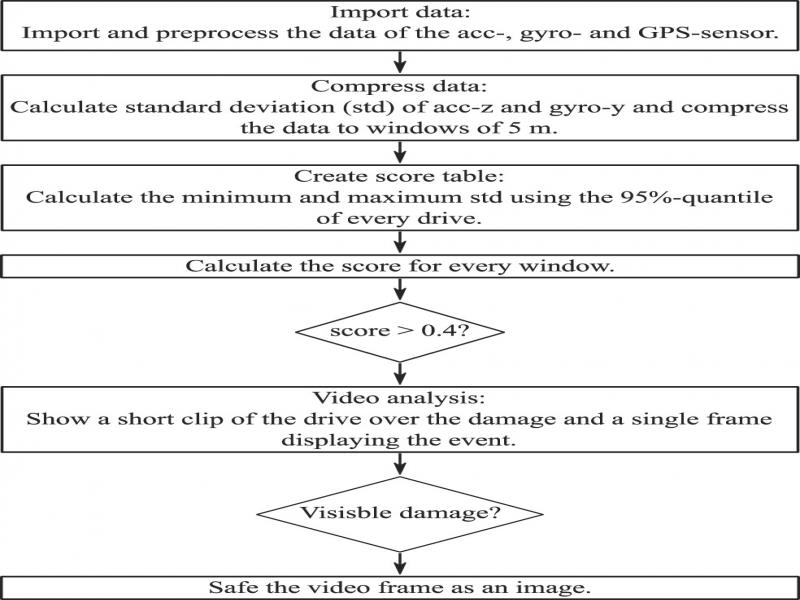
Figure 1:
Overview of the program workflow.
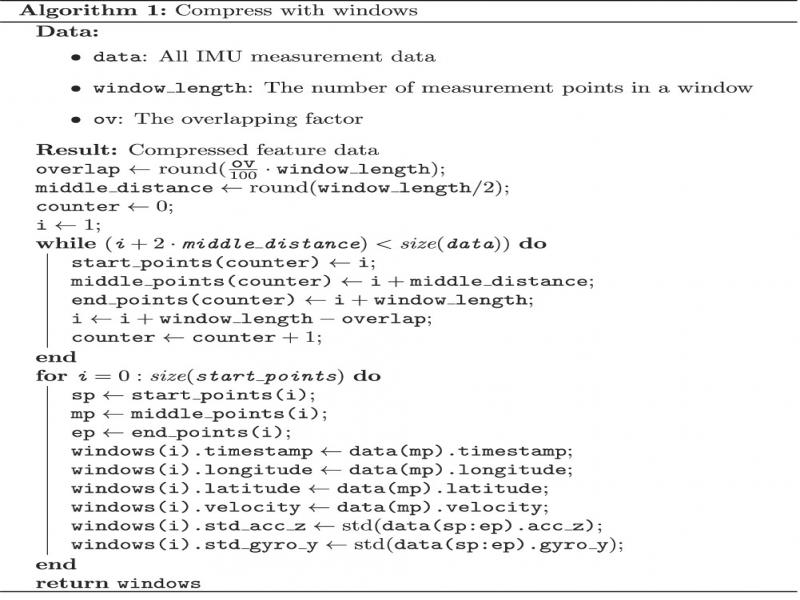
Figure 2:
Algorithm to compress the data and extract information about oscillation.
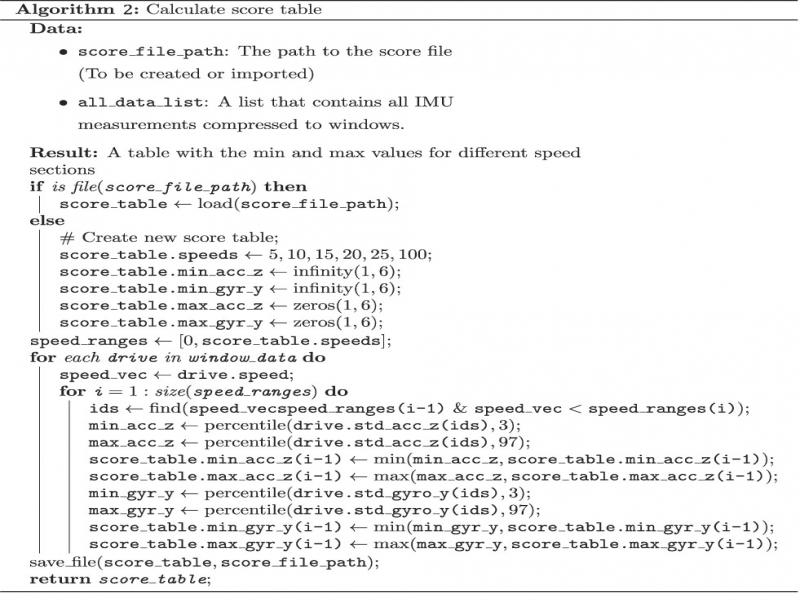
Figure 3:
Algorithm to calculate the score comparison table.
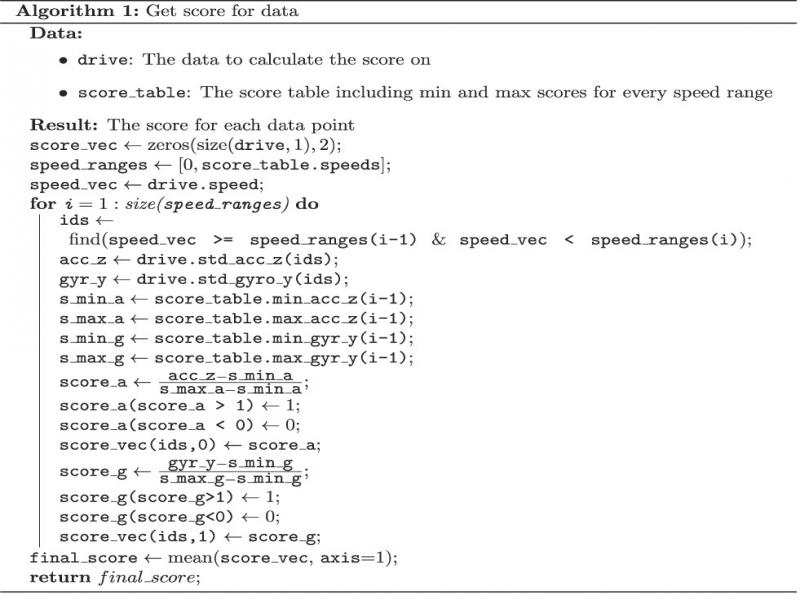
Figure 4:
Algorithm to calculate the final score for each window.
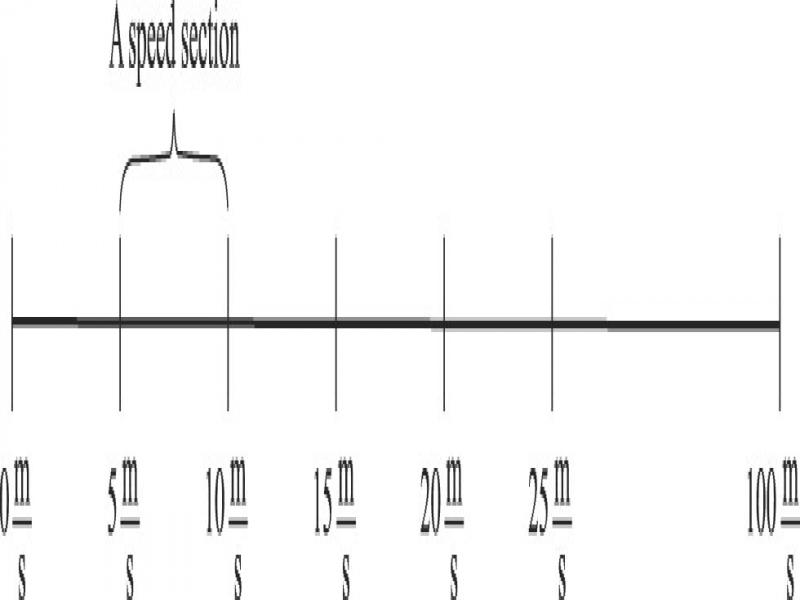
Figure 5:
Arrangement of speed sections.
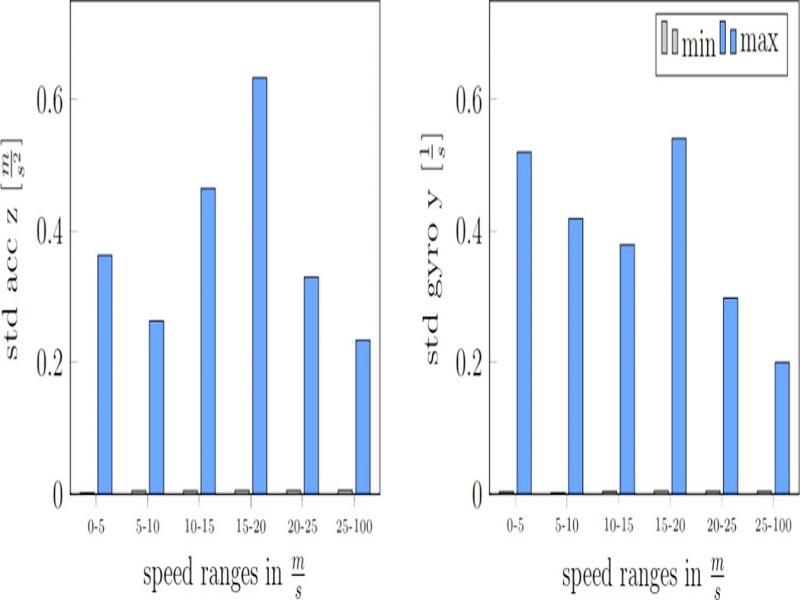
Figure 6:
Score table entries for the minimum and maximum standard deviation of z-acceleration.
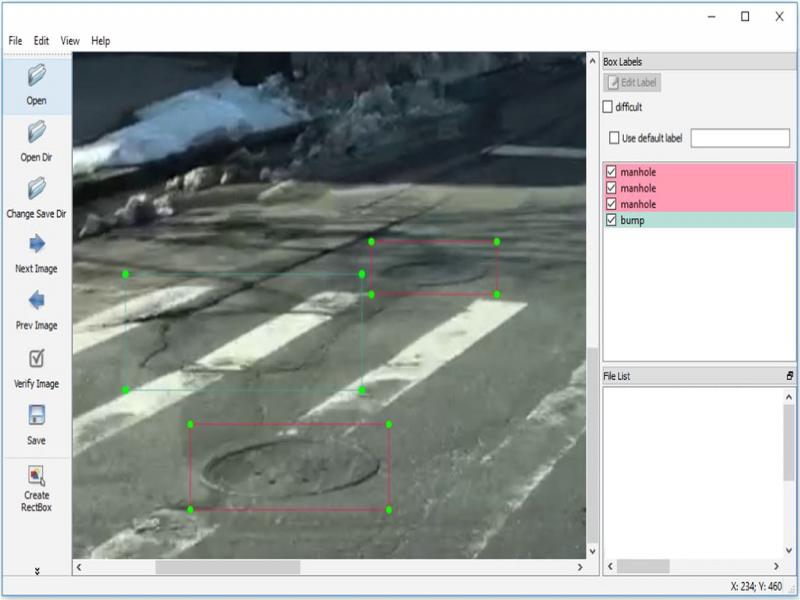
Figure 7:
Image annotation using ‘labelImg’.
Table 1.
Comparison of evaluations with different thresholds.
| Threshold | 0.28 | 0.3 | 0.35 | Manual |
|---|---|---|---|---|
| Total distance (km) | 73.95 | 73.95 | 73.95 | 8.34 |
| Total video time (min) | 162.88 | 162.88 | 162.88 | 18.62 |
| Evaluation time (min) | 40 | 30 | 17 | 35 |
| Images shown | 119 | 89 | 50 | 1,117 |
| Cracks | 10 | 5 | 3 | 20 |
| Patches | 6 | 3 | 2 | 5 |
| Potholes | 14 | 9 | 6 | 1 |
| Railroad tracks | 1 | 1 | 0 | 0 |
| Speedbump | 4 | 4 | 0 | 1 |
| Sunken manholes | 12 | 9 | 5 | 4 |
| Sum of events | 47 | 31 | 16 | 31 |
| Images containing events (%) | 39.5 | 34.8 | 32 | 2.8 |
| Time per true event (s) | 51 | 58 | 64 | 68 |
| Event every × m | 1,573 | 2,385 | 4,622 | 269 |
Table 2.
Comparison between our approach, Maeda, Angulo, and manual labeling.
| Proposed method | Maeda | Angulu | Manual (video) | |
|---|---|---|---|---|
| Presented images | 119 | 163,664 | 180,345 | 1,117 sec |
| Containing event (%) | 39.5 | 9.4 | 25.2 | 2.8 |
| Severe damages (%) | 29.8 | 2.65 | 2.64 | 3.22 |
| Light damages (%) | 59.6 | 67.9 | Unknown | 93.5 |
| Other (%) | 10.6 | 29.45 | Unknown | 3.28 |
| Event every × m | 1,573 | 97 | 36 | 269 |
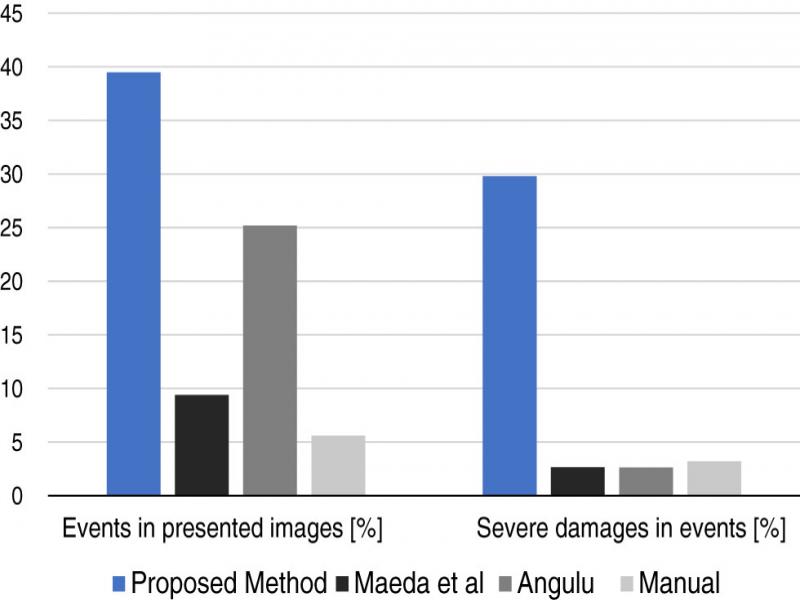
Figure 8:
Comparison between our approach, Maeda, Angulo, and manual labeling. The higher number of events per shown image leads to a lower evaluation time and a less tiring workflow. The significantly higher percentage of severe damages in the labeled set is important for a ground truth with a balanced number of events per class.