
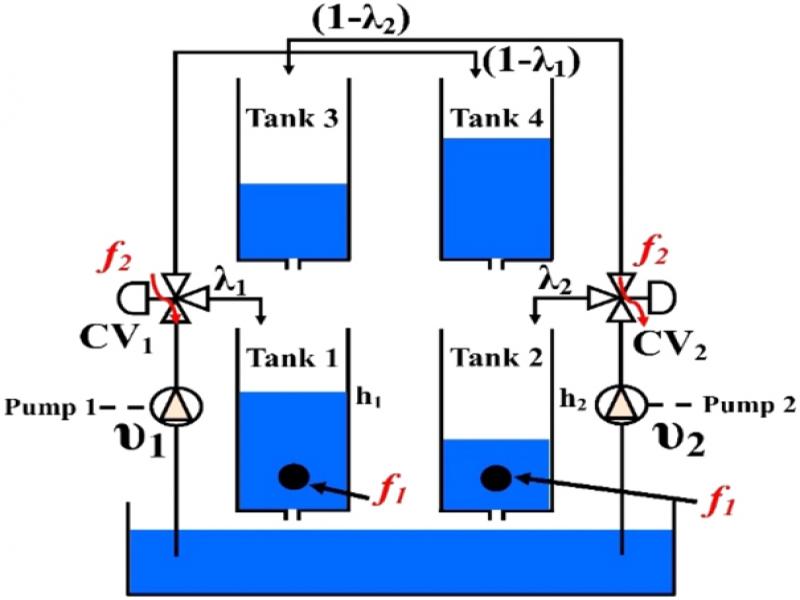
Figure 1:
Quadruple tank level process (QTLP) scheme with fault.
Table 1.
Parameters of the quadruple tank level process.
| Sr. no. | Description | Value |
|---|---|---|
| 1 | Area of the tanks A1, A3, A2, and A4 | 32 cm2 |
| 2 | Area of outlet pipes a1 and a3 | 0.071 cm2 |
| 3 | Area of outlet pipes a2 and a4 | 0.057 cm2 |
| 4 | Constant k | 0.50 V/cm |
| 5 | Gravitational constant g | 981 cm/s2 |
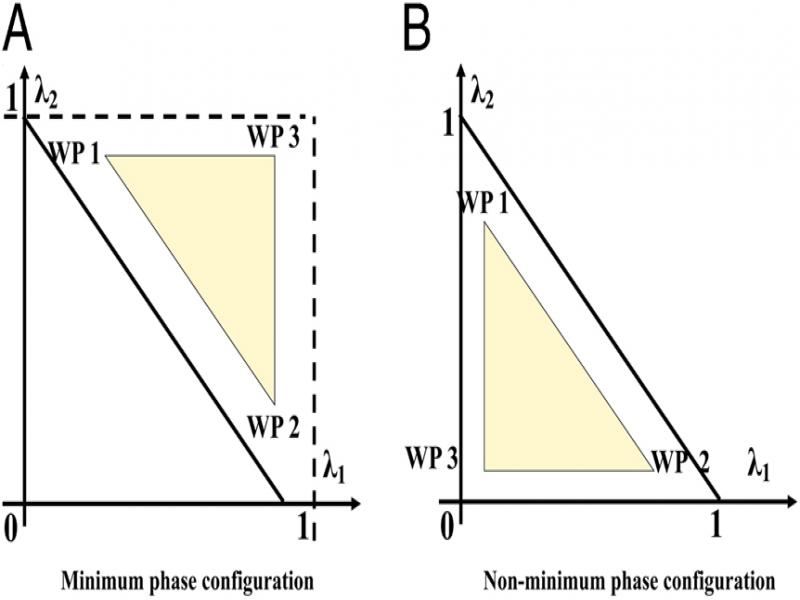
Figure 2:
Uncertainty domain specified by working points.
Table 2.
Operating parameters of minimum phase and non-minimum phase system.
| Parameters | Operating point minimum phase | Operating point non-minimum phase |
|---|---|---|
| , | 12.76, 13.1 | 12.3, 12.7 |
| , | 2.1, 1.8 | 5.1, 5.7 |
| , | 3.33, 3.36 | 3.14, 3.31 |
| k1, k2 | 3.33, 3.38 | 3.14, 3.33 |
| λ1, λ2 | 0.7, 0.6 | 0.43, 0.34 |
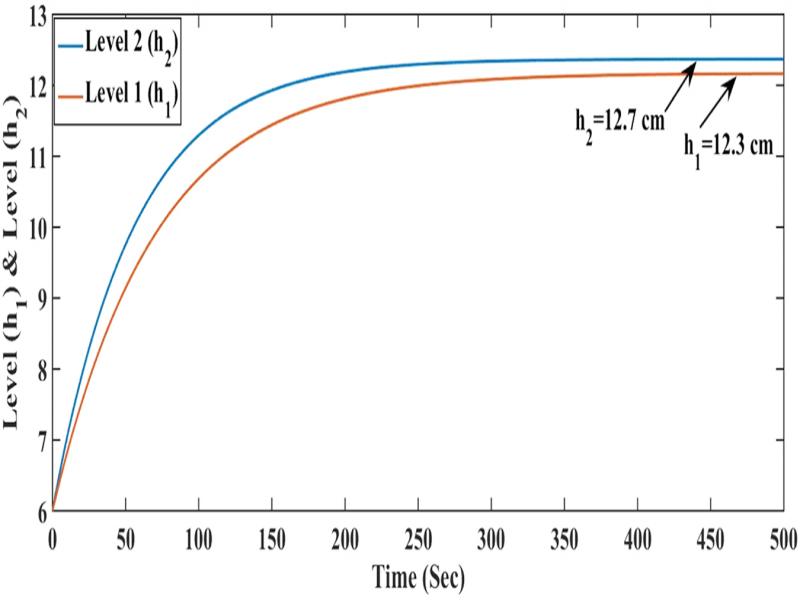
Figure 3:
Open-loop response of quadruple system with non-minimum phase configuration.
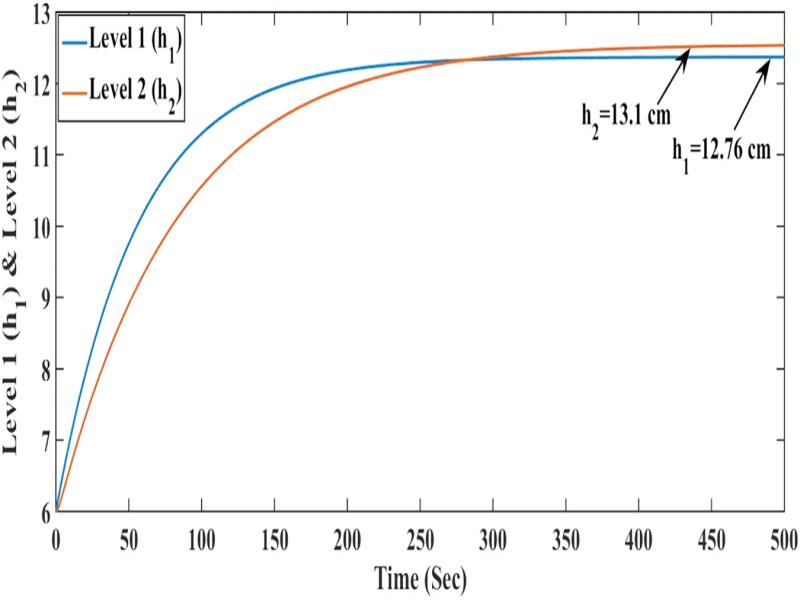
Figure 4:
Open-loop response of quadruple system with minimum phase configuration.
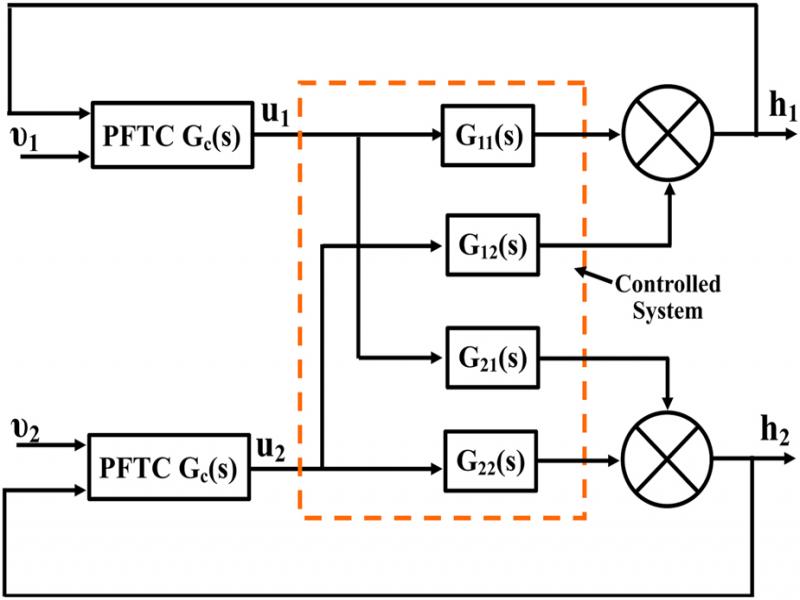
Figure 5:
Schema of simplest decentralized control of TITO system (Schmidt, 2002).
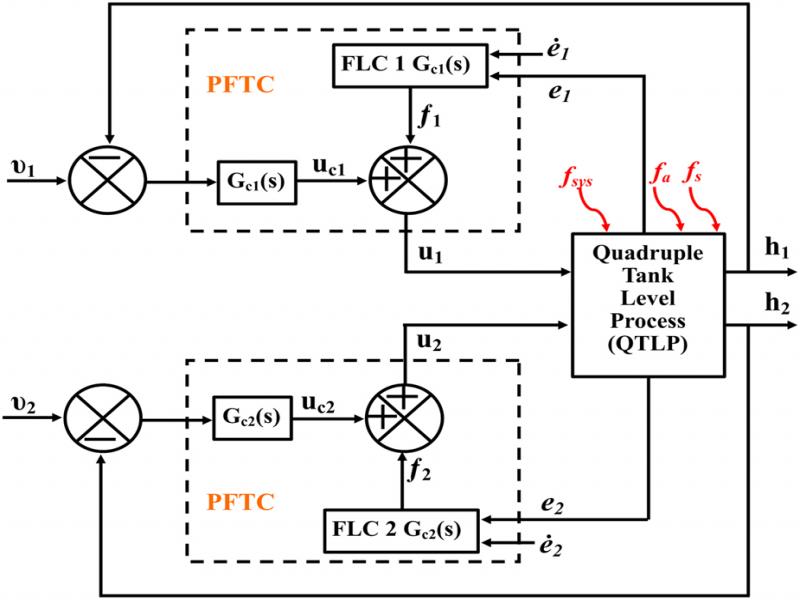
Figure 6:
Decentralized control structure for minimum phase system with two fuzzy and two PI controllers. fsys, fa, and fs denotes system component (leak), actuator, and sensor faults, respectively.
Table 3.
Rule base for type-1 FLC 1 loop 1.
| f1, e1 and ė1 | NB | NM | NS | ZR | PS | PM | PB |
|---|---|---|---|---|---|---|---|
| NB | NB | NB | NB | NM | NS | NS | ZR |
| NM | NB | NB | NM | NS | NS | ZR | PM |
| NS | NB | NM | NS | ZR | PS | PM | PB |
| ZR | NM | NM | NS | ZR | PS | PM | PB |
| PS | NM | NS | ZR | PS | PS | PM | PB |
| PM | NS | ZR | PS | PS | PM | PB | PB |
| PB | ZR | PS | PS | PM | PB | PB | PB |
Table 4.
Rule base for type-1 FLC 2 loop 2.
| f2, e2 and ė2 | NB | NM | NS | ZR | PS | PM | PB |
|---|---|---|---|---|---|---|---|
| NB | NB | NB | NB | NM | NS | NS | ZR |
| NM | NB | NB | NM | NS | NS | ZR | PM |
| NS | NB | NM | NS | ZR | PS | PM | PB |
| ZR | NM | NM | NS | ZR | PS | PM | PB |
| PS | NM | NS | ZR | PS | PM | PB | PB |
| PM | NS | ZR | PS | PM | PM | PB | PB |
| PB | ZR | PS | PM | PB | PB | PB | PB |
Table 5.
Parameters for FLC.
| Parameter | Parameter value |
|---|---|
| No. of input variables | 2 |
| No. of output variables | 1 |
| No. of linguistic variables per MF | 7 |
| No. of rules | 49 |
| Membership function (MF) | Triangular |
| Defuzzification methods | Center of gravity method |
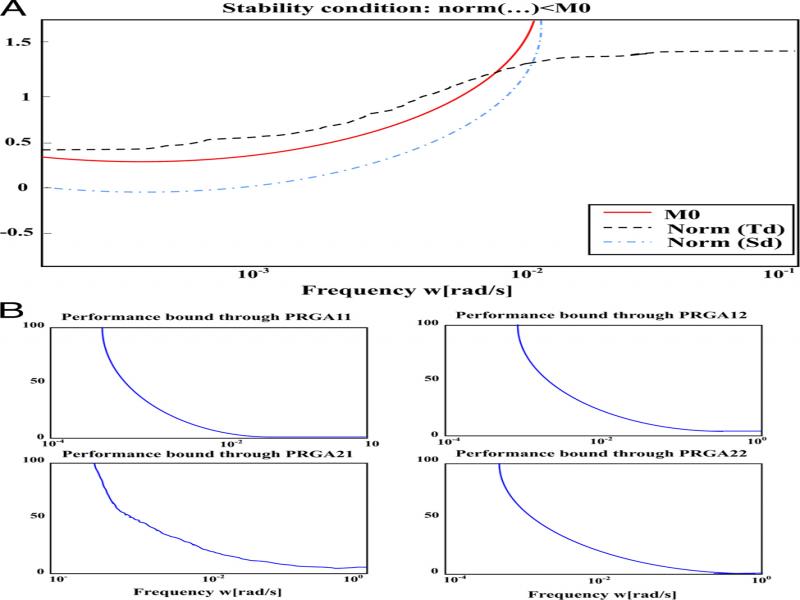
Figure 7:
Stability analysis for minimum phase configuration.
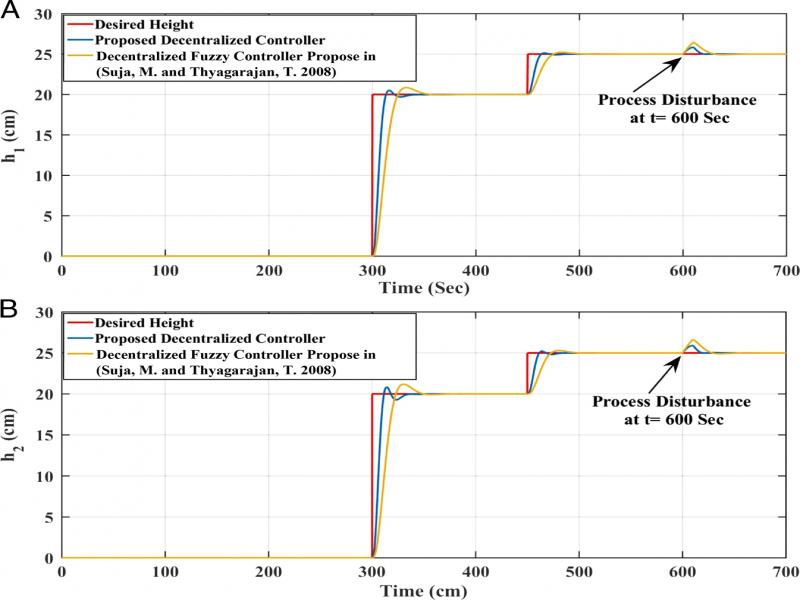
Figure 8:
Step responses: minimum phase stable system subject to process disturbances.
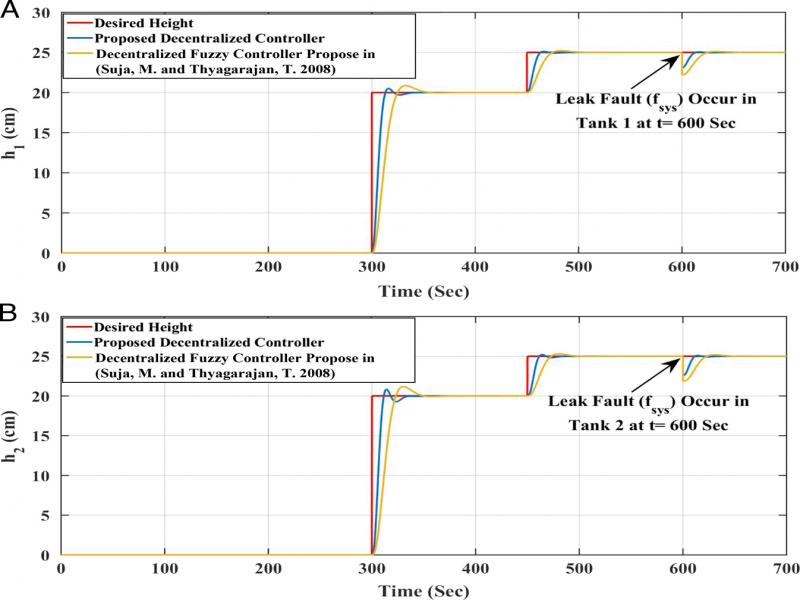
Figure 9:
Step responses: minimum phase stable system subject to system component (leak) fault.
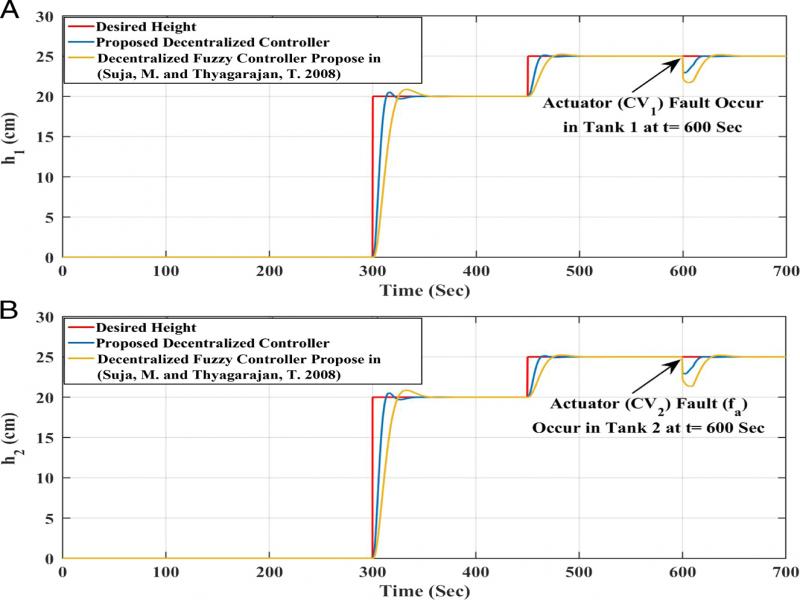
Figure 10:
Step responses: minimum phase stable system subject to actuator fault.
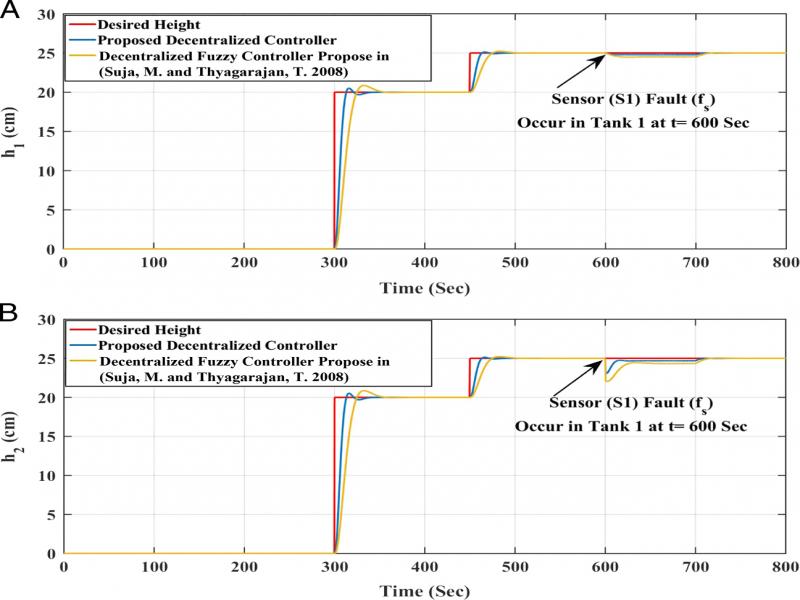
Figure 11:
Step responses: minimum phase stable system subject to sensor fault.
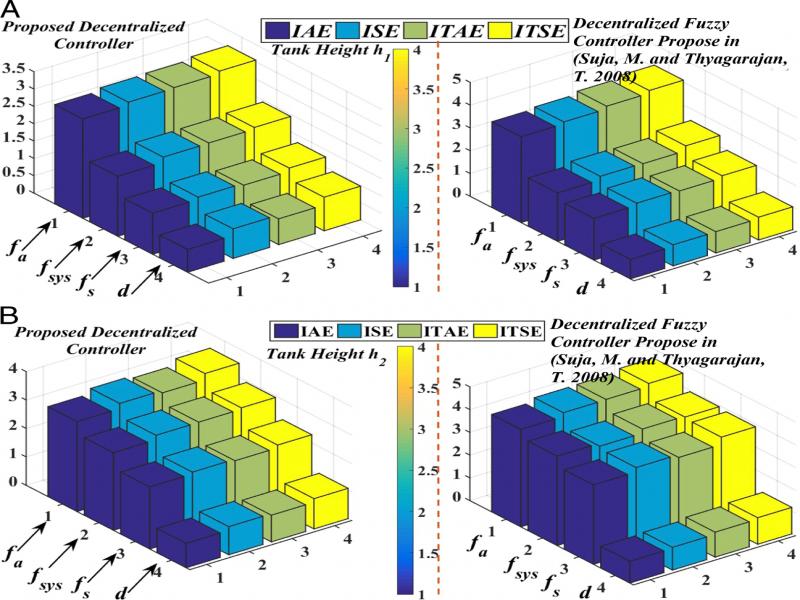
Figure 12:
Error comparison for minimum phase configuration.
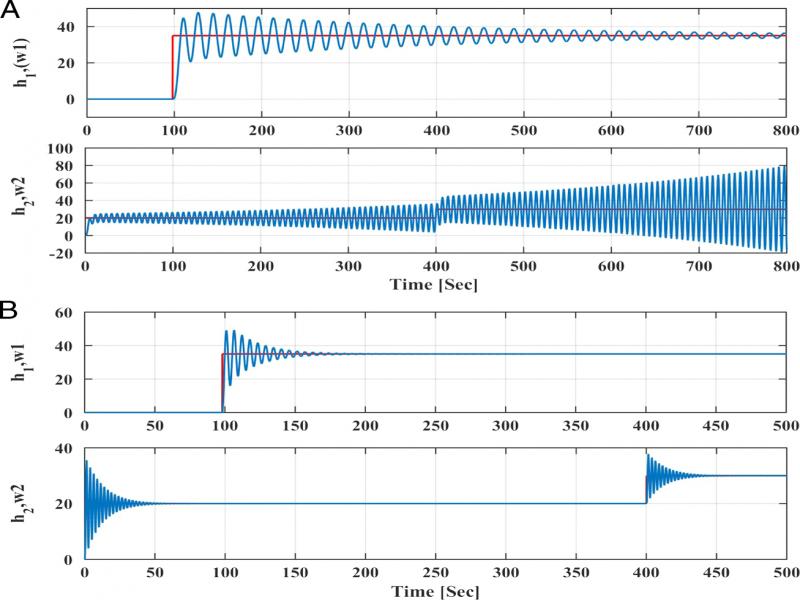
Figure 13:
Step responses: non-minimum phase, unstable system.
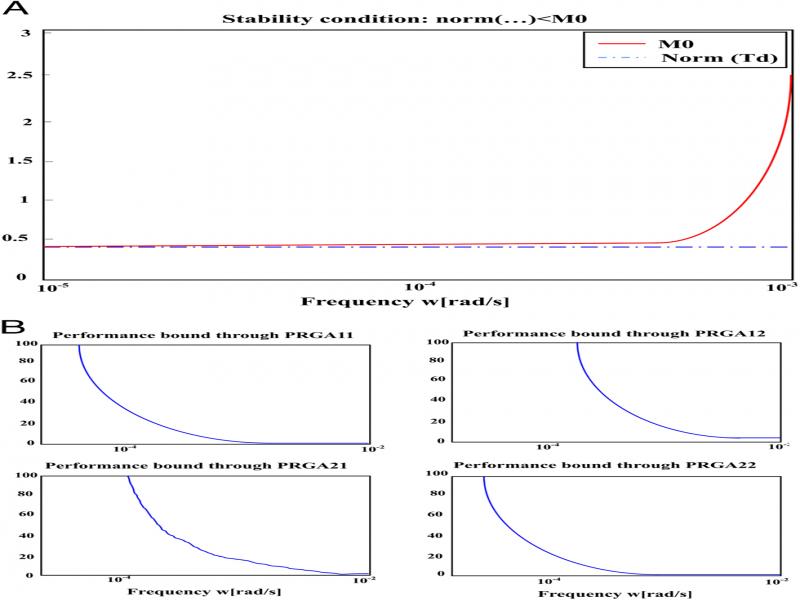
Figure 14:
Stability analysis for non-minimum phase configuration.
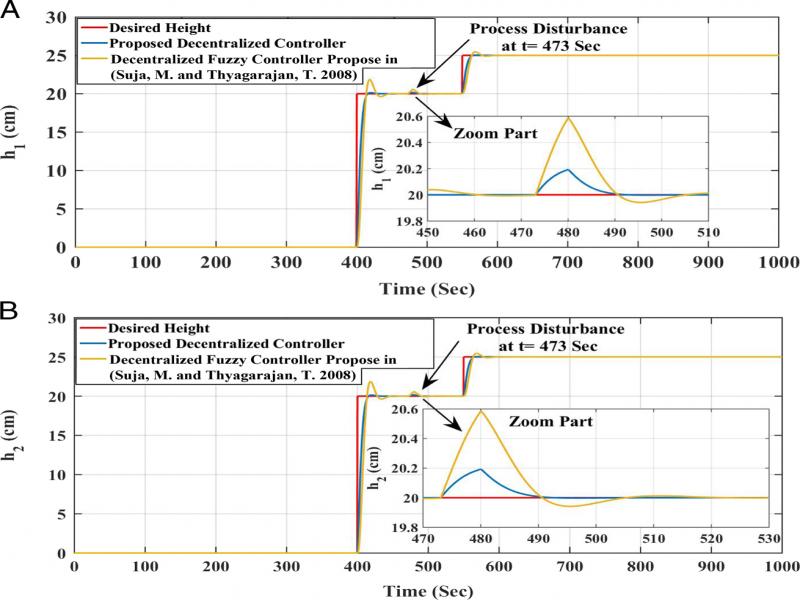
Figure 15:
Step responses: non-minimum phase stable system subject to process disturbances.
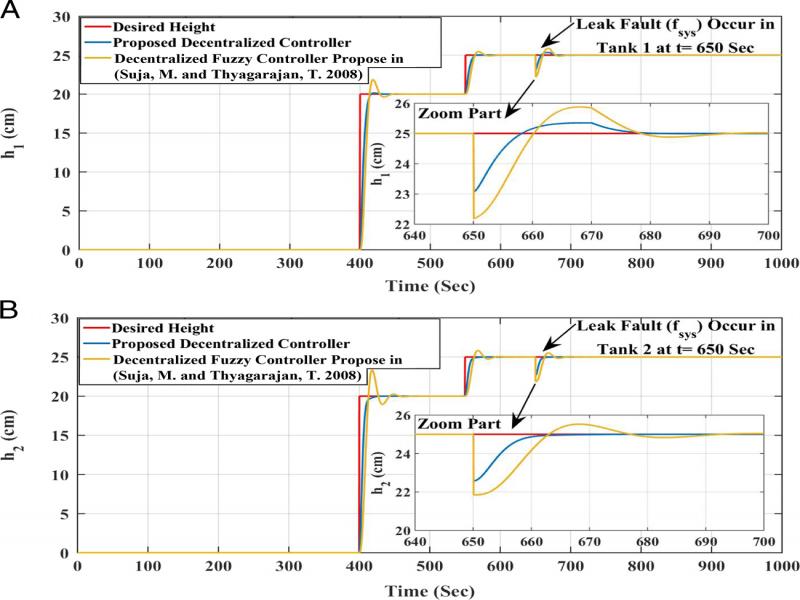
Figure 16:
Step responses: non-minimum phase stable system subject to system component fault.
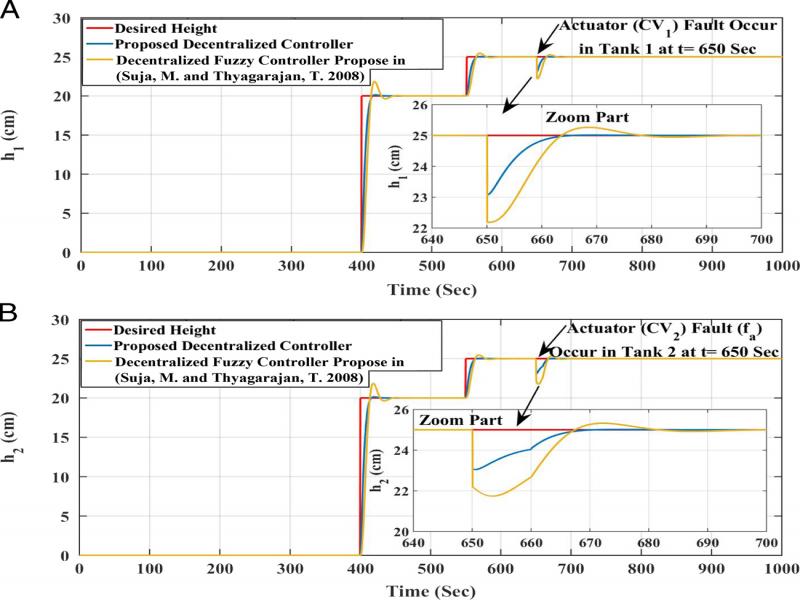
Figure 17:
Step responses: non-minimum phase stable system subject to actuator fault.
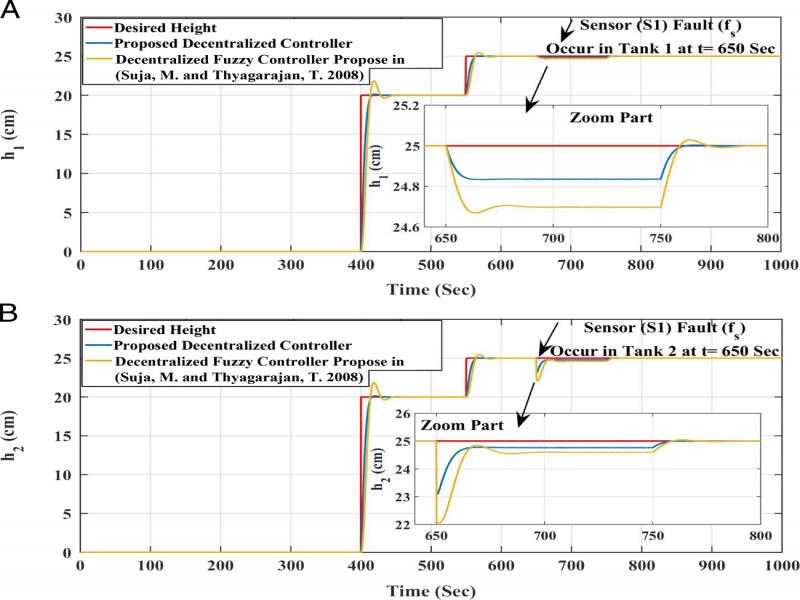
Figure 18:
Step responses: non-minimum phase stable system subject to sensor fault.
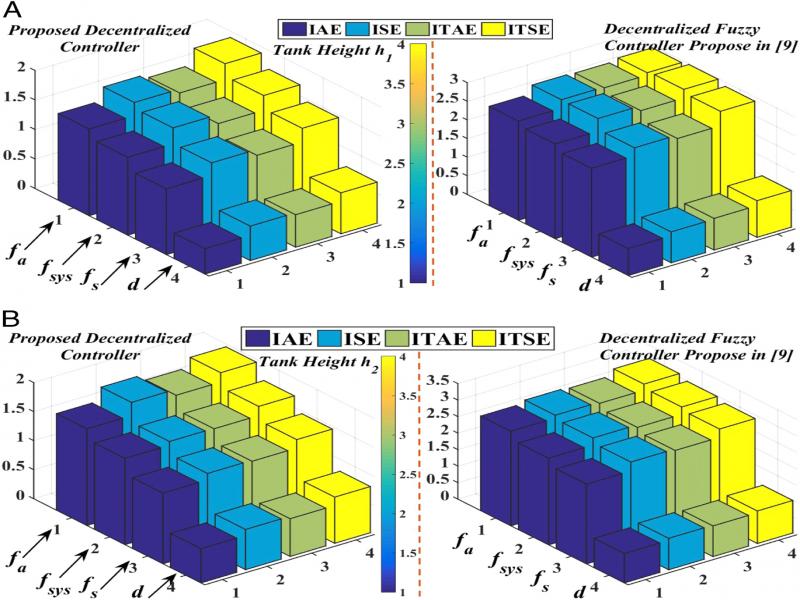
Figure 19:
Error comparison for non-minimum phase configuration.