
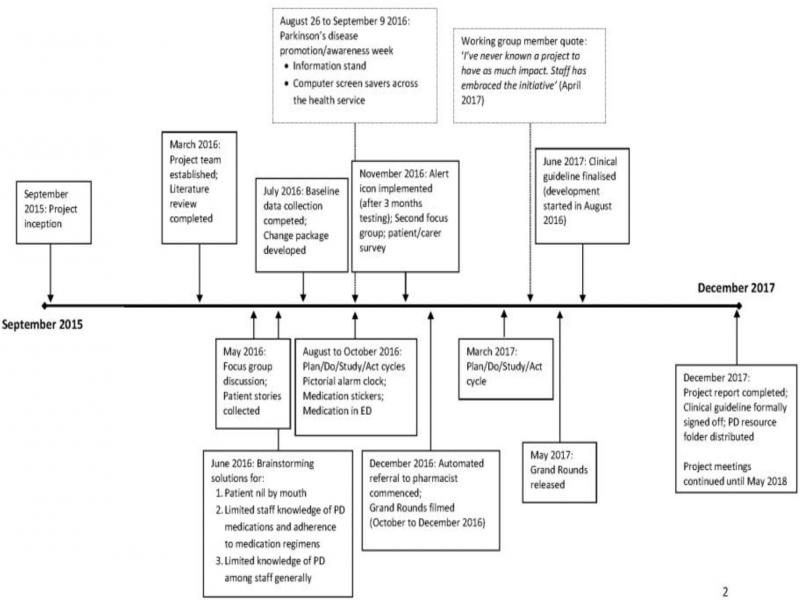
Figure 1:
Overview of the project flow.
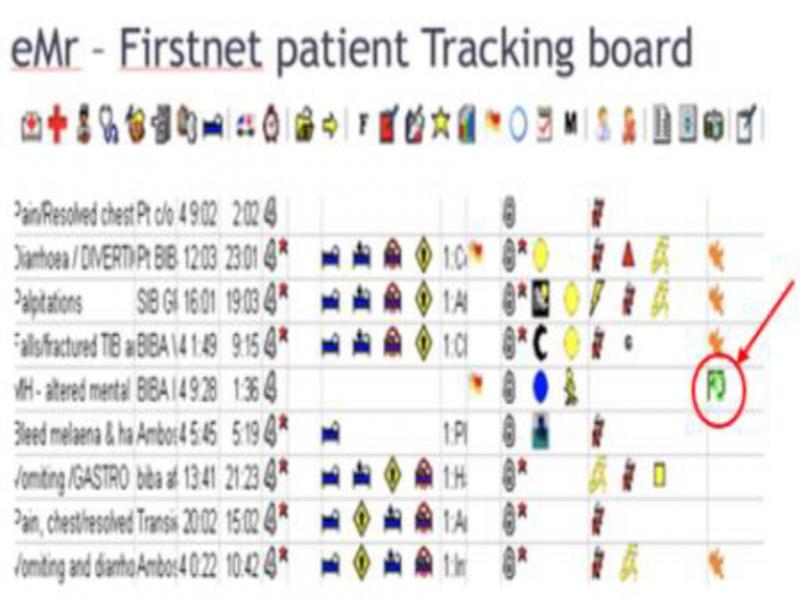
Figure 2.
Parkinson’s disease tracking icon (red circle).
Table 1.
Summary of main pre- and post-implementation differences (chart audit)
| Intervention | Baseline | Post-implementation |
|---|---|---|
| Identification of patients with PD within 4 hours of admission | 90% | 100% |
| Automated referral to pharmacist for patient review on admission | 27% | 31% |
| Prescription and administration of contraindicated medications | 44% | 16% |
| Contraindicated medications identified on medication charts (post-implementation) | - | 94.7% |
| PD medications administered on time | 44.4% | 63.2% |
| Time critical stickers used on medication charts (post-implementation) | - | 68.4% |
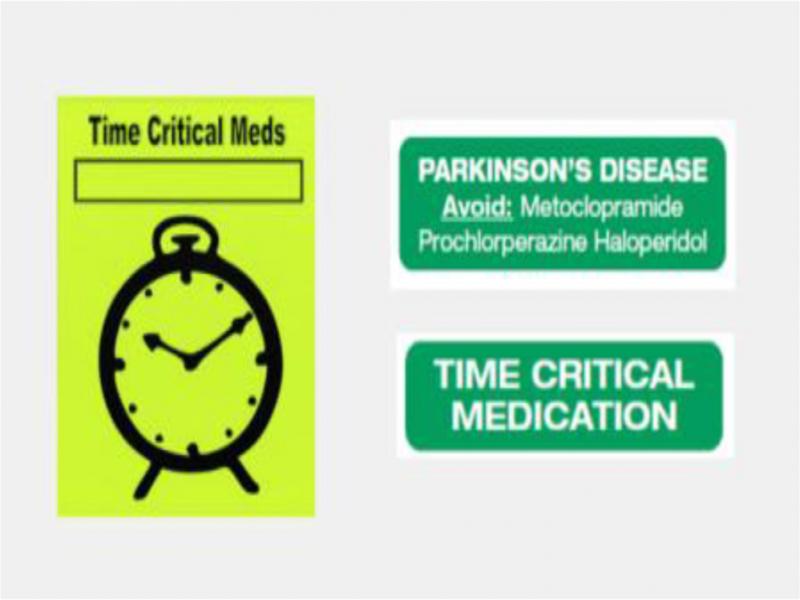
Figure 3:
Medication management interventions. A: Pictorial alarm clock. B: Stickers for medication charts.
Table 2.
Nursing staff responses to the medication management intervention surveys
| Yes n (%) | No n (%) | Not applicable n (%) | |
|---|---|---|---|
| Contraindicated sticker (N=24) | |||
| Have you cared for a patient with Parkinson’s disease in the last 2 months? | 23 (95.8) | 1 (0.4) | |
| Have you seen the contraindicated medication sticker? | 16 (66.7) | 8 (33.3) | |
| If yes, did the sticker highlight the importance of NOT administering the listed medications? | 16 (66.7) | 0 | 8 (33.3) |
| If yes, did the sticker result in a change of practice? | 9 (37.5) | 5 (20.8) | 8 (33.3) |
| Did you know that these commonly prescribed meds were contraindicated for people with PD? | 18 (75) | 6 (25) | |
| Did the sticker result in a change of knowledge? | 10 (41.6) | 8 (33.3) | 6 (25) |
| Time-critical sticker (N=19) | |||
| Have you seen the time critical sticker? | 15 (78.9) | 4 (21) | |
| If yes, did the sticker result in a change of knowledge? | 5 (26.3) | 10 (52.6) | 4 (21) |
| If yes, did the sticker result in a change of practice | 5 (26.3) | 10 (52.6) | 4 (21) |
| Are the stickers user friendly? | 18 (94.7) | 1 (5.3) | |
| Medications available in the ED (N=12) | |||
| Are you aware that medications are available in the ED? | 11 (91.7) | 1 (8.3) | |
| If yes, were you able to identify the correct medication for the patient? | 9 (75) | 3 (25) | |
| If yes, has access to the medication been beneficial in providing the correct medication for the patient? | 9 (75) | 3 (25) | |
| Should these medications be available in the ED on a permanent basis? | 12 (100) | ||
| Has the initiative raised your awareness of Parkinson’s disease? | 10 (83.3) | 2 (16.7) | |
| Pictorial alarm clock (N=18)a | |||
| Did the alarm clock highlight the importance of the need to administer the meds on time? | 18 (100) | ||
| Did the alarm clock result in a change in practise? | 8 (44.4) | 7 (38.9) | 3 (16.7) |
| Is the alarm clock picture user friendly? | 14 (77.8) | ||
Table 3.
Medication incidents and length of hospital stay before and during the project period
| 2015 | 2016 | 2017 | |
|---|---|---|---|
| Number of patients with Parkinson’s disease admitted | 101 | 149 | 112 |
| Number of reported medication incidents | 11 | 6 | 5 |
| Length of hospital stay (days)a | 9 | 6 | 8 |
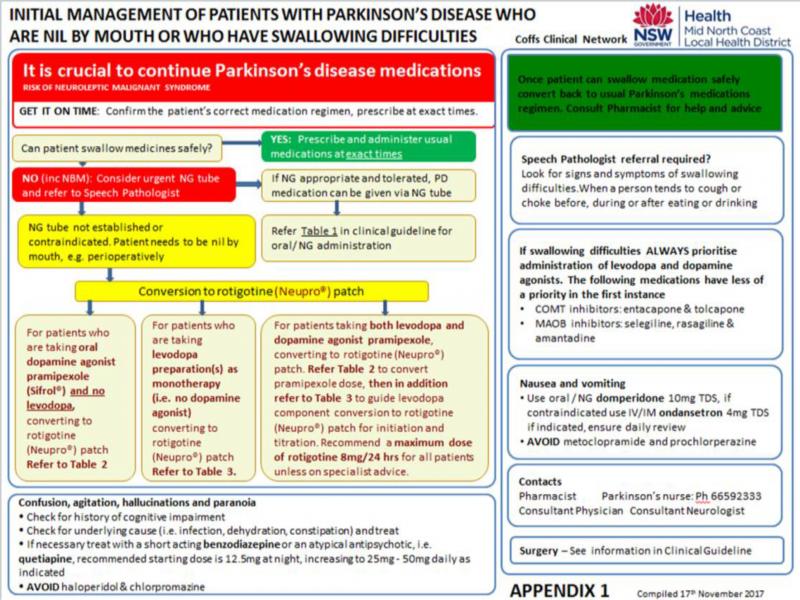
Figure 4:
Clinical algorithm for patients that are nil by mouth.
Table 4.
Patient/carer satisfaction (N=15)
| Item | Responses | |||
|---|---|---|---|---|
| Always n (%) | Sometimes n (%) | No n (%) | Don’t know n (%) | |
| Parkinson’s disease medications received on time? | 12 (80) | 2 (13.3%) | - | 1 (6.7) |
| Dissatisfied n (%) | Neither satisfied nor dissatisfied n (%) | Somewhat satisfied n (%) | Very satisfied n (%) | |
| Satisfaction with mediation management | - | - | 3 (20) | 12 (80) |
| Free text comments (examples) | ‘I don’t know much about my medications, just a new diagnosis’ ‘They were pretty good. Wife explained to hospital staff that it was important that the meds be given on time’ ‘Different medication to what he has at home. In hospital he was given a white tablet where he has capsules at home’ | |||