
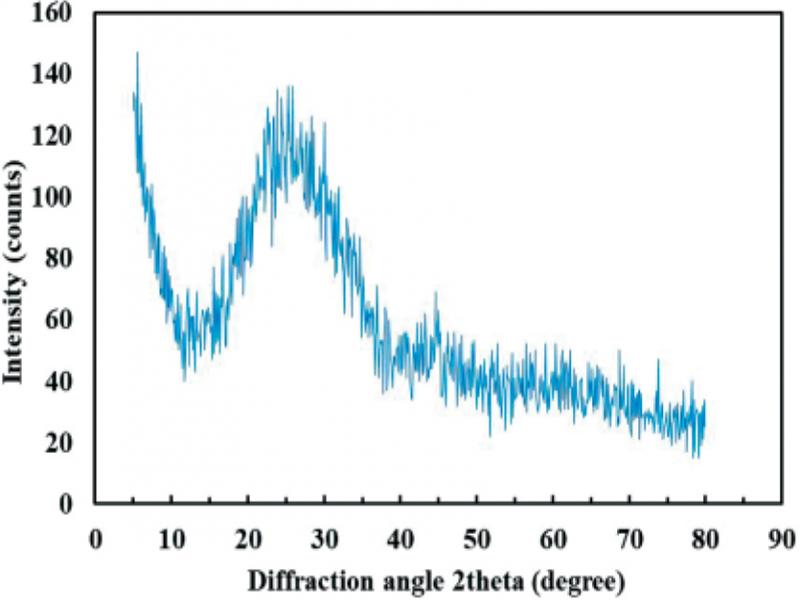
Figure 1.
XRD patterns for GP used in the study
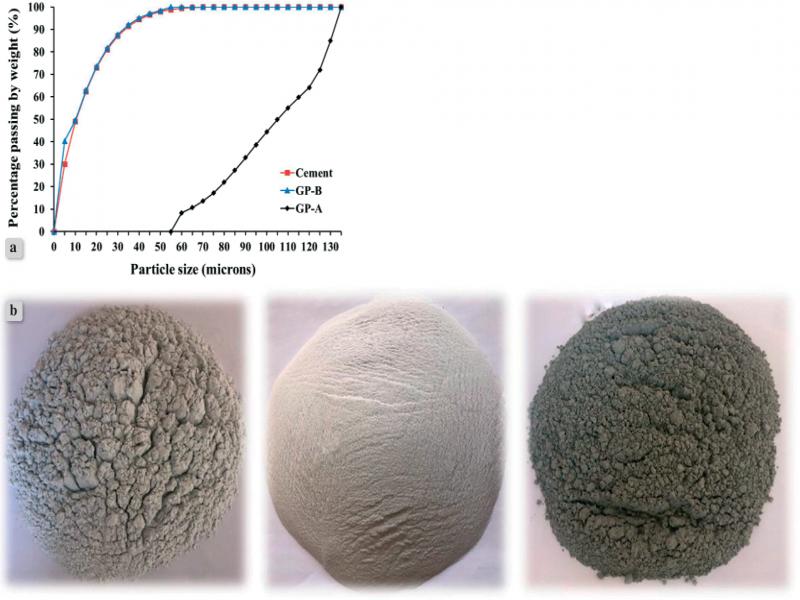
Figure 2.
(a) Particle size distribution curves of cement, GP-A, and GP-B, (b) waste glass powder after milling and cement used in the study
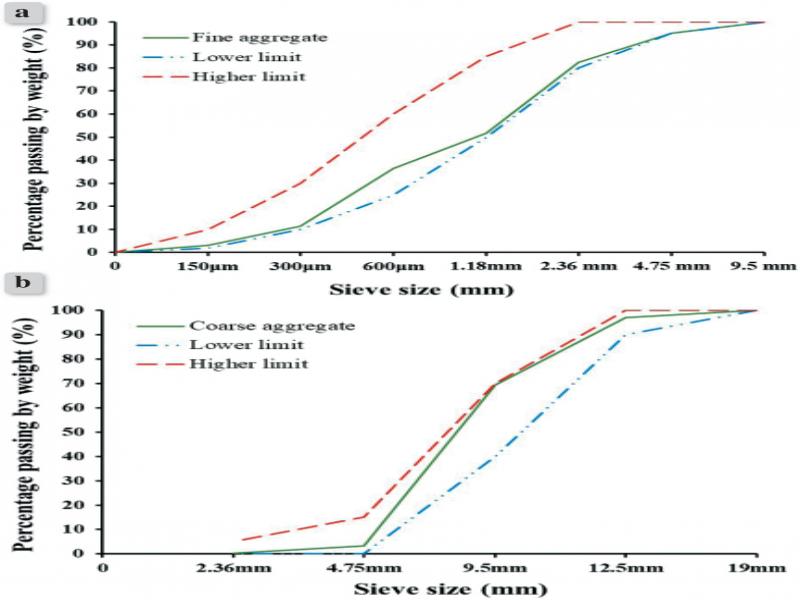
Figure 3.
Grain size distribution for aggregates according to ASTM C33 limits. (a) sand and (b) gravel
Table 1.
Chemical composition for ordinary Portland cement and glass powder with requirements of ASTM C618 for pozzolans used in the study
| Chemical Composition | Chemical Formula | OPC (%) | GP (%) | ASTM C618 |
|---|---|---|---|---|
| Lime | Cao | 61.66 | 9.868 | |
| Silica | SiO2 | 19.83 | 74.03 | |
| Alumina | AI2O3 | 4.48 | 1.023 | |
| Ferrite | Fe2O3 | 2.32 | 0.108 | |
| Magnesia | MgO | 3.14 | 4.739 | |
| Sulfur trioxide | SO3 | 2.57 | 0.13 | |
| Potassium oxide | K2O | 0.68 | 0.198 | |
| Sodium oxide | Na2O | 0.19 | 8.024 | |
| Loss on Ignition | LOI | 1.5 | 1.83 | |
| Tricalcium silicate | Ca3SiO5 | 59.50 | ||
| Dicalcium silicate | Ca2SiO4 | 11.98 | ||
| Aluminate Tricalcium | Ca3Al2O6 | 7.95 | ||
| Tetracalcium Aluminoferrite | Ca4Al2Fe2O10 | 7.05 | ||
| SiO2 + AI2O3 + Fe203, min. % | 75.16 | 70 | ||
| SO3, max. % | 0.13 | 4 | ||
| Moisture content, max. % | - | 3 | ||
| Loss on ignition, max. % | 1.83 | 10 | ||
Table 2.
Physical properties of sand and gravel
| Physical Properties | Sand | Gravel | ASTM-Designation | |
|---|---|---|---|---|
| Sand | Gravel | |||
| Bulk specific gravity, Dry | 2.65 | 2.47 | ASTM C128 | ASTM C127 |
| Bulk specific gravity, (SSD) | 2.69 | 2.49 | ||
| Apparent specific gravity | 2.77 | 2.52 | ||
| % Absorption | 1.68 | 0.94 | ||
| Dense-dry density, (kg/m3) | 1875 | 1600 | ASTM-C29 | |
| Loose-dry density, (kg/m3) | 1716 | 1462 | ||
| Fineness Modulus, (unitless) | 3.20 | 2.30 | ASTM C 125 | |
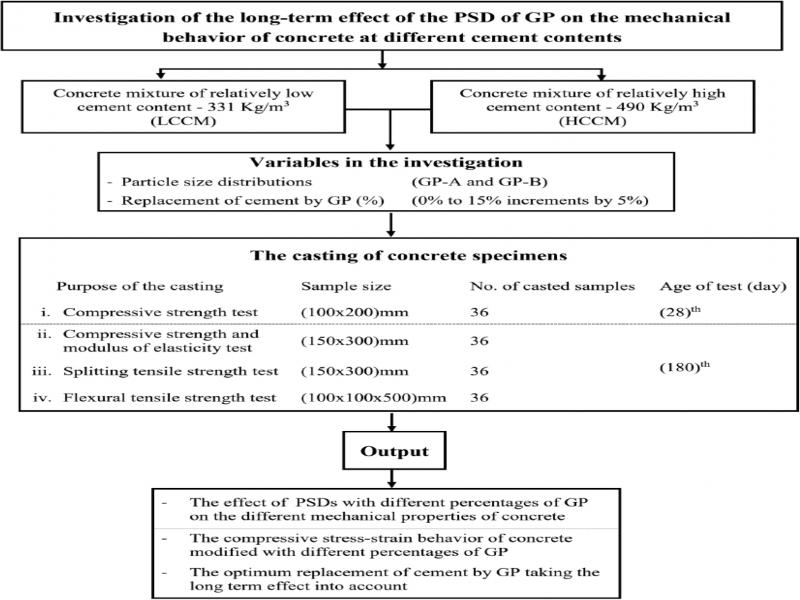
Figure 4.
Flowchart of the experimental program
Table 3.
Mixture proportions for 1m3 of concrete
| Mix. type | Specimen Details | Cement (kg) | Sand (SSD) (kg) | Gravel (SSD) (kg) | Water (kg) | GP | Water/binder W/C+GP | |||
|---|---|---|---|---|---|---|---|---|---|---|
| GP-A | GP-B | % | (kg) | |||||||
| LCCM | CR-2 | 331.0 | 956.64 | 848.0 | 178.74 | - | 0.54 | |||
| A5-2 | B5-2 | 314.5 | 953.01 | 952.97 | 848.0 | 178.74 | 5 | 16.55 | 0.54 | |
| A10-2 | B10-2 | 297.9 | 949.43 | 949.36 | 848.0 | 178.74 | 10 | 33.10 | 0.54 | |
| HCCM | CR-3 | 490.0 | 838.67 | 776.31 | 200.9 | - | ||||
| A5-3 | B5-3 | 465.5 | 833.33 | 833.28 | 776.31 | 200.9 | 5 | 24.5 | 0.41 | |
| A10-3 | B10-3 | 441.0 | 828.0 | 827.89 | 776.31 | 200.9 | 10 | 49.0 | 0.41 | |
| A15-3 | B15-3 | 416.5 | 822.66 | 822.51 | 776.31 | 200.9 | 15 | 73.5 | 0.41 | |
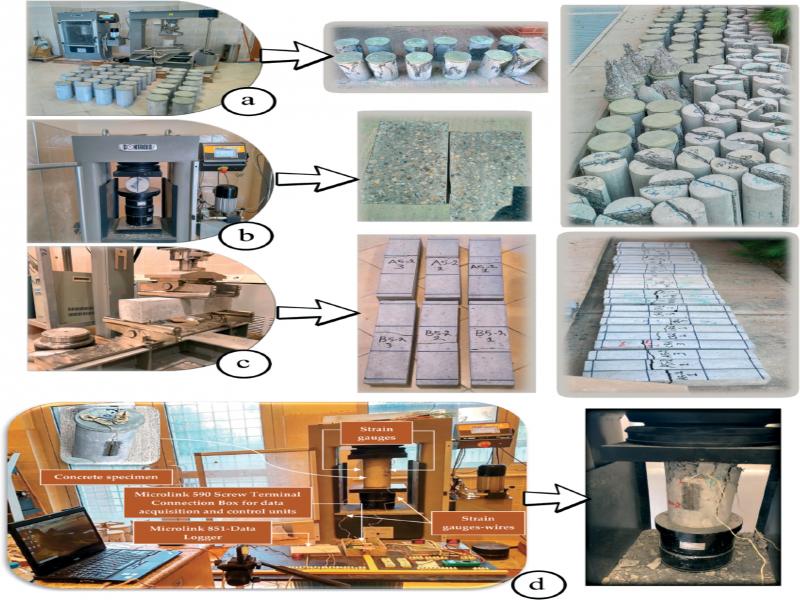
Figure 5.
Pictures showing the sides of the tests carried out on hardened concrete modified with and without GP. (a) Samples being prepared and tested for their compressive strength; (b) splitting tensile strength test; (c) flexural tensile strength test; (d) test configuration for modulus of elasticity
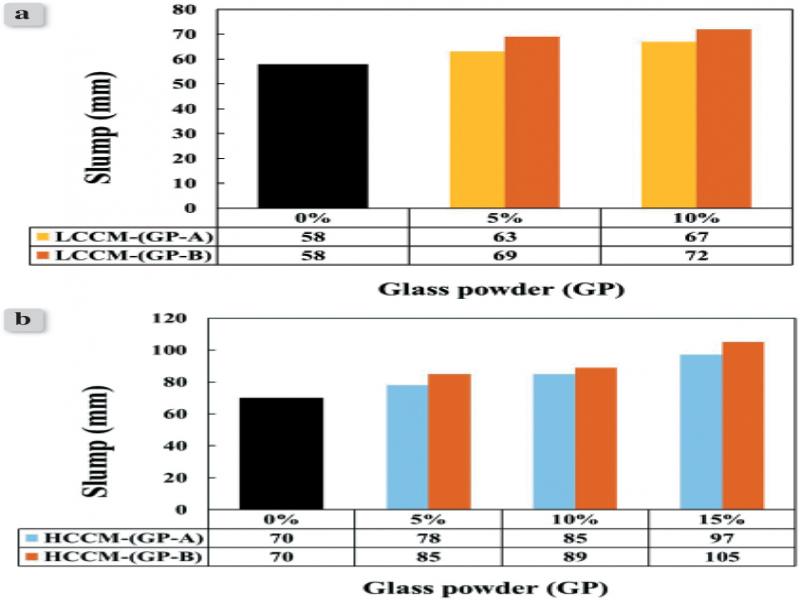
Figure 6.
Effect of particle size of GP with various percentages on the workability of concrete made of: (a) relatively low cement content (LCCM), (b) relatively high cement content (HCCM)
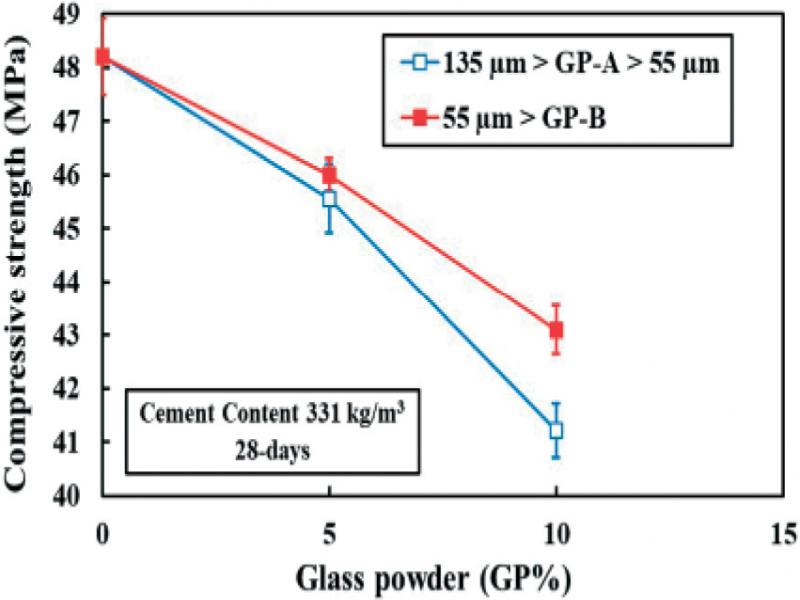
Figure 7.
Short-term effect of GP-A and GP-B with various replacements on compressive strength development when cement content is relatively low (331 kg/m3)
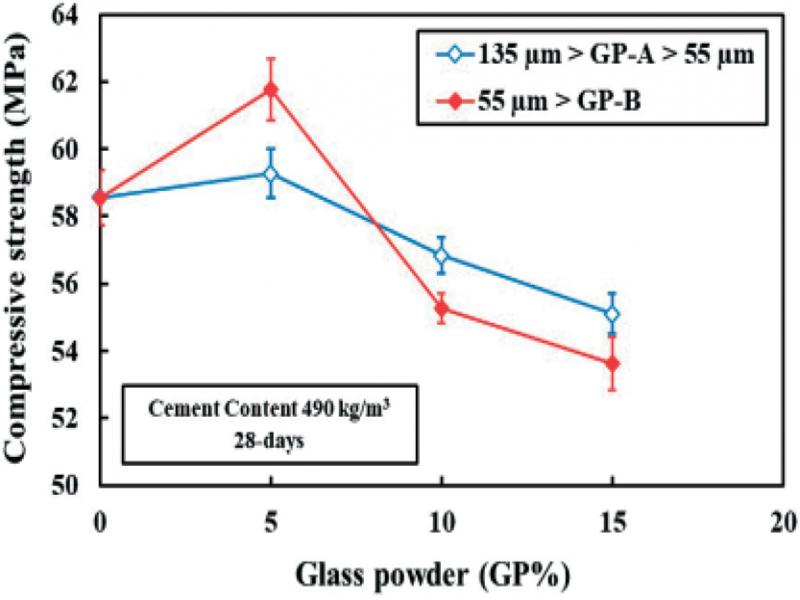
Figure 8.
Short-term effect of GP-A and GP-B with various replacements on compressive strength development when cement content is relatively high (490 kg/m3)
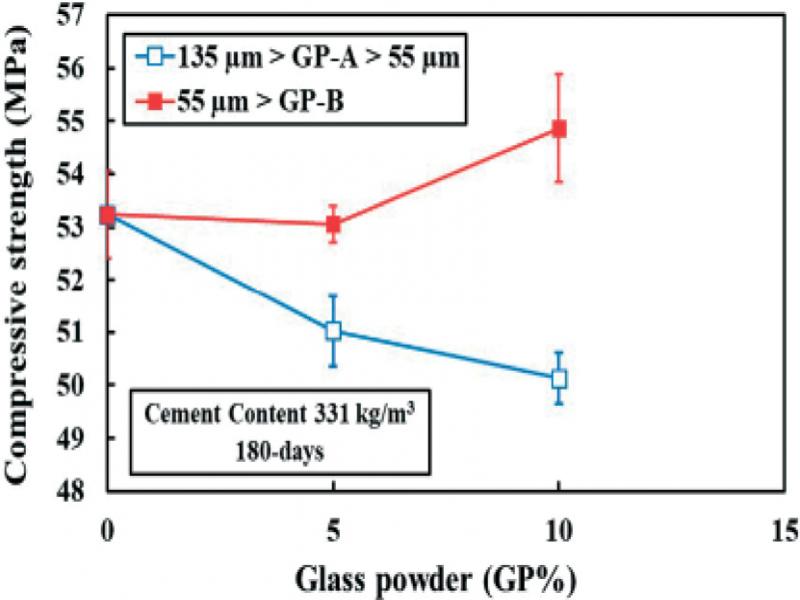
Figure 9.
Long-term effect of GP-A and GP-B with various replacements on compressive strength development when cement content is relatively low (331 kg/m3)
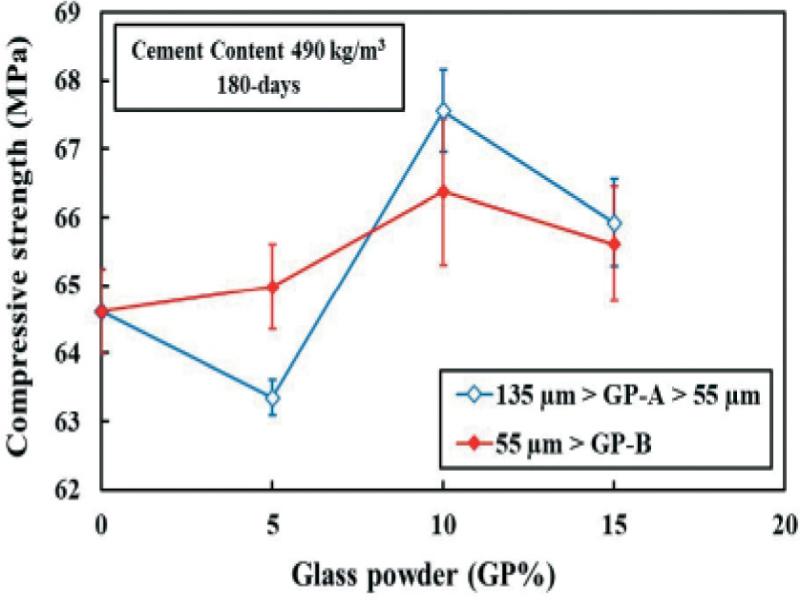
Figure 10.
Long-term effect of GP-A and GP-B with various replacements on compressive strength development when cement content is relatively high (490 kg/m3)
Table 4.
Mechanical properties of GP cement replacement mixtures
| Mix. type | Specimen Details | Strengths (MPa) | |||
|---|---|---|---|---|---|
| Compressive (28 days) | Compressive (180 days) | Splitting (180 days) | Flexural (180 days) | ||
| LCCM | CR-2 | 48.21 | 53.24 | 4.59 | 8.00 |
| A5-2 | 45.56 | 51.02 | 4.61 | 8.08 | |
| A10-2 | 41.22 | 50.13 | 4.60 | 7.80 | |
| B5-2 | 46.00 | 53.06 | 4.68 | 8.15 | |
| B10-2 | 43.09 | 54.86 | 4.74 | 8.18 | |
| HCCM | CR-3 | 58.56 | 64.61 | 4.45 | 7.60 |
| A5-3 | 59.27 | 63.35 | 4.49 | 7.63 | |
| A10-3 | 56.84 | 67.56 | 4.75 | 7.65 | |
| A15-3 | 55.10 | 65.92 | 4.65 | 7.60 | |
| B5-3 | 61.78 | 64.98 | 4.56 | 7.68 | |
| B10-3 | 55.26 | 66.38 | 4.72 | 7.63 | |
| B15-3 | 65.61 | 4.61 | 7.55 | ||
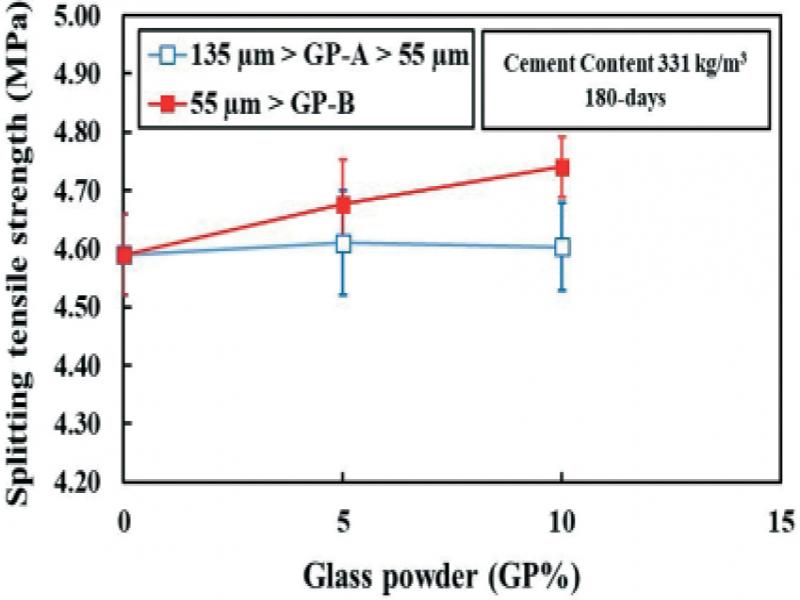
Figure 11.
Long-term effect of GP-A and GP-B with various replacements on splitting tensile strength development when cement content is relatively low (331 kg/m3)
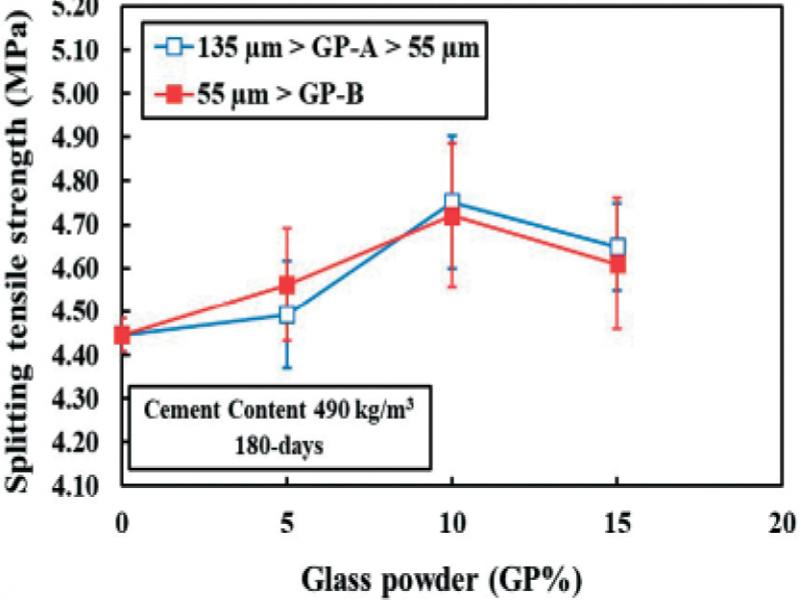
Figure 12.
Long-term effect of GP-A and GP-B with various replacements on splitting tensile strength development when cement content is relatively high (490 kg/m3)
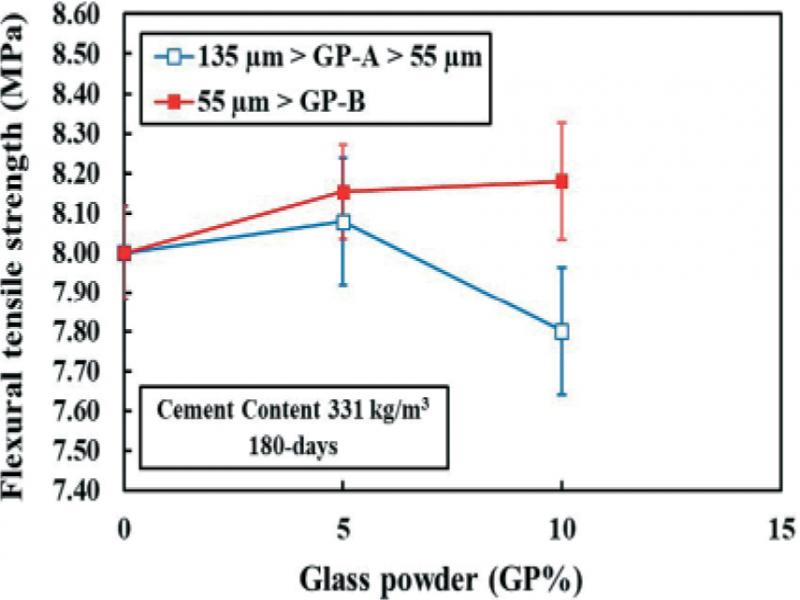
Figure 13.
Long-term effect of GP-A and GP-B with various replacements on flexural tensile strength development when cement content is relatively low (331 kg/m3)
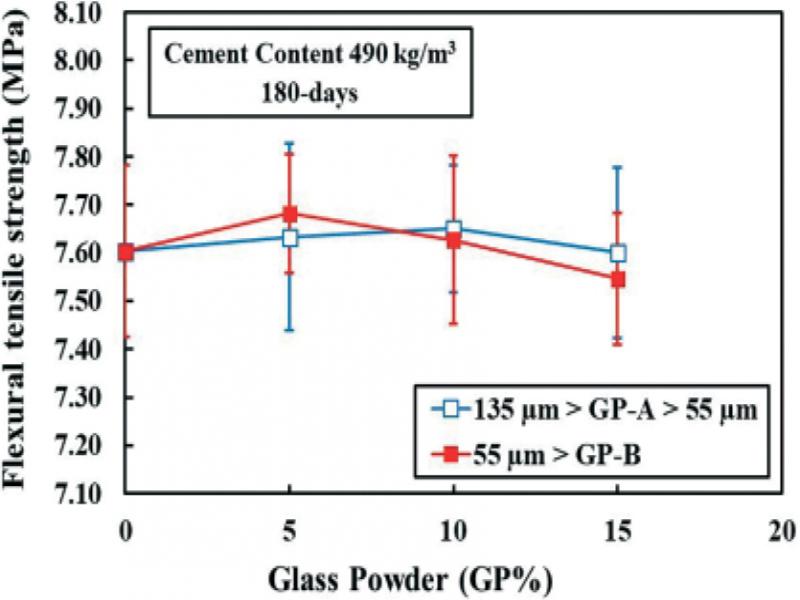
Figure 14.
Long-term effect of GP-A and GP-B with various replacements on flexural tensile strength development when cement content is relatively high (490 kg/m3)
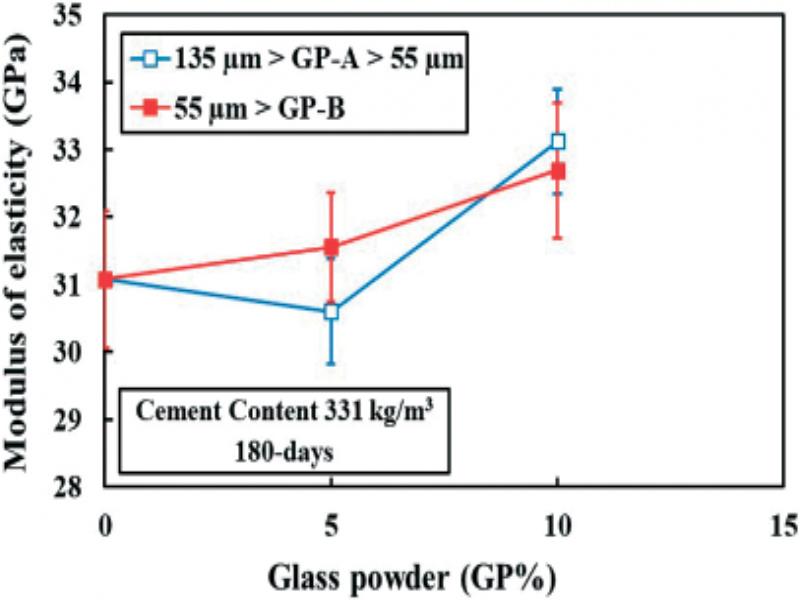
Figure 15.
Long-term effect of GP-A and GP-B with various replacements on elastic modulus when cement content is relatively low (331 kg/m3)
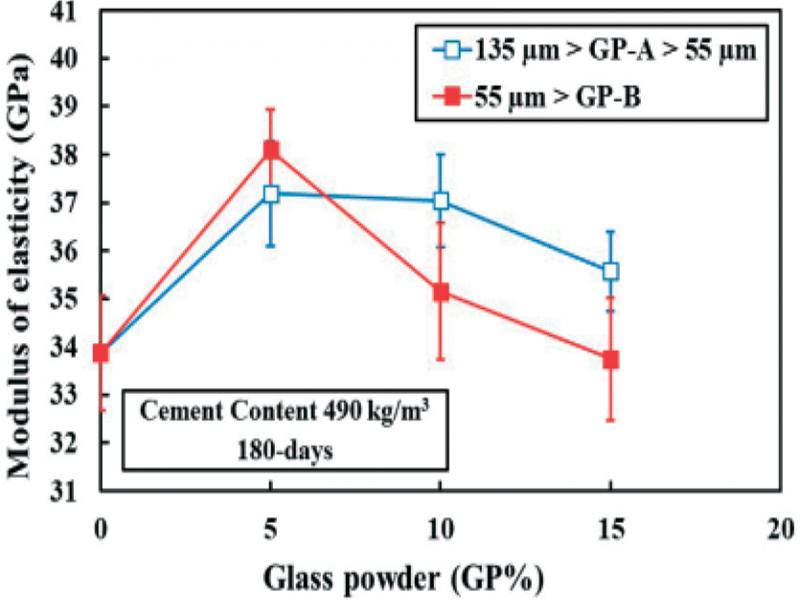
Figure 16.
Long-term effect of GP-A and GP-B with various replacements on elastic modulus when cement content is relatively high (490 kg/m3)
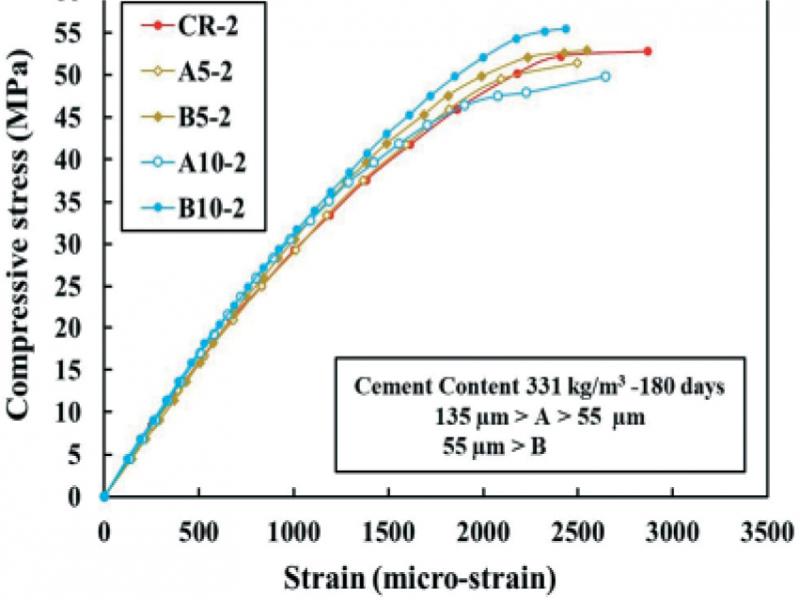
Figure 17.
Effect of GP-A and GP-B with various replacements on nonlinear stress-strain curves of concrete with a relatively low cement content (331 kg/m3)
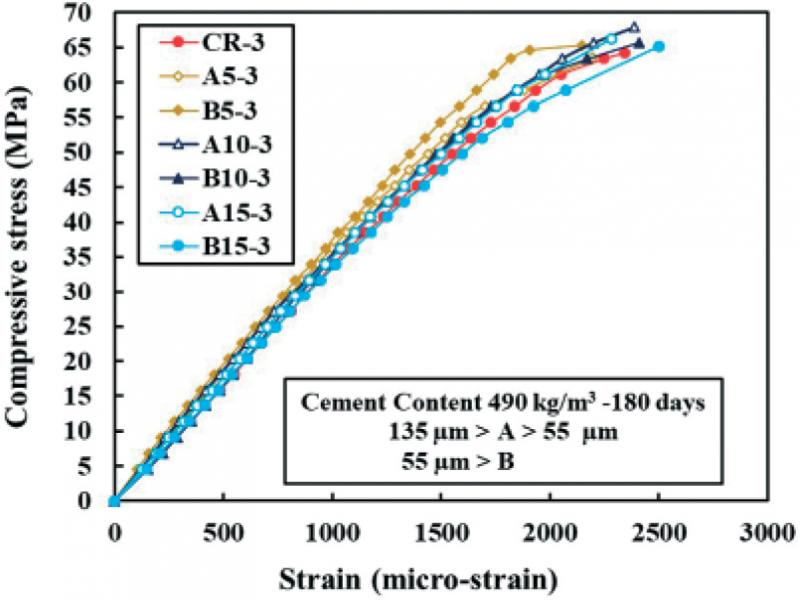
Figure 18.
Effect of GP-A and GP-B with various replacements on nonlinear stress-strain curves of concrete with a relatively high cement content (490 kg/m3)
Table 5.
Results of the average value of the two tested cylinders used for calculating the modulus of elasticity and compression toughness at 180 days of testing
| Mix. type | Specimen detail | w/b | Compressive strength (MPa) | Modulus of elasticity (GPa) | Toughness (MPa x 10-2) | Specific Toughness (%) | Peak strain (micro-strain) |
|---|---|---|---|---|---|---|---|
| LCCM | CR-2 | 0.54 | 52.76 | 31.08 | 9.950 | 0.189 | 2870 |
| A5-2 | 0.54 | 51.40 | 30.60 | 7.990 | 0.155 | 2495 | |
| A10-2 | 0.54 | 49.85 | 33.12 | 8.790 | 0.176 | 2645 | |
| B5-2 | 0.54 | 52.86 | 31.56 | 8.540 | 0.162 | 2549 | |
| B10-2 | 0.54 | 55.45 | 32.69 | 8.290 | 0.150 | 2436 | |
| HCCM | CR-3 | 0.41 | 64.25 | 33.87 | 8.600 | 0.134 | 2341 |
| A5-3 | 0.41 | 63.50 | 37.19 | 8.106 | 0.128 | 2196 | |
| A10-3 | 0.41 | 67.91 | 37.04 | 9.360 | 0.138 | 2388 | |
| A15-3 | 0.41 | 66.29 | 35.57 | 8.610 | 0.130 | 2283 | |
| B5-3 | 0.41 | 65.34 | 38.10 | 8.240 | 0.126 | 2147 | |
| B10-3 | 0.41 | 65.76 | 35.15 | 9.270 | 0.141 | 2407 | |
| B15-3 | 0.41 | 65.12 | 33.75 | 9.430 | 0.145 | 2502 |