
1. INTRODUCTION
Today's waste management faces a great challenge. The consumptive lifestyle of nowadays societies (extract → produce → use → throw away) produces a growing stream of waste. This forces a search for new solutions for the waste management. Current purposes of waste management focus on taking maximum advantage of the waste potential. Reasonable use of the natural resources and assuring sustainable economy is a priority of the European legislature. Waste Framework Directive assumes elastic application of the recovery order: Reduce, Reuse, Recycle, Recover [1, 2, 3]. The main assumption of the Directive [3] is establishing laws which would promote the idea of „recycling society” that tries to limit the production of waste and use them as raw materials and sources of energy. By applying the above rule, we gradually approach the circular economy. The circular economy is an idea of producing and consuming energy, products or services in such a way as to limit demand for fuels, primary raw materials and water as well as land and natural resources. Realization of such defined assumption requires above others segregation “at the source”, segregation and recycling of priority stream of waste, e.g. plastics, paper, metals, etc.
Growing amount of municipal waste is one of the most serious problems that the country members of the European Union face. Most of the municipal waste produced in the EU-28 countries is deposited in landfills [1–4].
For many years, Poland has been fighting with the problem of the municipal waste stream. The stream of municipal waste collected in 2016 in Poland is 7.5% larger than in 2015 and reaches 11.65 M Mg. Currently, there are average about 393 kg of collected municipal waste [2] per one Polish citizen comparing with an average of 483 kg [4–6] of municipal waste per one inhabitant of EU.
In EU countries, the recovery index of municipal waste and their reuse e.g. as secondary raw materials is improving. The recovery index in countries members of EU reached 47%.
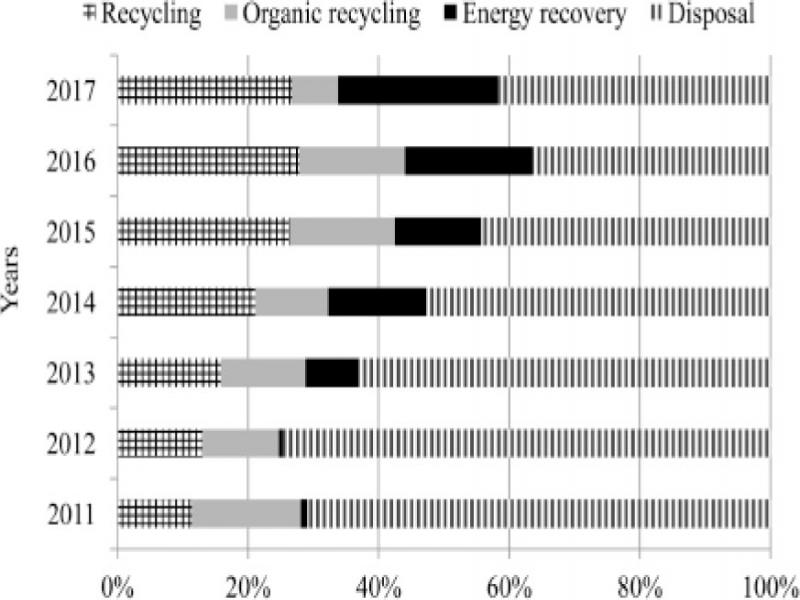
Figure 1.
In Poland, in 2016 disposal of municipal waste in landfills decreased (Fig. 1). Statistics Poland informs that 4.2 M Mg of the total amount of waste (approximately 36%) were directed to landfills, 7.8% (3.2 Mg) were recycled, 18.1% were destined for energy recovery and 16.2% of collected municipal waste underwent organic recycling (composting, fermentation) [4–6].
The direction of energetic use of a combustible fraction of the municipal waste has advantages because on the one hand it contributes to limiting the amount of waste at landfills and on the other hand it constitutes an alternative for depleting resources of conventional fuels [5–8].
2. METHODS OF ENERGY RECOVERY FROM THE WASTE
According to the current tendency of EU concerning directions of waste management, it is recommended to perform mechanical recycling or feedstock recycling. It needs to be noted that recycling of some waste, e.g. not uniform, mixed and contaminated is not always justified by the economy or environment. Recovery of energy is an alternative to recycling. It consists in combustion in the technology of combined heat and power generation. Recovery of energy from the municipal waste should constitute a method that is complementary to recycling and leads to the decrease of the stream of waste directed to landfills. From the energetic and economic point of view, some fractions selected from the stream of municipal waste constitute precious energetic material [8–13]. This management method has another advantage – it can cover all types of waste – especially non-uniform and contaminated for example with organic fraction [13–17].
Methods of thermal transformation of waste are represented by three basic processes: combustion, pyrolysis and gasification (Fig. 2). These processes are similar to a certain extent – the waste are heated to high temperatures. However, the basic difference lays in the amount of oxygen in the process:
Combustion is performed in the presence of the excess oxygen and products non-combustible oxidization products: mainly carbon dioxide and steam.
Gasification is performed with the reduced amount of oxygen directly supplied to the reactor, steam or carbon dioxide and generates combustible gas which contains hydrogen and carbon oxide.
Pyrolysis occurs without the oxygen and leads to breaking polymer chains (depolymerisation) which results in the generation of light hydrocarbon fractions.
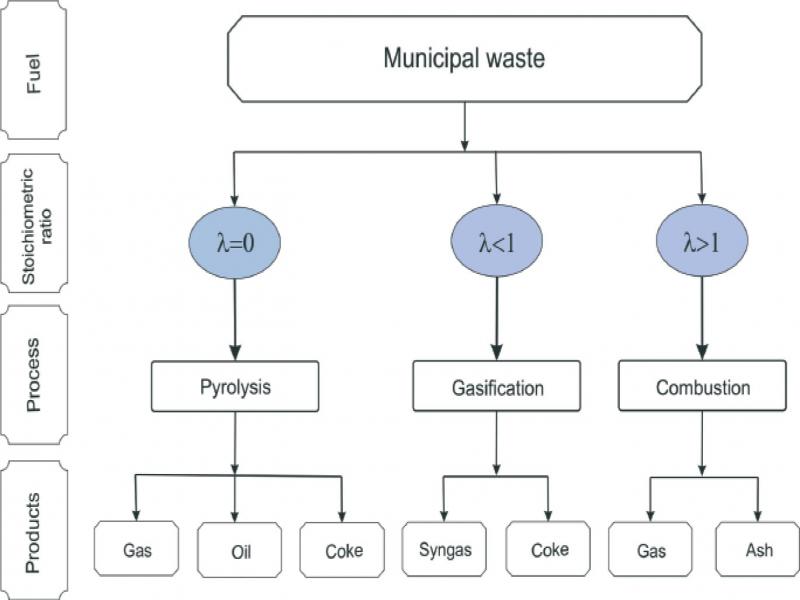
Figure 2.
Directions of thermal transformation of waste (owe work)
Another difference between the discussed thermal methods is the process temperature:
Combustion is a high-temperature reaction which requires ignition, followed by the spontaneous sustenance of the process. The temperature obtained depends on the content of the combusted waste, excessive oxygen used and combustion technology.
Gasification is conducted under high pressure in temperatures between 600°C and 1800°C, depending on the process used and expected substances in gas which is a product of the reaction.
Pyrolysis is conducted mainly in temperatures that range from 350°C to 500°C.
The paper presents a concept of a plant for gasification of waste where organic waste are processed [18–21].
3. A DESIGN OF GASIFICATION PLANT FOR ORGANIC WASTE
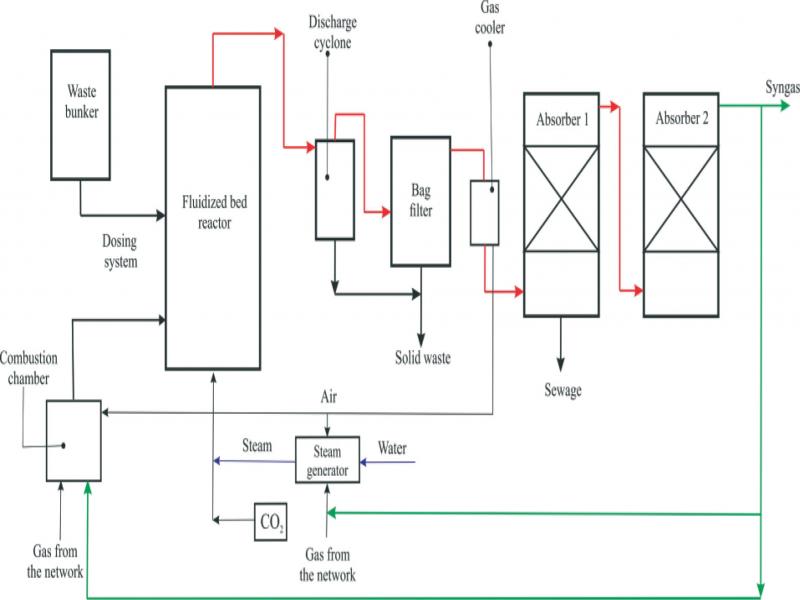
The plant will consist of the following modules: a feeder, a reactor, a system for mechanical purification of the gas, a system for chemical purification of the gas, pipelines of auxiliary utilities, automatic and control systems, supportive structures and access ways [22]. Flowchart of the plant with circulating fluidized bed is presented in drawing 3.
Gasification process will be carried out with parameters defined in Table 1.
Table 1.
Technical parameters of the plant for gasification of waste [22]
| The type of deposit | Circulating fluidized bed | |||||
| Process temperature, °C | 1200 | |||||
| Working pressure, MPa | 1.0–1.5 | |||||
| Reactor operating pressure, MPa | 2.0 | |||||
| Gasification agent | steam/ O2/ CO2 | |||||
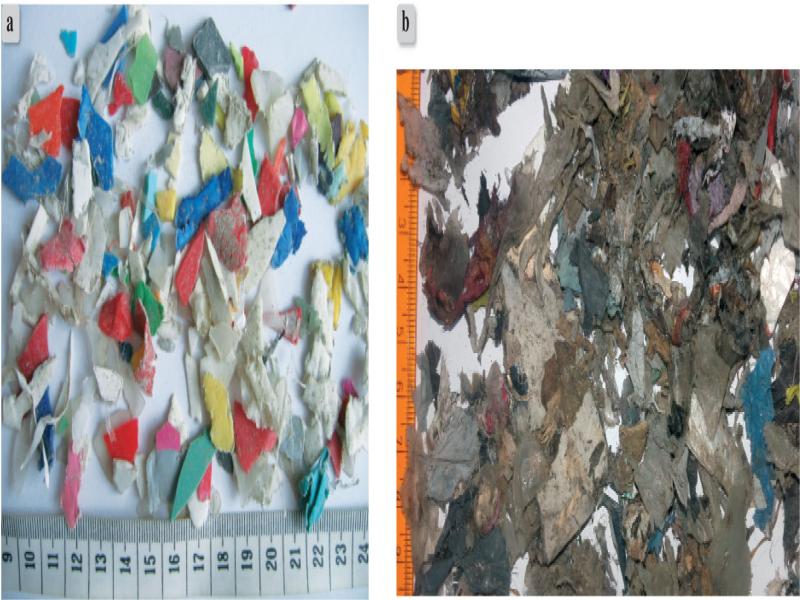
| Title | Unit | Symbol | Standard | |||
| Determination of moisture content | % | MT | PN-Z-15008-02:1993 | |||
| Determining combustion heat and calculating the calorific value | MJ/kg | GCV, NCV | PN-Z-15008-04:1993 | |||
| Determination of ash content | % | A | PN-EN 15403:2011 | |||
| Determination of fly ash by weighting | % | V | PN-EN 15402:2011 | |||
| Determination of carbon and hydrogen | % | C, H | PN-Z-15008-05:1993 | |||
| Determination of nitrogen with the Kjeldahl method | % | N | PN-G-04523:1992 | |||
| Determination of sulfur with the Eschka method | % | S | PN-ISO 334:1997 | |||
| Determination of chloride using the Eschka mixture | % | Cl | PN-ISO 587:2000 | |||
| Parameter | Symbol | Unit | WP | MW | ||
| Total moisture content | MT | % | 0.03 | 22.47 | ||
| Combustible substances, Air Dried | Xd | % | 99.10 | 92.44 | ||
| Combustible substances, As Received | Xar | % | 99.07 | 71.67 | ||
| Ash, Air Dried | Ad | % | 0.86 | 7.56 | ||
| Ash, As Received | Aar | % | 0.86 | 5.86 | ||
| Volatile matter, Air Dried | Vd | % | 99.13 | 79.06 | ||
| Gross calorific value, Air Dried | GCVd | MJ/kg | 47.52 | 23.66 | ||
| Gross calorific value, As Received | GCVar | 47.50 | 18.29 | |||
| Net calorific value, Air Dried | NCVd | MJ/kg | 44.38 | 22.62 | ||
| Net calorific value, As Received | NCVar | 44.36 | 16.97 | |||
| Parameter | Symbol | Unit | WP | MW | ||
| As Received | Air Dried | As Received | Air Dried | |||
| Carbon | C | % | 85.28 | 85.31 | 34.63 | 43.29 |
| Hydrogen | H | % | 13.95 | 13.96 | 3.42 | 4.27 |
| Sulphur | S | % | 0.22 | 0.22 | 0.47 | 0.59 |
| Nitrogen | N | % | 0.29 | 0.29 | 0.88 | 1.10 |
| Chlorine | Cl | % | 0.19 | 0.19 | 0.41 | 0.51 |
| Oxygen | O | % | 0.00 | 0.00 | 31.86 | 39.64 |
| Components | Symbol | Unit | The composition of synthesis gas for WP |
| Hydrogen | H2 | vol % | 51.64 |
| Carbon monoxide | CO | 46.10 | |
| Nitrogen | N2 | 0.44 | |
| Steam | H2O | 0.78 | |
| Carbon dioxide | CO2 | 0.27 | |
| Argon | Ar | 0.67 | |
| Sulfur dioxide | SO2 | 0.00 | |
| Hydrogen sulfide | H2S | ppm | 429 |
| Ammonia | NH3 | ppm | 20 |
| Hydrogen chloride | HCl | ppm | 349 |
| Gross calorific value | GCV | MJ/kg | 19.03 |
| Net calorific value | NCV | MJ/kg | 17.44 |
| Components | Symbol | Unit | The composition of synthesis gas for WP |
| Hydrogen | H2 | vol % | 43.98 |
| Carbon monoxide | CO | 46.74 | |
| Nitrogen | N2 | 0.59 | |
| Steam | H2O | 5.81 | |
| Carbon dioxide | CO2 | 2.43 | |
| Sulfur dioxide | SO2 | 0.00 | |
| Hydrogen sulfide | H2S | ppm | 2500 |
| Ammonia | NH3 | ppm | 23 |
| Hydrogen chloride | HCl | ppm | 988 |
| Gross calorific value | GCV | MJ/kg | 15.85 |
| Net calorific value | NCV | MJ/kg | 14.49 |